

Alvaro Catarribera: Difference between revisions
No edit summary |
No edit summary |
||
| Line 1: | Line 1: | ||
{{Era|Individuals|Assassins}} | {{Era|Individuals|Assassins}} | ||
{{Quote|Before my day of atonement comes, I am content to do what I have always done. Kill in the name of freedom. To prove my faith in the name of a Brotherhood that will not have me, and the new one I will build.|Alvaro Catarribera's declaration, 1549.|Assassin's Creed: Shadows|Database: Rift 2 - The Heart of an Assassin}} | {{Quote|Before my day of atonement comes, I am content to do what I have always done. Kill in the name of freedom. To prove my faith in the name of a Brotherhood that will not have me, and the new one I will build.|Alvaro Catarribera's declaration, 1549.|Assassin's Creed: Shadows|Database: Rift 2 - The Heart of an Assassin}} | ||
{{Spoilerhd|16 October 2026|[[Assassin's Creed: Shadows – Tales of Iga]]}} | |||
{{Character Infobox | {{Character Infobox | ||
|name = Alvaro Catarribera | |name = Alvaro Catarribera | ||
| Line 33: | Line 34: | ||
Catarribera later sent a message to his apprentice Tsuyu about his findings. At the ''[[Daisen-ryō Kofun|kofun]]'' in [[Sakai]], Catarribera explains that his investigation led him to possible Templar bases in [[Mikawa]] and [[Nagasaki]] while Tsuyu informed him of the recent attack in Iga. However, he saw that Hanzō had followed them and then offered to investigate Mikawa, his home region. When Catarribera attacked him, Hanzō deduced that the Imperial Regalia was not in Iga but here at this ''[[kofun]]''. Impressed, he gave Hanzō a choice: join the Brotherhood or die. When Hanzō agreed, Catarribera gave him a [[hidden blade]] for Mikawa and ordered Tsuyu back to Iga before leaving for Nagasaki by himself.<ref name="ACSHInM 8">''[[Assassin's Creed: Shadows – Tales of Iga]]'' – [[Assassin's Creed: Shadows – Tales of Iga Chapter 8|Chapter 8]]</ref> | Catarribera later sent a message to his apprentice Tsuyu about his findings. At the ''[[Daisen-ryō Kofun|kofun]]'' in [[Sakai]], Catarribera explains that his investigation led him to possible Templar bases in [[Mikawa]] and [[Nagasaki]] while Tsuyu informed him of the recent attack in Iga. However, he saw that Hanzō had followed them and then offered to investigate Mikawa, his home region. When Catarribera attacked him, Hanzō deduced that the Imperial Regalia was not in Iga but here at this ''[[kofun]]''. Impressed, he gave Hanzō a choice: join the Brotherhood or die. When Hanzō agreed, Catarribera gave him a [[hidden blade]] for Mikawa and ordered Tsuyu back to Iga before leaving for Nagasaki by himself.<ref name="ACSHInM 8">''[[Assassin's Creed: Shadows – Tales of Iga]]'' – [[Assassin's Creed: Shadows – Tales of Iga Chapter 8|Chapter 8]]</ref> | ||
In 1562, Alvaro investigated the port city of Nagasaki and sought a target. Chasing him down into a ''tenshu'', he delivered a fatal blow to the [[Japanese Rite of the Templar Order|Japanese Templar]], who taunted him about the Templars' influence already expanded across the land before succumbing to his wounds. Leaving the scene after giving the last rites, he knew that Tsuyu holds a little part of an opportunity to redeem himself.<ref name="ACSHInM 13">''[[Assassin's Creed: Shadows – Tales of Iga]]'' – [[Assassin's Creed: Shadows – Tales of Iga Chapter 13|Chapter 13]]</ref> | In 1562, Alvaro investigated the port city of Nagasaki and sought a target. Chasing him down into a ''tenshu'', he delivered a fatal blow to the [[Japanese Rite of the Templar Order|Japanese Templar]], who taunted him about the Templars' influence already expanded across the land before succumbing to his wounds. Leaving the scene after giving the last rites, he knew that Tsuyu holds a little part of an opportunity to redeem himself.<ref name="ACSHInM 13">''[[Assassin's Creed: Shadows – Tales of Iga]]'' – [[Assassin's Creed: Shadows – Tales of Iga Chapter 13|Chapter 13]]</ref> Returning back to Iga, he learns of Hanzō's accomplishments in Mikawa and soon watches Tsuyu spar with Hanzō and Masayasu, proud. Talking to Sandayu, he admitted that he plans to leave Japan and give Tsuyu the reins to continue what he started.<ref name="ACSHInM 27">''[[Assassin's Creed: Shadows – Tales of Iga]]'' – [[Assassin's Creed: Shadows – Tales of Iga Chapter 27|Chapter 27]]</ref> | ||
Believing Tsuyu was ready to continue the Kakushiba ''ikki''{{'}}s mission alone, Catarribera gave her the responsibility of the Imperial Regalia and trusted her to protect the artifacts, leaving their brotherhood's future in her hands.<ref name="Secrets of the Blade"/> | Believing Tsuyu was ready to continue the Kakushiba ''ikki''{{'}}s mission alone, Catarribera gave her the responsibility of the Imperial Regalia and trusted her to protect the artifacts, leaving their brotherhood's future in her hands.<ref name="Secrets of the Blade"/> | ||
Revision as of 17:35, 17 July 2026

|
He who increaseth knowledge, increaseth sorrow. This article contains spoilers, meaning it has information and facts concerning Assassin's Creed: Shadows – Tales of Iga. If you do not want to know about these events, it is recommended to read on with caution, or not at all. |
Alvaro Catarribera was a Spanish Assassin who operated during the 16th century. Despite being excommunicated from the Assassins for breaking the Creed, he traveled to East Asia, where he founded the Kakushiba ikki, a new Assassin Guild in Japan, alongside his apprentice, Tsuyu.
Biography
Founding the Kakushiba ikki
Formerly a member of the Spanish Brotherhood, Catarribera was excommunicated after he killed an innocent girl during a pursuit gone wrong, breaking one of the Creed's tenets. Purposeless, he left Spain and embarked on a journey to the Far East, spending time in Malacca, Formosa, and finally ending up in Macau.[1]
While in Macau, Catarribera was roused from a drunken haze when he overheard two Templars speaking of starting an expedition to Japan to spread their ideals. Loyal to the Assassin cause though no longer a member, Catarribera rediscovered his resolve and, determined to stop the Order's efforts, followed the Templars to Nagasaki in 1549, using the arrival of the Jesuit and Templar Francis Xavier's delegation as cover and access.[1]
Aboard one of the Templars' ship, Catarribera noticed a young girl running away from the Templar Balthazar's men. Instantly, he assassinated both men and told the young girl to hide,.[2] before the Templar shot at him. Deflecting it, he chased the Templar to the deck but was held at gunpoint once more. Fortunately, the young girl Tsuyu managed to incapacitate the Templar with a bucket and knocked him overboard. Thanking her, Catarribera offered to take her inland but she desired to train under him. While he rejected initially, she begged and promised to kill herself if he did not. Recalling his last mission, he gave into her pleads and offered to train her.[3]
For nearly more than a decade, Alvaro trained her to follow in his footsteps; this laid the foundation for what eventually became the Kakushiba ikki.[1][3] Shortly after establishing their brotherhood, Catarribera and Tsuyu contacted Emperor Go-Nara for support against the growing Templar threat in Japan.[4] In return, the emperor entrusted them with the Imperial Regalia, tasking them to keep the three artifacts safe.[5]
Passing the torch
By 1560, Catarribera had heard rumors about a shinobi named Momochi Sandayu fighting daimyō oppression in Iga. Believing Sandayu had the potential to become a valuable ally, Catarribera and Tsuyu traveled to Iga,[4] where they met Sandayu and informed him of their cause.[6]
Later, Catarribera and Sandayu observed a fight between Sandayu's apprentice Hattori Hanzō and Fujibayashi Masayasu, a talented young farmer whom Sandayu also hoped to recruit. While spectating the fight from the treetops, the Assassin and shinobi discussed their respective apprentices' strengths and weaknesses, and Sandayu expressed his belief that, if Hanzō were to work alongside someone like Tsuyu, he could learn from her and change for the better. To this, Catarribera revealed that Tsuyu's character was still a mystery to him even after all these years, as she had lived her entire life thinking only about how to fight.[6]
Eventually, Sandayu decided to take Masayasu under his wing and train him as a shinobi, after the latter impressed him by beating Hanzō during their fight.[6] Meanwhile, Catarribera arranged for Tsuyu to continue her training under Sandayu's guidance, and sent her to live and train alongside Masayasu and Hanzō. Before leaving, he explained the Templars' arrival in Sakai and how their plan for Japan has already commenced.[7]
Catarribera later sent a message to his apprentice Tsuyu about his findings. At the kofun in Sakai, Catarribera explains that his investigation led him to possible Templar bases in Mikawa and Nagasaki while Tsuyu informed him of the recent attack in Iga. However, he saw that Hanzō had followed them and then offered to investigate Mikawa, his home region. When Catarribera attacked him, Hanzō deduced that the Imperial Regalia was not in Iga but here at this kofun. Impressed, he gave Hanzō a choice: join the Brotherhood or die. When Hanzō agreed, Catarribera gave him a hidden blade for Mikawa and ordered Tsuyu back to Iga before leaving for Nagasaki by himself.[8]
In 1562, Alvaro investigated the port city of Nagasaki and sought a target. Chasing him down into a tenshu, he delivered a fatal blow to the Japanese Templar, who taunted him about the Templars' influence already expanded across the land before succumbing to his wounds. Leaving the scene after giving the last rites, he knew that Tsuyu holds a little part of an opportunity to redeem himself.[9] Returning back to Iga, he learns of Hanzō's accomplishments in Mikawa and soon watches Tsuyu spar with Hanzō and Masayasu, proud. Talking to Sandayu, he admitted that he plans to leave Japan and give Tsuyu the reins to continue what he started.[10]
Believing Tsuyu was ready to continue the Kakushiba ikki's mission alone, Catarribera gave her the responsibility of the Imperial Regalia and trusted her to protect the artifacts, leaving their brotherhood's future in her hands.[4]
Legacy
During his life, Catarribera had kept a journal which eventually came to be stored at their kofun. In 1582, Fujibayashi Naoe investigated the kofun at Hattori Hanzō's suggestion and found the book. As it was written in Latin, she could not read it and met with her ally Yasuke for a translation. Thus, the two learned about Catarribera's role in founding the Kakushiba ikki, training Naoe's mother Tsuyu, and safeguarding the Imperial Regalia.[4]
Personality and traits
- "A young girl, fear and confusion etched into her lifeless eyes. My hidden blade, bright and sticky with the waxy sheen of her blood. To this day, I do not know her name. It is likely for the best. One thing to have nightmares. Another thing to know them on a first-name basis. A nightmare that has pursued me since my excommunication from the Brotherhood."
- ―Catarribera talking about his nightmares.[src]-[m]
Alvaro Catarribera was a jovial individual, always trying to see the best in people and occasionaly making jokes to lighten the atmosphere; a stark contrast to his apprentice Tsuyu, who remained ever-stoic.[6]
However, deep inside, Catarribera was haunted by his unintentional murder of an innocent girl and perceived failures as an Assassin, frequently having nightmares in which he would see the girl's face as his Hidden Blade struck her. For years, he wandered the world aimlessly while trying to drink his sorrows away, until learning about the Templars' planned expansion to Japan, which made him regain his sense of duty. Despite no longer being an Assassin, he felt it was his responsibility to stop the Templars' plans and establish a Brotherhood in Japan to fight against them.[1]
Upon meeting Tsuyu, Catarribera saw the determination in her eyes and her willingness to learn, and trained her as an Assassin to follow in his footsteps. Although he was uncertain whether he could ever achieve redemption for his past transgressions, Catarribera nonetheless resolved to fight in the name of freedom, as he always had, and hoped that the new Brotherhood he built was proof that he never lost faith in the Assassins' cause.[1]
Behind the scenes
Alvaro Catarribera is a character introduced in the modern-day Rifts of Assassin's Creed: Shadows, through his voice only, before appearing in the game's prequel manga, Assassin's Creed: Shadows – Tales of Iga. His role as the founder of the Kakushiba ikki, which became the Japanese Brotherhood of Assassins, contradicts information from the 2019 manga Assassin's Creed: Blade of Shao Jun, which concludes with the implication that Shao Jun's apprentice, Kotetsu, would found the Japanese Brotherhood.
Despite being a former member of the Spanish Assassins, who were notable for retaining the practice of the ring finger sacrifice long after it was rendered unnecessary by Altaïr Ibn-La'Ahad's modifications to the Hidden Blade, Catarribera is shown having all of his fingers in Tales of Iga. This could imply that the Spanish Assassins abandoned the practice shortly before Catarribera joined the Brotherhood.
Etymology
The name Alvaro, an alternate spelling of Álvaro, is of Spanish and Portuguese origin and is derived from the Germanic Visigothic elements alls ("all") and wars ("watchful", "cautious", "guard"). Catarribera is not a common Spanish surname, although it appears to be composed of two elements: "Catarri", possibly derived from the Latin cataracta ("waterfall"), and "Ribera", which is a common Spanish surname meaning "riverbank".
Gallery
-
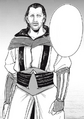 Alvaro Catarribera in Tales of Iga
 -
 Catarribera's notebook left behind in the Old Kofun


Appearances
- Assassin's Creed: Shadows (voice only)
- Claws of Awaji (mentioned in Database entry only)
- Animus Hub (mentioned in Database entry only)
- Assassin's Creed: Shadows – Tales of Iga (first appearance)
References
- ↑ 1.0 1.1 1.2 1.3 1.4 Assassin's Creed: Shadows – Database: Rift 2 - The Heart of an Assassin
- ↑ Assassin's Creed: Shadows – Tales of Iga – Chapter 16
- ↑ 3.0 3.1 Assassin's Creed: Shadows – Tales of Iga – Chapter 17
- ↑ 4.0 4.1 4.2 4.3 Assassin's Creed: Shadows – Secrets of the Blade
- ↑ Assassin's Creed: Shadows – The Meaning of the Blade
- ↑ 6.0 6.1 6.2 6.3 Assassin's Creed: Shadows – Tales of Iga – Chapter 1
- ↑ Assassin's Creed: Shadows – Tales of Iga – Chapter 3
- ↑ Assassin's Creed: Shadows – Tales of Iga – Chapter 8
- ↑ Assassin's Creed: Shadows – Tales of Iga – Chapter 13
- ↑ Assassin's Creed: Shadows – Tales of Iga – Chapter 27


| |||||||||||||||||||||||||
| |||||||||||||||||||||||||||||||||||||||||||
| ||||||||||||||||||||||||||||