

Iltani
Iltani (fl. 4th century BCE) was a legendary Babylonian founder of the Assassins. A member of a secret order later known to history as the Babylonian Brotherhood, her fame owes to her assassination of Alexander the Great through poison she had procured from an Achaemenid alchemist.
Biography[edit | edit source]
During Iltani's lifetime, Persia was conquered by the Macedonian Empire under Alexander the Great, and she watched as the ambitious, young king swept through her homeland with a Staff of Eden provided to him by the Order of the Ancients.[2][3][1]
Determined to put an end to Alexander's path of conquest, Iltani tracked him to Herat in modern-day Afghanistan, where he was holed up in a mighty citadel.[4] Despite its high walls, she managed to infiltrate the citadel but remained apprehensive that she would be able to eliminate him through force.[5] Sure enough, she became aware that through cunning, Alexander had somehow divined her presence within the fortress. Realizing that the risks were too great, she aborted her mission and withdrew from Herat.[6]
Her failure did not disrupt her resolve, and she quickly devised an alternative plan, one that involved meeting with a renowned Achaemenid alchemist who was then being hunted by the Greeks. After a perilous journey,[7] she arrived in Babylon, where she found the alchemist and acquired the secret formula for a deadly poison. While the poison was not as fast-acting as she had hoped, it was virulent enough to guarantee death.[8]
Throughout her mission to kill Alexander, she had left messages across the lands she travelled, including India and Herat. These messages chronicled her quest and could only be deciphered through Eagle Vision. In the event that her assassination were to fail, she even left behind the recipe of the poison on her last message, hoping it would serve her order.[8]
This proved unnecessary, as in 323 BCE, Iltani successfully poisoned Alexander the Great after infiltrating the palace of Nebuchadnezzar II in Babylon. True to the slow nature of her poison, Alexander withered away over several days until he finally perished.[9][10]
Legacy[edit | edit source]
- "Have you heard of Iltani? One of the first of our founders. She assassinated Alexander with an ingenious poison. I have attempted to recreate it from historical records... Iltani has taught me that no enemy is untouchable... no matter how powerful they appear!"
- ―Tabid Al-Nubi describing Iltani to Basim ibn Ishaq, c. 862.[src]-[m]
More than a thousand years later, Iltani's feats were still remembered among the Hidden Ones. Although she lived long before their founding in Egypt in 47 BCE,[11][12] by the 9th century, the Hidden Ones of Alamut had come to regard her as one of the earliest founders of their order.[13] In 862, the Rafiq Tabid Al-Nubi was trying to recreate Iltani's concoction that she had used to poison Alexander the Great.[13]

By the time of the Renaissance, Iltani had been memorialized as an Assassin of the Babylonian Brotherhood,[10][14] and statues of her and six other individuals similarly held in high esteem had been erected in the Sanctuary below the Villa Auditore in Monteriggioni.[3] Additionally, the cupola of Santa Maria del Fiore in Florence had been converted into a tomb dedicated to Iltani, which contained a sarcophagus with a hidden seal. The Italian Assassin Ezio Auditore later explored the tomb and retrieved its seal, which allowed him to obtain the Armor of Altaïr locked away in the Sanctuary.[15]
In 1841, the Indian Assassin Arbaaz Mir came across Iltani's scrolls during his missions across the Sikh Empire and Afghanistan. Using his Eagle Vision, Arbaaz was able to decipher the scrolls' ancient Akkadian text and learn fragments of her history.[1] Iltani continued to be honoured by the Assassins into the 21st century, for in the year 2000, a statue of her stood in the Mentor's office in Dubai.[16]
Behind the scenes[edit | edit source]
Iltani is a character first mentioned in the 2009 video game Assassin's Creed II as one of seven legendary Assassins with a dedicated statue in the Sanctuary of the Villa Auditore. Outside of Altaïr Ibn-La'Ahad, each of these Assassins have a unique accomplishment in history pertaining to the assassination of a historical figure; in Iltani's case, it is the assassination of Alexander the Great using poison. Details of Iltani's story were later expanded upon in the Assassin's Creed: Initiates platform and in the 2016 game Assassin's Creed Chronicles: India via five collectible scrolls that can be found throughout the game.
Despite the retroactive continuity introduced by Assassin's Creed: Origins (2017) that the Assassins were founded as the Hidden Ones in 47 BCE—centuries after Iltani's time—she is referred to as a Hidden Ones founder in Assassin's Creed: Mirage (2023) by one of the supporting characters, Tabid Al-Nubi.
Gallery[edit | edit source]
-
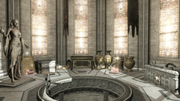 Iltani's statue and sarcophagus
 -
 The Seal of Iltani
 -
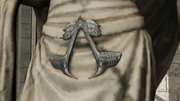 Iltani's insignia


Appearances[edit | edit source]
- Assassin's Creed II (sculpture only)
- Assassin's Creed: Brotherhood (sculpture only)
- Assassin's Creed: Initiates (mentioned only)
- Assassin's Creed: The Fall (sculpture only)
- Assassin's Creed Chronicles: India (mentioned only)
- Assassin's Creed: Mirage (mentioned only)
References[edit | edit source]
- ↑ 1.0 1.1 1.2 Assassin's Creed Chronicles: India
- ↑ Assassin's Creed Encyclopedia
- ↑ 3.0 3.1 Assassin's Creed II – Floating conversations: Unlocking Monteriggioni's Secrets
- ↑ Assassin's Creed Chronicles: India – Database: Iltani's Story 1
- ↑ Assassin's Creed Chronicles: India – Database: Iltani's Story 2
- ↑ Assassin's Creed Chronicles: India – Database: Iltani's Story 3
- ↑ Assassin's Creed Chronicles: India – Database: Iltani's Story 4
- ↑ 8.0 8.1 Assassin's Creed Chronicles: India – Database: Iltani's Story 5
- ↑ Assassin's Creed: Initiates – Timeline
- ↑ 10.0 10.1 Assassin's Creed II
- ↑ Assassin's Creed: Origins – The Aftermath
- ↑ Assassin's Creed: Origins – Last of the Medjay
- ↑ 13.0 13.1 Assassin's Creed: Mirage – Taking Flight
- ↑ Assassin's Creed: The Essential Guide
- ↑ Assassin's Creed II – Il Duomo's Secret
- ↑ Assassin's Creed: The Fall – Issue #3


| |||||||||||||||||||||||||||||||