
Gamilat
Gamilat (died 38 BCE) was the leader of the Nabataean rebels who opposed the Roman occupation of the Sinai. He was also an ally of the Hidden Ones and assisted in their struggle against the Order of the Ancients.
However, Gamilat secretly employed corrupt tactics to fight the Romans and the Order, which involved sacrificing the lives of innocents to further the rebellion's cause. When the Hidden Ones' Mentor Bayek learned about this, he confronted and ultimately killed Gamilat.
Biography[edit | edit source]
Rebellion against the Romans[edit | edit source]
In the late 1st century BCE, Gamilat served as the leader of the Nabataean rebels in the Sinai against the Roman forces led by Gaius Julius Rufio.[1] Desperate to recruit the inhabitants of the peninsula to his cause, Gamilat would deliberately initiate skirmishes against the Romans and then have his men hidden among the villagers to cause massacres. This effectively created new rebels, bolstering the size of his army.[2]
Around 38 BCE, Gamilat caught word of a plot to invade Egypt. To this end, he sent a note to Otis, a scribe from Alexandria, who in return contacted the Hidden One Mentor Amunet for Bayek's whereabouts.[3] In addition, Gamilat received assistance from Tahira, another Hidden One who oversaw a local bureau in Klysma. However, during an altercation with the Romans, two of Tahira's fellow Hidden Ones were killed, causing her to write to Bayek and request his assistance.[4]

Bayek answered Tahira's pleas for help and traveled to the Hidden Ones bureau in Klysma, where Tahira and Gamilat were waiting. They briefed Bayek on the deaths of the two Hidden One recruits and on Rufio, who was in charge of the Roman forces in the Sinai. Together, Gamilat and the Hidden Ones came up with a plan to reduce Rufio's influence and draw him out by assassinating his three lieutenants: Ampelius, Ptahmose, and Tacito.[5]
Sometime later, Gamilat met with Bayek outside the Pyramid of Amenmesse in Arsinoe Nome, where Ptahmose was supposedly operating. They infiltrated the pyramid, eliminating Roman soldiers in the process, and came upon a dead end. They later discovered a hidden pathway by accident and navigated through the tomb to find an exit.[6]
Though unable to find Ptahmose in the necropolis, Gamilat and Bayek were able to locate a scroll relating to the Shards of a Star legend, which the former deemed to be useless and thus passed it to Bayek. Deducing Ptahmose to be located in Arsinoe instead, Gamilat planned to send his men from an outpost to attack the city. However, Bayek believed his plan might incur the loss of innocent lives and thus took it upon himself to eliminate the priest. Gamilat agreed and returned to his camp.[6]
Death[edit | edit source]

Later, with assistance from Amunet, who had also arrived in the Sinai, Bayek was able to eliminate Rufio's remaining lieutenants and the general himself.[7] However, they realized that Gamilat was purposely provoking the Romans to attack villagers in order to create new martyrs for his cause. Bayek confronted Gamilat about his actions in a sunken quarry in Madiama Nome, leading them to fight a duel to the death.[2]
Bayek was eventually able to defeat the rebel, convincing him that his methods had endangered the lives of the innocent. Gamilat repented, understanding his mistakes, and as he passed away, he expressed his wish that Bayek's organization would last until the end of time.[2]
Legacy[edit | edit source]
Gamilat was seen as a hero in the Sinai, even after his death. Many stories and ballads were told in his honor, especially by Haganu. Gamilat's death served its cause, in that no more martyrs would be made. The local populace would later forget about the Hidden Ones, who returned to operating in the shadows.[2] Gamilat's actions also served as the inspiration for the first tenet of the Assassins' Creed, which obliged the Brotherhood's members to stay their blades from the flesh of the innocent.[2]
Behind the scenes[edit | edit source]
Gamilat is a character first mentioned in the 2017 game Assassin's Creed: Origins before he appeared in its 2018 downloadable expansion, The Hidden Ones. Although he has no historical basis, the origin of his name is actually feminine, as he shares it with the last queen-consort of Nabataea.[8]
Gallery[edit | edit source]
-
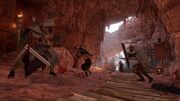 Bayek and Gamilat fighting bandits
 -
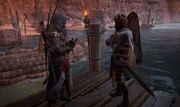 Bayek and Gamilat discussing their next move
 -
 Gamilat recruiting new members to his cause
 -
 Gamilat praying
 -
 Gamilat confronted by Bayek


Appearances[edit | edit source]
- Assassin's Creed: Origins (first mentioned)
- The Hidden Ones (first appearance)
References[edit | edit source]
- ↑ Assassin's Creed: Origins – The Hidden Ones
- ↑ 2.0 2.1 2.2 2.3 2.4 Assassin's Creed: Origins – The Hidden Ones – The Greater Good
- ↑ Assassin's Creed: Origins – Incoming Threat
- ↑ Assassin's Creed: Origins – The Hidden Ones – The Hidden Ones
- ↑ Assassin's Creed: Origins – The Hidden Ones – The Land of Turquoise
- ↑ 6.0 6.1 Assassin's Creed: Origins – The Hidden Ones – The Setting Sun
- ↑ Assassin's Creed: Origins – The Hidden Ones – Sic Semper Tyrannis
- ↑
 List of Nabataean kings on Wikipedia


| ||||||||||||||||||||||||||||||||||||||||