

Tokugawa Ieyasu

|
He who increaseth knowledge, increaseth sorrow. This article contains spoilers, meaning it has information and facts concerning Assassin's Creed: Shadows – Tales of Iga. If you do not want to know about these events, it is recommended to read on with caution, or not at all. |

|
Ezio, my friend! How may I be of service? This article has a lot of room for expansion. Please improve it with additional information in accordance with the Manual of Style |

|
Where are the paintings? This article is in need of more images and/or better quality pictures from official media in order to achieve a higher status. You can help the Assassin's Creed Wiki by uploading better images on this page. |
Tokugawa Ieyasu (徳川 家康; 1543 – 1616), born Matsudaira Takechiyo (松平 元康),[1] was a daimyō during the Sengoku period of Japan, and the last of Japan's three great unifiers (三英傑) who founded the Tokugawa shogunate and ruled as its first shōgun.
Ieyasu actively opposed the Portuguese Jesuit missionaries spreading Christianity—and veiled Templar influence—through the country. As such, he tasked his former squire Chaya Shirōjirō Kiyonobu with reporting any Templar activity in the land, and was the lord of the Japanese Assassin Hattori Hanzō.
Biography[edit | edit source]
Early life[edit | edit source]
The son of a minor daimyō, Ieyasu spent his early life as a hostage of Imagawa Yoshimoto, the daimyō of Suruga Province.[1] Following Yoshimoto's death during his failed invasion of the neighboring Owari Province, Ieyasu took advantage of the Imagawa clan's downfall to reclaim his ancestral seat in Mikawa Province, formerly ruled by the Imagawa.[2][3]
However, in 1561, the daimyō had his wife Sena and his children detained by Yoshimoto's son Imagawa Ujizane.[4] With this offense, he met with his retainers Watanabe Moritsuna and Hattori Hanzō,[5] who came back home to investigate any Templar activity. Fortunately, he informed his retainers of learning about Ujizane's recent meetings with a Jesuit priest named Paulino Massa, who wore an Templar cross around his neck. With this, he tasked both men with the secret rescue of his family, which they agreed.[4]
Within a year, Ieyasu readied his men to attack Kaminogō Castle in a matter to save his family as a last resort.[6] Commencing the siege,[7] he led the charge, unaware of his family being held hostage by Massa, one of the Templars Hanzō sought.[8] While he won the siege and captured the castle, he ultimately was relieved when Hanzō managed to rescue his family and eliminated Massa. Afterwards, he gave thanks to Hanzō and offered him a place besides Moritsuna but Hanzō needed to return back to Iga to finish his mission.[9]
As the daimyō of Mikawa, Ieyasu later formed an alliance with Oda Nobunaga, Owari's daimyō who had defeated Yoshimoto, and aided him in his military conquests,[2][3] becoming one of his most trusted generals.[10]
Service under Oda Nobunaga[edit | edit source]
In the autumn of 1581, Ieyasu was at the shooting range of Azuchi Castle to test the teppō firearms that they had acquired and modified from the Portuguese. He was joined by Oda Nobunaga and the newly-appointed samurai Yasuke, who participated in the testing of the guns as well. Just as Yasuke was half-way through the test, several shinobi attacked the group with the intention of assassinating Nobunaga.[10]
Though the assassins were eliminated, the incident prompted Nobunaga to arrange for an emergency meeting, with Ieyasu being asked to gather the generals. At the meeting, Ieyasu defended his fellow general Hashiba Hideyoshi when Akechi Mitsuhide questioned his absence, but the clash was swiftly defused upon the arrival of Nobunaga and Yasuke. As the meeting began, the generals were soon joined by Hideyoshi, who brought the head of Harima's slain daimyō Bessho Nagaharu, much to Nobunaga's delight.[10]
With all generals present and the meeting underway, Ieyasu brought up the issue of the Iga ikki, who had defeated and pushed back Oda Nobukatsu's army two years earlier in 1579. Ieyasu also suggested that the assassins earlier were likely of Igan origin and they were being led by someone who wielded a blade on his wrist. Ultimately, Nobunaga concluded that they would invade Iga and set out the next day.[10]
Forming the Tokugawa shogunate[edit | edit source]
At the Battle of Sekigahara on 21 October 1600, Ieyasu defeated Ishida Mitsunari and united the land under the Tokugawa clan, who would reign until 1868.[11]
Behind the scenes[edit | edit source]
Tokugawa Ieyasu is a historical figure and character introduced to the Assassin's Creed franchise in the 2014 mobile game Assassin's Creed: Memories. While not clearly identified as an Assassin, the game depicts Ieyasu giving orders and missions to Assassins like Yamauchi Taka and Hattori Hanzō, as well as wearing a helmet emblazoned with the Assassin insignia, implying that Ieyasu was an Assassin himself.
This was later disproven by his appearance in Assassin's Creed: Shadows, which features no hints of Ieyasu's possible Assassin affiliations outside his role as Hanzō's lord and opposition to the Templars. Ieyasu's original service to Oda Nobunaga, which put him into direct conflict with the Iga ikki—led by the Assassin Momochi Sandayu—further disproves the possibility of Ieyasu being a member of the Brotherhood.
Gallery[edit | edit source]
-
 Ieyasu as he appeared in Memories
 -
 Ieyasu in Tales of Iga
 -
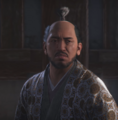 Closeup of Ieyasu
 -
 Render of Ieyasu in his kosode


Appearances[edit | edit source]
- Assassin's Creed: Memories (first appearance)
- Echoes of History – Shadows (mentioned only)
- Assassin's Creed: Shadows
- Assassin's Creed: Shadows – Tales of Iga
References[edit | edit source]
- ↑ 1.0 1.1
 Tokugawa Ieyasu on Wikipedia
- ↑ 2.0 2.1 Echoes of History – Shadows – Episode 5: Oda Nobunaga
- ↑ 3.0 3.1 Assassin's Creed: Shadows – Database: Oda Nobunaga
- ↑ 4.0 4.1 Assassin's Creed: Shadows – Tales of Iga – Chapter 12
- ↑ Assassin's Creed: Shadows – Tales of Iga – Chapter 11
- ↑ Assassin's Creed: Shadows – Tales of Iga – Chapter 22
- ↑ Assassin's Creed: Shadows – Tales of Iga – Chapter 24
- ↑ Assassin's Creed: Shadows – Tales of Iga – Chapter 25
- ↑ Assassin's Creed: Shadows – Tales of Iga – Chapter 26
- ↑ 10.0 10.1 10.2 10.3 Assassin's Creed: Shadows – Lords of Azuchi
- ↑ Assassin's Creed: Memories


| |||||||||||||||||||||||||
| |||||||||||||||||||||||||||||||||||||||||||
| ||||||||||||||||||||||||||||