

Yari

The yari (槍) is a family of Japanese spears characterized by narrow blades forged in the same manner as katana, tantō, and other nihontō (日本刀, i.e. Japanese swords). It was the weapon favored by the samurai and ninja Hattori Hanzō, whose skill with the yari was said to have been legendary.[1]
Description[edit | edit source]
Yari (槍) in the Japanese language is one of two words for 'spear', the other being hoko (矛). The two are distinguished by narrow and broad spearheads respectively.[2] Although yari in Japanese also applies to spears around the world generically, the term is loaned into English to refer specifically to a class of Japanese-style spears that arose during the Sengoku period for use by the many foot soldiers untrained in swordfighting.[3] The blades of these new spears followed the same principles that had led to the development of the katana over the previous centuries. They were forged from tamahagane, a type of steel smelted from ironsand. They also bore hamon, which is the visual pattern that results from differential hardening of the steel during forging. This technique ensures that a blade's edges are keen but its inner core is ductile, so that it is neither too dull nor too brittle.[4]
Overall, a yari's profile is that of a straight, double-edged sword blade mounted to a pole to form a spear.[3] From this simple form called the suyari (素槍, lit. 'plain spear') came numerous variations, among them the kamayari (鎌槍, 'sickle spear'), the katakamayari (片鎌槍, 'partial sickle spear'), the kagiyari (鍵槍 or 鑰槍, 'key spear'), kudayari (管槍, 'tube spear'), ōmiyari (大身槍, 'great-bodied spear'), the nagaeyari (長柄槍, 'long-pole spear'), and the kikuchiyari (菊池槍) named after the samurai Kikuchi Takemitsu.[2]
Kamayari[edit | edit source]
Of these, the kamayari is the most iconic. Also known as the jūmonji yari (十文字槍, 'cross spear'), it consists of bladed protrusions perpendicular to the spearhead but forged as a single piece.[2][4] It is so named because it resembles a cross, and the side blades can be used for either parry or attack. The katakamayari is a derivative with only one protrusion on one side.[2]
Kagiyari[edit | edit source]
The kagiyari incorporates an L-shaped guard below the spearhead that can be used to parry or hook an enemy weapon. The guard can be removed for reversion into a standard suyari.[2]
Kudayari[edit | edit source]
The flexible, upper segment of a kudayari is demarcated from the rigid pole by an intervening guard and hilt. The design enables the user to vibrate the blade when it is embedded in a target's body so as to inflict greater injury although it was criticized for its cruelty.[2]
Ōmiyari[edit | edit source]
An ōmiyari is a yari that boasts a much longer blade.[2]
Nagaeyari[edit | edit source]
The nagaeyari invented by Oda Nobunaga for his troops has an elongated pole, making it akin to a European pike.[2]
Kikuchiyari[edit | edit source]
The unconventional kikuchiyari uses a short, single-edged blade. When Kikuchi Takemitsu fought a battle at Chikugo River (筑後川), he tied a tantō to a bamboo pole and found that its performance exceeded his expectations, and this inspired the creation of the kikuchiyari, also known as the Chikugo-yari (筑後槍).[2]
History[edit | edit source]
Yari truly came into being during the Sengoku period as daimyō had to find ways of equipping the masses of ashigaru in their armies. Because these peasant foot soldiers needed to split their time between farming and military service, they could not be professionally trained to the same level of skill as samurai. Spears were effective battlefield weapons which were easier to learn to wield proficiently than a katana, and thus the type of spear composed of a nihontō blade mounted on a pole was invented.[3]
The weapon was not exclusive to ashigaru, for it became popular among samurai as well, and they were responsible for developing sōjutsu (槍術, 'the art of the spear'), as well as its many subtypes.[3]
The use of the yari endured during the centuries after the Sengoku period, and it remained a popular weapon in Japan, used by soldiers during the Edo period.[5] In February 1725, a number of ninja employed by the Shimazu clan utilized the weapon against the British Assassin Edward Kenway when they encountered him in Macau.[6]
Gallery[edit | edit source]
-
 Edward Kenway dodging a yari
 -
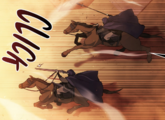 A Shimazu ninja wielding a yari


Behind the scenes[edit | edit source]
The yari appears in the 2025 video game Assassin's Creed: Shadows.[7] It is used by the ashigaru, or foot soldiers, and some samurai enemies.
As a polearm, it allows the wielder to attack from a longer range than most melee weapons. Enemies can deliver a flurry of stabs, or wide, sweeping slashes that must be deflected or parried.
Appearances[edit | edit source]
- Assassin's Creed: Memories (first mentioned)
- Assassin's Creed: Fragments – The Blade of Aizu (first appearance)
- Assassin's Creed: Forgotten Temple
- Assassin's Creed: Shadows
References[edit | edit source]
- ↑ Assassin's Creed: Memories – Cards: Hattori Hanzō
- ↑ 2.0 2.1 2.2 2.3 2.4 2.5 2.6 2.7 2.8 Ichikawa Sadaharu [市川定春]. (2023). "Polearms" [長柄]. In Dictionary of the Weapon [武器事典] (3rd ed.), translated by Lin Tsit-i [林哲逸] and Kao Yin-liang [高胤喨]. Taipei, Taiwan: Cite Publishing Ltd., pp. 113–165.
- ↑ 3.0 3.1 3.2 3.3 Kapp, Leon; Kapp, Hiroko; and Yoshihara Yoshindo. (2012). "Rekishi: A Brief History of the Japanese Sword". In The Art of the Japanese Sword: The Craft of Swordmaking and its Appreciation. Tokyo, Japan: Tuttle Publishing, pp. 69–104.
- ↑ 4.0 4.1 Ibid., "Kansho: Appreciating the Japanese Sword", pp. 13–67.
- ↑ Assassin's Creed: Fragments – The Blade of Aizu
- ↑ Assassin's Creed: Forgotten Temple – Episode 8
- ↑ Purslow, Matt (15 May 2024). Assassin's Creed Shadows: 40 Details You Need To Know. IGN. Archived from the original on 15 May 2024. Retrieved on 7 June 2024.
| ||||||||||||||||||||||||||||
| |||||||||||||||||||||||||||||||||||||||||||