

-
 Concept art of the Castel Sant'Angelo
 -
 Concept art of Rome
 -
 Antique District concept art
 -
 Medieval District concept art
 -
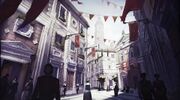 Renaissance District concept art
 -
 The countryside of Rome concept art
 -
 Database image of Rome in Assassin's Creed: Identity
Welcome to Assassin's Creed Wiki! Log in and join the community.
Rome: Difference between revisions
Jump to navigation
Jump to search
imported>Francesco75 No edit summary |
|||
| (36 intermediate revisions by 10 users not shown) | |||
| Line 1: | Line 1: | ||
{{Era|Locations}}{{WP-REAL}} | {{Era|Locations}}{{WP-REAL}} | ||
{{Update|'' | {{Update|''[[Assassin's Creed: Brotherhood of Venice]], [[Roma (expansion pack)|Roma]], [[Discovery Tour: Ancient Egypt]], [[Echoes of History]]'' and the [[Assassin's Creed (Netflix series)|Netflix series]]}} | ||
{{Quote|''Roma'' is the pillar that holds our entire enterprise aloft. She cannot waver; which means neither can you.|Cesare Borgia to his allies, 1501.|Assassin's Creed: Brotherhood|Castello Crasher}} | {{Quote|''Roma'' is the pillar that holds our entire enterprise aloft. She cannot waver; which means neither can you.|Cesare Borgia to his allies, 1501.|Assassin's Creed: Brotherhood|Castello Crasher}} | ||
{{Location Infobox | {{Location Infobox | ||
|image = Rome.jpg | |image=<gallery>Rome.jpg|1476 | ||
|state = Italian Republic | ACO Theatre of Pompey Garden 1.jpg|44 BCE | ||
|rulers = | </gallery> | ||
| | |state=Italian Republic | ||
|founded = [[Romulus]] and [[Remus]] | |rulers=[[Roman Kingdom]], [[Roman Republic|Republic]], and [[Roman Empire|Empire]] {{c|753 BCE–476 CE}}<br>[[Papacy]] {{c|754–1798; 1799–1804; 1804–1870}}<br>[[Italy]] {{c|1870–present}} | ||
|date = 753 BCE | |founded=[[Romulus]] and [[Remus]] | ||
|landmark = [[Colosseum]]<br>[[Sistine Chapel]]<br>[[Castel Sant'Angelo]]<br>[[ | |date=753 BCE | ||
|flags = 101 [[House of Borgia|Borgia]] [[flags]] | |coordinates=41°53'25.3"N 12°29'31.9"E<ref>''[[Assassin's Creed: Atlas]]</ref> | ||
|landmark=[[Colosseum]]<br>[[Sistine Chapel]]<br>[[Castel Sant'Angelo]]<br>[[Basilica di San Pietro]]<br>[[Pantheon]] | |||
|flags=101 [[House of Borgia|Borgia]] [[flags]] | |||
}} | |||
'''Rome''' (Latin and Italian: ''Roma'') is the capital and the largest city of [[Italy]]. During the [[Renaissance]], Rome was the capital of the {{Wiki|Papal States}} and headquarters of the [[Roman Rite of the Templar Order|Roman Rite]] of the [[Templars|Templar Order]]. Also, as part of [[Liberation of Rome|Rome's liberation]], the city became the base for the [[Italian Brotherhood of Assassins|Italian Brotherhood]] of the [[Assassins]]. During the Renaissance, Rome was divided in four districts: [[Antico District]], [[Campagna District]], [[Centro District]] and [[Vaticano District]]. | '''Rome''' (Latin and Italian: ''Roma'') is the capital and the largest city of [[Italy]]. During the [[Renaissance]], Rome was the capital of the {{Wiki|Papal States}} and headquarters of the [[Roman Rite of the Templar Order|Roman Rite]] of the [[Templars|Templar Order]]. Also, as part of [[Liberation of Rome|Rome's liberation]], the city became the base for the [[Italian Brotherhood of Assassins|Italian Brotherhood]] of the [[Assassins]]. During the Renaissance, Rome was divided in four districts: [[Antico District]], [[Campagna District]], [[Centro District]] and [[Vaticano District]]. | ||
==History== | ==History== | ||
===Isu era=== | ===Isu era=== | ||
During the [[Isu Era]], the [[Isu|First Civilization]] built at least three [[Temple (Isu)|sites]] | During the [[Isu Era]], the [[Isu|First Civilization]] built at least three [[Temple (Isu)|sites]] around the future location of Rome. The Isu [[Jupiter]], [[Minerva]], and [[Juno]] were remembered as the [[Capitoline Triad]] and assimilated into gods.<ref name="Brotherhood">''[[Assassin's Creed: Brotherhood]]''</ref> | ||
===Roman era=== | ===Roman era=== | ||
====Kingdom of Rome==== | ====Kingdom of Rome==== | ||
Archaeological evidence supports that Rome grew from pastoral settlements on [[Palatine Hill|Colle Palatino]], the future site of the [[Roman Forum]], upon which there are several caves. According to legends, the city of Rome was founded in 753 BCE by | [[File:Colle Palatino.png|thumb|250px|left|The Palatine Hill, one of the most ancient parts of Rome]] | ||
Archaeological evidence supports that Rome grew from pastoral settlements on [[Palatine Hill|Colle Palatino]], the future site of the [[Roman Forum]], upon which there are several caves. According to legends, the city of Rome was founded in 753 BCE by King [[Romulus]], one of the twin sons of the god [[Mars (deity)|Mars]] bred by a she-wolf on the [[Palatine Hill]], which became the place of the royal palace.<ref name="Roma">''[[Assassin's Creed: Brotherhood]]'' – [[Database: Roma]]</ref> | |||
Between the 8th and the 7th centuries BCE, a Sabine settlement was installed on the [[Quirinal Hill]] before being assimilated by Rome.<ref name="Quirinale">''[[Assassin's Creed: Brotherhood]]'' – [[Database: Colle Quirinale]]</ref> | Between the 8th and the 7th centuries BCE, a Sabine settlement was installed on the [[Quirinal Hill]] before being assimilated by Rome.<ref name="Quirinale">''[[Assassin's Creed: Brotherhood]]'' – [[Database: Colle Quirinale]]</ref> | ||
| Line 27: | Line 30: | ||
====Republic of Rome==== | ====Republic of Rome==== | ||
Circa 510 BCE, Rome became the heart of a Republic which eventually began to conquer territories through [[Mediterranean Sea]], having influence over [[France|Gaul]], [[Spain|Hispania]], [[Greece]], [[Egypt]] and Middle-East.<ref name="Roma"/> In 456 BCE, a law was passed allowing plebeians to own property on the [[Aventine Hill]], causing the city to quickly grow beyond its walls. After an invasion of the Gauls, a wall was built encircling the hill.<ref>''[[Assassin's Creed: Brotherhood]]'' – [[Database: Aventino]]</ref> | |||
Around 361 BCE, the city of [[Tivoli]] allied itself with the Gauls. They remained peaceful for 23 years until the Romans defeated the Gauls and absorbed the village.<ref name="Tivoli">''[[Assassin's Creed: Brotherhood]]'' – [[Database: Tivoli]]</ref> | |||
Between 144 and 140 BCE, the Praetor Quintus Marcius Rex built the longest [[Acqua Marcia|aqueduct]] of the city, running | Between 144 and 140 BCE, the Praetor Quintus Marcius Rex built the longest [[Acqua Marcia|aqueduct]] of the city, running 91 miles.<ref>''[[Assassin's Creed: Brotherhood]]'' – [[Database: Acqua Marcia]]</ref> In 62 BCE, [[Lucius Fabricius]] built a [[Pons Fabricius|bridge]] connecting the [[Tiber Island]] to Rome.<ref>''[[Assassin's Creed: Brotherhood]]'' – [[Database: Ponte Fabricio]]</ref> | ||
In 90 BCE, Tivoli received official Roman citizenship and became a resort destination for the Roman elite who traveled there for its beauty and superb water.<ref name="Tivoli"/> | In 90 BCE, Tivoli received official Roman citizenship and became a resort destination for the Roman elite who traveled there for its beauty and superb water.<ref name="Tivoli"/> | ||
[[File: ACO Fall of an Empire, Rise of Another 28.jpg|thumb | [[File: ACO Fall of an Empire, Rise of Another 28.jpg|thumb|250px|Caesar's assassination]] | ||
In 49 BCE, a [[Caesar's civil war|civil war]] began between the consuls [[Pompey]] and [[Gaius Julius Caesar|Julius Caesar]]. The conflict ended with Pompey's death and Caesar becoming the dictator of the Republic, supported by the [[Order of the Ancients]] after his campaign in [[Egypt]]. On 15 March 44 BCE, Caesar was [[Assassination of Julius Caesar|assassinated]] in the [[Theatre of Pompey]] by forty senators, calling themselves the ''Liberatores'', who were secretly [[Assassins|Hidden Ones]]. These ''Liberatores'' were led by [[Marcus Junius Brutus]] and [[Gaius Cassius Longinus]], and helped by the [[Egyptian Brotherhood of Assassins|Egyptian Hidden One]] [[Amunet|Aya]].<ref name="Project Legacy">''[[Assassin's Creed: Project Legacy]]'' – [[Holidays: Chapter 1 – Ghosts of Christmas Past]]</ref><ref name="Fall of an Empire">''[[Assassin's Creed: Origins]]'' – [[Fall of an Empire, Rise of Another]]</ref> | |||
In the aftermath of Caesar's assassination, his friend and former lieutenant [[Marcus Antonius]] rallied the Roman citizens against Caesar's killers. An angry mob pursued Aya, who was injured during a fight atop an [[aqueduct]] before being found and nursed back to health by Brutus and Cassius.<ref>[[Assassin's Creed: Origins (comic)|''Assassin's Creed: Origins'' comic]] – [[Assassin's Creed: Origins 2|Issue #2]]</ref> Later, Aya was captured by Antonius' men and sentenced to death after refusing to betray her fellow Hidden Ones' whereabouts. She managed to escape with the help of Brutus and Cassius,<ref>[[Assassin's Creed: Origins (comic)|''Assassin's Creed: Origins'' comic]] – [[Assassin's Creed: Origins 3|Issue #3]]</ref> before all three Hidden Ones were confronted by Antonius and a group of Caesar's supporters.<ref name="ACO Comic">[[Assassin's Creed: Origins (comic)|''Assassin's Creed: Origins'' comic]] – [[Assassin's Creed: Origins 4|Issue #4]]</ref> | |||
After defeating their assailants, Aya convinced Brutus not to betray his ideals by killing Antonius, who left after thanking Aya for saving him. Soon after, Brutus and Cassius fled Rome and went into hiding, while Aya stayed in the city to continue building up the Hidden Ones' influence.<ref name="ACO Comic"/> By 43 BCE, she had successfully established a [[Assassin bureau|bureau]] in the [[Pantheon]] district and began training new [[Assassin apprentice|recruits]].<ref name="Fall of an Empire"/> | |||
Following Caesar's death, his {{Wiki|Adoption in ancient Rome|adopted}} son and heir [[Augustus|Octavian]] formed the {{Wiki|Second Triumvirate}} with Antonius and {{Wiki|Lepidus}} to pursue revenge against the ''Liberatores'' and wrest control of the Roman Republic from Brutus and Cassius. In 42 BCE, the two Hidden Ones committed suicide after their armies were defeated by the Triumvirate's forces at the [[Battle of Philippi]].<ref name="ACO Comic"/><ref name="Project Legacy"/> | |||
Over the following decade, Octavian continued to accumulate more power and, in 32 BCE, convinced the Roman Senate to declare war against [[Cleopatra]], the Queen of Egypt and Antonius' lover.<ref>''[[Discovery Tour: Ancient Egypt]]'' – [[Tours: Cleopatra, Queen of Egypt]]: "War With Rome"</ref> Antonius and Cleopatra's deaths during the subsequent [[War of Actium]] allowed Octavian to transform the republic into the Roman Empire, having removed all of his opposition.<ref name="ACO Comic"/> | |||
====Roman Empire==== | ====Roman Empire==== | ||
[[File:Mausoleo di Augusto v.png|thumb|250px|left|The Mausoleum of Augustus]] | |||
Octavian became the first Roman Emperor under the name Augustus. During his reign, he constructed many monuments, including finishing the [[Basilica Julia]] in honor of his adoptive father and using it as a court of civil law as well as for sessions of the Centumviri who presided over matters of inheritance.<ref>''[[Assassin's Creed: Brotherhood]]'' – [[Database: Basilica Giulia]]</ref> He also ordered the construction of the [[Pantheon]] by [[Marcus Vipsanius Agrippa]] to celebrate his victory over Antonius,<ref name="Pantheon">''[[Assassin's Creed: Brotherhood]]'' – [[Database: The Pantheon]]</ref> and the [[Mausoleum of Augustus]], where he would eventually be buried alongside other important individuals.<ref name="Mausoleo">''[[Assassin's Creed: Brotherhood]]'' – [[Database: Mausoleo di Augusto]]</ref> | |||
Between 18 and 12 BCE, the magistrate [[Caius Cestius]] constructed a [[Pyramid of Cestius|pyramid]] which bore his name later.<ref>''[[Assassin's Creed: Brotherhood]]'' – [[Database: Piramide Cestia]]</ref> | Between 18 and 12 BCE, the magistrate [[Caius Cestius]] constructed a [[Pyramid of Cestius|pyramid]] which bore his name later on.<ref>''[[Assassin's Creed: Brotherhood]]'' – [[Database: Piramide Cestia]]</ref> | ||
Between 20 and 23 CE under the reign of Emperor [[Tiberius]], the Praetorian Prefect Sejanus constructed the [[Castra Praetoria]] to house the nine cohorts of the Praetorian Guard.<ref>''Assassin's Creed: Brotherhood'' – [[Database: Castra Praetoria]]</ref> | Between 20 and 23 CE under the reign of Emperor [[Tiberius]], the Praetorian Prefect Sejanus constructed the [[Castra Praetoria]] to house the nine cohorts of the Praetorian Guard.<ref>''[[Assassin's Creed: Brotherhood]]'' – [[Database: Castra Praetoria]]</ref> | ||
On 24 January 41 CE, the Hidden One [[Leonius]] assassinated Emperor [[Caligula]], a puppet of the Order of the Ancients, stabbing him with a [[Short blade|dagger]] in an underground corridor beneath the Palatine Hill.<ref name="AC2">''[[Assassin's Creed II]]''</ref> Caligula was succeeded by [[Claudius]], who in 52 CE finished the construction of the [[Acquedotto Claudia|aqueduct]] started by his predecessor.<ref>''[[Assassin's Creed: Brotherhood]]'' – [[Database: Acquedotto Claudia]]</ref> | |||
Between 54 and 68 CE, Rome was ruled by | Between 54 and 68 CE, Rome was ruled by Emperor [[Nero]], who was known for his tyranny and extravagance. In 64 CE, a Great Fire occurred in Rome. Some accused Nero of intentionally starting the fire to make room for his [[Nero's Golden Palace|golden palace]] on [[Esquiline Hill]]. It was also likely that Nero used the aqueducts to build his palace because they did not give water to civilians anymore for a time.<ref>''[[Assassin's Creed: Brotherhood]]'' – [[Database: Nero's Golden Palace]]</ref> As Nero accused the Christians of having started the Fire, the Apostle and [[Jesus Christ|Jesus]]' disciple [[Peter]] was crucified in the Circus of Nero circa 68 CE where he was also buried.<ref name="San Pietro"/> As Peter was the wielder of a [[Papal Staff of Eden|Staff of Eden]], all the leaders of the Christian community and later the Popes kept the artifact.<ref>''[[Assassin's Creed II]]'' – [[Glyphs|Glyph #5]]: "Instruments of Power"</ref> | ||
Under the Flavian dynasty, many monuments were constructed by the Emperors. Between 72 and 80 CE, the [[Colosseum]] was built as a place of entertainment.<ref name="Colosseo">''Assassin's Creed: Brotherhood'' – [[Database: Colosseo (Brotherhood)|Database: Colosseo]]</ref> The [[Temple of Vespasian]] and the [[Arch of Titus]] honored the two first Emperor of the dynasty.<ref>''Assassin's Creed: Brotherhood'' – [[Database: Tempio di Vespasiano]]</ref><ref>''Assassin's Creed: Brotherhood'' – [[Database: Arco di Tito]]</ref> [[Domitian]] ordered the construction of a [[Piazza Navona|stadium]] in Rome.<ref name="Navona">''Assassin's Creed: Brotherhood'' – [[Database: Piazza Navona]]</ref> | Under the Flavian dynasty, many monuments were constructed by the Emperors. Between 72 and 80 CE, the [[Colosseum]] was built as a place of entertainment.<ref name="Colosseo">''[[Assassin's Creed: Brotherhood]]'' – [[Database: Colosseo (Brotherhood)|Database: Colosseo]]</ref> The [[Temple of Vespasian]] and the [[Arch of Titus]] honored the two first Emperor of the dynasty.<ref>''[[Assassin's Creed: Brotherhood]]'' – [[Database: Tempio di Vespasiano]]</ref><ref>''[[Assassin's Creed: Brotherhood]]'' – [[Database: Arco di Tito]]</ref> Emperor [[Domitian]] ordered the construction of a [[Piazza Navona|stadium]] in Rome.<ref name="Navona">''[[Assassin's Creed: Brotherhood]]'' – [[Database: Piazza Navona]]</ref> | ||
During the 2nd century | [[File:Colonna Traiana.png|thumb|250px|The Column of Trajan]] | ||
During the 2nd century, the Roman Empire knew a Golden Age under the Nerva-Antonine. Emperor [[Trajan]] and his architect [[Apollodorus of Damascus]] constructed three monuments to the glory of the Emperor: a [[Trajan's Market|market]],<ref>''[[Assassin's Creed: Brotherhood]]'' – [[Database: Mercati di Traiano]]</ref> a [[Trajan's Column|column]],<ref>''[[Assassin's Creed: Brotherhood]]'' – [[Database: Colonna Traiana]]</ref> and [[Baths of Trajan|public baths]] on the ruins of Nero's Golden Palace.<ref>''[[Assassin's Creed: Brotherhood]]'' – [[Database: Terme di Traiano]]</ref> Trajan's successor, [[Hadrian]] ordered the construction of a [[Castel Sant'Angelo|mausoleum]] bigger than that of Augustus,<ref name="Castel">''[[Assassin's Creed: Brotherhood]]'' – [[Database: Castel Sant'Angelo (Brotherhood)|Database: Castel Sant'Angelo]]</ref> and restored the Pantheon.<ref name="Pantheon"/> | |||
In 140 CE, a part of the [[Circus Maximus]] collapsed, killing 1,112 spectators. That same year, Empress [[Faustina the Elder]] died. Her husband [[Antoninus Pius]] erected a [[Temple of Antoninus and Faustina|temple]] in her honor on the [[Roman Forum]]. Twenty years later, the Emperor died and the temple was also dedicated to him.<ref name="Faustina">''[[Assassin's Creed: Brotherhood]]'' – [[Database: Tempio di Antonino e Faustina]]</ref> During this century, the [[Catacombs of Rome]] were constructed and served as a burial place for the Christians who hid in the city.<ref>''[[Assassin's Creed: Brotherhood]]'' – [[Database: Catacombe di Roma]]</ref> | |||
At the end of the 2nd century, the Severian dynasty ruled over Rome. To celebrate his victory over the Parthians, Emperor [[Septimius Severus]] constructed an [[Arch of Septimius Severus|arch]] near the Colosseum. His sons [[Geta]] and [[Caracalla]] succeeded him but in 211 CE, Caracalla killed Geta and destroyed all records of Geta's existence, as his representations on the arch.<ref>''[[Assassin's Creed: Brotherhood]]'' – [[Database: Arco di Settimio Severo]]</ref> Caracalla ordered the construction of [[Baths of Caracalla|public baths]]<ref>''[[Assassin's Creed: Brotherhood]]'' – [[Database: Terme di Caracalla]]</ref> with the [[Acqua Antoniniana]]<ref>''[[Assassin's Creed: Brotherhood]]'' – [[Database: Acqua Antoniniana]]</ref> and restored the [[Porta Tiburtina]].<ref>''[[Assassin's Creed: Brotherhood]]'' – [[Database: Porta Tiburtina]]</ref> | |||
In | In 259 CE, the Hidden One [[Aquilus]] assassinated [[Caïus Fulvus Vultur]], a Roman Senator and secret member of the Order of the Ancients, inside the latter's home in Rome to avenge his father [[Lucius]] and reclaim the [[Ankh]] stolen by Vultur.<ref name="ACAccipiter">''[[Assassin's Creed 3: Accipiter]]''</ref> | ||
In 271 CE, Emperor [[Aurelian]] began the construction of [[Aurelian Walls|walls]] around the city, connecting numerous arches and gates. His successor [[Probus]] completed his work in 275 CE.<ref name="Mura">''[[Assassin's Creed: Brotherhood]]'' – [[Database: Mura Aureliane]]</ref> In 283 CE, the [[Temple of Saturn]] was restored.<ref>''[[Assassin's Creed: Brotherhood]]'' – [[Database: Tempio di Saturno]]</ref> | |||
As Constantine authorized the Christian religion, in 326 CE the [[ | [[File:Arco di Constantino.png|thumb|250px|left|The Arch of Constantine]] | ||
At the end of the 3rd century, Emperor [[Diocletian]] constructed [[Baths of Diocletian|public baths]] on the [[Viminal Hill]].<ref name="Diocleziano">''[[Assassin's Creed: Brotherhood]]'' – [[Database: Terme di Diocleziano]]</ref> In 308 CE, Emperor [[Maxentius]] began the construction of a [[Basilica of Maxentius|basilica]] in the Roman Forum. After Maxentius was defeated by [[Constantine I]], the basilica was finished by Maxentius' rival,<ref>''[[Assassin's Creed: Brotherhood]]'' – [[Database: Basilica di Massenzio]]</ref> who constructed an [[Arch of Constantine|arch]] to remember his victory.<ref>''[[Assassin's Creed: Brotherhood]]'' – [[Database: Arco di Constantino]]</ref> As the Praetorian Guard sided with Maxentius during the war, Constantine disbanded it and destroyed the barracks in the Castra Praetoria.<ref name="Praetoria">''[[Assassin's Creed: Brotherhood]]'' – [[Database: Castra Praetoria]]</ref> The Emperor also built his lavish private baths on the Quirinal hill.<ref name="Quirinale"/> | |||
As Constantine authorized the Christian religion, in 326 CE the [[Basilica di San Pietro]] was constructed on the site of Peter's death.<ref name="San Pietro">''[[Assassin's Creed: Brotherhood]]'' – [[Database: Basilica di San Pietro]]</ref> The [[Lateran Palace]] became the principal residence of the Pope.<ref name="Laterano">''[[Assassin's Creed: Brotherhood]]'' – [[Database: Palazzo Laterano]]</ref> | |||
In 401 CE, Hadrian's Mausoleum was changed into a military fortress.<ref name="Castel"/> In 410 CE, the King of the Visigoths Alaric I entered Rome by the [[Porta Salaria]] with his army and began to sack the city.<ref>''[[Assassin's Creed: Brotherhood]]'' – [[Database: Porta Salaria]]</ref> The [[Basilica Aemilia]] was destroyed during the attack<ref>''[[Assassin's Creed: Brotherhood]]'' – [[Database: Basilica Emilia]]</ref> and the urns and ashes of Hadian's Mausoleum were scattered by looters.<ref name="Castel"/> In 476 CE, the {{Wiki|Western Roman Empire}} fell, ending the rule of the Romans on the city.<ref name="Roma"/> | In 401 CE, Hadrian's Mausoleum was changed into a military fortress.<ref name="Castel"/> In 410 CE, the King of the Visigoths Alaric I entered Rome by the [[Porta Salaria]] with his army and began to sack the city.<ref>''[[Assassin's Creed: Brotherhood]]'' – [[Database: Porta Salaria]]</ref> The [[Basilica Aemilia]] was destroyed during the attack<ref>''[[Assassin's Creed: Brotherhood]]'' – [[Database: Basilica Emilia]]</ref> and the urns and ashes of Hadian's Mausoleum were scattered by looters.<ref name="Castel"/> In 476 CE, the {{Wiki|Western Roman Empire}} fell, ending the rule of the Romans on the city.<ref name="Roma"/> | ||
| Line 66: | Line 83: | ||
===Middle Ages=== | ===Middle Ages=== | ||
====Gothic-Byzantine War==== | ====Gothic-Byzantine War==== | ||
During the 6th century, Rome was disputed between the {{Wiki|Ostrogoths}} and the [[Byzantine Empire|Eastern Romans]]. In 536 CE, the Roman general [[Belisarius]] entered | During the 6th century, Rome was disputed between the {{Wiki|Ostrogoths}} and the [[Byzantine Empire|Eastern Romans]]. In 536 CE, the Roman general [[Belisarius]] entered the city by the [[Porta Asinaria]] and took back Rome.<ref name="Asinaria">''[[Assassin's Creed: Brotherhood]]'' – [[Database: Porta Asinaria]]</ref> A year later, the Ostrogoths besieged the city, cutting the water supply<ref name="Diocleziano"/> and attacking the Hadrian's Mausoleum.<ref name="Castel"/> During the Gothic Wars in 545 CE, much of Aurelian Walls were destroyed by the army of the Ostrogoth King [[Totila]].<ref name="Mura"/> In 546 CE, a traitor opened the Porta Asinaria to the Ostrogoths who sacked the city.<ref name="Asinaria"/> In 549 CE, the treason of the Isaurian garrison permitted to the Ostrogoths to enter by the [[Porta Ostiense]] and sacked another time the city.<ref>''[[Assassin's Creed: Brotherhood]]'' – [[Database: Porta Ostiense]]</ref> | ||
During the | During the [[Middle Ages]], the {{Wiki|Catholic Church|Roman Catholic Church}} increased their influence in Rome. Around 550s CE, [[Pelagius I]] ordered the construction of the [[Church of the Twelve Holy Apostles]] to celebrate the victory of the Roman General [[Narses]] over the Ostrogoths.<ref name="Apostoli">''[[Assassin's Creed: Brotherhood]]'' – [[Database: Santi Apostoli]]</ref> At the end of the 6th century, [[Gregory I]] built the church [[Santa Maria in Vallicella]].<ref name="Vallicella">''[[Assassin's Creed: Brotherhood]]'' – [[Database: Santa Maria in Vallicella]]</ref> In 609 CE, Boniface IV converted the Pantheon into a church.<ref name="Pantheon"/> | ||
====Beginning of the Papal State==== | ====Beginning of the Papal State==== | ||
In 756 CE, the Catholic Church managed to take power in Rome, founding its own [[Papacy|state]] with the Pope as the spiritual leader of Christian Europe.<ref name="Roma"/> | In 756 CE, the Catholic Church managed to take power in Rome, founding its own [[Papacy|state]] with the Pope as the spiritual leader of Christian Europe.<ref name="Roma"/> | ||
[[File:Vaticano District Overlook.png|thumb|250px|The Vatican]] | |||
In the middle of the 9th century, Rome became the target of Arab raids. In 849 CE, one of these raids was repelled by the forces of [[Leo IV]] at the Battle of Ostia.<ref>''[[Assassin's Creed: Valhalla]]'' – [[Database: Aelfred]]</ref> In 852 CE, to forbid any further raids, the [[Vaticano District|Vatican]] was enclosed by the Leonine Walls, composed by the [[Porta San Pellegrino|Porta Viridaria]]<ref>''[[Assassin's Creed: Brotherhood]]'' – [[Database: Porta Viridaria]]</ref> and the [[Porta Cavalleggeri]].<ref>''[[Assassin's Creed: Brotherhood]]'' – [[Database: Porta Turrionis]]</ref> During the 11th Century, the Church converted the ruins of the Temple of Antoninus and Faustina into the church of San Lorenzo in Miranda.<ref name="Faustina"/> | In the middle of the 9th century, Rome became the target of Arab raids. In 849 CE, one of these raids was repelled by the forces of [[Leo IV]] at the Battle of Ostia.<ref>''[[Assassin's Creed: Valhalla]]'' – [[Database: Aelfred]]</ref> In 852 CE, to forbid any further raids, the [[Vaticano District|Vatican]] was enclosed by the Leonine Walls, composed by the [[Porta San Pellegrino|Porta Viridaria]]<ref>''[[Assassin's Creed: Brotherhood]]'' – [[Database: Porta Viridaria]]</ref> and the [[Porta Cavalleggeri]].<ref>''[[Assassin's Creed: Brotherhood]]'' – [[Database: Porta Turrionis]]</ref> During the 11th Century, the Church converted the ruins of the Temple of Antoninus and Faustina into the church of San Lorenzo in Miranda.<ref name="Faustina"/> | ||
| Line 79: | Line 97: | ||
During the 12th century, the House of Colonna occupied the area around the Mausoleum of Augustus, which was fortified and converted into part of the Castel Sant'Angelo. During this period, a Commune of Rome was established but eventually failed in 1167 and the Colonna family was disgraced, banished from the city and their fortification was dismantled.<ref name="Mausoleo"/> | During the 12th century, the House of Colonna occupied the area around the Mausoleum of Augustus, which was fortified and converted into part of the Castel Sant'Angelo. During this period, a Commune of Rome was established but eventually failed in 1167 and the Colonna family was disgraced, banished from the city and their fortification was dismantled.<ref name="Mausoleo"/> | ||
Between the 12th and the 13th century, | Between the 12th and the 13th century, Pope [[Innocent III]] ordered the construction of the [[Torre delle Milizie]].<ref name="Milizie">''[[Assassin's Creed: Brotherhood]]'' – [[Database: Torre Milizie]]</ref> | ||
During the 13th and the 14th | During the 13th and the 14th centuries, the [[Capitoline Hill]] became the siege of the communal power with the construction of the [[Palazzo dei Conservatori]] as the seat of the Roman magistrates<ref name="Conservatori">''[[Assassin's Creed: Brotherhood]]'' – [[Database: Palazzo dei Conservatori]]</ref> and the [[Palazzo Senatorio]] for the judges.<ref name="Senatorio">''[[Assassin's Creed: Brotherhood]]'' – [[Database: Palazzo Senatorio]]</ref> On the ruins of the Temple of Juno was constructed the church [[Santa Maria in Aracoeli]].<ref>''[[Assassin's Creed: Brotherhood]]'' – [[Database: Basilica di Santa Maria in Ara Coeli]]</ref> | ||
[[File:Rosa in Fiore 1.png|thumb|250px|left|The Rosa in Fiore]] | |||
During the 14th century, some accidents occurred in the city. After the Lateran Palace burned in 1307 and 1361, the Pope left it to go to the Hadrian Mausoleum, which became the Castel Sant'Angelo.<ref name="Laterano"/> A [[Passetto di Borgo|passage]] was created between the Papal residence and St Peter's.<ref name="Castel"/> In 1348, an earthquake damaged the Church of the Twelve Holy Apostles<ref name="Apostoli"/> and the Torre delle Milizie.<ref name="Milizie"/> A year later, another earthquake made a part of the Colosseum collapsed.<ref name="Colosseo"/> | During the 14th century, some accidents occurred in the city. After the Lateran Palace burned in 1307 and 1361, the Pope left it to go to the Hadrian Mausoleum, which became the Castel Sant'Angelo.<ref name="Laterano"/> A [[Passetto di Borgo|passage]] was created between the Papal residence and St Peter's.<ref name="Castel"/> In 1348, an earthquake damaged the Church of the Twelve Holy Apostles<ref name="Apostoli"/> and the Torre delle Milizie.<ref name="Milizie"/> A year later, another earthquake made a part of the Colosseum collapsed.<ref name="Colosseo"/> | ||
The year 1400 saw the construction of the [[Rosa in Fiore]], one of the most popular brothels in Rome, also known for its preferential treatment of members of the Vatican.<ref>''[[Assassin's Creed: Brotherhood]]'' – [[Database: Rosa in Fiore]]</ref> In 1417, Pope [[Martin V]] from the Colonna family ordered the restoration of the Church of the Twelve Holy Apostles.<ref name="Apostoli"/> | |||
===Modern Era=== | ===Modern Era=== | ||
====Renaissance==== | ====Renaissance==== | ||
{{Quote|I say we work here. In Roma. Erode the | {{Quote|I say we work here. In Roma. Erode the Borgia's influence while restoring our own. And in fact, I want to begin right now.|Ezio Auditore to his allies, before beginning the liberation of Rome, 1501.|Assassin's Creed: Brotherhood|Man of the People}} | ||
During the 15th century, Rome became an economic and cultural powerhouse in [[Europe]], even though [[Florence]] surpassed Rome as the center of the Italian [[Renaissance]]. Due to the rivalry between the two cities, the papacy spent vast amounts of money to create cultural masterworks.<ref name="Roma"/> | |||
Between 1440 and 1445, the cardinal [[Antonio de Chavez]] built the [[Sant'Antonio dei Portoghesi]] and annexed the hospice for [[Portugal|Portuguese]] pilgrims.<ref name="Portoghesi">''[[Assassin's Creed: Brotherhood]]'' – [[Database: Sant'Antonio dei Portoghesi]]</ref> | Between 1440 and 1445, the cardinal [[Antonio de Chavez]] built the [[Sant'Antonio dei Portoghesi]] and annexed the hospice for [[Portugal|Portuguese]] pilgrims.<ref name="Portoghesi">''[[Assassin's Creed: Brotherhood]]'' – [[Database: Sant'Antonio dei Portoghesi]]</ref> | ||
The Jubilee of 1450 was particularly deadly for the pilgrims. The balustrades of the [[Ponte Sant'Angelo]] buckled due to a surging mob of pilgrims making their way to the Basilica San Pietro, leading to a mass drowning.<ref>''[[Assassin's Creed: Brotherhood]]'' – [[Database: Ponte Sant'Angelo]]</ref> Several hundred pilgrims were also trampled to death moving between churches in 1450. The populace was so traumatized by the insanity of the events unfolding, that performers stayed in the city for several years afterward to help ease Jubilee's withdrawal.<ref>''Assassin's Creed: Brotherhood'' – [[Database: Jubilee Performers]]</ref> | The Jubilee of 1450 was particularly deadly for the pilgrims. The balustrades of the [[Ponte Sant'Angelo]] buckled due to a surging mob of pilgrims making their way to the Basilica San Pietro, leading to a mass drowning.<ref>''[[Assassin's Creed: Brotherhood]]'' – [[Database: Ponte Sant'Angelo]]</ref> Several hundred pilgrims were also trampled to death moving between churches in 1450. The populace was so traumatized by the insanity of the events unfolding, that performers stayed in the city for several years afterward to help ease Jubilee's withdrawal.<ref>''[[Assassin's Creed: Brotherhood]]'' – [[Database: Jubilee Performers]]</ref> | ||
In 1461, Pope [[Pius II]] built the Rocca Pia in an attempt to control the population of Tivoli which often rioted. The fortress stood as a symbol of the omnipotence of the papal temporal power. During the Renaissance, Tivoli opened several open-air travertine mines, excavating stone for the palazzos and courtyards of Rome.<ref name="Tivoli"/> | In 1461, Pope [[Pius II]] built the Rocca Pia in an attempt to control the population of Tivoli which often rioted. The fortress stood as a symbol of the omnipotence of the papal temporal power. During the Renaissance, Tivoli opened several open-air travertine mines, excavating stone for the palazzos and courtyards of Rome.<ref name="Tivoli"/> | ||
[[File:Giovanni's fight.jpg|thumb|250px|Giovanni fighting guards in St Peter's]] In 1476, cardinal [[Rodrigo Borgia]], [[Grand Master of the Templar Order|Grand Master]] of the [[Roman Rite of the Templar Order|Italian Templars]] and a powerful figure in Vatican politics, briefly left the city to discuss his Order's | [[File:Giovanni's fight.jpg|thumb|250px|Giovanni fighting guards in St Peter's]] | ||
In 1476, cardinal [[Rodrigo Borgia]], the [[Grand Master of the Templar Order|Grand Master]] of the [[Roman Rite of the Templar Order|Italian Templars]] and a powerful figure in Vatican politics, briefly left the city to discuss his Order's [[Pazzi conspiracy|plans]] to take over Florence and kill [[Lorenzo de' Medici]], before returning to affirm [[Sixtus IV|Papal approval]]. Assent was given by Pope Sixtus IV, and the Templars were provided with military support for their future endeavors.<ref name="Lineage"/> | |||
In St Peter's, Rodrigo was confronted by the Assassin [[Giovanni Auditore da Firenze]], as the [[Italian Brotherhood of Assassins|Italian Brotherhood]] knew about the Templars' schemes. After failing to turn Giovanni against the Brotherhood, Rodrigo ordered his guards to kill the Assassin. Giovanni survived,<ref name="Lineage">''[[Assassin's Creed: Lineage]]''</ref> but was later hung with two of [[Federico Auditore da Firenze|his]] [[Petruccio Auditore da Firenze|sons]] in Florence by the Templar [[Uberto Alberti]] to prevent him from revealing their plans.<ref>''[[Assassin's Creed II]]'' – [[Last Man Standing]]</ref> | |||
During his pontificate, Sixtus IV built the [[Ponte Sisto]] between 1473 and 1479 to connect the [[Centro District]] and the Vatican.<ref>''[[Assassin's Creed: Brotherhood]]'' – [[Database: Ponte Sisto]]</ref> In 1483, construction of the [[Sistine Chapel]] began, serving as the Pope's chapel near St Peter's. Artists such as [[Pietro Perugino]], [[Sandro Botticelli]] and [[Domenico Ghirlandaio]] worked on the painting of the chapel. The chapel was unknowingly constructed on the site of an [[Vatican Vault|Isu vault]].<ref>''[[Assassin's Creed: Brotherhood]]'' – [[Database: Cappella Sistina]]</ref> After the death of Sixtus IV in 1484, looters sacked Rome. [[Caterina Sforza]], ruler of [[Forlì]] and wife of Sixtus' nephew [[Girolamo Riario]], organized the defense of the Vatican, with cannon fire and soldiers.<ref>''[[Assassin's Creed II]]'' – [[Database: Caterina Sforza (Assassin's Creed II)|Database: Caterina Sforza]]</ref> | |||
====Borgia rule==== | |||
In 1492, Rodrigo became Pope Alexander VI and head of the Papal States and Catholic Church. Ruling with [[House of Borgia|his family]] and the Templars, he maintained oppression over the city with [[Borgia Towers|towers]] located throughout Rome, which prevented [[Merchant|shops]] from opening.<ref name="New Man">''[[Assassin's Creed: Brotherhood]]'' – [[New Man in Town]]</ref> | |||
[[File:A Glass of Wine with Caesar Borgia - John Collier.jpg|thumb|250px|left|The Borgia family]] | [[File:A Glass of Wine with Caesar Borgia - John Collier.jpg|thumb|250px|left|The Borgia family]] | ||
In | In 1497, [[Juan Borgia the Younger]], Rodrigo's elder son, was assassinated by the [[courtesan]] [[Fiora Cavazza]] under the order of his own brother, [[Cesare Borgia]], who became the Captain-General of the [[Papal Guard|Papal Army]].<ref>''[[Assassin's Creed: Ascendance]]''</ref> His hitman, [[Micheletto Corella]], killed some of Cesare's enemies in the city. Cesare maintained control of Rome with the help of the Templars' many allies in the city, such as the thieves of the [[Cento Occhi]] and the cultists of the [[Followers of Romulus]], who engaged in different illegal activities: [[Slavery|slavery]], corruption, smuggling, persecution, and murders. Cesare also enlisted the help of his cousin [[Juan Borgia the Elder]] to fund his army, and allied with the French noble [[Octavian de Valois]], who established his troops in the countryside of Rome.<ref name="Brotherhood"/> | ||
The Assassin Brotherhood also intervened in Rome in the 1490s. Around 1493, the [[Mercenary|condottiero]] and Assassin [[Bartolomeo d'Alviano]] arrived in the city with his companies installed in a [[Caserma di Alviano|barrack]] in Rome. His guild controlled the fighting club in the city and recruited the champion [[Corvo Antonelli]] into the Brotherhood.<ref>''[[Assassin's Creed: Rebellion]]'' – [[Database: Corvo Antonelli]]</ref> In 1496, Bartolomeo allied with the [[House of Orsini]] to fight Cesare.<ref>''[[Assassin's Creed: Brotherhood]]'' – [[Database: Bartolomeo d'Alviano (Brotherhood)|Database: Bartolomeo d'Alviano]]</ref> | |||
In 1497, the Assassin [[Perotto Calderon]] was sent undercover in the Borgia court as a courier but he compromised the Brotherhood when he had an affair with Rodrigo's daughter [[Lucrezia Borgia|Lucrezia]], which resulted in the birth of [[Giovanni Borgia]] and the death of Perotto in 1498.<ref>''[[Assassin's Creed: Project Legacy]]'' – [[Italian Wars: Chapter 4 – Perotto Calderon]]</ref> The Assassin and Florentine thief [[La Volpe]] arrived in Rome and established a guild to fight the Cento Occhi. The Assassin [[Niccolò Machiavelli]] served as a diplomate in the Papal court.<ref name="Brotherhood"/> | |||
In | In 1498, Rodrigo ordered the renovation of the [[Porta Settimiana]], as he wanted the gate to evoke a military vibe.<ref>''[[Assassin's Creed: Brotherhood]]'' – [[Database: Porta Settimiana]]</ref> | ||
In | [[File:IBAL 4.png|thumb|250px|Ezio fighting Rodrigo in the Sistine Chapel]] | ||
In 1499, the [[Master Assassin]] [[Ezio Auditore da Firenze|Ezio Auditore]], Giovanni's son, learned that the Vatican Vault was beneath the Sistine Chapel and confronted Rodrigo in a fight. Defeating him, he used the Papal Staff and an [[Apple of Eden 6|Apple of Eden]] to open the vault. There, he was contacted by a hologram of Minerva, who delivered a message—intended for Ezio's descendant, [[Desmond Miles]]—about the [[Great Catastrophe]] and the impending [[Second Disaster]].<ref>''[[Assassin's Creed II]]'' – [[In Bocca al Lupo]]</ref> After that, the Staff was locked in the vault, and Ezio escaped Rome with the Apple.<ref>''[[Assassin's Creed: Brotherhood]]'' – [[Mass Exodus]]</ref> | |||
In 1500, Cesare Borgia led the Papal Army to [[Monteriggioni]], the headquarters of the Assassins. During the [[Siege of Monteriggioni|siege]], Cesare took the Apple of Eden, captured Caterina Sforza, and killed the Assassin leader [[Mario Auditore]], Ezio's uncle.<ref>''[[Assassin's Creed: Brotherhood]]'' – [[Vilified]]</ref> Escaping from the city with the population, Ezio returned to Rome to exact his revenge. At the time, the city had fallen far behind those of Florence and [[Venice]] and had grown stagnant in terms of development, due to the influence of the Borgia.<ref>''[[Assassin's Creed: Brotherhood]]'' – [[As Good As New]]</ref> | |||
In | |||
Allying with Machiavelli, Ezio decided to increase their network in the city. To free Rome of the Borgia influence, Ezio killed the [[Borgia captains|overlords]] of the [[Borgia Tower|towers]] and burned the structures themselves to the ground, taking them over for the Assassin Order afterward and renovating the districts.<ref name="New Man"/> [[Claudia Auditore da Firenze|Claudia Auditore]], Ezio's sister, took control of the Rosa in Fiore, using the courtesans to gather information from the men of the Vatican.<ref>''[[Assassin's Creed: Brotherhood]]'' – [[High-Stakes Negotiation]]</ref> Ezio helped Bartolomeo in his fight with the French.<ref name="Between">''[[Assassin's Creed: Brotherhood]]'' – [[Between a Rock and a Hard Place]]</ref> With La Volpe, he founded [[La Volpe Addormentata]], a tavern that served as the headquarters of the Roman thieves.<ref>''[[Assassin's Creed: Brotherhood]]'' – [[Double Agent]]</ref> Ezio also accomplished some assassination contracts for Machiavelli,<ref name="Between"/> and tracked the Followers of Romulus to expose their ties with the Borgia.<ref>''[[Assassin's Creed: Brotherhood]]'' – [[Roman Underground]]</ref> | |||
In November 1500, the Templar and astronomer [[Nicolaus Copernicus]] wanted to share his scientific discoveries but the [[Master of the Sacred Palace]] tried to kill him. Ezio protected him and killed the Master while Copernicus studied the lunar eclipse in Rome.<ref>''[[Assassin's Creed: Brotherhood]] – [[Copernicus Conspiracy]]'' – [[Close the Book]]</ref> | |||
In | [[File:Ascension 3.png|thumb|250px|left|The Assassins Brotherhood in Rome]] | ||
In 1501, during his mission to assassinate Rodrigo and his son, Ezio rescued Caterina Sforza, who was imprisoned in the Castel Sant'Angelo.<ref>''[[Assassin's Creed: Brotherhood]]'' – [[Guardian of Forlì]]</ref> Understanding they couldn't attack Cesare directly, Ezio established the [[Assassins Guild]] in Rome and set up its [[Tiber Island headquarters|headquarters]] on [[Tiber Island]] to decrease the power of Cesare. By recruiting several Roman [[civilian]]s as Assassin [[Assassin apprentice|apprentices]], the Brotherhood worked to free Rome of Templar control, killing some of their agents and going on missions throughout Europe and Asia.<ref>''[[Assassin's Creed: Brotherhood]]'' – [[Man of the People]]</ref> | |||
Cesare captured the inventor [[Leonardo da Vinci]] to force him to construct [[war machine]]s while he studied the Apple of Eden for Rodrigo. Leonardo decided to help his old friend Ezio by indicating which guards in Rome had the locations of the war machines, so the Assassin could destroy them.<ref>''[[Assassin's Creed: Brotherhood]]'' – [[An Unexpected Visitor]]</ref> | |||
In 1501, the ancient speaking statue of Pasquino was unearthed at Piazza Navona. The citizens used it as a signpost for social parodies and anonymous derogatory comments, which were attached to it for all to read.<ref name="Navona"/> | In 1501, the ancient speaking statue of Pasquino was unearthed at Piazza Navona. The citizens used it as a signpost for social parodies and anonymous derogatory comments, which were attached to it for all to read.<ref name="Navona"/> | ||
In 1502, | In 1502, King [[Louis XII of France]] commissioned the church [[Trinità dei Monti]] to celebrate the French invasion of [[Naples]].<ref>''[[Assassin's Creed: Brotherhood]]'' – [[Database: Trinita dei Monti]]</ref> | ||
[[File:Roads lead to 3.png|thumb|250px|The Assassins uniting against Cesare]] | [[File:Roads lead to 3.png|thumb|250px|The Assassins uniting against Cesare]] | ||
In August 1503, Ezio killed Juan Borgia the Elder, cutting | In August 1503, Ezio killed Juan Borgia the Elder, cutting off Cesare's funds,<ref>''[[Assassin's Creed: Brotherhood]]'' – [[In and Out]]</ref> and Octavian de Valois, removing the French army's support of the Borgia.<ref>''[[Assassin's Creed: Brotherhood]]'' – [[Au Revoir]]</ref> Ezio also saved the actor [[Pietro Rossi]] from Micheletto Corella to obtain the key of the Castel Sant'Angelo.<ref>''[[Assassin's Creed: Brotherhood]]'' – [[Intervention]]</ref> As the Italian Assassins' new [[Mentor]], Ezio infiltrated the Papal residence and witnessed Cesare's murder of Rodrigo after the latter had refused to give his son the Apple of Eden. The Assassin and the Templar then raced to the location of the artifact in the place of St. Peter's, and Ezio ultimately claimed it first.<ref>''[[Assassin's Creed: Brotherhood]]'' – [[An Apple a Day]]</ref> | ||
Over the following months, the Assassins used the Apple to eliminate Cesare's remaining supporters, removing the Templars' control over Rome. During a final battle in the [[Piazza del Popolo]] in December, Cesare was defeated by the Assassins and then arrested on the order of Pope [[Julius II]].<ref>''[[Assassin's Creed: Brotherhood]]'' – [[All Roads Lead To...]]</ref> | |||
The following year, in 1504, Cesare managed to break out of prison but was re-captured by Ezio before he could flee Rome. Julius II subsequently decided to have Cesare moved to a new prison in [[Spain]], whose location was a closely guarded secret. During this time, the Assassins continued to fight the remaining Borgia diehards in Rome.<ref name="BH novel">[[Assassin's Creed: Brotherhood (novel)|''Assassin's Creed: Brotherhood'' novel]]</ref> After eliminating them, Ezio hid the Apple of Eden in the Isu vault under Santa Maria in Aracoeli.<ref>''[[Assassin's Creed: Brotherhood]]'' – [[A Seed]]</ref> | |||
In | In 1506, the [[Hermeticists]] led by [[Ercole Massimo]] kidnapped Leonardo da Vinci to open the [[Temple of Pythagoras]] hidden in the catacombs underneath Rome.<ref>''[[Assassin's Creed: Brotherhood]] – [[The Da Vinci Disappearance]]'' – [[A Roll of the Dice]]</ref> Ezio recovered the paintings of his friend and discovered hidden clues on them leading to the location of the Temple.<ref>''[[Assassin's Creed: Brotherhood]] – [[The Da Vinci Disappearance]]'' – [[Decoding Da Vinci]]</ref> After killing the Hermeticists and saving Leonardo, the pair decided to enter the [[Pythagorean Vault]] inside the Temple, which gave the coordinates for the [[Grand Temple]] in [[North America]].<ref>''[[Assassin's Creed: Brotherhood]] – [[The Da Vinci Disappearance]]'' – [[The Temple of Pythagoras]]</ref> | ||
During the war, several fortifications were raised around and inside Rome. A detachment of the Papal Army was sent to build camp around the Colosseum | In 1508, Pope Julius II created the [[War of the League of Cambrai|League of Cambrai]], which served as an anti-Venetian alliance that included Louis XII of France, the [[Holy Roman Empire|Holy Roman Emperor]] [[Maximilian I, Holy Roman Emperor|Maximillian I]], and [[Ferdinand II of Aragon]], intending to curb the Venetian influence in northern Italy. The League was initially a success, but the friction between Julius and Louis caused it to collapse by 1510.<ref>''[[Assassin's Creed: Identity]]'' – [[Database: War of the League of Cambrai]]</ref> | ||
During the war, several fortifications were raised around and inside Rome. A detachment of the Papal Army was sent to build a camp around the Colosseum to protect the southern part of the city and the ruins.<ref name="A Storm of Crows">''[[Assassin's Creed: Identity]]'' – [[A Storm of Crows]]</ref> Around 1506, this camp was occupied by the [[Crows]], a Templar-affiliated organization created with the goal of eliminating the Assassins by replicating their techniques.<ref>''[[Assassin's Creed: Identity]]'' – [[Niccolò Machiavelli's journal]] – [[Database: Journal – A Storm of Crows|Entry #6]]: "A Storm of Crows"</ref> The Assassin [[Lo Sparviero]], sent to investigate the camp by Niccolò Machiavelli, encountered and killed [[Matteo Favero]], a high-ranking Crow Leader, while his brethren captured Matteo's father [[Sirus Favero|Sirus]].<ref name="A Storm of Crows"/> | |||
[[File:ACID Castel Sant'Angelo Concept Johannes Mücke.jpg|thumb|250px|left|Lo Sparviero infiltrating the Castel Sant'Angelo]] | |||
Secretly the Grand Master of the Crows, Sirus pretended to be a merchant forced to collaborate with the Templars, and managed to infiltrate the Assassins by becoming their ally and providing them with valuable intelligence on Borgia operations.<ref>''[[Assassin's Creed: Identity]]'' – [[Niccolò Machiavelli's journal]] – [[Database: Journal – Burning Pages|Entry #7]]: "Burning Pages"</ref> However, his true identity was eventually discovered by Lo Sparviero when he lured the Assassin into an ambush in a failed attempt to avenge his son's death.<ref>''[[Assassin's Creed: Identity]]'' – [[Under the Red Sun]]</ref><ref>''[[Assassin's Creed: Identity]]'' – [[Niccolò Machiavelli's journal]] – [[Database: Journal – Under the Red Sun|Entry #8]]: "Under the Red Sun"</ref> | |||
Sirus later summoned all Crows to Rome to organize an attack against the Assassins, and took refuge inside the Castel Sant'Angelo. With Machiavelli, Lo Sparviero fought through the Crows to reach and assassinate Sirus, whereupon his surviving followers either surrendered or dispersed.<ref>''[[Assassin's Creed: Identity]]'' – [[Saviors of Roma]]</ref> Having defeated the Crows, Lo Sparviero and Machiavelli investigated their hideout, but were forced to escape as it was set on fire by Borgia troops.<ref>''[[Assassin's Creed: Identity]]'' – [[Niccolò Machiavelli's journal]] – [[Database: Journal – Saviors of Roma|Entry #10]]: "Saviors of Roma"</ref> | |||
====Leonardo da Vinci's research on the havens==== | |||
Just before his death in 1519, [[Leonardo da Vinci]], afraid of possible interception, hid encoded information with trusted friends scattered around [[Europe]] under express instructions to destroy it should the [[Assassins]] not be able to contact them within a month of his death.<ref>''[[Assassin's Creed: The Last Quest of Leonardo da Vinci]]'' – Letter from Leonardo</ref> Leonardo's letter to the Assassins about Rome informed them that the clue to the havens was left in a hidden compartment behind the [[Sistine Chapel]]'s ceiling, but getting it to open would require outwitting the [[Papal Guard]] and uncovering a riddle.<ref>''[[Assassin's Creed: The Last Quest of Leonardo da Vinci]]'' – Mini-map: Rome</ref> Having received the quest, the local chapter sent agents to five landmarks to investigate. | |||
At Leonardo's [[Bottega di Leonardo#Rome|former atelier]],<ref>''[[Assassin's Creed: The Last Quest of Leonardo da Vinci]]'' – Portfolio 12</ref> after a full day searching through the bric-a-brac he had left behind, an Assassin uncovered a small clay tablet with a riddle.<ref>''[[Assassin's Creed: The Last Quest of Leonardo da Vinci]]'' – Card 133</ref> An ally of Leonardo's was located at the [[Colosseum]],<ref>''[[Assassin's Creed: The Last Quest of Leonardo da Vinci]]'' – Portfolio 07</ref> waiting for the Assassin atop the tallest pillar<ref>''[[Assassin's Creed: The Last Quest of Leonardo da Vinci]]'' – Card 158</ref> in order to hand them a reproduction of one of the scenes painted on the Sistine Chapel's ceiling.<ref>''[[Assassin's Creed: The Last Quest of Leonardo da Vinci]]'' – Card 122</ref> Seeking further help in [[Tiber Island]],<ref>''[[Assassin's Creed: The Last Quest of Leonardo da Vinci]]'' – Portfolio 30</ref> they followed an Assassin to a hideout<ref>''[[Assassin's Creed: The Last Quest of Leonardo da Vinci]]'' – Card 188</ref> and, after convincing those inside they were part of the Brotherhood, two of them, [[Arturo]]<ref>''[[Assassin's Creed: The Last Quest of Leonardo da Vinci]]'' – Card 061</ref> and [[Esteban]],<ref>''[[Assassin's Creed: The Last Quest of Leonardo da Vinci]]'' – Card 016</ref> offered to join in their quest.<ref>''[[Assassin's Creed: The Last Quest of Leonardo da Vinci]]'' – Carnet de voyage 32</ref> | |||
Incursion into the [[Vaticano District]] began with the [[Castel Sant'Angelo]],<ref>''[[Assassin's Creed: The Last Quest of Leonardo da Vinci]]'' – Portfolio 39</ref> where the Assassins infiltrated the administrator's study, where important items intercepted by the Papal authorities were kept.<ref>''[[Assassin's Creed: The Last Quest of Leonardo da Vinci]]'' – Card 113</ref> Searching through the writing desk,<ref>''[[Assassin's Creed: The Last Quest of Leonardo da Vinci]]'' – Card 032</ref> they found another reproduction among many licencious images.<ref>''[[Assassin's Creed: The Last Quest of Leonardo da Vinci]]'' – Card 179</ref> Climbing down the stairs towards the dungeon led to a skirmish with the guards,<ref>''[[Assassin's Creed: The Last Quest of Leonardo da Vinci]]'' – Card 136</ref> which, in turn, allowed the Assassins to retrieve the cell keys from the guard captain.<ref>''[[Assassin's Creed: The Last Quest of Leonardo da Vinci]]'' – Card 091</ref> They then freed two prisoners, a man who ran away in tears<ref>''[[Assassin's Creed: The Last Quest of Leonardo da Vinci]]'' – Card 104</ref> and a woman who thanked them for liberating her. She claimed she had been arrested because she had been hiding something, handing a small reproduction to her savior, mentioning that Leonardo had been correct in trusting them.<ref>''[[Assassin's Creed: The Last Quest of Leonardo da Vinci]]'' – Card 164</ref> | |||
Reaching the Sistine Chapel,<ref>''[[Assassin's Creed: The Last Quest of Leonardo da Vinci]]'' – Portfolio 21</ref> they dealt with the guard captain stationed ther taking another of the reproduction from his belongings.<ref>''[[Assassin's Creed: The Last Quest of Leonardo da Vinci]]'' – Card 102</ref> Cleared to approach the ceiling without interruptions, they climbed up.<ref>''[[Assassin's Creed: The Last Quest of Leonardo da Vinci]]'' – Card 152</ref> In the borders of some of the scenes of the fresco, they located buttons,<ref>''[[Assassin's Creed: The Last Quest of Leonardo da Vinci]]'' – Card 068</ref> which they pushed according to the riddle, revealing the secret compartment mentioned by da Vinci. Inside, they found another note from him as well as a map of Europe and the Mediterranean.<ref>''[[Assassin's Creed: The Last Quest of Leonardo da Vinci]]'' – Card 082</ref> | |||
====Counter-Reformation==== | ====Counter-Reformation==== | ||
During the | During the early 16th century, two members of the [[House of Medici]] became Pope. In 1518, [[Leo X]] initiated an architectural completion for a [[San Giovanni dei Fiorentini|new church]] to be built in place of the old Saint Pantaleo. The winning architect went by the name of Sansovino but there were complications, the construction slowly ground to a halt and many different individuals tried to finish the church tower for over two centuries.<ref name="Fiorentini">''[[Assassin's Creed: Brotherhood]]'' – [[Database: San Giovanni dei Fiorentini]]</ref> In 1527, Rome was sacked by the [[Holy Roman Empire|imperial]] troops. [[Clement VII]] who was imprisoned in the Castel Sant'Angelo, escaped from the fortress disguised as a tradesman.<ref>''[[Assassin's Creed II]]'' – [[Database: Giuliano de' Medici]]</ref> | ||
During his papacy, Pope [[Paul III]] commissioned [[Michelangelo]] to improve Capitol Hill to impress | During his papacy, Pope [[Paul III]] commissioned [[Michelangelo]] to improve Capitol Hill to impress Emperor [[Charles V, Holy Roman Emperor|Charles V]]. The artist re-designed the facade of the Palazzo dei Conservatori, adding gigantic Corinthian pilaster strips on high pedestals to make it a little less ostentatious.<ref name="Conservatori"/> He also designed a double-flighted staircase in front of the Palazzo Senatorio.<ref name="Senatorio"/> | ||
In 1542, Paul III established the [[Roman Inquisition|Supreme Sacred Congregation of the Roman and Universal Inquisition]], a system of tribunals for prosecuting anyone with alternate religious beliefs.<ref> | In 1542, Paul III established the [[Roman Inquisition|Supreme Sacred Congregation of the Roman and Universal Inquisition]], a system of tribunals for prosecuting anyone with alternate religious beliefs.<ref>''[[Assassin's Creed DNA]]'' – Timeline: 1542</ref> | ||
In 1563, the [[Porta San Pellegrino]] was rendered unnecessary when the third set of Leonine Walls was constructed, enclosing the existing set.<ref>''Assassin's Creed: Brotherhood'' – [[Database: Porta Viridaria]]</ref> | In 1563, the [[Porta San Pellegrino]] was rendered unnecessary when the third set of Leonine Walls was constructed, enclosing the existing set.<ref>''[[Assassin's Creed: Brotherhood]]'' – [[Database: Porta Viridaria]]</ref> | ||
====Baroque period==== | ====Baroque period==== | ||
Prior to joining the [[Jesuits|Jesuit]] mission to [[Japan]] and working with [[Alessandro Valignano]], the [[Portugal|Portuguese]] priest [[Luís Fróis]] spent some time in Rome, where he learned about the city's corruption under the Boriga decades prior. According to rumors, a secret organization had been responsible for eradicating the Borgia and restoring Rome to its former glory, but although Fróis was able to uncover the Borgia's ties to the Templars, he never found out about the Assassins' existence.<ref>''[[Assassin's Creed: Shadows]]'' – [[The Path He Walks]]</ref> | |||
In 1575, construction of the cathedral Santa Maria in Vallicella got underway, which was eventually finished and consecrated in 1599.<ref name="Vallicella"/> | In 1575, construction of the cathedral Santa Maria in Vallicella got underway, which was eventually finished and consecrated in 1599.<ref name="Vallicella"/> | ||
Around 1580, the Duchess of Amalfi, who was a descendant of Pope Pius II, was then charged by the order of Theatine with the responsibility of erecting a [[San Andrea della Valle|church in | [[File:San Andrea della Valle.png|thumb|250px|The Chiesa di Sant'Andrea della Valle]] | ||
Around 1580, the Duchess of Amalfi, who was a descendant of Pope Pius II, was then charged by the order of Theatine with the responsibility of erecting a [[San Andrea della Valle|church in honor of Saint Andrew]].<ref name="San Andrea">''[[Assassin's Creed: Brotherhood]]'' – [[Database: San Andrea della Valle]]</ref> | |||
During his papacy, | During his papacy, Pope [[Sixtus V]] wished to make use of the remaining shell of the Colosseo to convert the structure into a giant wool factory to employ Rome's prostitutes. However, he died before his plan could become reality.<ref name="Colosseo"/> | ||
In 1598, a flood swept away the eastern arch of the [[Pons Aemilius]], the oldest bridge in Rome. City officials deemed it too expensive to fix, as all money was heading into Pope Clement VIII's execution fund.<ref>''[[Assassin's Creed: Brotherhood]]'' – [[Database: Ponte Emilio]]</ref> | In 1598, a flood swept away the eastern arch of the [[Pons Aemilius]], the oldest bridge in Rome. City officials deemed it too expensive to fix, as all money was heading into Pope Clement VIII's execution fund.<ref>''[[Assassin's Creed: Brotherhood]]'' – [[Database: Ponte Emilio]]</ref> | ||
Between 1594 and 1600, the Dominican Friar and | Between 1594 and 1600, the Dominican Friar and Hermeticist [[Giordano Bruno]] was held prisoner in the Castel Sant'Angelo for heresy. In 1600, he was burnt at the stake in the small interior courtyard of the Castel<ref name="Castel"/> | ||
In 1601, plague struck the city due to a stagnant river of the small channel near Porta Metronia.<ref name="Metronia">''[[Assassin's Creed: Brotherhood]]'' – [[Database: Porta Metronia]]</ref> | In 1601, plague struck the city due to a stagnant river of the small channel near Porta Metronia.<ref name="Metronia">''[[Assassin's Creed: Brotherhood]]'' – [[Database: Porta Metronia]]</ref> | ||
During his papacy, [[Urban VIII]] | During his papacy, [[Urban VIII]] remodeled the [[Porta Aurelia]], after which it was renamed Porta San Pancrazio.<ref>''[[Assassin's Creed: Brotherhood]]'' – [[Database: Porta Aurelia]]</ref> | ||
In 1638, a massive facelift was begun on Sant'Antonio dei Portoghesi at the hands of Martino Longhi the Younger, converting it into the national church of the Portuguese people.<ref name="Portoghesi"/> | In 1638, a massive facelift was begun on Sant'Antonio dei Portoghesi at the hands of Martino Longhi the Younger, converting it into the national church of the Portuguese people.<ref name="Portoghesi"/> | ||
[[File:Piazzadelpopolo2.png|thumb|250px|left|Piazza del Popolo]] | |||
In 1650, San Andrea della Valle was completed and celebrated the world over for its stunning interior.<ref name="San Andrea"/> | In 1650, San Andrea della Valle was completed and celebrated the world over for its stunning interior.<ref name="San Andrea"/> | ||
Between 1662 and 1675, the modest church of [[Santa Maria dei Miracoli and Santa Maria di Montesant|Santa Maria dei Miracoli]] which | Between 1662 and 1675, the modest church of [[Santa Maria dei Miracoli and Santa Maria di Montesant|Santa Maria dei Miracoli]], which housed the Carmelite, monks was renovated, becoming one of the twin churches of the [[Piazza del Popolo]].<ref>''[[Assassin's Creed: Brotherhood]]'' – [[Database: Santa Maria dei Miracoli and Santa Maria di Montesant]]</ref> | ||
In 1734, San Giovanni dei Fiorentini was | In 1734, San Giovanni dei Fiorentini was finally completed.<ref name="Fiorentini"/> | ||
===Modern times=== | ===Modern times=== | ||
In 1821, the Romantic [[United Kingdom|British]] poet John Keats spent his final hours in a flat overlooking the [[Piazza di Spagna]] before succumbing to tuberculosis.<ref>''[[Assassin's Creed: Brotherhood]]'' | In 1821, the Romantic [[United Kingdom|British]] poet John Keats spent his final hours in a flat overlooking the [[Piazza di Spagna]] before succumbing to tuberculosis.<ref>''[[Assassin's Creed: Brotherhood]]'' – [[Database: Piazza di Spagna]]</ref> | ||
In 1827, the British embassy was constructed in the sealed [[Porta Nomentana]].<ref>''[[Assassin's Creed: Brotherhood]]'' | In 1827, the British embassy was constructed in the sealed [[Porta Nomentana]].<ref>''[[Assassin's Creed: Brotherhood]]'' – [[Database: Porta Nomentana]]</ref> | ||
In 1853, the [[Aurora Equestrian Troupe]] | In 1853, the [[Aurora Equestrian Troupe]] traveled to Rome to perform for three weeks while its acrobat, [[Pierrette Arnaud]], looked for any sign of [[Simeon Price]].<ref name="Chapter 09">''[[Assassin's Creed: The Engine of History – The Magus Conspiracy]]'' – Chapter 9</ref> | ||
In 1925, the Italian Ministry of Interior was installed on the [[Viminal Hill]].<ref>''[[Assassin's Creed: Brotherhood]]'' | In 1925, the Italian Ministry of Interior was installed on the [[Viminal Hill]].<ref>''[[Assassin's Creed: Brotherhood]]'' – [[Database: Colle Viminale]]</ref> | ||
In 1960, the spot where the Caserma di Alviano | In 1960, the spot where the Caserma di Alviano stood was marked for a memorial, but no one was quite sure where the barracks were located, so the idea was scrapped in favor of a park, which was, in turn, scrapped in favor of a fast food restaurant.<ref>''[[Assassin's Creed: Brotherhood]]'' – [[Database: Caserma di Alviano]]</ref> | ||
In 2007, a construction accident halted temporarily the flow of the [[Acqua Vergine]], the source providing water to the Trevi Fountain, the Villa Borghese, the north and south fountains of the Piazza Navona and the fountains of Piazza del Popolo.<ref>''[[Assassin's Creed: Brotherhood]]'' | In 2007, a construction accident halted temporarily the flow of the [[Acqua Vergine]], the source providing water to the Trevi Fountain, the Villa Borghese, the north and south fountains of the Piazza Navona, and the fountains of Piazza del Popolo.<ref>''[[Assassin's Creed: Brotherhood]]'' – [[Database: Acqua Vergene]]</ref> | ||
In 2012, the Assassin [[Clay Kaczmarek]] was tasked to infiltrate the [[Animus Project laboratory|Abstergo laboratory]] in Rome, as Subject 16 of the [[Animus Project]]. Clay remained in the lab for the remainder of his physical life, until the consequences of the Bleeding Effect drove him insane and led him to commit suicide. Clay | [[File:AC1 Abstergo Lab Animus Room.png|thumb|250px|The Abstergo laboratory in Rome]] | ||
In 2012, the Assassin [[Clay Kaczmarek]] was tasked to infiltrate the [[Animus Project laboratory|Abstergo laboratory]] in Rome, as Subject 16 of the [[Animus Project]]. Clay remained in the lab for the remainder of his physical life, until the consequences of the [[Bleeding Effect]] drove him insane and led him to commit suicide. Before his death, Clay implanted a digitial copy of consciousness within the [[Animus]] to help his successor, [[Desmond Miles]].<ref name="AC2"/> | |||
In September 2012, Desmond | In September 2012, Desmond was captured by the Templars and brought to the same facility in Rome. There, Desmond was marked Subject 17 of the Animus Project, in which [[Warren Vidic]] examined the [[Genetic memory|genetic memories]] of Desmond's ancestor, [[Altaïr Ibn-La'Ahad]], for a week.<ref>''[[Assassin's Creed]]'' – [[21st century conversations#Assassin's Creed|Modern day]]: "The Experiment Begins"</ref> Desmond subsequently escaped from the facility with the help of [[Lucy Stillman]], who was secretly a Templar double agent. The pair then made their way to an Assassin [[Rome hideout|hideout]] nearby, where Desmond relived Ezio Auditore's memories to gain his abilities through the Bleeding Effect.<ref name="AC2"/> Once Vidic and the Templars located the Assassins, Desmond and his team were forced to relocate to another safehouse in Monteriggioni.<ref name="Brotherhood"/> | ||
On October | On 10 October, Desmond, Lucy, [[Rebecca Crane]], and [[Shaun Hastings]] returned to Rome to retrieve the Apple of Eden, after Desmond had discovered its whereabouts in the [[Colosseum Vault]] from Ezio's memories. As he touched the artifact, however, Desmond was influenced by Juno to kill Lucy to prevent her from delivering the Apple to the Templars. Desmond subsequently fell into a coma and had to be flown out of Italy by the Assassins.<ref name="Brotherhood"/> | ||
On December | On 28 November, [[Adriano Maestranzi]]'s [[Assassin cell]] attacked the Abstergo campus in Rome, killing four hackers and several guards and destroying their servers to prevent the Templars from tracking down [[William Miles]]' team.<ref>''[[Assassin's Creed: Initiates]]'' – [[The Desmond Files]]: "Hacker Massacre"</ref> As the Assassins returned to their hideout in Florence, they were tailed by [[Juhani Otso Berg]], who was given command of Abstergo's [[Sigma Team]] to raid the safehouse and wipe out the cell.<ref>''[[Assassin's Creed: Initiates]]'' – [[The Desmond Files]]: "The Hound"</ref> | ||
[[File:AC3 Desmond Entering Abstergo.png|thumb|250px|left|Desmond's return to the Abstergo facility in Rome]] | |||
On 14 December, Desmond returned to Rome, to the same Abstergo laboratory he had been held in months before, in order to rescue his father William following his capture by the Templars. Desmond fought his way to Warren Vidic's office, killing [[Daniel Cross]] and many Abstergo guards along the way. Inside the office, Desmond managed to free his father and kill Vidic using Ezio's Apple of Eden, which he and William also used to escape the laboratory.<ref name="AC3">''[[Assassin's Creed III]]'' – [[Return to Abstergo]]</ref> | |||
==Districts== | ==Districts== | ||
| Line 200: | Line 247: | ||
===Antico District=== | ===Antico District=== | ||
{{Main|Antico District}} | {{Main|Antico District}} | ||
Named because of the many Roman ruins | Named so because of the many Roman ruins it housed, the Antico District was the southern district of Rome. The Roman Forum, the Colosseum, and the remnants of the baths recalled the city's Roman past. Among other landmarks were the Lateran Palace, the first papal residence, and ''La Volpe Addormentata'', the headquarters of the Thieves' Guild disguised as an inn. Three Borgia towers controlled the district.<ref name="Brotherhood"/> | ||
===Campagna District=== | ===Campagna District=== | ||
{{Main|Campagna District}} | {{Main|Campagna District}} | ||
Situated at the east of the city, the Campagna District | [[File:Campagna District Overlook.png|thumb|250px|The Campagna District]] | ||
Situated at the east end of the city, the Campagna District was characterized by its farmlands, sparse settlements, and the presence of military encampments. The Mercenaries' Guild took their headquarters at the Caserma di Alviano while the French troops installed themselves in the Castra Praetoria. There were also four Borgia towers that controlled the Campagna.<ref name="Brotherhood"/> | |||
===Centro District=== | ===Centro District=== | ||
{{Main|Centro District}} | {{Main|Centro District}} | ||
As the urban center of Rome, | As the urban center of Rome, the Centro District was densely populated. Among the houses and the churches, the Pantheon and the Mausoleum were the last landmarks of the Roman era while the Capitoline Hill overlooked the district. The Tiber River crossed the district from the north to the south, separating the poorer Trastevere from the east part of the Centro.<ref name="Brotherhood"/> | ||
This district was home to the Rosa in Fiore, established by the city's courtesans and having nobles and clergymen as its clients. On the Tiber Island, the Assassins set up their guild, permitting them to use the Roman sewers to travel through the city. During the early 1500s, the cityscape was dominated by five Borgia towers.<ref name="Brotherhood"/> | |||
===Vaticano District=== | ===Vaticano District=== | ||
{{Main|Vaticano District}} | {{Main|Vaticano District}} | ||
Situated in the northern part of the city, the Vaticano District was the political and religious center of Rome, with the papal residence of the Castel Sant'Angelo and St Peter Cathedral. As one of the richer districts, many clergymen and papal guards crossed its streets.<ref name="Brotherhood"/> | |||
==Simulation== | ==Simulation== | ||
As well as this, [[Abstergo Industries]] used Rome as a simulated training location in the [[Assassin's Creed: Brotherhood|primary]] and [[Assassin's Creed: Revelations|secondary]] stages of their [[Animi Training Program]].<ref name="ACB Multiplayer">''[[Assassin's Creed: Brotherhood]]'' | As well as this, [[Abstergo Industries]] used Rome as a simulated training location in the [[Assassin's Creed: Brotherhood|primary]] and [[Assassin's Creed: Revelations|secondary]] stages of their [[Animi Training Program]].<ref name="ACB Multiplayer">''[[Assassin's Creed: Brotherhood]]'' – [[Multiplayer/ACBH|Multiplayer]]</ref> | ||
The simulation was set in the [[Centro District]], depicting the market square, upon which a great many market stalls had been set up, located in front of the [[Pantheon]] and the surrounding residences. Although the Pantheon could be seen, its interior and exterior were inaccessible. The streets themselves were relatively spacious, but the many hidden alleyways allowed people to slip away from the masses with ease.<ref name="ACB Multiplayer"/> | The simulation was set in the [[Centro District]], depicting the market square, upon which a great many market stalls had been set up, located in front of the [[Pantheon]] and the surrounding residences. Although the Pantheon could be seen, its interior and exterior were inaccessible. The streets themselves were relatively spacious, but the many hidden alleyways allowed people to slip away from the masses with ease.<ref name="ACB Multiplayer"/> | ||
| Line 227: | Line 277: | ||
*The area where Ezio climbed up to the Castel Sant'Angelo from the river in ''[[Assassin's Creed II]]'' was unreachable in ''Assassin's Creed: Brotherhood'', with fencing and blockades along the Castello and Vaticano district. | *The area where Ezio climbed up to the Castel Sant'Angelo from the river in ''[[Assassin's Creed II]]'' was unreachable in ''Assassin's Creed: Brotherhood'', with fencing and blockades along the Castello and Vaticano district. | ||
*The buildings seen north of the Passetto di Borgo in ''Assassin's Creed II'' did not appear in ''Assassin's Creed: Brotherhood''. | *The buildings seen north of the Passetto di Borgo in ''Assassin's Creed II'' did not appear in ''Assassin's Creed: Brotherhood''. | ||
*In the ''Assassin's Creed'' series, there were two bridges that could clearly be seen that led into the Vaticano district of Rome: | *In the ''Assassin's Creed'' series, there were two bridges that could clearly be seen that led into the Vaticano district of Rome: the [[Ponte Sant'Angelo]], leading first into Castel Sant'Angelo, and the {{Wiki|Ponte Vittorio Emanuele II}}, which lay west of the Ponte Sant'Angelo. While both bridges could be seen in ''Assassin's Creed II'', the Ponte Vittorio Emanuele II was missing in ''Assassin's Creed: Brotherhood''. | ||
**While the [[In Bocca al Lupo|final memory]] | **While the [[In Bocca al Lupo|final memory]] of ''Assassin's Creed II'' took place in 1499, construction on the Ponte Emanuele did not begin until 1886. This is one of the largest anachronisms in the series to date, and an oversight of 387 years. | ||
*During gameplay, as Rome is renovated and the Borgia's influence ebbs, the ambiance of the city would change to reflect the improved livelihood of the city: the initial faded color filter will change to a warmer color palette, and the menacing soundtrack would change to a more serene one. | |||
==Gallery== | ==Gallery== | ||
<gallery captionalign="center" position="center | <tabber> | ||
|-|Concept art= | |||
<gallery captionalign="center" position="center" widths="180"> | |||
ACB Castel concept art.jpg|Concept art of the Castel Sant'Angelo | ACB Castel concept art.jpg|Concept art of the Castel Sant'Angelo | ||
ACB Isola Tiberina Festival - Concept Art.jpg|Concept art of Rome | ACB Isola Tiberina Festival - Concept Art.jpg|Concept art of Rome | ||
Rome's Antique District concept art.jpg|Antique District concept art | Rome's Antique District concept art.jpg|Antique District concept art | ||
Rome's Medieval District concept art.jpg|Medieval District concept art | Rome's Medieval District concept art.jpg|Medieval District concept art | ||
Rome's Renaissance District concept art.jpg|Renaissance District concept art | Rome's Renaissance District concept art.jpg|Renaissance District concept art | ||
The Countryside of Rome concept art.jpg|The | The Countryside of Rome concept art.jpg|The countryside of Rome concept art | ||
Rome Bird's eye view.jpg|A bird's | ACIdentity Roma.png|Database image of Rome in ''[[Assassin's Creed: Identity]]'' | ||
</gallery> | |||
|-|Screenshots= | |||
<gallery captionalign="center" position="center" widths="180"> | |||
ACB Map of Rome.png|Map of Rome | |||
Rome Animi Training Program.jpg|The map of Rome used for [[Abstergo Industries]]' Animi Training Program | |||
ACO Fall of an Empire, Rise of Another 17.jpg|Aya in ancient Rome | |||
Rome AC2 Panoramas.png|Panoramic views of Rome | |||
Rome Bird's eye view.jpg|A bird's eye view of Rome | |||
Rome Panorama Sunset.jpg|Rome at sunset | Rome Panorama Sunset.jpg|Rome at sunset | ||
Rome at night.jpg|Panoramic view of Rome at night | Rome at night.jpg|Panoramic view of Rome at night | ||
Romedusk.jpg|Panoramic view of Rome at dusk | Romedusk.jpg|Panoramic view of Rome at dusk | ||
ACB Ezio Riding Horse Pantheon.jpg|Ezio riding through the city towards the Pantheon | |||
ACB DB Castel Sant'Angelo.png|The centre of Borgia control, the Castel Sant'Angelo | |||
ACFT - Rodrigo Borgia.png|Rodrigo Borgia preaching in Rome | |||
</gallery> | </gallery> | ||
</tabber> | |||
==Appearances== | ==Appearances== | ||
*''[[Assassin's Creed: Lineage]]'' {{1st}} | *''[[Assassin's Creed: Lineage]]'' {{1st}} | ||
*''[[Assassin's Creed II]]'' | *''[[Assassin's Creed II]]'' | ||
*''[[Assassin's Creed: Renaissance]]'' | |||
*''[[Assassin's Creed: Project Legacy]]'' | *''[[Assassin's Creed: Project Legacy]]'' | ||
*''[[Assassin's Creed: Ascendance]]'' {{c|non- | *''[[Assassin's Creed: Ascendance]]'' {{c|non-canon}} | ||
*''[[Assassin's Creed: Brotherhood]]'' | *''[[Assassin's Creed: Brotherhood]]'' | ||
**''[[Copernicus Conspiracy]]'' | |||
**''[[The Da Vinci Disappearance]]'' | **''[[The Da Vinci Disappearance]]'' | ||
*[[Assassin's Creed: Brotherhood (novel)|''Assassin's Creed: Brotherhood'' novel]] | |||
*''[[Assassin's Creed 3: Accipiter]]'' {{c|ambiguously canonical appearance}} | |||
*''[[Assassin's Creed III]]'' | |||
*''[[Assassin's Creed: Initiates]]'' {{Mdat}} | |||
*''[[Assassin's Creed: Identity]]'' {{c|ambiguously canonical appearance}} | *''[[Assassin's Creed: Identity]]'' {{c|ambiguously canonical appearance}} | ||
*''[[Assassin's Creed: Origins]]'' | *''[[Assassin's Creed: Origins]]'' | ||
| Line 266: | Line 331: | ||
*''[[Echoes of History]]'' {{Mo}} | *''[[Echoes of History]]'' {{Mo}} | ||
*''[[Assassin's Creed: The Engine of History – The Magus Conspiracy]]'' | *''[[Assassin's Creed: The Engine of History – The Magus Conspiracy]]'' | ||
*''[[Assassin's Creed: The Last Quest of Leonardo da Vinci]]'' | |||
*''[[The World of Assassin's Creed Valhalla: Journey to the North – Logs and Files of a Hidden One]]'' {{Mo}} | |||
*''[[Assassin's Creed: Mirage]]'' {{Mo}} | |||
*''[[Assassin's Creed: Nexus VR]]'' {{Mdat}} | |||
*''[[Assassin's Creed: Forgotten Temple]]'' {{c|cameo}} | |||
*''[[Assassin's Creed Roleplaying Game]]'' {{Mo}} | |||
*''[[Assassin's Creed: Shadows]]'' {{Mo}} | |||
*''[[Animus Hub]]'' {{Mdat}} | |||
*[[Assassin's Creed (Netflix series)|''Assassin's Creed'' (Netflix series)]] | |||
==References== | ==References== | ||
{{Scroll box|content={{Reflist|2}}}} | {{Scroll box|content={{Reflist|2}}}} | ||
{{ | {{ACLin}} | ||
{{ | {{ACII}} | ||
{{ACB}} | {{ACB}} | ||
{{ACPL}} | {{ACPL}} | ||
{{ACFC}} | |||
{{ACIII}} | {{ACIII}} | ||
{{ACM}} | {{ACM}} | ||
{{Initiates}} | {{Initiates}} | ||
{{ACID}} | |||
{{ACO}} | {{ACO}} | ||
{{ACOC}} | {{ACOC}} | ||
{{ACBV}} | {{ACBV}} | ||
{{ACTEH}} | {{ACTEH}} | ||
[[Category:Rome| ]] | |||
[[Category:Rome]] | |||
[[Category:Cities in Ancient Rome]] | [[Category:Cities in Ancient Rome]] | ||
[[Category:Animi virtual locations]] | [[Category:Animi virtual locations]] | ||
Latest revision as of 18:18, 2 September 2026

|
Patience, brothers. Soon we will reveal the secrets of Assassin's Creed: Brotherhood of Venice, Roma, Discovery Tour: Ancient Egypt, Echoes of History and the Netflix series. This article has been identified as being out of date. Please update the article to reflect recent releases and then remove this template once done. |
Rome (Latin and Italian: Roma) is the capital and the largest city of Italy. During the Renaissance, Rome was the capital of the Papal States and headquarters of the Roman Rite of the Templar Order. Also, as part of Rome's liberation, the city became the base for the Italian Brotherhood of the Assassins. During the Renaissance, Rome was divided in four districts: Antico District, Campagna District, Centro District and Vaticano District.
History[edit | edit source]
Isu era[edit | edit source]
During the Isu Era, the First Civilization built at least three sites around the future location of Rome. The Isu Jupiter, Minerva, and Juno were remembered as the Capitoline Triad and assimilated into gods.[2]
Roman era[edit | edit source]
Kingdom of Rome[edit | edit source]

Archaeological evidence supports that Rome grew from pastoral settlements on Colle Palatino, the future site of the Roman Forum, upon which there are several caves. According to legends, the city of Rome was founded in 753 BCE by King Romulus, one of the twin sons of the god Mars bred by a she-wolf on the Palatine Hill, which became the place of the royal palace.[3]
Between the 8th and the 7th centuries BCE, a Sabine settlement was installed on the Quirinal Hill before being assimilated by Rome.[4]
Around 600 BCE, King Lucius Tarquinius Priscus ordered the construction of the Cloaca Maxima, one of the world's first major sewage systems.[5]
Republic of Rome[edit | edit source]
Circa 510 BCE, Rome became the heart of a Republic which eventually began to conquer territories through Mediterranean Sea, having influence over Gaul, Hispania, Greece, Egypt and Middle-East.[3] In 456 BCE, a law was passed allowing plebeians to own property on the Aventine Hill, causing the city to quickly grow beyond its walls. After an invasion of the Gauls, a wall was built encircling the hill.[6]
Around 361 BCE, the city of Tivoli allied itself with the Gauls. They remained peaceful for 23 years until the Romans defeated the Gauls and absorbed the village.[7]
Between 144 and 140 BCE, the Praetor Quintus Marcius Rex built the longest aqueduct of the city, running 91 miles.[8] In 62 BCE, Lucius Fabricius built a bridge connecting the Tiber Island to Rome.[9]
In 90 BCE, Tivoli received official Roman citizenship and became a resort destination for the Roman elite who traveled there for its beauty and superb water.[7]

In 49 BCE, a civil war began between the consuls Pompey and Julius Caesar. The conflict ended with Pompey's death and Caesar becoming the dictator of the Republic, supported by the Order of the Ancients after his campaign in Egypt. On 15 March 44 BCE, Caesar was assassinated in the Theatre of Pompey by forty senators, calling themselves the Liberatores, who were secretly Hidden Ones. These Liberatores were led by Marcus Junius Brutus and Gaius Cassius Longinus, and helped by the Egyptian Hidden One Aya.[10][11]
In the aftermath of Caesar's assassination, his friend and former lieutenant Marcus Antonius rallied the Roman citizens against Caesar's killers. An angry mob pursued Aya, who was injured during a fight atop an aqueduct before being found and nursed back to health by Brutus and Cassius.[12] Later, Aya was captured by Antonius' men and sentenced to death after refusing to betray her fellow Hidden Ones' whereabouts. She managed to escape with the help of Brutus and Cassius,[13] before all three Hidden Ones were confronted by Antonius and a group of Caesar's supporters.[14]
After defeating their assailants, Aya convinced Brutus not to betray his ideals by killing Antonius, who left after thanking Aya for saving him. Soon after, Brutus and Cassius fled Rome and went into hiding, while Aya stayed in the city to continue building up the Hidden Ones' influence.[14] By 43 BCE, she had successfully established a bureau in the Pantheon district and began training new recruits.[11]
Following Caesar's death, his adopted son and heir Octavian formed the Second Triumvirate with Antonius and Lepidus to pursue revenge against the Liberatores and wrest control of the Roman Republic from Brutus and Cassius. In 42 BCE, the two Hidden Ones committed suicide after their armies were defeated by the Triumvirate's forces at the Battle of Philippi.[14][10]
Over the following decade, Octavian continued to accumulate more power and, in 32 BCE, convinced the Roman Senate to declare war against Cleopatra, the Queen of Egypt and Antonius' lover.[15] Antonius and Cleopatra's deaths during the subsequent War of Actium allowed Octavian to transform the republic into the Roman Empire, having removed all of his opposition.[14]
Roman Empire[edit | edit source]

Octavian became the first Roman Emperor under the name Augustus. During his reign, he constructed many monuments, including finishing the Basilica Julia in honor of his adoptive father and using it as a court of civil law as well as for sessions of the Centumviri who presided over matters of inheritance.[16] He also ordered the construction of the Pantheon by Marcus Vipsanius Agrippa to celebrate his victory over Antonius,[17] and the Mausoleum of Augustus, where he would eventually be buried alongside other important individuals.[18]
Between 18 and 12 BCE, the magistrate Caius Cestius constructed a pyramid which bore his name later on.[19]
Between 20 and 23 CE under the reign of Emperor Tiberius, the Praetorian Prefect Sejanus constructed the Castra Praetoria to house the nine cohorts of the Praetorian Guard.[20]
On 24 January 41 CE, the Hidden One Leonius assassinated Emperor Caligula, a puppet of the Order of the Ancients, stabbing him with a dagger in an underground corridor beneath the Palatine Hill.[21] Caligula was succeeded by Claudius, who in 52 CE finished the construction of the aqueduct started by his predecessor.[22]
Between 54 and 68 CE, Rome was ruled by Emperor Nero, who was known for his tyranny and extravagance. In 64 CE, a Great Fire occurred in Rome. Some accused Nero of intentionally starting the fire to make room for his golden palace on Esquiline Hill. It was also likely that Nero used the aqueducts to build his palace because they did not give water to civilians anymore for a time.[23] As Nero accused the Christians of having started the Fire, the Apostle and Jesus' disciple Peter was crucified in the Circus of Nero circa 68 CE where he was also buried.[24] As Peter was the wielder of a Staff of Eden, all the leaders of the Christian community and later the Popes kept the artifact.[25]
Under the Flavian dynasty, many monuments were constructed by the Emperors. Between 72 and 80 CE, the Colosseum was built as a place of entertainment.[26] The Temple of Vespasian and the Arch of Titus honored the two first Emperor of the dynasty.[27][28] Emperor Domitian ordered the construction of a stadium in Rome.[29]

During the 2nd century, the Roman Empire knew a Golden Age under the Nerva-Antonine. Emperor Trajan and his architect Apollodorus of Damascus constructed three monuments to the glory of the Emperor: a market,[30] a column,[31] and public baths on the ruins of Nero's Golden Palace.[32] Trajan's successor, Hadrian ordered the construction of a mausoleum bigger than that of Augustus,[33] and restored the Pantheon.[17]
In 140 CE, a part of the Circus Maximus collapsed, killing 1,112 spectators. That same year, Empress Faustina the Elder died. Her husband Antoninus Pius erected a temple in her honor on the Roman Forum. Twenty years later, the Emperor died and the temple was also dedicated to him.[34] During this century, the Catacombs of Rome were constructed and served as a burial place for the Christians who hid in the city.[35]
At the end of the 2nd century, the Severian dynasty ruled over Rome. To celebrate his victory over the Parthians, Emperor Septimius Severus constructed an arch near the Colosseum. His sons Geta and Caracalla succeeded him but in 211 CE, Caracalla killed Geta and destroyed all records of Geta's existence, as his representations on the arch.[36] Caracalla ordered the construction of public baths[37] with the Acqua Antoniniana[38] and restored the Porta Tiburtina.[39]
In 259 CE, the Hidden One Aquilus assassinated Caïus Fulvus Vultur, a Roman Senator and secret member of the Order of the Ancients, inside the latter's home in Rome to avenge his father Lucius and reclaim the Ankh stolen by Vultur.[40]
In 271 CE, Emperor Aurelian began the construction of walls around the city, connecting numerous arches and gates. His successor Probus completed his work in 275 CE.[41] In 283 CE, the Temple of Saturn was restored.[42]

At the end of the 3rd century, Emperor Diocletian constructed public baths on the Viminal Hill.[43] In 308 CE, Emperor Maxentius began the construction of a basilica in the Roman Forum. After Maxentius was defeated by Constantine I, the basilica was finished by Maxentius' rival,[44] who constructed an arch to remember his victory.[45] As the Praetorian Guard sided with Maxentius during the war, Constantine disbanded it and destroyed the barracks in the Castra Praetoria.[46] The Emperor also built his lavish private baths on the Quirinal hill.[4]
As Constantine authorized the Christian religion, in 326 CE the Basilica di San Pietro was constructed on the site of Peter's death.[24] The Lateran Palace became the principal residence of the Pope.[47]
In 401 CE, Hadrian's Mausoleum was changed into a military fortress.[33] In 410 CE, the King of the Visigoths Alaric I entered Rome by the Porta Salaria with his army and began to sack the city.[48] The Basilica Aemilia was destroyed during the attack[49] and the urns and ashes of Hadian's Mausoleum were scattered by looters.[33] In 476 CE, the Western Roman Empire fell, ending the rule of the Romans on the city.[3]
Middle Ages[edit | edit source]
Gothic-Byzantine War[edit | edit source]
During the 6th century, Rome was disputed between the Ostrogoths and the Eastern Romans. In 536 CE, the Roman general Belisarius entered the city by the Porta Asinaria and took back Rome.[50] A year later, the Ostrogoths besieged the city, cutting the water supply[43] and attacking the Hadrian's Mausoleum.[33] During the Gothic Wars in 545 CE, much of Aurelian Walls were destroyed by the army of the Ostrogoth King Totila.[41] In 546 CE, a traitor opened the Porta Asinaria to the Ostrogoths who sacked the city.[50] In 549 CE, the treason of the Isaurian garrison permitted to the Ostrogoths to enter by the Porta Ostiense and sacked another time the city.[51]
During the Middle Ages, the Roman Catholic Church increased their influence in Rome. Around 550s CE, Pelagius I ordered the construction of the Church of the Twelve Holy Apostles to celebrate the victory of the Roman General Narses over the Ostrogoths.[52] At the end of the 6th century, Gregory I built the church Santa Maria in Vallicella.[53] In 609 CE, Boniface IV converted the Pantheon into a church.[17]
Beginning of the Papal State[edit | edit source]
In 756 CE, the Catholic Church managed to take power in Rome, founding its own state with the Pope as the spiritual leader of Christian Europe.[3]

In the middle of the 9th century, Rome became the target of Arab raids. In 849 CE, one of these raids was repelled by the forces of Leo IV at the Battle of Ostia.[54] In 852 CE, to forbid any further raids, the Vatican was enclosed by the Leonine Walls, composed by the Porta Viridaria[55] and the Porta Cavalleggeri.[56] During the 11th Century, the Church converted the ruins of the Temple of Antoninus and Faustina into the church of San Lorenzo in Miranda.[34]
During his papacy, Callixtus II created a small channel through the sealed Porta Metronia for the Acqua Mariana.[57]
During the 12th century, the House of Colonna occupied the area around the Mausoleum of Augustus, which was fortified and converted into part of the Castel Sant'Angelo. During this period, a Commune of Rome was established but eventually failed in 1167 and the Colonna family was disgraced, banished from the city and their fortification was dismantled.[18]
Between the 12th and the 13th century, Pope Innocent III ordered the construction of the Torre delle Milizie.[58]
During the 13th and the 14th centuries, the Capitoline Hill became the siege of the communal power with the construction of the Palazzo dei Conservatori as the seat of the Roman magistrates[59] and the Palazzo Senatorio for the judges.[60] On the ruins of the Temple of Juno was constructed the church Santa Maria in Aracoeli.[61]

During the 14th century, some accidents occurred in the city. After the Lateran Palace burned in 1307 and 1361, the Pope left it to go to the Hadrian Mausoleum, which became the Castel Sant'Angelo.[47] A passage was created between the Papal residence and St Peter's.[33] In 1348, an earthquake damaged the Church of the Twelve Holy Apostles[52] and the Torre delle Milizie.[58] A year later, another earthquake made a part of the Colosseum collapsed.[26]
The year 1400 saw the construction of the Rosa in Fiore, one of the most popular brothels in Rome, also known for its preferential treatment of members of the Vatican.[62] In 1417, Pope Martin V from the Colonna family ordered the restoration of the Church of the Twelve Holy Apostles.[52]
Modern Era[edit | edit source]
Renaissance[edit | edit source]
During the 15th century, Rome became an economic and cultural powerhouse in Europe, even though Florence surpassed Rome as the center of the Italian Renaissance. Due to the rivalry between the two cities, the papacy spent vast amounts of money to create cultural masterworks.[3]
Between 1440 and 1445, the cardinal Antonio de Chavez built the Sant'Antonio dei Portoghesi and annexed the hospice for Portuguese pilgrims.[63]
The Jubilee of 1450 was particularly deadly for the pilgrims. The balustrades of the Ponte Sant'Angelo buckled due to a surging mob of pilgrims making their way to the Basilica San Pietro, leading to a mass drowning.[64] Several hundred pilgrims were also trampled to death moving between churches in 1450. The populace was so traumatized by the insanity of the events unfolding, that performers stayed in the city for several years afterward to help ease Jubilee's withdrawal.[65]
In 1461, Pope Pius II built the Rocca Pia in an attempt to control the population of Tivoli which often rioted. The fortress stood as a symbol of the omnipotence of the papal temporal power. During the Renaissance, Tivoli opened several open-air travertine mines, excavating stone for the palazzos and courtyards of Rome.[7]

In 1476, cardinal Rodrigo Borgia, the Grand Master of the Italian Templars and a powerful figure in Vatican politics, briefly left the city to discuss his Order's plans to take over Florence and kill Lorenzo de' Medici, before returning to affirm Papal approval. Assent was given by Pope Sixtus IV, and the Templars were provided with military support for their future endeavors.[66]
In St Peter's, Rodrigo was confronted by the Assassin Giovanni Auditore da Firenze, as the Italian Brotherhood knew about the Templars' schemes. After failing to turn Giovanni against the Brotherhood, Rodrigo ordered his guards to kill the Assassin. Giovanni survived,[66] but was later hung with two of his sons in Florence by the Templar Uberto Alberti to prevent him from revealing their plans.[67]
During his pontificate, Sixtus IV built the Ponte Sisto between 1473 and 1479 to connect the Centro District and the Vatican.[68] In 1483, construction of the Sistine Chapel began, serving as the Pope's chapel near St Peter's. Artists such as Pietro Perugino, Sandro Botticelli and Domenico Ghirlandaio worked on the painting of the chapel. The chapel was unknowingly constructed on the site of an Isu vault.[69] After the death of Sixtus IV in 1484, looters sacked Rome. Caterina Sforza, ruler of Forlì and wife of Sixtus' nephew Girolamo Riario, organized the defense of the Vatican, with cannon fire and soldiers.[70]
Borgia rule[edit | edit source]
In 1492, Rodrigo became Pope Alexander VI and head of the Papal States and Catholic Church. Ruling with his family and the Templars, he maintained oppression over the city with towers located throughout Rome, which prevented shops from opening.[71]

In 1497, Juan Borgia the Younger, Rodrigo's elder son, was assassinated by the courtesan Fiora Cavazza under the order of his own brother, Cesare Borgia, who became the Captain-General of the Papal Army.[72] His hitman, Micheletto Corella, killed some of Cesare's enemies in the city. Cesare maintained control of Rome with the help of the Templars' many allies in the city, such as the thieves of the Cento Occhi and the cultists of the Followers of Romulus, who engaged in different illegal activities: slavery, corruption, smuggling, persecution, and murders. Cesare also enlisted the help of his cousin Juan Borgia the Elder to fund his army, and allied with the French noble Octavian de Valois, who established his troops in the countryside of Rome.[2]
The Assassin Brotherhood also intervened in Rome in the 1490s. Around 1493, the condottiero and Assassin Bartolomeo d'Alviano arrived in the city with his companies installed in a barrack in Rome. His guild controlled the fighting club in the city and recruited the champion Corvo Antonelli into the Brotherhood.[73] In 1496, Bartolomeo allied with the House of Orsini to fight Cesare.[74]
In 1497, the Assassin Perotto Calderon was sent undercover in the Borgia court as a courier but he compromised the Brotherhood when he had an affair with Rodrigo's daughter Lucrezia, which resulted in the birth of Giovanni Borgia and the death of Perotto in 1498.[75] The Assassin and Florentine thief La Volpe arrived in Rome and established a guild to fight the Cento Occhi. The Assassin Niccolò Machiavelli served as a diplomate in the Papal court.[2]
In 1498, Rodrigo ordered the renovation of the Porta Settimiana, as he wanted the gate to evoke a military vibe.[76]

In 1499, the Master Assassin Ezio Auditore, Giovanni's son, learned that the Vatican Vault was beneath the Sistine Chapel and confronted Rodrigo in a fight. Defeating him, he used the Papal Staff and an Apple of Eden to open the vault. There, he was contacted by a hologram of Minerva, who delivered a message—intended for Ezio's descendant, Desmond Miles—about the Great Catastrophe and the impending Second Disaster.[77] After that, the Staff was locked in the vault, and Ezio escaped Rome with the Apple.[78]
In 1500, Cesare Borgia led the Papal Army to Monteriggioni, the headquarters of the Assassins. During the siege, Cesare took the Apple of Eden, captured Caterina Sforza, and killed the Assassin leader Mario Auditore, Ezio's uncle.[79] Escaping from the city with the population, Ezio returned to Rome to exact his revenge. At the time, the city had fallen far behind those of Florence and Venice and had grown stagnant in terms of development, due to the influence of the Borgia.[80]
Allying with Machiavelli, Ezio decided to increase their network in the city. To free Rome of the Borgia influence, Ezio killed the overlords of the towers and burned the structures themselves to the ground, taking them over for the Assassin Order afterward and renovating the districts.[71] Claudia Auditore, Ezio's sister, took control of the Rosa in Fiore, using the courtesans to gather information from the men of the Vatican.[81] Ezio helped Bartolomeo in his fight with the French.[82] With La Volpe, he founded La Volpe Addormentata, a tavern that served as the headquarters of the Roman thieves.[83] Ezio also accomplished some assassination contracts for Machiavelli,[82] and tracked the Followers of Romulus to expose their ties with the Borgia.[84]
In November 1500, the Templar and astronomer Nicolaus Copernicus wanted to share his scientific discoveries but the Master of the Sacred Palace tried to kill him. Ezio protected him and killed the Master while Copernicus studied the lunar eclipse in Rome.[85]

In 1501, during his mission to assassinate Rodrigo and his son, Ezio rescued Caterina Sforza, who was imprisoned in the Castel Sant'Angelo.[86] Understanding they couldn't attack Cesare directly, Ezio established the Assassins Guild in Rome and set up its headquarters on Tiber Island to decrease the power of Cesare. By recruiting several Roman civilians as Assassin apprentices, the Brotherhood worked to free Rome of Templar control, killing some of their agents and going on missions throughout Europe and Asia.[87]
Cesare captured the inventor Leonardo da Vinci to force him to construct war machines while he studied the Apple of Eden for Rodrigo. Leonardo decided to help his old friend Ezio by indicating which guards in Rome had the locations of the war machines, so the Assassin could destroy them.[88]
In 1501, the ancient speaking statue of Pasquino was unearthed at Piazza Navona. The citizens used it as a signpost for social parodies and anonymous derogatory comments, which were attached to it for all to read.[29]
In 1502, King Louis XII of France commissioned the church Trinità dei Monti to celebrate the French invasion of Naples.[89]

In August 1503, Ezio killed Juan Borgia the Elder, cutting off Cesare's funds,[90] and Octavian de Valois, removing the French army's support of the Borgia.[91] Ezio also saved the actor Pietro Rossi from Micheletto Corella to obtain the key of the Castel Sant'Angelo.[92] As the Italian Assassins' new Mentor, Ezio infiltrated the Papal residence and witnessed Cesare's murder of Rodrigo after the latter had refused to give his son the Apple of Eden. The Assassin and the Templar then raced to the location of the artifact in the place of St. Peter's, and Ezio ultimately claimed it first.[93]
Over the following months, the Assassins used the Apple to eliminate Cesare's remaining supporters, removing the Templars' control over Rome. During a final battle in the Piazza del Popolo in December, Cesare was defeated by the Assassins and then arrested on the order of Pope Julius II.[94]
The following year, in 1504, Cesare managed to break out of prison but was re-captured by Ezio before he could flee Rome. Julius II subsequently decided to have Cesare moved to a new prison in Spain, whose location was a closely guarded secret. During this time, the Assassins continued to fight the remaining Borgia diehards in Rome.[95] After eliminating them, Ezio hid the Apple of Eden in the Isu vault under Santa Maria in Aracoeli.[96]
In 1506, the Hermeticists led by Ercole Massimo kidnapped Leonardo da Vinci to open the Temple of Pythagoras hidden in the catacombs underneath Rome.[97] Ezio recovered the paintings of his friend and discovered hidden clues on them leading to the location of the Temple.[98] After killing the Hermeticists and saving Leonardo, the pair decided to enter the Pythagorean Vault inside the Temple, which gave the coordinates for the Grand Temple in North America.[99]
In 1508, Pope Julius II created the League of Cambrai, which served as an anti-Venetian alliance that included Louis XII of France, the Holy Roman Emperor Maximillian I, and Ferdinand II of Aragon, intending to curb the Venetian influence in northern Italy. The League was initially a success, but the friction between Julius and Louis caused it to collapse by 1510.[100]
During the war, several fortifications were raised around and inside Rome. A detachment of the Papal Army was sent to build a camp around the Colosseum to protect the southern part of the city and the ruins.[101] Around 1506, this camp was occupied by the Crows, a Templar-affiliated organization created with the goal of eliminating the Assassins by replicating their techniques.[102] The Assassin Lo Sparviero, sent to investigate the camp by Niccolò Machiavelli, encountered and killed Matteo Favero, a high-ranking Crow Leader, while his brethren captured Matteo's father Sirus.[101]

Secretly the Grand Master of the Crows, Sirus pretended to be a merchant forced to collaborate with the Templars, and managed to infiltrate the Assassins by becoming their ally and providing them with valuable intelligence on Borgia operations.[103] However, his true identity was eventually discovered by Lo Sparviero when he lured the Assassin into an ambush in a failed attempt to avenge his son's death.[104][105]
Sirus later summoned all Crows to Rome to organize an attack against the Assassins, and took refuge inside the Castel Sant'Angelo. With Machiavelli, Lo Sparviero fought through the Crows to reach and assassinate Sirus, whereupon his surviving followers either surrendered or dispersed.[106] Having defeated the Crows, Lo Sparviero and Machiavelli investigated their hideout, but were forced to escape as it was set on fire by Borgia troops.[107]
Leonardo da Vinci's research on the havens[edit | edit source]
Just before his death in 1519, Leonardo da Vinci, afraid of possible interception, hid encoded information with trusted friends scattered around Europe under express instructions to destroy it should the Assassins not be able to contact them within a month of his death.[108] Leonardo's letter to the Assassins about Rome informed them that the clue to the havens was left in a hidden compartment behind the Sistine Chapel's ceiling, but getting it to open would require outwitting the Papal Guard and uncovering a riddle.[109] Having received the quest, the local chapter sent agents to five landmarks to investigate.
At Leonardo's former atelier,[110] after a full day searching through the bric-a-brac he had left behind, an Assassin uncovered a small clay tablet with a riddle.[111] An ally of Leonardo's was located at the Colosseum,[112] waiting for the Assassin atop the tallest pillar[113] in order to hand them a reproduction of one of the scenes painted on the Sistine Chapel's ceiling.[114] Seeking further help in Tiber Island,[115] they followed an Assassin to a hideout[116] and, after convincing those inside they were part of the Brotherhood, two of them, Arturo[117] and Esteban,[118] offered to join in their quest.[119]
Incursion into the Vaticano District began with the Castel Sant'Angelo,[120] where the Assassins infiltrated the administrator's study, where important items intercepted by the Papal authorities were kept.[121] Searching through the writing desk,[122] they found another reproduction among many licencious images.[123] Climbing down the stairs towards the dungeon led to a skirmish with the guards,[124] which, in turn, allowed the Assassins to retrieve the cell keys from the guard captain.[125] They then freed two prisoners, a man who ran away in tears[126] and a woman who thanked them for liberating her. She claimed she had been arrested because she had been hiding something, handing a small reproduction to her savior, mentioning that Leonardo had been correct in trusting them.[127]
Reaching the Sistine Chapel,[128] they dealt with the guard captain stationed ther taking another of the reproduction from his belongings.[129] Cleared to approach the ceiling without interruptions, they climbed up.[130] In the borders of some of the scenes of the fresco, they located buttons,[131] which they pushed according to the riddle, revealing the secret compartment mentioned by da Vinci. Inside, they found another note from him as well as a map of Europe and the Mediterranean.[132]
Counter-Reformation[edit | edit source]
During the early 16th century, two members of the House of Medici became Pope. In 1518, Leo X initiated an architectural completion for a new church to be built in place of the old Saint Pantaleo. The winning architect went by the name of Sansovino but there were complications, the construction slowly ground to a halt and many different individuals tried to finish the church tower for over two centuries.[133] In 1527, Rome was sacked by the imperial troops. Clement VII who was imprisoned in the Castel Sant'Angelo, escaped from the fortress disguised as a tradesman.[134]
During his papacy, Pope Paul III commissioned Michelangelo to improve Capitol Hill to impress Emperor Charles V. The artist re-designed the facade of the Palazzo dei Conservatori, adding gigantic Corinthian pilaster strips on high pedestals to make it a little less ostentatious.[59] He also designed a double-flighted staircase in front of the Palazzo Senatorio.[60]
In 1542, Paul III established the Supreme Sacred Congregation of the Roman and Universal Inquisition, a system of tribunals for prosecuting anyone with alternate religious beliefs.[135]
In 1563, the Porta San Pellegrino was rendered unnecessary when the third set of Leonine Walls was constructed, enclosing the existing set.[136]
Baroque period[edit | edit source]
Prior to joining the Jesuit mission to Japan and working with Alessandro Valignano, the Portuguese priest Luís Fróis spent some time in Rome, where he learned about the city's corruption under the Boriga decades prior. According to rumors, a secret organization had been responsible for eradicating the Borgia and restoring Rome to its former glory, but although Fróis was able to uncover the Borgia's ties to the Templars, he never found out about the Assassins' existence.[137]
In 1575, construction of the cathedral Santa Maria in Vallicella got underway, which was eventually finished and consecrated in 1599.[53]

Around 1580, the Duchess of Amalfi, who was a descendant of Pope Pius II, was then charged by the order of Theatine with the responsibility of erecting a church in honor of Saint Andrew.[138]
During his papacy, Pope Sixtus V wished to make use of the remaining shell of the Colosseo to convert the structure into a giant wool factory to employ Rome's prostitutes. However, he died before his plan could become reality.[26]
In 1598, a flood swept away the eastern arch of the Pons Aemilius, the oldest bridge in Rome. City officials deemed it too expensive to fix, as all money was heading into Pope Clement VIII's execution fund.[139]
Between 1594 and 1600, the Dominican Friar and Hermeticist Giordano Bruno was held prisoner in the Castel Sant'Angelo for heresy. In 1600, he was burnt at the stake in the small interior courtyard of the Castel[33]
In 1601, plague struck the city due to a stagnant river of the small channel near Porta Metronia.[57]
During his papacy, Urban VIII remodeled the Porta Aurelia, after which it was renamed Porta San Pancrazio.[140]
In 1638, a massive facelift was begun on Sant'Antonio dei Portoghesi at the hands of Martino Longhi the Younger, converting it into the national church of the Portuguese people.[63]

In 1650, San Andrea della Valle was completed and celebrated the world over for its stunning interior.[138]
Between 1662 and 1675, the modest church of Santa Maria dei Miracoli, which housed the Carmelite, monks was renovated, becoming one of the twin churches of the Piazza del Popolo.[141]
In 1734, San Giovanni dei Fiorentini was finally completed.[133]
Modern times[edit | edit source]
In 1821, the Romantic British poet John Keats spent his final hours in a flat overlooking the Piazza di Spagna before succumbing to tuberculosis.[142]
In 1827, the British embassy was constructed in the sealed Porta Nomentana.[143]
In 1853, the Aurora Equestrian Troupe traveled to Rome to perform for three weeks while its acrobat, Pierrette Arnaud, looked for any sign of Simeon Price.[144]
In 1925, the Italian Ministry of Interior was installed on the Viminal Hill.[145]
In 1960, the spot where the Caserma di Alviano stood was marked for a memorial, but no one was quite sure where the barracks were located, so the idea was scrapped in favor of a park, which was, in turn, scrapped in favor of a fast food restaurant.[146]
In 2007, a construction accident halted temporarily the flow of the Acqua Vergine, the source providing water to the Trevi Fountain, the Villa Borghese, the north and south fountains of the Piazza Navona, and the fountains of Piazza del Popolo.[147]

In 2012, the Assassin Clay Kaczmarek was tasked to infiltrate the Abstergo laboratory in Rome, as Subject 16 of the Animus Project. Clay remained in the lab for the remainder of his physical life, until the consequences of the Bleeding Effect drove him insane and led him to commit suicide. Before his death, Clay implanted a digitial copy of consciousness within the Animus to help his successor, Desmond Miles.[21]
In September 2012, Desmond was captured by the Templars and brought to the same facility in Rome. There, Desmond was marked Subject 17 of the Animus Project, in which Warren Vidic examined the genetic memories of Desmond's ancestor, Altaïr Ibn-La'Ahad, for a week.[148] Desmond subsequently escaped from the facility with the help of Lucy Stillman, who was secretly a Templar double agent. The pair then made their way to an Assassin hideout nearby, where Desmond relived Ezio Auditore's memories to gain his abilities through the Bleeding Effect.[21] Once Vidic and the Templars located the Assassins, Desmond and his team were forced to relocate to another safehouse in Monteriggioni.[2]
On 10 October, Desmond, Lucy, Rebecca Crane, and Shaun Hastings returned to Rome to retrieve the Apple of Eden, after Desmond had discovered its whereabouts in the Colosseum Vault from Ezio's memories. As he touched the artifact, however, Desmond was influenced by Juno to kill Lucy to prevent her from delivering the Apple to the Templars. Desmond subsequently fell into a coma and had to be flown out of Italy by the Assassins.[2]
On 28 November, Adriano Maestranzi's Assassin cell attacked the Abstergo campus in Rome, killing four hackers and several guards and destroying their servers to prevent the Templars from tracking down William Miles' team.[149] As the Assassins returned to their hideout in Florence, they were tailed by Juhani Otso Berg, who was given command of Abstergo's Sigma Team to raid the safehouse and wipe out the cell.[150]

On 14 December, Desmond returned to Rome, to the same Abstergo laboratory he had been held in months before, in order to rescue his father William following his capture by the Templars. Desmond fought his way to Warren Vidic's office, killing Daniel Cross and many Abstergo guards along the way. Inside the office, Desmond managed to free his father and kill Vidic using Ezio's Apple of Eden, which he and William also used to escape the laboratory.[151]
Districts[edit | edit source]
During the 16th century, Rome was separated into four districts. Falling into disrepair under the Borgia rule, the Assassin Ezio Auditore invested to reopen shops and fight the Templars' influence.[2]
Antico District[edit | edit source]
- Main article: Antico District
Named so because of the many Roman ruins it housed, the Antico District was the southern district of Rome. The Roman Forum, the Colosseum, and the remnants of the baths recalled the city's Roman past. Among other landmarks were the Lateran Palace, the first papal residence, and La Volpe Addormentata, the headquarters of the Thieves' Guild disguised as an inn. Three Borgia towers controlled the district.[2]
Campagna District[edit | edit source]
- Main article: Campagna District

Situated at the east end of the city, the Campagna District was characterized by its farmlands, sparse settlements, and the presence of military encampments. The Mercenaries' Guild took their headquarters at the Caserma di Alviano while the French troops installed themselves in the Castra Praetoria. There were also four Borgia towers that controlled the Campagna.[2]
Centro District[edit | edit source]
- Main article: Centro District
As the urban center of Rome, the Centro District was densely populated. Among the houses and the churches, the Pantheon and the Mausoleum were the last landmarks of the Roman era while the Capitoline Hill overlooked the district. The Tiber River crossed the district from the north to the south, separating the poorer Trastevere from the east part of the Centro.[2]
This district was home to the Rosa in Fiore, established by the city's courtesans and having nobles and clergymen as its clients. On the Tiber Island, the Assassins set up their guild, permitting them to use the Roman sewers to travel through the city. During the early 1500s, the cityscape was dominated by five Borgia towers.[2]
Vaticano District[edit | edit source]
- Main article: Vaticano District
Situated in the northern part of the city, the Vaticano District was the political and religious center of Rome, with the papal residence of the Castel Sant'Angelo and St Peter Cathedral. As one of the richer districts, many clergymen and papal guards crossed its streets.[2]
Simulation[edit | edit source]
As well as this, Abstergo Industries used Rome as a simulated training location in the primary and secondary stages of their Animi Training Program.[152]
The simulation was set in the Centro District, depicting the market square, upon which a great many market stalls had been set up, located in front of the Pantheon and the surrounding residences. Although the Pantheon could be seen, its interior and exterior were inaccessible. The streets themselves were relatively spacious, but the many hidden alleyways allowed people to slip away from the masses with ease.[152]
Rome, like most of the simulated locations in the first and second stages, had two aesthetic variations. As such, it could be utilized during the day or at dusk.[152]
Trivia[edit | edit source]
- In-game, the city was tilted roughly 15 degrees to the right from its real counterpart.
- In an interview, developers mentioned Rome to be four times bigger than Venice, despite in reality being only three times bigger.
- While Rome and Florence's architecture were historically similar during the game's time period, the developers of Assassin's Creed: Brotherhood designed Rome with its later Baroque style to be more familiar to their audience.
- The area where Ezio climbed up to the Castel Sant'Angelo from the river in Assassin's Creed II was unreachable in Assassin's Creed: Brotherhood, with fencing and blockades along the Castello and Vaticano district.
- The buildings seen north of the Passetto di Borgo in Assassin's Creed II did not appear in Assassin's Creed: Brotherhood.
- In the Assassin's Creed series, there were two bridges that could clearly be seen that led into the Vaticano district of Rome: the Ponte Sant'Angelo, leading first into Castel Sant'Angelo, and the Ponte Vittorio Emanuele II, which lay west of the Ponte Sant'Angelo. While both bridges could be seen in Assassin's Creed II, the Ponte Vittorio Emanuele II was missing in Assassin's Creed: Brotherhood.
- While the final memory of Assassin's Creed II took place in 1499, construction on the Ponte Emanuele did not begin until 1886. This is one of the largest anachronisms in the series to date, and an oversight of 387 years.
- During gameplay, as Rome is renovated and the Borgia's influence ebbs, the ambiance of the city would change to reflect the improved livelihood of the city: the initial faded color filter will change to a warmer color palette, and the menacing soundtrack would change to a more serene one.
Gallery[edit | edit source]


-
 Map of Rome
 -
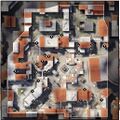 The map of Rome used for Abstergo Industries' Animi Training Program
 -
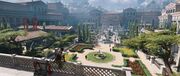 Aya in ancient Rome
 -
 Panoramic views of Rome
 -
 A bird's eye view of Rome
 -
 Rome at sunset
 -
 Panoramic view of Rome at night
 -
 Panoramic view of Rome at dusk
 -
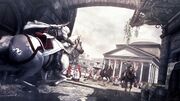 Ezio riding through the city towards the Pantheon
 -
 The centre of Borgia control, the Castel Sant'Angelo
 -
 Rodrigo Borgia preaching in Rome


Appearances[edit | edit source]
- Assassin's Creed: Lineage (first appearance)
- Assassin's Creed II
- Assassin's Creed: Renaissance
- Assassin's Creed: Project Legacy
- Assassin's Creed: Ascendance (non-canon)
- Assassin's Creed: Brotherhood
- Assassin's Creed: Brotherhood novel
- Assassin's Creed 3: Accipiter (ambiguously canonical appearance)
- Assassin's Creed III
- Assassin's Creed: Initiates (mentioned in Database entry only)
- Assassin's Creed: Identity (ambiguously canonical appearance)
- Assassin's Creed: Origins
- The Hidden Ones (mentioned only)
- Discovery Tour: Ancient Egypt
- Assassin's Creed: Origins comic
- Assassin's Creed: Brotherhood of Venice
- Echoes of History (mentioned only)
- Assassin's Creed: The Engine of History – The Magus Conspiracy
- Assassin's Creed: The Last Quest of Leonardo da Vinci
- The World of Assassin's Creed Valhalla: Journey to the North – Logs and Files of a Hidden One (mentioned only)
- Assassin's Creed: Mirage (mentioned only)
- Assassin's Creed: Nexus VR (mentioned in Database entry only)
- Assassin's Creed: Forgotten Temple (cameo)
- Assassin's Creed Roleplaying Game (mentioned only)
- Assassin's Creed: Shadows (mentioned only)
- Animus Hub (mentioned in Database entry only)
- Assassin's Creed (Netflix series)
References[edit | edit source]
| ||||||||||||||||||||||||||||
| |||||||||||||||||||||||||||||||||||||
| ||||||||||||||||||||||||||||||||||
| ||||||||||||||||||||||||||||
| ||||||||||||||||||||||||||||||||||||||||
| |||||||||||||||||||||||||
| |||||||||||||||||||||||||
| |||||||||||||||||||||||||||||||
| ||||||||||||||||||||||||||||||||||||||||
| |||||||||||||||||||||||||
| ||||||||||||||||||||||||||||
| |||||||||||||||||||||||||||||||