Ever since Darius, a Proto-Assassin, eliminated the Persian king Xerxes, the Hidden Blade has become the signature weapon of the Brotherhood of Assassins. It is usually hidden using an armband and can be deployed in a flash, revealing a formidably sharp point. Thanks to modifications made by Altaïr, you no longer need to cut off a finger to use it to its best advantage. Some Assassins, however, continue to mutilate themselves out of tradition and devotion to the Brotherhood.
Welcome to Assassin's Creed Wiki! Log in and join the community.

Assassin's Creed: Brotherhood of Venice
Jump to navigation
Jump to search
Assassin's Creed: Brotherhood of Venice is a crowdfunded, 4-player tabletop role-playing game series created by the Canadian company Triton Noir that is inspired by and set within Ubisoft's Assassin's Creed franchise, with their approval. The core game was released on 20 May 2021 in Asia, and on 15 June in the United States and the European Union.
Originally covering events in Renaissance Italy between the 2010 video game Assassin's Creed: Brotherhood and its 2011 sequel Assassin's Creed: Revelations, its critical acclaim later led Triton Noir to fund and release a number of expansion packs with campaigns against the Templar-aligned Followers of Romulus and Crows in Rome, the Templar front company Abstergo Industries in modern-day Tokyo, and a rogue Italian Assassin in Cambodia.
Description[edit | edit source]
Discover and play a 20+ hours immersive campaign based on untold stories of the Venetian Brotherhood.
This narrative campaign is taking place during the Renaissance between Assassin's Creed: Brotherhood and Assassin's Creed: Revelations.[3]
Roma[edit | edit source]
Discover 4 new assassins! You can play them in the main campaign from the core box. The assassins will explore the city of Rome in search of a hidden artifact. The enemies will also be unique to this expansion and will include Papal Guards and Followers of Romulus.[4]
Tokyo XXI[edit | edit source]
The modern-day expansion is an optional setting that will tie in the main storyline, it features 4 modern day Assassins in a completely different environment! The expansion is set in Tokyo, modern day, and has been confirmed to be canon. It will feature a unique storyline involving well known characters, led by Layla Hassan, Rebecca Crane, Kiyoshi Takakura, and Shaun Hastings.[5]
Creed vs Crows[edit | edit source]
The Competitive Versus Game Mode is played with 2 to 4 players. Two teams are opposed in a Borgia Fortress in 8 standalone Memories: two Assassins on one side and two Crows on the other. The teams start from opposite sides of the game board and must complete objectives before the other team. Both teams can call on their Mentor (Ezio Auditore or Cesare Borgia) to come help them.
Objectives are variable and range from destroying the other team's Tower to capturing an Objective in the other side's territory, eliminating all the opponents' teammates and more. The Assassins and Crows are intruders in the Fortress so Guards will act as usual against both teams.
This mode allows players to jump in and jump out of the game without any influence on the campaign. All Memories are independent and can be played in 30 to 90 minutes. All Memories are highly replayable depending on each player's strategy.[6]
Apocalypse[edit | edit source]
The action will take place during the Renaissance as well, but thousands of miles east of Italy, in the ancient kingdom of Cambodia. You will meet again the Assassins from the Roma expansion or those from the core box, accompanied by the Assassin Shao Jun. You'll track down a renegade Assassin through the jungle through a dozen Memories full of surprises and twists![7]
Supplementary material[edit | edit source]
The main campaign's booklet includes a number of database-like entries:
Made under duress by Leonardo da Vinci for the Baron de Valois, this pistol of rare precision includes several innovations never seen on weapons of this era. It can be immediately identified thanks to its golden metal spinning wheel.
In Venice, the Doge is the first magistrate of the republics of Venice and Genoa. He is elected for life. From the Palazzo Ducale, he leads the armies, presides over the Senate, can declare war, and sign peace. He is responsible for the Council of Ten, an assembly made up of the lords of the most powerful Venetian families. The current Doge, elected in 1501, is Leonardo Loredan. He is a cultured merchant and a fine politician.
Gian Giacomo Caprotti da Oreno, born in 1480, is the most famous of Leonardo da Vinci's apprentices. He maintains an ambiguous relationship with the Maestro, made of a deep friendship, but also of some mischief due to the young apprentice's passion for gambling. A few years ago, this passion almost cost the Assassins dearly when Salaì failed to keep track of his mission: Protect Leonardo. Fortunately his courage, his insight, and some decisive help from Ezio allowed the Assassins to find the Maestro safe and sound. Salaì would do just about anything for Leonardo da Vinci, and the feeling is probably mutual.
Leonardo da Vinci, aged 57 in 1509, is one of those rare people who are gifted in all they choose to do. His first meeting with Ezio was more than thirty years ago and Ezio still carries the Hidden Blade that the genius repaired and upgraded for him. As a staunch ally, Leonardo enabled the Assassins to technologically surpass their Templar enemies thanks to numerous inventions, including the Flying Machine. The Maestro, as we sometimes call him, has the habit of appearing without warning, whether in Rome, Florence, or where he is now, Venice.
Niccolò Orsini di Pitigliano (1442 - 1510) was a Leader of Italian mercenaries. He was the Captain-General of the Venetians during the war against the Cambrai league.
Niccolò di Bernardo dei Machiavelli, born in 1469, is a Florentine with many talents. Philosopher, politician, and member of the Brotherhood of Assassins since he was 19, Niccolò is one of those who allowed Ezio to join the Brotherhood. He is a powerful enemy of the Borgias and has helped Ezio dismantle one of their bases in Rome. He faithfully supports Ezio in all circumstances, despite the apparent discord between the two men. It was probably at his request that Niccolò temporarily left his native Florence to lend a hand once again to the Assassins in Rome. His political visions will have to wait a few more years before being written down on paper in his famous book: The Prince.
The Bocca di Leone ("Lion's Mouth") were boxes made for denunciation. They often bore the shape of a human or animal mouth. Some were dedicated to various types of accusations: Concealment of income, favors, misdemeanors linked to public health, etc. Denunciations could not be completely anonymous (except in case of emergency) and were processed according to a sophisticated investigation system. The lion sometimes appeared on the boxes as a reference to the Lion of Venice, emblem of the Republic.
The Assassins know the secrets of a civilization that existed long before humanity. lts members were known under the names Isu, Precursors, or First Civilization. Some elements of their technology have endured, such as the Pieces of Eden. As rare as they are powerful, they have been used repeatedly to influence the course of humankind's history. The Assassins are trying by all means to prevent Templars from finding and using the fragments.
Among the Pieces of Eden, the Staves were created to take control of the body and mind of humans. Used properly, they are an extremely powerful instrument of control, which can be used for good or evil. Doubt remains as to whether their extraordinary powers, such as levitation or invisibility, are real or are simply illusions.
The famous Lion of Venice is none other than a representation of Saint Mark, decorated with wings inspired by the Bible. When its fore paws are crossed, one rests on the ground and the other on the water, symbolizing the balance of Venetian powers between land and water. When depicted with a book, it symbolizes peace, whereas it is sometimes holding a sword during periods of armed conflict.
The Animus was originally a technological project of Abstergo Industries, a façade for the Order of the Templars. Thanks to a DNA fragment, it allows the person who is connected to explore and relive the memories of their ancestors–their Genetic Memories. Improved over time, used by both Assassins and Templars, the latest versions of the Animus are no longer dependent on the user's DNA and allow anyone to explore the memories of a subject as long as they have their DNA. The newest versions of the Animus, HR-8 and HR-8.5, developed under the supervision of Sophia Rikkin and Layla Hassan, are now portable and do away with the need to use a DNA sample. The Memory only needs to be saved in order to share it with others. However, it happens that the Animus experiences some failures when displaying the Memories. These are the glitches that Assassins sometimes fear. It is rumored that some of these glitches may have been intentionally introduced into the Animus code by the Templars... If so, only an Assassin from the present day can help us!
Lucrezia Borgia, from a famous family of Templars, is cruel and merciless, just like her brother Cesare. Her use of excessive violence and her poisonings are almost legendary. Bold and independent, she defied social conventions by entertaining many romantic relationships during her numerous marriages. The few people who have really known her have been able to recognize the fragility beneath her arrogance and violence, no doubt linked to her family's turbulent history. During her two encounters with Ezio, they both tried to take advantage of the situation by playing the muddle game of seduction. She is still mad with rage at having let herself be taken in by her own game. She ruminates on a revenge that will certainly be terrible.
Cynical, sarcastic and self-confident, Shaun works for the Brotherhood as a historian and analyst. His knowledge is a valuable source of information for modern Assassins who are looking for Pieces of Eden and other First Civilization resources from the memories of various historical figures. Shaun offers precious help to people who visualize their genetic memories through the Animus. He creates databases for the Assassins by analyzing people, locations, and eras from historical experiences. With Rebecca Crane, Desmond Miles, and William Miles, Shaun was an essential member of the Assassins team who located an Apple of Eden and then the Great Temple in 2012, which changed the course of the conflict between Assassins and Templars. After perilous missions to London and Madrid, Shaun seems to have disappeared. Rumors of his reappearance were true!
Development[edit | edit source]

Assassin's Creed: Brotherhood of Venice began development in 2017 with Ubisoft's approval. All art and miniatures needed to be validated by Ubisoft before being fully implemented.[8] A Kickstarter for the game was launched on 13 November 2018,[9] and was successfully funded in less than 24 hours.[10] The first stretch goal, 10 horsemen guards miniatures and their card, was met shortly after the announcement. Just in the first day, the stretch goals of a Leonardo da Vinci figure, a courtesan headquarters, and their respective event cards and minifigures; Leondardo's tank; two mystery events; and an Animus glitch were all reached.[11] After congratulating backers on reaching 10 stretch goals,[12] Triton Noir announced the first planned expansion pack, Roma, on 16 November.[4] After their next stretch goals were made too far apart, Triton Noir issued an apology to backers and awarded them the thief cards and minifigures,[13] and revealed the next stretch goals—Venetian tiles and the Sword of Altaïr which themselves were later unlocked.[14][15] On 20 November, Triton Noir updated their Assassin Pledge tier to include an extra 26 minifigures and a 24cm tower model.[16] That same day the stretch goal for four treasure chests was unlocked.[17] Stretch goals for blunt weapons and fast travel stations were the next to be unlocked.[18][19] The contents of the Roma expansion pack were revealed on 23 November.[20] A new memory to retrieve Kassandra's Spear of Leonidas and Eagle Kopis was the next stretch goal to be unlocked.[21] Triton Noir later unveiled a series of social stretch goals which included: 100 retweets on Twitter awarding the Auditore cape, 100 shares on Facebook awarding Leonardo's Flying Machine, 5,300 Kickstarter backers awarding 1 Venetian location, and 200 BoardGameGeeks fans awarding a splinter bomb.[22] All these social stretch goals were later met.[23] An addition for the Spear of Leonidas memory was added that gave players a secret boss, next was 6 tiles for a Lost Temple, and finally two weapon cards for Kassandra's weapons.[24] A set of Helmschmied Drachen Armor was added next.[25] The next stretch goal unlocked was a memory about Salaì. It was fully funded On 30 November.[26] That same day, the second expansion pack, Creed vs Crows, was announced.[6] The last stretch goal of November unlocked was disguise cards.[27] November marked the end of preproduction.[28]
On 2 December, rooftop garden minis were unlocked and the next memory was announced.[29] The memory, featuring a plague doctor known as the Vulture was fully funded on 4 December.[30] The third and final expansion pack was announced as Tokyo XXI, and with it a mystery member of the Assassins.[5] The next stretch goal unlocked was the Animus memory. With this memory fully funded on 5 December, the crowdfunding reached $1,000,000.[31] On the same day, a Niccolò Machiavelli memory was announced and then fully funded.[32] Digital audios for introductions and conclusions of memories were the next stretch goals unlocked. The next goal was announced, as the Amun Memory.[33] On 6 December, the Amun memory was fully funded and the Carnival memory was announced.[34] Next to be unlocked were objective bases to replace tokens.[35] On 7 December, the Carnival memory was fully funded,[36] and a legendary difficulty was added.[37] One last memory involving Ezio Auditore da Firenze was announced and then fully funded on the same day. The crowdfunding campaign ended with a total of CA$ 1,391,215 being raised from a total of 6,762 backers.[38]
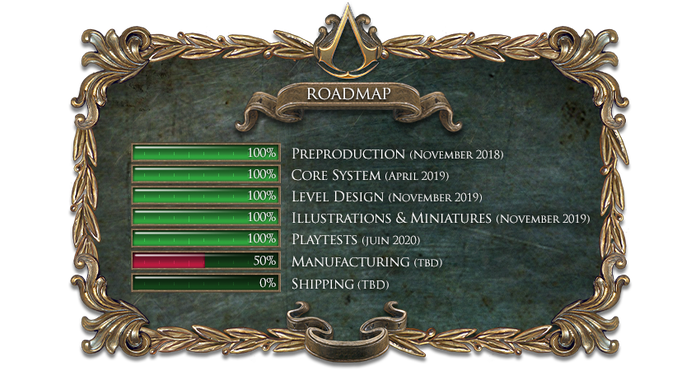
In February 2019, Triton Noir started looking for a new visual artist to design new versions of tiles. Final weight estimates were calculated and international shipping costs were being quoted.[39] In March, after receiving player feedback, the tile designs were changed. The new tiles were made using a mix of 2D and 3D with assets by Ubisoft used with permission.[28] In April, Dariâ's minifigure was updated. Instead of a blowpipe, the new Dariâ bore a wrist crossbow. The core systems of the game were also finished by April.[40] By May, the base game's memories were nearing completion and Triton Noir began working more closely with Ubisoft on the narrative. The team were also addressed issues on tariffs from board games made in China may affect importation to the US.[41] In June, miniatures were close to completion and painting had begun. Illustrators Pascal Quidault and Paul Vérité worked to create the new tile and cards artwork.[42] In July, work on Roma's tile artwork began and the 3D printed towers were being produced.[43] In August, Triton Noir collaborated their effort with Ubisoft for the Tokyo XXI expansion. They made sure that the narrative of Tokyo XXI fitted in with the canon of the series and that it can reused in future media.[44] In September, Triton Noir announced that in addition to English, French, and German, the game would also be published in Spanish and Italian.[45] In October, name tiles for Roma, Creed vs Crow, and Tokyo XXI were also teased along with further artwork. The Pledge Manager for the game closed on 7 November.[46] In November, the green dice were removed entirely after playtests and the red detection and white attack die were modified.[47] A draft version of the rule book was created in December, after proofreading it was printed. Translations into languages other than English and French had also started with help from professional translators.[48]
In January 2020, after ongoing communication with the manufacturer's engineers some minor changes were made to the miniatures to ensure that they would cast properly. Some had to be into multi-part miniatures to keep their poses. Creed vs Crow received a content update that removed some cards with their tokens and added others.[48] In February, due to the COVID-19 pandemic, deliveries were delayed for at least 4 months. Box organization was designed, with each figures place in the plastic mold being worked out. The illustrations and miniatures were also all completed. The rule book had still not been fully approved by Ubisoft at that time.[49] In March, the rule book had been approved and proofread. Translation on the campaign book then started.[50] In April, all miniatures were validated and ready for casting with red wax models. The team then received White Boxes to check final component quality, dimensions and number of elements, and to organize how best to fit everything in the boxes. The Roma expansion was noted as being too big and its dimensions have since been rectified. The cards were then sent to be translated.[51] By September, playtests were finished and manufacturing was halfway completed.[52]
On 13 March 2023, a future fundraising campaign was announced for the newest expansion Apocalypse, which followed the Renaissance-era Assassins while they travelled to the distant Khmer Empire during Cambodia's Post-Angkor period[53] to hunt a rogue Assassin with the aid of Shao Jun.[7]
Gameplay[edit | edit source]

The campaign is expected to take over 20 hours. It can be played by 1-4 players against an enemy faction. The characters operate out of an HQ.[9] Each memory is described in the campaign book and each has their own envelope, effectively keeping the other memories a secret until they are played. Envelopes also contain new sets of Events, Equipment, and Special cards (such as Synchronization card) that are all then added to the existing deck. Some Event cards are memory specific and will be timed then once played are discarded. The game is designed to have unlimited replayability as the game tiles can be placed anywhere for any mission.[54] During the tutorial memories, players will take the role of an unnamed Assassin apprentice.[55]

Each turn has 4 phases: the Event Phase, in which players draw an event card and apply its effect; the Assassins Phase, in which each Assassin takes actions with their in the order they want; the Guards Phase, when Guards can move, fight if applicable, and summon reinforcements but only after players discover it following the first Memory's completion; and the End Phase, in which players check if a new Game Turn should be started.[56]

Players can climb towers to synchronize and reveal secret items in the level. Stealth is also an element of the game, players can risk moving onto a square shared by a guard but will need to pass a stealth check with the detection die. If a player is detected they can flee to the rooftops where guards cannot follow, players then need to wait until they are anonymous again.[56]

In each memory, players have a specific objective they need to complete before moving on. Trophies tokens are vital for players to achieve 100% synchronization, trophie tokens are then added to a player's trophy bar once achieved. Players can compare their trophy bars with other players at the end of the campaign.[56] Amongst the variety of enemy types there are the crossbowmen and agile guards. Crossbowmen can shoot a distance of one tile, cannot move from a ground tile to a roof without a ladder and use one Attack die only. The Agile guards are slightly harder to kill as they can move freely from Ground tiles to Roof tiles just like the Assassins and attack in melee with two Black Attack Die. Each memory will have a boss type enemy with unique special abilities.[57]

Each Assassin has equipment they can use, these are applied by playing Equipment cards. Equipment cards will show the equipments' type, value in florins, Number of the envelopment the card was from, Action Cube cost to use, and the symbol designating where on the board it goes. A weapon's effect can be applied by rolling the white die and landing on the Assassin insignia. Players can level up their Assassin, flipping over their card allows a player to upgrade their personal ability. There are three aptitudes to choose from for each memory.[56]

The game is projected to take over 25 hours to complete all memories. Most memories will take 30-90 minutes each, with more challenging ones taking over 2 hours minutes to complete. There are at least 18 memories in the base game.[54]
Release[edit | edit source]
In November 2018, the originally predicted release date for Assassin's Creed: Brotherhood of Venice was in June 2020.[58] In March 2020, Triton Noir issued a statement regarding a delay in deliveries due to COVID-19. November was the new estimated release date.[50] However in April, Triton Noir revealed in a road map that playtests would be taking place in June and the manufacturing and shipping dates were still to be determined.[51]
It would eventually be released in Asia on 20 May 2021, the United States and Europe on 15 June,[1] and Australia on 4 November 2022.[2]
Marketing[edit | edit source]
On 2 November 2018, Triton Noir uploaded a concept video their YouTube channel before crowdfunding began as a way to show potential backers what the game was going to be about. At this stage, a basic prototype of the game had already been created.[59] On 14 November, the day the game's Kickstarter was created and successfully funded, Triton Noir uploaded a prototype gameplay video as part of the Kickstarter campaign.[60] A French-language only gameplay livestream premiered on 21 November.[61] On 28 September 2019, a video detailing the minifigure painting process was released.[62] At the 2019 Montreal ComicCon, Brotherhood of Venice was playtested by members of the fan site Access the Animus.[63]
Editions[edit | edit source]
Triton Noir currently has advertised two editions for pre-order.
- 144 miniatures (including secret miniatures in opaque boxes)
- 6 Secret Boxes
- 47 Two-Sided Tiles
- 32 Envelopes
- 180 Large Cards (70 x 120 mm)
- 232 Small Cards (68 x 43 mm)
- 26 Custom Dice (3 types)
- 4 Dual Layer Assassin Boards
- Headquaters Board (Mercenaries + Courtesan)
- Enemy Board
- Compass Board
- 60 Tokens
- 12 Clip-on Bases
- 4 Transparent Objective Bases
- 67 Plastic Cubes
- Headquarters Save Box
- 6 Sticker Sheets
- Rulebook
- Campaign Booklet

- A retail copy of Assassin's Creed: Brotherhood of Venice
- Everything included in the Core Box
- Roma expansion pack
- Tokyo XXI expansion pack
- Creed vs Crows expansion pack
- Deluxe Assassins Dice Set
- Crow's Nest Tower (Kickstarter exclusive)
- Ezio the Assassin Bonus Miniature (Kickstarter exclusive)
Gallery[edit | edit source]
-
 Logo
Logo -
 Venetian and Roman Assassins Set
 -
 The Complete Board Game
 -
 The expansion packs


References[edit | edit source]


External links[edit | edit source]
- Official KickStarter page
 Assassin's Creed: Brotherhood of Venice (@CreedVenice) on Twitter
 Assassin's Creed: Brotherhood of Venice (@ACBrotherhoodOfVenice) on Facebook
| ||||||||||||||||||||||||||||