

Dart

A dart is an airborne long-range weapon used to silently deal with targets. Depending on the type of chemical applied to the dart, these could be used to sedate (usually called sleep darts),[1] poison (poison darts)[2] or cause hallucinations (berserk darts[3] or hallucinogenic darts)[4] on the victim.
Being both a subtle and long distance weapon allowed for its users to stay unnoticed by their targets, which made darts a weapon widely used by the Assassins and Templars throughout history, though methods of delivery differed: from blowpipes[1] to modified guns.[5]
Usage and effects[edit | edit source]

Sleep darts were used to temporarily incapacitate enemies without killing them, useful for infiltrators that wished to leave no evidence of their actions.[1][5][3][6] On the other hand, berserk darts were used to make a target fight with others, be it with their own allies or with nearby civilians, before the poison would kill them, thus dealing with the target while also causing a distraction if needed.[7][1][5][8][6]
Poison darts varied in their effects depending on the composition, from simply causing a slow death, like the darts used by Aveline de Grandpré,[7] to a more complex three stage based poisoning, like the darts used by Ezio Auditore:[2]
- After being hit, the target would soon begin to clutch at their chest and struggle to remain standing, as the poison's effects set in.
- The poison began to have serious effects on the target. They began to flail helplessly in a circle, striking anyone who came within their reach. If they had a weapon, they may have drawn it and flailed it around as well.
- The target was overcome completely by the poison and fell on the ground, still experiencing the effects caused by the toxin running through their veins. After a short time; the target died, after the poison had sapped away all of their energy.
History[edit | edit source]
Ptolemaic Egypt[edit | edit source]
During the 1st century BCE, the Medjay Bayek of Siwa utilized two types of darts: a sedative that caused targets to fall unconscious for a while, and a highly poisonous one that caused dizziness, nausea, and eventually death.[3]
Islamic Golden Age[edit | edit source]
The Hidden Ones of Alamut that operated in Baghdad during the 9th century regularly used a blowpipe and darts during their missions, which could be equipped from their bureaus' arms stock.[6] In the 860s, Basim ibn Ishaq acquired a blowpipe from one of the Banū Mūsā brothers—Abu Jafar Muhammad, Ahmad, and Al-Hasan—sometime following his assassination of the Order of the Ancients member Mas'ood Al-Ya'qoob.[9] Although he initially trained with just sedative darts, Basim could upgrade them to deliver poison or hallucinogens with sufficient supplies.[10]
Renaissance[edit | edit source]

In the early 1500s, during Ezio Auditore's time in Rome, his friend Leonardo da Vinci fashioned a dart-firing upgrade for the Assassin's Poison Blade. These darts were filled with the same poison used in the blade, which prompted Ezio to purchase bigger pouches for an increased capacity.[2] Ezio also procured some ingredients as a favor for the doctor of Tiber Island, receiving in return a faster acting poison, capable of killing a target in roughly half the amount of time compared to the kind of poison he had been using previously.[11]
Ezio continued using poison darts later in his life, particularly during his travels in Constantinople in 1511.[12] He notably utilized one such dart to assassinate the Templar Mirela Djuric, who herself had been using poison to eliminate her targets.[13]
Golden Age of Piracy[edit | edit source]
In 1670, the Mentor of the West Indies Assassins, Bahlam, used an unusually potent sleep dart to subdue the Sage Thom Kavanagh[14] before safely transporting him to the Assassin camp of Tulum, where Thom awoke some days later.[15]

During the early 18th century, the West Indies Assassins crafted darts from animal bones for use in both sleep and berserk darts, which were fired from blowpipes.[1] In 1716, the pirate Edward Kenway, who later became affiliated with the Brotherhood, received his first blowpipe from his friend Mary Read and used it to repel a Royal Navy attack on Tulum.[16] Edward later managed to enhance the darts' effectiveness by crafting upgrades from the hides of different animals.[17]
In 1725, during his travels in Southeast Asia, Edward had the Zhang Wei Union's engineer Yun Pyeong-Gyu build him a custom blowpipe similar to the one he had used in the Caribbean. As Yun lacked the necessary knowledge to craft the darts for the blowpipe, he enlisted the aid of Xialun Qing, who used her knowledge of medicine and alchemy to craft both sleep and berserk darts.[18]
Seven Years' War[edit | edit source]
In July 1752, then-Assassin Shay Cormac discovered an air rifle while infiltrating Mount Vernon. Being surprised by a guard, Shay accidentally shot him with a sleep dart and, amazed with the weapon's silence, decided to take it for himself, using berserk darts against a number of guards in the way to finding Lawrence Washington.[19] He would also improve the effectiveness of both berserk and sleep darts,[20] as well as eventually use grenades with the same functions.[5]
18th century Louisiana[edit | edit source]

In 1766, Agaté gifted Aveline de Grandpré the blowpipe of his former mentor, François Mackandal, after discovering an impostor had been using Mackandal's name to gather followers in the Louisiana Bayou.[21] Two years later, Gérald Blanc built a parasol capable of firing darts, which Aveline could utilise while dressed up as a lady without attracting any attention.[22] Also in 1768, the Houngan of San Danje gifted Aveline a new poison he had been testing, one that would drive the victim momentarily hysterical, allowing Aveline the use of berserk darts.[23]
American Revolution[edit | edit source]
During the American Revolution, the Assassin Ratonhnhaké:ton crafted poison darts from lead ore and sulfur in the Davenport Homestead.[24] Besides its use on human targets, the poison darts were useful for hunting, as a great number of animals were weak to the poison's effect, be they predators, such as bears,[25] bobcats,[26] and cougars,[27] or prey, such as beavers,[28] elks,[29] or hares.[30]
French Revolution[edit | edit source]
The Parisian Brotherhood of Assassins used a miniaturized crossbow attached to the Hidden Blade to fire darts discreetly. The projectile mechanism was called the Phantom Blade.[8] On 19 January 1791, Arno Dorian received his first Phantom Blade from the Mentor Honoré de Mirabeau in recognition of his successful assassination of the Templar Charles Gabriel Sivert.[31] Over the course of the French Revolution, he made frequent use of it in his missions, as did other Assassins who accompanied him.[8] After October 1792,[32][33] he had it upgraded, allowing him to fire two darts without reloading and to launch berserk blades.[34]
Victorian London[edit | edit source]

In 1868 London, Alexander Graham Bell adapted a dart mechanism to work with the Assassin Gauntlets used by Jacob and Evie Frye, attaching it to the top of their gauntlets, having had the idea after intercepting a message with the recipe for a powerful hallucinogenic serum.[35] The darts were also highly combustible, and would explode if launched into a heat source. This had the added effect of spreading the toxin over a wider area, affecting multiple people.[4] The twins later invested money to bring down the cost of the dart,[36] and also improved its capabilities after locating the relevant schematics.[37]
Modern times[edit | edit source]
In 2016, the teenager Javier Mondragón received a hybrid crossbow-pistol that could fire sleep darts from the Assassin Griffin.[38] He used the weapon to tranquilize several Abstergo Industries guards while infiltrating the Aerie alongside Owen Meyers to rescue their captive friends.[39] Later, during their search for a prong of the Trident of Eden in Mongolia, Grace Collins used Javier's crossbow-pistol to momentarily incapacitate Griffin and his fellow Assassin Yanmei due to her distrust of them.[40]
In 2023, an agent of the Zhawang Corporation approached Noa Kim while he was in Macau's A-Ma Cultural Village with the Abstergo doctor and Templar Shimazu Sei. The agent offered to help Noa escape from Abstergo's captivity, but the young man refused, wishing to learn more about his family's history by reliving Edward Kenway's memories at Abstergo. Seeing he could not convince Noa to come willingly, the agent shot him with a tranquilizer dart, but it had no effect and Noa pinned the man against a wall. Eventually, the agent relented and decided to respect Noa's wishes to be left alone for the time being.[41]
Behind the scenes[edit | edit source]
In Assassin's Creed: Brotherhood, firing a poison dart at a horseman would force him to dismount, and the effects would skip to the poison's third stage. In the game's novelization the poison darts were thrown as opposed to being projectiles fired from the wrist.
In-game files from Assassin's Creed III contained an unused description for the poison darts:
- These highly toxic darts have their tips dipped in extract of Cicuta virosa - also known as Water Hemlock. This plant's poisonous effects directly attack the nervous system, causing paralysis, loss of consciousness, and even death.
In Assassin's Creed: Unity, the effects of berserk darts would not wear off. In addition, firing a second dart at an already-poisoned target would cause them to collapse immediately.
Gallery[edit | edit source]
-
 Sleep darts used by Bayek
 -
 Poison darts used by Ezio Auditore
 -
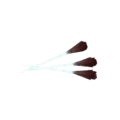 Berserk darts used by Edward Kenway
 -
 Edward's blowpipe and darts used in Southeast Asia
 -
 Sleep darts used by Shay Cormac
 -
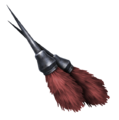 Berserk darts used by Shay
 -
 Poison darts used by Ratonhnhaké:ton
 -
 Poison darts used by Aveline de Grandpré
 -
 The dart gun atop an Assassin Gauntlet
 -
 Unused concept art of Victorian era hallucinogenic darts
 -
 Noa Kim shot by a tranquilizer dart


Appearances[edit | edit source]
- Assassin's Creed: Brotherhood (first appearance)
- Assassin's Creed: Revelations
- Assassin's Creed III
- Assassin's Creed III: Liberation
- Assassin's Creed IV: Black Flag
- Assassin's Creed: Rogue
- Assassin's Creed: Unity
- Assassin's Creed: Syndicate
- Assassin's Creed: Last Descendants – Tomb of the Khan
- Assassin's Creed: Origins
- Assassin's Creed: Mirage
- Assassin's Creed: Forgotten Temple
References[edit | edit source]
| |||||||||||||||||||||||||||||||||||||
| |||||||||||||||||||||||||||||||||||||
| ||||||||||||||||||||||||||||||||||
| |||||||||||||||||||||||||||||||||||||||||||
| ||||||||||||||||||||||||||||||||||
| |||||||||||||||||||||||||||||||
| |||||||||||||||||||||||||||||||||||||
| ||||||||||||||||||||||||||||||||||||||||
| |||||||||||||||||||||||||||||||||||||
| |||||||||||||||||||||||||||||||||||||