

Anbar
Anbar was an ancient and medieval town in Iraq which briefly served as the Abbasid Caliphate's capital. After the founding of Baghdad in 762, Anbar was superceded as the capital and became a province of Baghdad.
History[edit | edit source]
By 861, the street thief Basim ibn Ishaq lived in Anbar, where he joined a network of fellow thieves led by Dervis, performing errands for him on behalf of his allies, the Hidden Ones. On 11 December, the caliph al-Mutawakkil arrived in Anbar with his envoy to meet his secret allies, the Order of the Ancients, and present them an artifact he had been asked to find. Learning about this and hoping to steal the artifact for the Hidden Ones, Basim broke into the Winter Palace that same night.[1]
After observing al-Mutawakkil's meeting with the Order, during which one of the Ancients threatened the caliph to keep in line for his own sake, Basim grabbed the artifact, but was caught red-handed by al-Mutawakkil, who tried to kill him. Acting in self-defense, Basim stabbed the caliph with his own dagger and then fled the palace as al-Mutawakkil's son Abu 'Abdallah called for the guards to capture his father's murderer. Ultimately, Basim managed to escape from the guards and returned to his hideout, where the Hidden One Roshan found him the next day.[1]
Roshan took the artifact and invited Basim to leave Anbar with her, as the guards had started a manhunt for all thieves in the city. Basim refused at first, only to discover that most of his friends had already been executed. Deciding to flee Anbar alone, Basim was intercepted by several guards at the docks, but Roshan rescued him and they escaped together.[1] After becoming a Hidden One, Basim would return to Anbar several more times to find and speak to his "friend", Nehal.[2][3][4]
Gallery[edit | edit source]
-
 Concept art of Anbar
 -
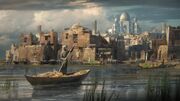 Concept art of Anbar as seen from the Euphrates river
 -
 Basim and Nehal freerunning in Anbar
 -
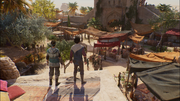 Basim and Nehal near the city gate
 -
 Basim atop a tower at Anbar's docks


Appearances[edit | edit source]
References[edit | edit source]