

Hookblade

The Hookblade was a modification to the Hidden Blade first adopted by the Ottoman Assassins in Constantinople from at least the time of the Ottoman Empire. It consisted of both a curved hook and a regular blade, allowing it to be used for freerunning and during combat. When the Italian Assassins' Mentor Ezio Auditore arrived in the city, the local Master Assassin Yusuf Tazim introduced him to this advancement and instructed him in its application towards both battle and travel.[1]
History[edit | edit source]
The Hookblade had been used by the Ottoman Assassins since at least the latter half of the 15th century. The father of Yusuf Tazim utilized one until he was killed in the line of duty, whereupon the Brotherhood returned the blade to his family. In 1480, Yusuf's mother Nalan passed the blade down to her son while informing him of his late father's fight against oppression and his wish for Yusuf to follow in his footsteps. Yusuf subsequently made use of the Hookblade during his thieving endeavors,[2] until he was recruited into the Assassin Order in his late teens.[3]
By the early 16th century, the Hookblade had become a standard tool for the Ottoman Brotherhood. Most members wielded one alongside their standard Hidden Blade, allowing them to easily navigate the rooftops of Constantinople.[1] Despite this, the technology seemingly never carried over to other Assassin Guilds, as Ezio Auditore of the Italian Brotherhood was completely unfamiliar with the weapon until Yusuf introduced it to him.[4]
Usage[edit | edit source]
[edit | edit source]

The Hookblade was designed to make travel quick and easy, specifically through the use of ziplines that were installed throughout Constantinople. From a zipline, an Assassin could also drop and use the Hookblade to assassinate guards below, a move that they called a "zipline assassination". The mechanism could also be used in several acrobatic movements, such as for quickly climbing up walls in a similar manner to the climb-leap maneuver, and for extending one's reach during a jump.[1]
It could also be used for flipping over enemies to avoid a fight, a method the Assassins referred to as the "hook and run." However, on using the technique against a Janissary, it led to the Hookblade becoming caught on their armor, slowing the Assassin down slightly.[1]

When climbing, the Hookblade allowed an Assassin to spring quickly onto a rooftop after grabbing the ledge, rather than spending extra time gaining a foothold and pulling themselves up. Similarly, one did not need a foothold when assassinating a targeted guard by pulling them from a rooftop ledge. Additionally, it could be used with corner chase breakers, where the swinging support could be used as a trapeze to jump towards an adjacent rooftop instead of turning around the corner.[1]
Combat[edit | edit source]

When engaged in battle, an Assassin could use the Hookblade to pull targets in for a close-range attack, or throw an enemy onto the ground with the "hook and throw," a method similar to the hook and run. In combat itself, the Hookblade could be used in attacks as well as to counter a weapon. During such instances, one could hook onto an enemy's armor and throw them to the ground, or hook onto an enemy's helmet to snap their neck. As defined by Yusuf, the Hookblade not only worked as a hook, but also as a substitute of the dual Hidden Blade, as the Hookblade was comprised of these two parts. The blade could be used to perform dual assassinations.[1]
Other uses[edit | edit source]
An Assassin could also perform a counter-steal to tear off an enemy's purse with the Hookblade, provoking them further and leaving them open to an easy counterattack. Following this, the Hookblade could also be used to pull down scaffolds, subsequently slowing down or eliminating pursuers; this was particularly useful when done in conjunction with caltrop bombs.[1]

The hook's unique design and its exclusive usage by the Assassins resulted in them also using it as a special key, since it could not be easily copied by forgers. As such, the tip of the Hookblade could be used to unlock numerous hidden areas around Constantinople and permitted access to the Ottoman Assassins' secured bomb-crafting stations.[1]
Trivia[edit | edit source]
- Early images of Assassin's Creed: Revelations showed Ezio with a Hookblade on his left arm, rather than on his right. In these, the hook was incorporated directly onto the blade, rather than as a separate function. However, one image showed Ezio dual wielding Mehmet's Dagger and the Hookblade, with the Hookblade worn on the right with the use of a hook and the dual Hidden Blade.
- In various interviews and print media, Ubisoft Montreal stated that the Hookblade was intended to increase navigation speed by a factor of 30% in Revelations, in comparison to previous installments of the Assassin's Creed series.[5]
- The actual hook of the Hookblade resembled the head of an eagle, a bird frequently associated with the Assassin Order.
- Unlike the Hidden Gun and Poison Blade, the Hookblade was applied alongside Ezio's secondary Hidden Blade, rather than as part of his primary one.
- In the second stage of their Animi Training Program, Abstergo Industries adapted the Animus to allow the program's Animi Avatars to use the Hookblade for freerunning uses.
- There are several cutscenes in which Ezio's Hookblade is not actually on his wrist. Examples include his conversation with Yusuf in "Setting Sail" and whenever he recruits an Assassin.
- In Assassin's Creed III and Assassin's Creed III: Liberation, some British and Spanish troops could perform an animation that was similar to the hook and run, which would temporarily disorientate Ratonhnhaké:ton and Aveline de Grandpré.
- The Hookblade was considered for Assassin's Creed IV: Black Flag, but Darby McDevitt, the lead writer for Revelations and Black Flag, objected as he wanted to dispel the stereotype of hook-handed pirates.[6]
Gallery[edit | edit source]
-
 Concept art
 -
 Alternate concept art
 -
-
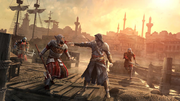
 Ezio catching a ledge with the Hookblade
 -
 Yusuf performing a long jump


Appearances[edit | edit source]
- Assassin's Creed: Revelations (first appearance)
- Assassin's Creed: Revelations novel
- Assassin's Creed: The Official Movie Novelization
References[edit | edit source]
- ↑ 1.0 1.1 1.2 1.3 1.4 1.5 1.6 1.7 Assassin's Creed: Revelations
- ↑ Assassin's Creed: The Official Movie Novelization – Regressions – Subject: Emir
- ↑ Assassin's Creed: Revelations – Database: Yusuf Tazim
- ↑ Assassin's Creed: Revelations – The Hookblade
- ↑ Miller, Greg (9 May 2011). Assassin's Creed Revelations Stars Ezio and Altair. IGN. Archived from the original on 19 October 2018. Retrieved on 19 March 2024.
- ↑ Valdes, Giancarlo (21 August 2013). False rumors, ugly cities, and sharks: How meticulous research shaped Assassin's Creed IV: Black Flag. Venture Beat. Archived from the original on 12 August 2023. Retrieved on 15 August 2023.
| |||||||||||||||||||||||||||||||||||||