

Portuguese Navy
The Portuguese Navy (Portuguese: Marinha Portuguesa) is the naval branch of the Portuguese Armed Forces.
History[edit | edit source]
During the early 18th century, the Portuguese Navy's principal aim was the protection of Portugal's colonial possessions and trade routes. One of the ships tasked to protect trade routes was the legendary Princesa do Céu. The Man O' War protected merchant ships in the Caribbean Sea until it was eventually sunk by the pirate Alonzo Batilla.[1]
In 1719, a group of Portuguese sailors stationed in Príncipe secured an alliance with the Templars and pirate hunters John Cockram and Josiah Burgess, who were out to capture Bartholomew Roberts, a Sage. The Portuguese subsequently ambushed the pirate ship that Roberts served on, killing the captain, Howell Davis. Despite this, Roberts managed to escape. Around the same time, the pirate Edward Kenway came to Príncipe in search of Roberts, and engaged a small Portuguese fleet that greeted him upon his arrival.[2]
Later that year, a fleet of the Portuguese Navy was assigned a task by the Templars to transport blood vials of Grand Master Laureano de Torres y Ayala, Benjamin Hornigold, Woodes Rogers and Laurens Prins, members and allies of the Templar Order, to a Templar warehouse in Rio de Janeiro, Brazil.[3] The vials were stored on the flagship Nosso Senhor da Compreensão, which, along with the rest of the fleet, was anchored off the coast of Mexico to resupply.[4]
Bartholomew Roberts found where the vials were hidden after capturing a Portuguese captain. With the help of Edward Kenway's Jackdaw, which was fitted with a stolen Portuguese flag, the pirates infiltrated the fleet, and to ease the task, captured the flagship along with the blood vials before escaping from the attacking fleet.[4]
Gallery[edit | edit source]
-
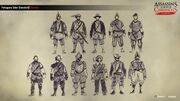 Concept sketches of Portuguese sailors
 -
 Concept art of a sailor
 -
 Concept art of a sailor
 -
 A Portuguese sailor


Appearances[edit | edit source]
- Assassin's Creed IV: Black Flag (first appearance)
- Assassin's Creed: Pirates
- Assassin's Creed Chronicles: China
References[edit | edit source]
| |||||||||||||||||||||||||||||||
| |||||||||||||||||||||||||||||||