

Memory Seals
Memory Seals are Precursor relics with the ability to record and store the memories of their users, whether Isu or human.
History[edit | edit source]
Isu Era[edit | edit source]
While the Isu Capitoline Triad of Minerva, Jupiter, and Juno worked within the Grand Temple to try and avert the Great Catastrophe,[9] Minerva and Jupiter recorded a series of messages on several Memory Seals that were intended for Desmond Miles to view thousands of years later. However, after Juno's consciousness was imprisoned within the Temple, she found the Memory Seals and threw them into the chasm below the compound, believing them to be "filled with lies".[1]
Ptolemaic dynasty[edit | edit source]

Around 34 BCE, the Medjay Bayek investigated rumors of ghosts and strange happenings in the Desheret Desert. While exploring the sands, he entered the buried Qeneb.too Kah'Aiye vault, where he saw a depiction of a Memory Seal engraved into one of the rock pillars holding up the vault's ceiling. After inserting the Seth-Anat stone in the engraving's empty center space, the stone conjured a host of illusory undead soldiers. Fleeing the temple, Bayek collapsed unconscious just outside its entry. When he awoke sometime later and returned to the temple, he found that the Memory Seal symbol had mysteriously disappeared.[10]
Abbasid Caliphate[edit | edit source]
In the 9th century CE, the Order of the Ancients found a number of Memory Seals while excavating Isu ruins in the desert surrounding Baghdad and sought to unravel their secrets. To this end, they built a device known as the Alruh, located underneath the House of Wisdom, which the Ancient Fazil Fahim al-Kemsa used to experiment on various test subjects by exposing them to the seals' contents. However, most subjects did not survive the experiments, and those who did were driven insane.[11]

In 861, Caliph al-Mutawakkil came into possession of a Memory Seal, which he kept within a locked chest. The Order of the Ancients forbade him from laying his eyes on the chest's contents and, on 11 December, held a meeting with the caliph at his Winter Palace in Anbar to see the artifact for themselves. After confirming that the artifact was a Memory Seal, the Ancients ordered al-Mutawakkil to keep it safe until their work was done and left.[12]
However, during the meeting, the thief Basim ibn Ishaq broke into the palace, intending to steal the chest's contents for the Hidden Ones. Upon picking up the seal, it projected a hologram of an unknown male striking a prisoner, which alerted al-Mutawakkil to Basim's presence. After killing the caliph in self-defense, Basim fled the palace with the seal in his pocket and returned to his dwelling. The next morning, he was visited by the Hidden One Roshan, who took the seal and brought it, along with Basim, to Alamut.[12]

After Basim became a Hidden One, he was tasked with eliminating the Order's presence in Baghdad. During his investigation, Basim learned about Fazil's experiments with the Alruh and the Memory Seals and infiltrated the House of Wisdom to assassinate the Ancient. Posing as a test subject, Basim was able to get close enough to his target to stab him with his Hidden Blade while Fazil attempted to experiment on him with the Alruh.[11]
Sometime later, when Basim entered the Isu temple underneath Alamut, he found dozens of Memory Seals locked away. One of them contained a recorded memory of Loki, who had been imprisoned inside the temple, and it helped Basim, who was Loki's incarnation, to unlock the dormant memories of his past life.[3]
High Middle Ages[edit | edit source]
In the early 13th century, the Levantine Assassins' Mentor Altaïr Ibn-La'Ahad was exiled from Masyaf and took refuge in Alamut, where his Apple of Eden guided him to the Isu temple underneath the fortress. Altaïr subsequently claimed six of the Memory Seals he found there, using them to record important events in his life for potential Assassins to view centuries later. Following his return to Masyaf, Altaïr began construction on a secret library and used five of his seals as the keys.[2]
In order, the events that Altaïr chose to record involved a Crusader skirmish in 1189,[13] the revolt shortly after Al Mualim's death in 1191,[14] Maria Thorpe's death and Altaïr's exile in 1228,[15] Altaïr's return to Masyaf in 1247,[16] Niccolò and Maffeo Polo's departure during the Fall of Masyaf,[17] and Altaïr's death shortly thereafter.[18]

Before his death, Altaïr passed the five seals to his library to Niccolò, trusting him to hide them.[19] Upon arriving in Constantinople, Niccolò hid the seals in several secret locations around the city and left behind clues to their whereabouts in his book, The Secret Crusade. Respectively, the five seals were placed within Topkapı Palace,[19] the Yerebatan Cistern,[20] the Galata Tower,[21] the Forum of the Ox,[22] and the Maiden's Tower.[23] Meanwhile, the sixth and final seal remained with Altaïr inside his library, where he recorded his final moments.[18]
Renaissance[edit | edit source]
In 1509, the Byzantine Templars recovered the Memory Seal beneath Topkapı Palace after an earthquake struck Constantinople, allowing them to claim the artifact. They subsequently set out to retrieve the remaining four seals and uncover the secrets of Altaïr's library.[24]
In 1511, two Memory Seals in Alexandria were located by the Mamluk Sultan Al-Ashraf Qansuh al-Ghawri's soldiers during their excavation of the Library of Alexandria. These seals, kept within a chest dated to 331 BCE, were retrieved by both the Egyptian Assassins and their Ottoman brethren shortly afterwards.[25] The seals were later taken to the local Assassins' headquarters, where they were studied by a female initiate. As she worked to "unlock the mysteries" of the seals, the Templars led an attack on the headquarters and stole the artifacts,[26] though the Assassins later succeeded in recovering them.[27]

That same year, the Italian Assassins' Mentor Ezio Auditore journeyed to Constantinople after learning about Altaïr's library and the five Memory Seals required to access it. Using information from The Secret Crusade, Ezio was able to find and recover the seals kept within the Yerebatan Cistern,[20] the Galata Tower,[21] the Forum of the Ox,[22] and the Maiden's Tower.[23] Later, he journeyed to Cappadocia where he reclaimed the fifth seal from a dying Manuel Palaiologos,[28] and found the final one upon entering Altaïr's library.[29] Following his return to Constantinople, Ezio entrusted all six seals to the Ottoman Assassins, who hid them within the Yerebatan Cistern.[4]
Modern times[edit | edit source]
By the late 20th century, Abstergo Industries had found a number of Memory Seals, though very few of them contained recorded memories, none of which belonged to the Isu. Regardless, research of the artifacts helped the company in its early breakthroughs in genetic memory technology, which ultimately led to the development of the Animus.[5]
In 2013, an embedded file in the Abstergo Entertainment mainframe focused on several different Precursor technologies, including Memory Seals. The file mentioned that fewer than 40 seals had ever been found or accounted for, leading Abstergo to speculate that the artifacts were not widely used by the Isu and were reserved for the wealthiest and most powerful members of their society. The file also revealed that Abstergo knew of the six Memory Seals used by Altaïr and believed they could still be functional, but had been unable to locate them.[5]
Behind the scenes[edit | edit source]
Memory Seals are Isu artifacts first introduced in the 2011 video game Assassin's Creed: Revelations, where five seals, referred to as the Masyaf Keys, serve as a central plot element. The keys are never called Memory Seals in-game, but the descriptions for a set of contracts in the Mediterranean Defense menu refer to them as such. In Assassin's Creed IV: Black Flag, an unlockable file discussing Abstergo's research of various Precursor relics also identifies the artifacts as Memory Seals.
Memory Seals make a return in the 2023 game Assassin's Creed: Mirage, where they retain their appearance from Revelations but function differently, displaying a holographic recording of the memory stored on them. However, it is possible that the seals in Revelations also possessed this functionality and that there are multiple ways to view the memories stored on a seal.
Gallery[edit | edit source]
-
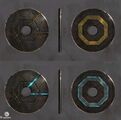 Concept art by Martin Deschambault
 -
 Minerva's projection in the Vatican Vault of a glowing Memory Seal
 -
 The Memory Seal found by Basim
 -
 Render of a Memory Seal from the Alamut Temple
 -
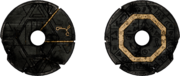 Render of a broken Memory Seal
 -
 Basim staring at an inert Memory Seal
 -
 A Memory Seal displaying a recorded memory
 -
 Roshan holding a Memory Seal
 -
 Memory Seals stored in the Alamut Temple
 -
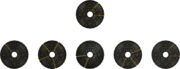 Render of the Masyaf Keys
 -
 Ezio reliving a memory stored on one of the Masyaf Keys
 -
 The Masyaf Keys in the Galata headquarters
 -
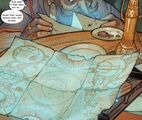 A Memory Seal on an extract of the Voynich manuscript
 -
 Abstergo Industries comparing a Memory Seal to the Phaistos Disc


Appearances[edit | edit source]
- Assassin's Creed: The Secret Crusade (first appearance)
- Assassin's Creed: Revelations
- Assassin's Creed: Revelations novel
- Assassin's Creed IV: Black Flag (photo only)
- Assassin's Creed: Brahman (photo only)
- Assassin's Creed: Origins (drawing only)
- Assassin's Creed: Where's the Assassin? (non-canon)
- Assassin's Creed: Mirage
References[edit | edit source]

| |||||||||||||||||||||||||||||||||||||
| |||||||||||||||||||||||||||||||||||||