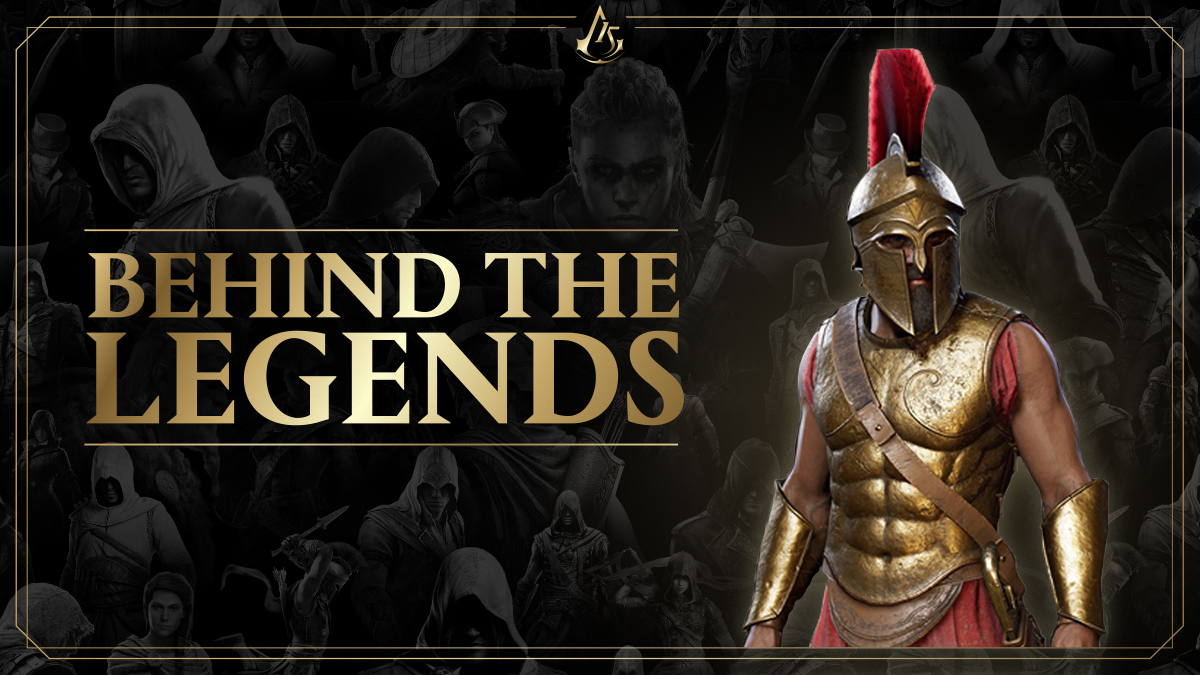
| *'''Danny Wallace:''' ''How far would you go to defend your people? This is probably what Leonidas, the legendary king of Sparta, asked himself one September morning in 480 BC. The Battle of Thermopylae was underway, and, overwhelmed by the Persians, the Greek army was in disarray. Heading up his troops of 300 valiant Spartans, Leonidas decided to fight until the death. Gazing out over the battlefield, he took stock. 300 Spartans against tens of thousands of Persians. This heroic sacrifice earned Leonidas a place in history, and much more besides. Passed down over generations, the tale of this battle has turned the king of Sparta into a legend, sometimes to outlandish effect.<br><br>You're listening to ''Echoes of History: Behind the Legends'', the podcast that tells you the true stories of some of history's most legendary heroes. As the ''Assassin's Creed'' franchise turns 15, travel back through 2,500 years of history to meet the men and women whose destiny lead them to greatness. Uncover their stories and bring their legends back to life. Episode one, Leonidas.<br><br>The year is 480 BC. The Greek [[Sanctuary of Delphi]] is home to a [[Temple of Apollo, Delphi|temple]] to [[Apollo]], where Spartans are jostling to see the [[Pythia]], the temple's [[Pythia (480 BCE)|priestess]] who has a foreboding prophecy to share...''<br><br>"O dwellers in Sparta of the wide spaces;<br>Either your famed, great town must be sacked by [[Perseus]]' sons,<br>Or, if that be not, the whole land of Lacedaemon<br>Shall mourn the death of a king."<ref>Herodotus. ''[https://www.perseus.tufts.edu/hopper/text?doc=Perseus:text:1999.01.0126 The Histories]'', VII.220. Translated by {{Wiki|A. D. Godley}}. {{Wiki|Cambridge, Massachusetts|Cambridge}}, MA: {{Wiki|Harvard University Press}}, 1920. ''Penelope Digital Library'', {{Wiki|Tufts University}}. Retrieved on 15 January 2024.</ref><br><br>''The Spartans have travelled to Delphi for a reason. Trouble is afoot. The Persian king [[Xerxes I of Persia|Xerxes]] has now made it clear that he plans to [[Greco-Persian Wars|invade]] the whole of Greece. The tyrant is readying himself to lead his endless army through the {{Wiki|Dardanelles|Hellespont}}, a narrow strait in today's northwestern [[Turkey]] that separates the Greek and Persian Empires. Standing his way, thirty-odd Greek cities have rallied together around Sparta, forming the {{Wiki|Hellenic League}}. King Leonidas' city boasts unparalleled military prestige, and the great man himself has been tasked with leading the Greek coalition into battle against the Persians. Paradoxically, the life of the legendary Leonidas is little known. Most Greek historians filled their writing with anecdotes that paint a portrait of an idealized king: Leonidas, the accomplished warlord; Leonidas, the great leader of men; Leonidas, the epitome of Spartan values—devoted to his city, valiant in battle, self-sacrificing. It isn't always easy to unpick fact from fiction. But, there are a handful of things we do know for certain about Leonidas' life.<br><br>As the third son of King {{Wiki|Anaxandridas II}}, he wasn't destined to succeed his father. His older half-brother {{Wiki|Cleomenes I|Cleomenes}} took to the throne, becoming king of Sparta in 520 BC. At the time, 20-year-old Leonidas had just finished his ''[[agoge]]'', an extensive military training program designed to produce devout citizens and disciplined fighters. All male {{Wiki|Spartiate|Spartan citizens}} were required to complete this program, with the exception of legitimate heirs to the throne. Despite his [[Agiad dynasty|royal ancestry]], Leonidas was thus accustomed to acute physical training from childhood, and suffered the whippings dealt out to him by his elders to correct his errors and toughen up his body without complaint. This demanding apprenticeship included fights with other young men, as well as races wearing {{Wiki|Panoply|full military gear}} and weaponry, designed to prepare them for battle. Ultimately, the Fates conspired to make Leonidas king of Sparta. Political machinations prompted the downfall of Cleomenes, who took his own life in 488 BC, leaving no male heir behind him. {{Wiki|Dorieus}}, his second brother, had died twenty years previously in a campaign to conquer [[Sicily]].<ref>Herodotus. ''The Histories'', VII.205</ref> As a result, Leonidas' time to rule had come. The fact that he had completed his ''agoge'' training was unusual for a king, and undoubtedly imbued him with a special aura and appeal in the eyes of Sparta's citizen-soldiers. Although no mention is made of his prowess in specific battles, Herodotus reports that Leonidas was "the most respected of the Greek generals".<ref>Herodotus. ''The Histories'', VII.204</ref><br><br>Back to 480 BC. Busy leading the Greek cities' resistance, Leonidas suddenly finds himself at the center of a morbid prophecy: die in battle, or see Sparta fall to the Persians. Yet today, historians all agree, that this presage was a complete fabrication, a legend that was made up well after the events it foreshadowed, the Battle of Thermopylae. The ''[[Hot Gates of Thermopylai|thermopylae]]'', meaning "[[wikt:Θερμοπύλαι|hot gates]]" in Greek, refer to a narrow, coastal passage between {{Wiki|Malian Gulf|sea}} and {{Wiki|Kallidromo|mountain}} in eastern Greece. Arriving from the north, with plans to march south to [[Athens]], Xerxes' infantry had no choice but to pass through it. Named after and known for its hot [[sulfur]] springs, the site has remained immortalized in history as the stage of the heroic sacrifice undertaken by Leonidas and his Spartans. In fact, the dark prophecy constitutes the first legendary element of a story that was partially true but tinged with myth in order to turn the battle into the stuff of {{Wiki|Epic (genre)|epics}}. After all, a legend as admirable as the story of Leonidas and his 300 men would require more than just death on the battlefield.<br><br>For the sacrifice to attain its fascinating appeal after all these years, the soldiers would have to be aware of their imminent death and decide to accept their fate without fear, all in the name of a higher cause. Leading the Greek troops, 60-year-old Leonidas played a decisive role in the strategies rolled out to beat back the invaders. The Greeks were faced with an insurmountable problem: the Persians drastically outnumbered them. While the figures offed up by Herodotus, over 2 million men—I mean, come on—are pure fantasy, modern scholars believe that at least 200, 000 Persian soldiers crossed the Hellespont in September 480 BC as a mere few thousand Greeks looked on. Leonidas' decision to take on the Persian army at a narrower spot, the Thermopylae, was therefore most likely a strategic one, a choice that turned his army's weakness into a strength. It as also a way to put a renowned Spartan war tactic to work, the [[hoplite]] {{Wiki|phalanx}}. Teamwork was central to this compact formation. {{Wiki|Dory (spear)|Long spears}} in hand, protected by their {{Wiki|Aspis|shields}}, and armored to the gills, the Spartans were able to withstand the swarms of foot soldiers—greater in number but less well-equipped—for lengthy periods of time.<ref>Herodotus. ''The Histories'', VII.211</ref> Leonidas proved his worth as a war leader, taking major decisions and boosting morale. He remained on the battlefield until the bitter end, unlike the Persian king Xerxes, who watched the battle unfold from a distance<ref name="Herodotus VII.212">Herodotus. ''The Histories'', VII.212</ref>—like a coward.<br><br>Four days went by, without the slightest breakthrough. Xerxes had not choice but to acknowledge the fact that the Greeks would neither surrender nor retreat as he had hoped they would.<ref>Herodotus. ''The Histories'', VII.210</ref> The Persian king sent across a messenger asking the Greeks to lay down their arms. Leonidas replied instantly, "{{Wiki|Molon labe|Come and get them}}."<ref>[[Plutarch]]. ''[https://www.perseus.tufts.edu/hopper/text?doc=Perseus:text:2008.01.0197 Moralia – Apophthegmata Laconica]'', 51.11. Translated by Frank Cole Babbitt. Cambridge, MA: Harvard University Press, London, 1920. ''Penelope Digital Library'', Tufts University. Retrieved on 15 January 2024.</ref> Xerxes decided to attack, but watched on as his 5,000 [[archer]]s were thwarted, their [[arrow]]s raining down to shatter against the Greek shields.<ref>Herodotus. ''The Histories'', VII.226</ref> Over two days, waves of Persian soldiers collided against the Greek phalanxes that blocked the pass without ever faltering. Tens of thousands of Xerxes' men fell, including some of his elite warriors known as the [[Immortals]]<ref>Herodotus. ''The Histories'', VII.210–212</ref>—which was probably over-selling things a bit. If you're going to call yourself an Immortal, you better be immortal! His salvation ultimately arrived in the form of one man, [[Ephialtes of Trachis|Ephialtes]].<ref>Herodotus. ''The Histories'', VII.213</ref><br><br>This Greek soldier betrayed his side, revealing the existence of another passage to the Persian king: a [[Cave of Kratos|mountain path]] that circumvented the Thermopylae. Problem solved. An unexpected chance to outsmart the Greeks. The next day, in the early hours of the morning, a detachment of Persian foot-soldiers set off to follow Ephialtes' directions.<ref>Herodotus. ''The Histories'', VII.215</ref> Leonidas' scouts sounded the alarm, and the Spartan king immediately called a war council.<ref>Herodotus. ''The Histories'', VII.219</ref> Most of the Greek cities voted to retreat, but Leonidas decided to stay with his men nevertheless, releasing those Greeks who wished to leave and saving about 3,000 lives in the process. It fell to the king and his famous 300 soldiers to defend the passage. But, the legend often skips over one key detail: they ''weren't'' alone. There's a plot twist! A little over a thousand soldiers from other Greek cities chose to stay behind with the Spartans,<ref>Herodotus. ''The Histories'', VII.217–218, 222</ref> with a total of 1,400 men fighting on. So, {{Wiki|300 (film)|that film}} really should have been called "300...plus a load of others".<br><br>Legend has turned this battle into a noble sacrifice, in which the Greeks gave themselves up to the death they'd been told would come, buoyed by the ''faintest'' glimmer of hope that they ''might'' delay the inevitable invasion by a couple of days. It comes as no surprise that the Greek texts, all written long after the battle, focus heavily on this notion of sacrifice. The Battle of Thermopylae was a defeat, after all, and needed to be gilded in some way—we all exaggerate our stories, don't we? And so, Herodotus recounts how Leonidas, despite his age, fell on the final day of fighting,<ref name="Herodotus VII.224">Herodotus. ''The Histories'', VII.224</ref> a selfless hero who fought with ardor to the very last. The historian also recounts how, after his death, his men had to fight for his body, which had been seized by the Persians, who were bent on defiling it.<ref>Herodotus. ''The Histories'', VII.225</ref><br><br>The legend of Leonidas is the tale of absolute self-sacrifice, but, the Spartan king's strategy wasn't as suicidal as it may first appear. By using the terrain to their advantage, and tapping into extraordinary courage, the Greeks risked their lives and managed to whittle down the Persian army. Today's leading military historians even believe that, had the Greeks been able to hold out for an extra few days, the Persians would have experienced some ''serious'' logistical problems. An army that large locked in place for such a long time would indeed have struggled with supplies and would've been forced to retreat or scatter. Who knows? If Ephialtes hadn't betrayed his own, perhaps the Greeks might have won. All we know for sure is that this tragic end secured the Battle of Thermopylae's place in history, and turned Leonidas into a legend.<br><br>Forty years after the battle, his remains were retrieved and returned to Sparta. A tomb to the hero-king was raised in the heart of the city,<ref name="Herodotus VII.224"/> and it wasn't long before Leonidas had his very own {{Wiki|Greek hero cult|cult}}. Every year, an athletics competition for Spartans was held in honor of the fallen king, and Leonidas went on to be immortalized in paintings, films—played by {{Wiki|Gerard Butler}} in the movie ''300''—and video games. In ''[[Assassin's Creed: Odyssey]]'', players become a [[Kassandra|descendant]] of the king of Sparta and bear his iconic [[Spear of Leonidas|broken spear]]. Through the ages, Leonidas has survived as a shining example of sacrifice and selfless devotion to one's country, and is much better known than his cousin and successor, {{Wiki|Pausanias the Regent}},<ref>Herodotus. ''The Histories'', XI.10</ref> who [[Battle of Plataia|defeated]] the Persian infantry just a year after the Battle of Thermopylae. Which just goes to show, sometimes the vanquished can overshadow the victorious. Thanks for listening to ''Echoes of History: Behind the Legends'', a Ubisoft podcast produced by Paradiso Media.'' | | *'''Danny Wallace:''' ''How far would you go to defend your people? This is probably what Leonidas, the legendary king of Sparta, asked himself one September morning in 480 BC. The Battle of Thermopylae was underway, and, overwhelmed by the Persians, the Greek army was in disarray. Heading up his troops of 300 valiant Spartans, Leonidas decided to fight until the death. Gazing out over the battlefield, he took stock. 300 Spartans against tens of thousands of Persians. This heroic sacrifice earned Leonidas a place in history, and much more besides. Passed down over generations, the tale of this battle has turned the king of Sparta into a legend, sometimes to outlandish effect.<br><br>You're listening to ''Echoes of History: Behind the Legends'', the podcast that tells you the true stories of some of history's most legendary heroes. As the ''Assassin's Creed'' franchise turns 15, travel back through 2,500 years of history to meet the men and women whose destiny lead them to greatness. Uncover their stories and bring their legends back to life. Episode one, Leonidas.<br><br>The year is 480 BC. The Greek [[Sanctuary of Delphi]] is home to a [[Temple of Apollo, Delphi|temple]] to [[Apollo]], where Spartans are jostling to see the [[Pythia]], the temple's [[Pythia (480 BCE)|priestess]] who has a foreboding prophecy to share...''<br><br>"O dwellers in Sparta of the wide spaces;<br>Either your famed, great town must be sacked by [[Perseus]]' sons,<br>Or, if that be not, the whole land of Lacedaemon<br>Shall mourn the death of a king."<ref>Herodotus. ''[https://www.perseus.tufts.edu/hopper/text?doc=Perseus:text:1999.01.0126 The Histories]'', VII.220. Translated by {{Wiki|A. D. Godley}}. {{Wiki|Cambridge, Massachusetts|Cambridge}}, MA: {{Wiki|Harvard University Press}}, 1920. ''Penelope Digital Library'', {{Wiki|Tufts University}}. Retrieved on 15 January 2024.</ref><br><br>''The Spartans have travelled to Delphi for a reason. Trouble is afoot. The Persian king [[Xerxes I of Persia|Xerxes]] has now made it clear that he plans to [[Greco-Persian Wars|invade]] the whole of Greece. The tyrant is readying himself to lead his endless army through the {{Wiki|Dardanelles|Hellespont}}, a narrow strait in today's northwestern [[Turkey]] that separates the Greek and Persian Empires. Standing his way, thirty-odd Greek cities have rallied together around Sparta, forming the {{Wiki|Hellenic League}}. King Leonidas' city boasts unparalleled military prestige, and the great man himself has been tasked with leading the Greek coalition into battle against the Persians. Paradoxically, the life of the legendary Leonidas is little known. Most Greek historians filled their writing with anecdotes that paint a portrait of an idealized king: Leonidas, the accomplished warlord; Leonidas, the great leader of men; Leonidas, the epitome of Spartan values—devoted to his city, valiant in battle, self-sacrificing. It isn't always easy to unpick fact from fiction. But, there are a handful of things we do know for certain about Leonidas' life.<br><br>As the third son of King {{Wiki|Anaxandridas II}}, he wasn't destined to succeed his father. His older half-brother {{Wiki|Cleomenes I|Cleomenes}} took to the throne, becoming king of Sparta in 520 BC. At the time, 20-year-old Leonidas had just finished his ''[[agoge]]'', an extensive military training program designed to produce devout citizens and disciplined fighters. All male {{Wiki|Spartiate|Spartan citizens}} were required to complete this program, with the exception of legitimate heirs to the throne. Despite his [[Agiad dynasty|royal ancestry]], Leonidas was thus accustomed to acute physical training from childhood, and suffered the whippings dealt out to him by his elders to correct his errors and toughen up his body without complaint. This demanding apprenticeship included fights with other young men, as well as races wearing {{Wiki|Panoply|full military gear}} and weaponry, designed to prepare them for battle. Ultimately, the Fates conspired to make Leonidas king of Sparta. Political machinations prompted the downfall of Cleomenes, who took his own life in 488 BC, leaving no male heir behind him. {{Wiki|Dorieus}}, his second brother, had died twenty years previously in a campaign to conquer [[Sicily]].<ref>Herodotus. ''The Histories'', VII.205</ref> As a result, Leonidas' time to rule had come. The fact that he had completed his ''agoge'' training was unusual for a king, and undoubtedly imbued him with a special aura and appeal in the eyes of Sparta's citizen-soldiers. Although no mention is made of his prowess in specific battles, Herodotus reports that Leonidas was "the most respected of the Greek generals".<ref>Herodotus. ''The Histories'', VII.204</ref><br><br>Back to 480 BC. Busy leading the Greek cities' resistance, Leonidas suddenly finds himself at the center of a morbid prophecy: die in battle, or see Sparta fall to the Persians. Yet today, historians all agree, that this presage was a complete fabrication, a legend that was made up well after the events it foreshadowed, the Battle of Thermopylae. The ''[[Hot Gates of Thermopylai|thermopylae]]'', meaning "[[wikt:Θερμοπύλαι|hot gates]]" in Greek, refer to a narrow, coastal passage between [[Bay of Xerxes|sea]] and {{Wiki|Kallidromo|mountain}} in eastern Greece. Arriving from the north, with plans to march south to [[Athens]], Xerxes' infantry had no choice but to pass through it. Named after and known for its hot [[sulfur]] springs, the site has remained immortalized in history as the stage of the heroic sacrifice undertaken by Leonidas and his Spartans. In fact, the dark prophecy constitutes the first legendary element of a story that was partially true but tinged with myth in order to turn the battle into the stuff of {{Wiki|Epic (genre)|epics}}. After all, a legend as admirable as the story of Leonidas and his 300 men would require more than just death on the battlefield.<br><br>For the sacrifice to attain its fascinating appeal after all these years, the soldiers would have to be aware of their imminent death and decide to accept their fate without fear, all in the name of a higher cause. Leading the Greek troops, 60-year-old Leonidas played a decisive role in the strategies rolled out to beat back the invaders. The Greeks were faced with an insurmountable problem: the Persians drastically outnumbered them. While the figures offed up by Herodotus, over 2 million men—I mean, come on—are pure fantasy, modern scholars believe that at least 200, 000 Persian soldiers crossed the Hellespont in September 480 BC as a mere few thousand Greeks looked on. Leonidas' decision to take on the Persian army at a narrower spot, the Thermopylae, was therefore most likely a strategic one, a choice that turned his army's weakness into a strength. It as also a way to put a renowned Spartan war tactic to work, the [[hoplite]] {{Wiki|phalanx}}. Teamwork was central to this compact formation. {{Wiki|Dory (spear)|Long spears}} in hand, protected by their {{Wiki|Aspis|shields}}, and armored to the gills, the Spartans were able to withstand the swarms of foot soldiers—greater in number but less well-equipped—for lengthy periods of time.<ref>Herodotus. ''The Histories'', VII.211</ref> Leonidas proved his worth as a war leader, taking major decisions and boosting morale. He remained on the battlefield until the bitter end, unlike the Persian king Xerxes, who watched the battle unfold from a distance<ref name="Herodotus VII.212">Herodotus. ''The Histories'', VII.212</ref>—like a coward.<br><br>Four days went by, without the slightest breakthrough. Xerxes had not choice but to acknowledge the fact that the Greeks would neither surrender nor retreat as he had hoped they would.<ref>Herodotus. ''The Histories'', VII.210</ref> The Persian king sent across a messenger asking the Greeks to lay down their arms. Leonidas replied instantly, "{{Wiki|Molon labe|Come and get them}}."<ref>[[Plutarch]]. ''[https://www.perseus.tufts.edu/hopper/text?doc=Perseus:text:2008.01.0197 Moralia – Apophthegmata Laconica]'', 51.11. Translated by Frank Cole Babbitt. Cambridge, MA: Harvard University Press, London, 1920. ''Penelope Digital Library'', Tufts University. Retrieved on 15 January 2024.</ref> Xerxes decided to attack, but watched on as his 5,000 [[archer]]s were thwarted, their [[arrow]]s raining down to shatter against the Greek shields.<ref>Herodotus. ''The Histories'', VII.226</ref> Over two days, waves of Persian soldiers collided against the Greek phalanxes that blocked the pass without ever faltering. Tens of thousands of Xerxes' men fell, including some of his elite warriors known as the [[Immortals]]<ref>Herodotus. ''The Histories'', VII.210–212</ref>—which was probably over-selling things a bit. If you're going to call yourself an Immortal, you better be immortal! His salvation ultimately arrived in the form of one man, [[Ephialtes of Trachis|Ephialtes]].<ref>Herodotus. ''The Histories'', VII.213</ref><br><br>This Greek soldier betrayed his side, revealing the existence of another passage to the Persian king: a [[Cave of Kratos|mountain path]] that circumvented the Thermopylae. Problem solved. An unexpected chance to outsmart the Greeks. The next day, in the early hours of the morning, a detachment of Persian foot-soldiers set off to follow Ephialtes' directions.<ref>Herodotus. ''The Histories'', VII.215</ref> Leonidas' scouts sounded the alarm, and the Spartan king immediately called a war council.<ref>Herodotus. ''The Histories'', VII.219</ref> Most of the Greek cities voted to retreat, but Leonidas decided to stay with his men nevertheless, releasing those Greeks who wished to leave and saving about 3,000 lives in the process. It fell to the king and his famous 300 soldiers to defend the passage. But, the legend often skips over one key detail: they ''weren't'' alone. There's a plot twist! A little over a thousand soldiers from other Greek cities chose to stay behind with the Spartans,<ref>Herodotus. ''The Histories'', VII.217–218, 222</ref> with a total of 1,400 men fighting on. So, {{Wiki|300 (film)|that film}} really should have been called "300...plus a load of others".<br><br>Legend has turned this battle into a noble sacrifice, in which the Greeks gave themselves up to the death they'd been told would come, buoyed by the ''faintest'' glimmer of hope that they ''might'' delay the inevitable invasion by a couple of days. It comes as no surprise that the Greek texts, all written long after the battle, focus heavily on this notion of sacrifice. The Battle of Thermopylae was a defeat, after all, and needed to be gilded in some way—we all exaggerate our stories, don't we? And so, Herodotus recounts how Leonidas, despite his age, fell on the final day of fighting,<ref name="Herodotus VII.224">Herodotus. ''The Histories'', VII.224</ref> a selfless hero who fought with ardor to the very last. The historian also recounts how, after his death, his men had to fight for his body, which had been seized by the Persians, who were bent on defiling it.<ref>Herodotus. ''The Histories'', VII.225</ref><br><br>The legend of Leonidas is the tale of absolute self-sacrifice, but, the Spartan king's strategy wasn't as suicidal as it may first appear. By using the terrain to their advantage, and tapping into extraordinary courage, the Greeks risked their lives and managed to whittle down the Persian army. Today's leading military historians even believe that, had the Greeks been able to hold out for an extra few days, the Persians would have experienced some ''serious'' logistical problems. An army that large locked in place for such a long time would indeed have struggled with supplies and would've been forced to retreat or scatter. Who knows? If Ephialtes hadn't betrayed his own, perhaps the Greeks might have won. All we know for sure is that this tragic end secured the Battle of Thermopylae's place in history, and turned Leonidas into a legend.<br><br>Forty years after the battle, his remains were retrieved and returned to Sparta. A tomb to the hero-king was raised in the heart of the city,<ref name="Herodotus VII.224"/> and it wasn't long before Leonidas had his very own {{Wiki|Greek hero cult|cult}}. Every year, an athletics competition for Spartans was held in honor of the fallen king, and Leonidas went on to be immortalized in paintings, films—played by {{Wiki|Gerard Butler}} in the movie ''300''—and video games. In ''[[Assassin's Creed: Odyssey]]'', players become a [[Kassandra|descendant]] of the king of Sparta and bear his iconic [[Spear of Leonidas|broken spear]]. Through the ages, Leonidas has survived as a shining example of sacrifice and selfless devotion to one's country, and is much better known than his cousin and successor, {{Wiki|Pausanias the Regent}},<ref>Herodotus. ''The Histories'', XI.10</ref> who [[Battle of Plataia|defeated]] the Persian infantry just a year after the Battle of Thermopylae. Which just goes to show, sometimes the vanquished can overshadow the victorious. Thanks for listening to ''Echoes of History: Behind the Legends'', a Ubisoft podcast produced by Paradiso Media.'' |