
Ptolemaic Royal Palace

|
I wanted to ask you something. Which is... what's your name? This article title is conjecture. Although the article subject is canon, no official name for it has been given. |

The Ptolemaic Royal Palace was the residence of the Ptolemaic pharaohs from 323 BCE to 30 BCE. Situated on the island of Antirhodos in Alexandria, it was occupied well into the Roman era until the Severan dynasty, and sank in 365 CE due to a tsunami created by an earthquake off the island of Crete.
History[edit | edit source]
The Royal Palace contained offices for the members of the court, including the Royal Scribe, Eudoros, who was also a member of the Order of the Ancients until his death in 48 BCE at the hands of the Medjay Bayek of Siwa.[1] Bayek's wife, Aya, had advised him to seek out proof of the identity of "the Snake" he was hunting within the Royal Scribe's office.[2]
Bayek managed to infiltrate the palace and search through the Royal Scribe's office, discovering a series of letters exchanged by Eudoros with other members of the Order of the Ancients, apparently confirming his suspicions about Eudoros' identity.[1]

A year later, in 47 BCE, Bayek, alongside Aya, Queen Cleopatra, and her follower Apollodorus, travelled to the palace to meet with the Roman general Gaius Julius Caesar. Apollodorus posed as a Phylakitai of Heliopolis, carrying Cleopatra wrapped in a carpet, while Aya and Bayek posed as his servants bringing gifts. Escorted by a Roman legionary, they interrupted a meeting between Caesar and Cleopatra's brother Ptolemy XIII, allowing the queen to secure an alliance with the former.[3]
In 30 BCE, Aya, now known as Amunet and a Mentor of the Hidden Ones, infiltrated the palace, where she knocked Caesarion unconscious and confronted Cleopatra. With Octavian's invasion imminent, Amunet urged Cleopatra to accept her fate and gave her a vial of poison. The queen subsequently committed suicide to avoid capture by Octavian's forces, while Amunet carried Caesarion out of the palace in order to fulfill her promise to Cleopatra to train him as a Hidden One.[4]
Gallery[edit | edit source]
-
 Concept art
 -
 Concept art of Ptolemy XIII at the palace
 -
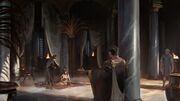 Concept art of Cleopatra meeting Caesar at the palace
 -
 Drawing of the palace by Jean-Claude Golvin
 -

-

-

-

-

-

-

-

-

-

-

-


Appearances[edit | edit source]
- Assassin's Creed: Origins (first appearance)
- Assassin's Creed: Origins comic
- Echoes of History – Behind the Legends (indirect mention only)
- Echoes of History – Renaissance (mentioned only)