-
 Concept art
 -
 Concept art
 -
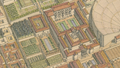 Reconstruction of the library drawn by Jean-Claude Golvin
Welcome to Assassin's Creed Wiki! Log in and join the community.


Library of Alexandria
Jump to navigation
Jump to search
The Library of Alexandria, also known as Great Library of Alexandria, was one of the largest and most significant libraries of the ancient world located in Alexandria, Egypt.
First built by Ptolemy I Soter and finished under Ptolemy II, it was dedicated to the Muses, the nine goddesses of the arts and daughters of Zeus, and was said to hold anywhere between 40,000 to 400,000 scrolls. It was part of a larger research institution known as the Mouseion of Alexandria.[1]
History[edit | edit source]
Some time between library's founding and the 1st century BCE, the misthios Kassandra visited the library and placed a copy of Herodotos' manuscript Histories within one of the shelves, in hopes that his stories and travels would be preserved and remembered by the later generations.[2]
In 48 BCE, Bayek, having followed the clues in Aya's home, travelled to the library in search of his wife. There he was greeted by Aya's cousin Phanos, who explained the reason for Aya's absence. Phanos then directed the Medjay to the entrance to Aya's hideout beneath the library.[3] Later, Bayek also found and solved a Papyrus Puzzle stored in the library.[4]
In 1511, during an excavation of the destroyed Library of Alexandria, the Mamluk Sultanate's soldiers discovered two Memory Seals in a chest from 331 BCE. Ezio Auditore sent a team of Assassins from Constantinople to Alexandria to retrieve the Seals.[5]
Behind the scenes[edit | edit source]

Historically, the library was partially destroyed during the siege of Alexandria.[6] However, in the events of the 2017 game Assassin's Creed: Origins, the library remained in one piece with no signs of damage whatsoever after the siege. This was explained by developers to be because research suggested that the building destroyed during the siege was merely a storage for the library, not the library itself. With no surviving contemporary records to base their digital models on, the developers instead took inspiration from the Library of Celsus in Ephesus build the facade for the Great Library.[7]
The in-game model of the library features three inscriptions on its facade. While a few errors can be noticed, the top inscription is meant to read "TEΧΝΗ, ΕΠΙΣTHΜΗ, ΦΡΟΝΗΣΙZ, ΣΟΦΙΑ, ΝΟMZ". These are the five intelletcual virtues explained in the Nicomachean Ethics by Aristotle: techne (craft, skill), epistomo (scientific knowledge), phronesis (practical wisdom), sofia (wisdom), and nous (intuition, understanding). Two cartouches are the royal and birth names of Pharaoh Thutmose III, with the upper cartouche being Men kheper ra and the lower cartouche Djehutimes nefer kheper. The middle inscription is "ΜΟΥΣΕION ΣΑΡAΠΙΣ ΠΤΟΛΕΜΑIΟZ ΣΩΤHP", which translated reads "Mouseion of Serapis, Ptolemy Soter (Savior)". The lower inscription is also "Mouseion of Serapis".
Gallery[edit | edit source]


.png)
-

-

-

-

-
 Life inside the library
 -
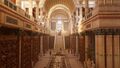 Interior of the library
 -
 Interior of the library
 -
 The astrolabe in the library
 -
 Closeup of the astrolabe


Appearances[edit | edit source]
- Assassin's Creed: Revelations (first mentioned)
- Assassin's Creed: Origins (first appearance)
- Assassin's Creed: Odyssey – Assassin's Creed Crossover Stories
- Echoes of History (mentioned only)
- Assassin's Creed: Mirage (mentioned in Database entry only)
References[edit | edit source]
- ↑ Assassin's Creed: Origins
- ↑ Assassin's Creed: Odyssey – Assassin's Creed Crossover Stories – A New Horizon
- ↑ Assassin's Creed: Origins – Aya
- ↑ Assassin's Creed: Origins – Papyrus Puzzle: "Divided Valley"
- ↑ Assassin's Creed: Revelations – Mediterranean Defense: "Alexandria: The Memory Seals, Part I"
- ↑
 Library of Alexandria on Wikipedia
- ↑ Discovery Tour: Ancient Egypt – Tours: The Great Library of Alexandria: "Recreating the Great Library"