|
|
| (6 intermediate revisions by one other user not shown) |
| Line 78: |
Line 78: |
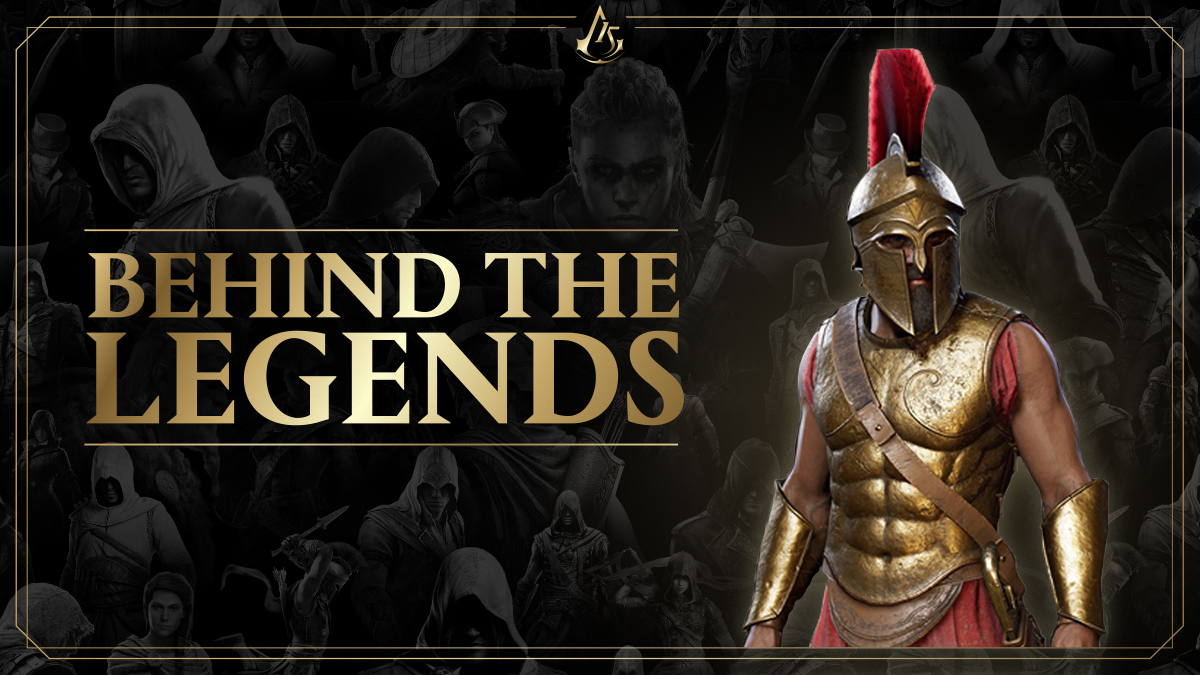
| [[File:AC Echoes of History Legends EP1 Title Card.jpg|thumb|300px|''Leonidas'' title card]] | | [[File:AC Echoes of History Legends EP1 Title Card.jpg|thumb|300px|''Leonidas'' title card]] |
| ;Leonidas | | ;Leonidas |
| ''The legendary [[Battle of Thermopylae]] has been told over and over and remains famous for an incredible act of valor: 300 [[Sparta]]n warriors defending [[Hot Gates of Thermopylai|a narrow]] path against [[Achaemenid Empire|tens of thousands]] of [[Iran|Persians]] to protect the retreat of the Greek army. A symbol of courage, sacrifice, and honor. But there's more to the story, as the Spartans weren’t actually alone at this moment. And [[Leonidas I of Sparta|Leonidas]]' personality deserves some enlightenment.'' | | ''The legendary [[Battle of Thermopylae]] has been told over and over and remains famous for an incredible act of valor: 300 [[Sparta]]n warriors defending [[Hot Gates of Thermopylai|a narrow]] path against [[Achaemenid Empire|tens of thousands]] of [[Iran|Persians]] to protect the retreat of the Greek army. A symbol of courage, sacrifice, and honor. But there's more to the story, as the Spartans weren't actually alone at this moment. And [[Leonidas I of Sparta|Leonidas]]' personality deserves some enlightenment.'' |
| *'''Danny Wallace:''' ''How far would you go to defend your people? This is probably what Leonidas, the legendary king of Sparta, asked himself one September morning in 480 BC. The Battle of Thermopylae was underway, and, overwhelmed by the Persians, the Greek army was in disarray. Heading up his troops of 300 valiant Spartans, Leonidas decided to fight until the death. Gazing out over the battlefield, he took stock. 300 Spartans against tens of thousands of Persians. This heroic sacrifice earned Leonidas a place in history, and much more besides. Passed down over generations, the tale of this battle has turned the king of Sparta into a legend, sometimes to outlandish effect.<br><br>You're listening to ''Echoes of History: Behind the Legends'', the podcast that tells you the true stories of some of history's most legendary heroes. As the ''Assassin's Creed'' franchise turns 15, travel back through 2,500 years of history to meet the men and women whose destiny lead them to greatness. Uncover their stories and bring their legends back to life. Episode one, Leonidas.<br><br>The year is 480 BC. The Greek [[Sanctuary of Delphi]] is home to a [[Temple of Apollo, Delphi|temple]] to [[Apollo]], where Spartans are jostling to see the [[Pythia]], the temple's [[Pythia (480 BCE)|priestess]] who has a foreboding prophecy to share...''<br><br>"O dwellers in Sparta of the wide spaces;<br>Either your famed, great town must be sacked by [[Perseus]]' sons,<br>Or, if that be not, the whole land of Lacedaemon<br>Shall mourn the death of a king."<ref>Herodotus. ''[https://www.perseus.tufts.edu/hopper/text?doc=Perseus:text:1999.01.0126 The Histories]'', VII.220. Translated by {{Wiki|A. D. Godley}}. {{Wiki|Cambridge, Massachusetts|Cambridge}}, MA: {{Wiki|Harvard University Press}}, 1920. ''Penelope Digital Library'', {{Wiki|Tufts University}}. Retrieved on 15 January 2024.</ref><br><br>''The Spartans have travelled to Delphi for a reason. Trouble is afoot. The Persian king [[Xerxes I of Persia|Xerxes]] has now made it clear that he plans to [[Greco-Persian Wars|invade]] the whole of Greece. The tyrant is readying himself to lead his endless army through the {{Wiki|Dardanelles|Hellespont}}, a narrow strait in today's northwestern [[Turkey]] that separates the Greek and Persian Empires. Standing his way, thirty-odd Greek cities have rallied together around Sparta, forming the {{Wiki|Hellenic League}}. King Leonidas' city boasts unparalleled military prestige, and the great man himself has been tasked with leading the Greek coalition into battle against the Persians. Paradoxically, the life of the legendary Leonidas is little known. Most Greek historians filled their writing with anecdotes that paint a portrait of an idealized king: Leonidas, the accomplished warlord; Leonidas, the great leader of men; Leonidas, the epitome of Spartan values—devoted to his city, valiant in battle, self-sacrificing. It isn't always easy to unpick fact from fiction. But, there are a handful of things we do know for certain about Leonidas' life.<br><br>As the third son of King {{Wiki|Anaxandridas II}}, he wasn't destined to succeed his father. His older half-brother {{Wiki|Cleomenes I|Cleomenes}} took to the throne, becoming king of Sparta in 520 BC. At the time, 20-year-old Leonidas had just finished his ''[[agoge]]'', an extensive military training program designed to produce devout citizens and disciplined fighters. All male {{Wiki|Spartiate|Spartan citizens}} were required to complete this program, with the exception of legitimate heirs to the throne. Despite his [[Agiad dynasty|royal ancestry]], Leonidas was thus accustomed to acute physical training from childhood, and suffered the whippings dealt out to him by his elders to correct his errors and toughen up his body without complaint. This demanding apprenticeship included fights with other young men, as well as races wearing {{Wiki|Panoply|full military gear}} and weaponry, designed to prepare them for battle. Ultimately, the Fates conspired to make Leonidas king of Sparta. Political machinations prompted the downfall of Cleomenes, who took his own life in 488 BC, leaving no male heir behind him. {{Wiki|Dorieus}}, his second brother, had died twenty years previously in a campaign to conquer [[Sicily]].<ref>Herodotus. ''The Histories'', VII.205</ref> As a result, Leonidas' time to rule had come. The fact that he had completed his ''agoge'' training was unusual for a king, and undoubtedly imbued him with a special aura and appeal in the eyes of Sparta's citizen-soldiers. Although no mention is made of his prowess in specific battles, Herodotus reports that Leonidas was "the most respected of the Greek generals".<ref>Herodotus. ''The Histories'', VII.204</ref><br><br>Back to 480 BC. Busy leading the Greek cities' resistance, Leonidas suddenly finds himself at the center of a morbid prophecy: die in battle, or see Sparta fall to the Persians. Yet today, historians all agree, that this presage was a complete fabrication, a legend that was made up well after the events it foreshadowed, the Battle of Thermopylae. The ''[[Hot Gates of Thermopylai|thermopylae]]'', meaning "[[wikt:Θερμοπύλαι|hot gates]]" in Greek, refer to a narrow, coastal passage between {{Wiki|Malian Gulf|sea}} and {{Wiki|Kallidromo|mountain}} in eastern Greece. Arriving from the north, with plans to march south to [[Athens]], Xerxes' infantry had no choice but to pass through it. Named after and known for its hot [[sulfur]] springs, the site has remained immortalized in history as the stage of the heroic sacrifice undertaken by Leonidas and his Spartans. In fact, the dark prophecy constitutes the first legendary element of a story that was partially true but tinged with myth in order to turn the battle into the stuff of {{Wiki|Epic (genre)|epics}}. After all, a legend as admirable as the story of Leonidas and his 300 men would require more than just death on the battlefield.<br><br>For the sacrifice to attain its fascinating appeal after all these years, the soldiers would have to be aware of their imminent death and decide to accept their fate without fear, all in the name of a higher cause. Leading the Greek troops, 60-year-old Leonidas played a decisive role in the strategies rolled out to beat back the invaders. The Greeks were faced with an insurmountable problem: the Persians drastically outnumbered them. While the figures offed up by Herodotus, over 2 million men—I mean, come on—are pure fantasy, modern scholars believe that at least 200, 000 Persian soldiers crossed the Hellespont in September 480 BC as a mere few thousand Greeks looked on. Leonidas' decision to take on the Persian army at a narrower spot, the Thermopylae, was therefore most likely a strategic one, a choice that turned his army's weakness into a strength. It as also a way to put a renowned Spartan war tactic to work, the [[hoplite]] {{Wiki|phalanx}}. Teamwork was central to this compact formation. {{Wiki|Dory (spear)|Long spears}} in hand, protected by their {{Wiki|Aspis|shields}}, and armored to the gills, the Spartans were able to withstand the swarms of foot soldiers—greater in number but less well-equipped—for lengthy periods of time.<ref>Herodotus. ''The Histories'', VII.211</ref> Leonidas proved his worth as a war leader, taking major decisions and boosting morale. He remained on the battlefield until the bitter end, unlike the Persian king Xerxes, who watched the battle unfold from a distance<ref name="Herodotus VII.212">Herodotus. ''The Histories'', VII.212</ref>—like a coward.<br><br>Four days went by, without the slightest breakthrough. Xerxes had not choice but to acknowledge the fact that the Greeks would neither surrender nor retreat as he had hoped they would.<ref>Herodotus. ''The Histories'', VII.210</ref> The Persian king sent across a messenger asking the Greeks to lay down their arms. Leonidas replied instantly, "{{Wiki|Molon labe|Come and get them}}."<ref>[[Plutarch]]. ''[https://www.perseus.tufts.edu/hopper/text?doc=Perseus:text:2008.01.0197 Moralia – Apophthegmata Laconica]'', 51.11. Translated by Frank Cole Babbitt. Cambridge, MA: Harvard University Press, London, 1920. ''Penelope Digital Library'', Tufts University. Retrieved on 15 January 2024.</ref> Xerxes decided to attack, but watched on as his 5,000 [[archer]]s were thwarted, their [[arrow]]s raining down to shatter against the Greek shields.<ref>Herodotus. ''The Histories'', VII.226</ref> Over two days, waves of Persian soldiers collided against the Greek phalanxes that blocked the pass without ever faltering. Tens of thousands of Xerxes' men fell, including some of his elite warriors known as the [[Immortals]]<ref>Herodotus. ''The Histories'', VII.210–212</ref>—which was probably over-selling things a bit. If you're going to call yourself an Immortal, you better be immortal! His salvation ultimately arrived in the form of one man, [[Ephialtes of Trachis|Ephialtes]].<ref>Herodotus. ''The Histories'', VII.213</ref><br><br>This Greek soldier betrayed his side, revealing the existence of another passage to the Persian king: a [[Cave of Kratos|mountain path]] that circumvented the Thermopylae. Problem solved. An unexpected chance to outsmart the Greeks. The next day, in the early hours of the morning, a detachment of Persian foot-soldiers set off to follow Ephialtes' directions.<ref>Herodotus. ''The Histories'', VII.215</ref> Leonidas' scouts sounded the alarm, and the Spartan king immediately called a war council.<ref>Herodotus. ''The Histories'', VII.219</ref> Most of the Greek cities voted to retreat, but Leonidas decided to stay with his men nevertheless, releasing those Greeks who wished to leave and saving about 3,000 lives in the process. It fell to the king and his famous 300 soldiers to defend the passage. But, the legend often skips over one key detail: they ''weren't'' alone. There's a plot twist! A little over a thousand soldiers from other Greek cities chose to stay behind with the Spartans,<ref>Herodotus. ''The Histories'', VII.217–218, 222</ref> with a total of 1,400 men fighting on. So, {{Wiki|300 (film)|that film}} really should have been called "300...plus a load of others".<br><br>Legend has turned this battle into a noble sacrifice, in which the Greeks gave themselves up to the death they'd been told would come, buoyed by the ''faintest'' glimmer of hope that they ''might'' delay the inevitable invasion by a couple of days. It comes as no surprise that the Greek texts, all written long after the battle, focus heavily on this notion of sacrifice. The Battle of Thermopylae was a defeat, after all, and needed to be gilded in some way—we all exaggerate our stories, don't we? And so, Herodotus recounts how Leonidas, despite his age, fell on the final day of fighting,<ref name="Herodotus VII.224">Herodotus. ''The Histories'', VII.224</ref> a selfless hero who fought with ardor to the very last. The historian also recounts how, after his death, his men had to fight for his body, which had been seized by the Persians, who were bent on defiling it.<ref>Herodotus. ''The Histories'', VII.225</ref><br><br>The legend of Leonidas is the tale of absolute self-sacrifice, but, the Spartan king's strategy wasn't as suicidal as it may first appear. By using the terrain to their advantage, and tapping into extraordinary courage, the Greeks risked their lives and managed to whittle down the Persian army. Today's leading military historians even believe that, had the Greeks been able to hold out for an extra few days, the Persians would have experienced some ''serious'' logistical problems. An army that large locked in place for such a long time would indeed have struggled with supplies and would've been forced to retreat or scatter. Who knows? If Ephialtes hadn't betrayed his own, perhaps the Greeks might have won. All we know for sure is that this tragic end secured the Battle of Thermopylae's place in history, and turned Leonidas into a legend.<br><br>Forty years after the battle, his remains were retrieved and returned to Sparta. A tomb to the hero-king was raised in the heart of the city,<ref name="Herodotus VII.224"/> and it wasn't long before Leonidas had his very own {{Wiki|Greek hero cult|cult}}. Every year, an athletics competition for Spartans was held in honor of the fallen king, and Leonidas went on to be immortalized in paintings, films—played by {{Wiki|Gerard Butler}} in the movie ''300''—and video games. In ''[[Assassin's Creed: Odyssey]]'', players become a [[Kassandra|descendant]] of the king of Sparta and bear his iconic [[Spear of Leonidas|broken spear]]. Through the ages, Leonidas has survived as a shining example of sacrifice and selfless devotion to one's country, and is much better known than his cousin and successor, {{Wiki|Pausanias the Regent}},<ref>Herodotus. ''The Histories'', XI.10</ref> who [[Battle of Plataia|defeated]] the Persian infantry just a year after the Battle of Thermopylae. Which just goes to show, sometimes the vanquished can overshadow the victorious. Thanks for listening to ''Echoes of History: Behind the Legends'', a Ubisoft podcast produced by Paradiso Media.'' | | *'''Danny Wallace:''' ''How far would you go to defend your people? This is probably what Leonidas, the legendary king of Sparta, asked himself one September morning in 480 BC. The Battle of Thermopylae was underway, and, overwhelmed by the Persians, the Greek army was in disarray. Heading up his troops of 300 valiant Spartans, Leonidas decided to fight until the death. Gazing out over the battlefield, he took stock. 300 Spartans against tens of thousands of Persians. This heroic sacrifice earned Leonidas a place in history, and much more besides. Passed down over generations, the tale of this battle has turned the king of Sparta into a legend, sometimes to outlandish effect.<br><br>You're listening to ''Echoes of History: Behind the Legends'', the podcast that tells you the true stories of some of history's most legendary heroes. As the ''Assassin's Creed'' franchise turns 15, travel back through 2,500 years of history to meet the men and women whose destiny lead them to greatness. Uncover their stories and bring their legends back to life. Episode one, Leonidas.<br><br>The year is 480 BC. The Greek [[Sanctuary of Delphi]] is home to a [[Temple of Apollo, Delphi|temple]] to [[Apollo]], where Spartans are jostling to see the [[Pythia]], the temple's [[Pythia (480 BCE)|priestess]] who has a foreboding prophecy to share...''<br><br>"O dwellers in Sparta of the wide spaces;<br>Either your famed, great town must be sacked by [[Perseus]]' sons,<br>Or, if that be not, the whole land of Lacedaemon<br>Shall mourn the death of a king."<ref>Herodotus. ''[https://www.perseus.tufts.edu/hopper/text?doc=Perseus:text:1999.01.0126 The Histories]'', VII.220. Translated by {{Wiki|A. D. Godley}}. {{Wiki|Cambridge, Massachusetts|Cambridge}}, MA: {{Wiki|Harvard University Press}}, 1920. ''Penelope Digital Library'', {{Wiki|Tufts University}}. Retrieved on 15 January 2024.</ref><br><br>''The Spartans have travelled to Delphi for a reason. Trouble is afoot. The Persian king [[Xerxes I of Persia|Xerxes]] has now made it clear that he plans to [[Greco-Persian Wars|invade]] the whole of Greece. The tyrant is readying himself to lead his endless army through the {{Wiki|Dardanelles|Hellespont}}, a narrow strait in today's northwestern [[Turkey]] that separates the Greek and Persian Empires. Standing his way, thirty-odd Greek cities have rallied together around Sparta, forming the {{Wiki|Hellenic League}}. King Leonidas' city boasts unparalleled military prestige, and the great man himself has been tasked with leading the Greek coalition into battle against the Persians. Paradoxically, the life of the legendary Leonidas is little known. Most Greek historians filled their writing with anecdotes that paint a portrait of an idealized king: Leonidas, the accomplished warlord; Leonidas, the great leader of men; Leonidas, the epitome of Spartan values—devoted to his city, valiant in battle, self-sacrificing. It isn't always easy to unpick fact from fiction. But, there are a handful of things we do know for certain about Leonidas' life.<br><br>As the third son of King {{Wiki|Anaxandridas II}}, he wasn't destined to succeed his father. His older half-brother {{Wiki|Cleomenes I|Cleomenes}} took to the throne, becoming king of Sparta in 520 BC. At the time, 20-year-old Leonidas had just finished his ''[[agoge]]'', an extensive military training program designed to produce devout citizens and disciplined fighters. All male {{Wiki|Spartiate|Spartan citizens}} were required to complete this program, with the exception of legitimate heirs to the throne. Despite his [[Agiad dynasty|royal ancestry]], Leonidas was thus accustomed to acute physical training from childhood, and suffered the whippings dealt out to him by his elders to correct his errors and toughen up his body without complaint. This demanding apprenticeship included fights with other young men, as well as races wearing {{Wiki|Panoply|full military gear}} and weaponry, designed to prepare them for battle. Ultimately, the Fates conspired to make Leonidas king of Sparta. Political machinations prompted the downfall of Cleomenes, who took his own life in 488 BC, leaving no male heir behind him. {{Wiki|Dorieus}}, his second brother, had died twenty years previously in a campaign to conquer [[Sicily]].<ref>Herodotus. ''The Histories'', VII.205</ref> As a result, Leonidas' time to rule had come. The fact that he had completed his ''agoge'' training was unusual for a king, and undoubtedly imbued him with a special aura and appeal in the eyes of Sparta's citizen-soldiers. Although no mention is made of his prowess in specific battles, Herodotus reports that Leonidas was "the most respected of the Greek generals".<ref>Herodotus. ''The Histories'', VII.204</ref><br><br>Back to 480 BC. Busy leading the Greek cities' resistance, Leonidas suddenly finds himself at the center of a morbid prophecy: die in battle, or see Sparta fall to the Persians. Yet today, historians all agree, that this presage was a complete fabrication, a legend that was made up well after the events it foreshadowed, the Battle of Thermopylae. The ''[[Hot Gates of Thermopylai|thermopylae]]'', meaning "[[wikt:Θερμοπύλαι|hot gates]]" in Greek, refer to a narrow, coastal passage between [[Bay of Xerxes|sea]] and {{Wiki|Kallidromo|mountain}} in eastern Greece. Arriving from the north, with plans to march south to [[Athens]], Xerxes' infantry had no choice but to pass through it. Named after and known for its hot [[sulfur]] springs, the site has remained immortalized in history as the stage of the heroic sacrifice undertaken by Leonidas and his Spartans. In fact, the dark prophecy constitutes the first legendary element of a story that was partially true but tinged with myth in order to turn the battle into the stuff of {{Wiki|Epic (genre)|epics}}. After all, a legend as admirable as the story of Leonidas and his 300 men would require more than just death on the battlefield.<br><br>For the sacrifice to attain its fascinating appeal after all these years, the soldiers would have to be aware of their imminent death and decide to accept their fate without fear, all in the name of a higher cause. Leading the Greek troops, 60-year-old Leonidas played a decisive role in the strategies rolled out to beat back the invaders. The Greeks were faced with an insurmountable problem: the Persians drastically outnumbered them. While the figures offed up by Herodotus, over 2 million men—I mean, come on—are pure fantasy, modern scholars believe that at least 200, 000 Persian soldiers crossed the Hellespont in September 480 BC as a mere few thousand Greeks looked on. Leonidas' decision to take on the Persian army at a narrower spot, the Thermopylae, was therefore most likely a strategic one, a choice that turned his army's weakness into a strength. It as also a way to put a renowned Spartan war tactic to work, the [[hoplite]] {{Wiki|phalanx}}. Teamwork was central to this compact formation. {{Wiki|Dory (spear)|Long spears}} in hand, protected by their {{Wiki|Aspis|shields}}, and armored to the gills, the Spartans were able to withstand the swarms of foot soldiers—greater in number but less well-equipped—for lengthy periods of time.<ref>Herodotus. ''The Histories'', VII.211</ref> Leonidas proved his worth as a war leader, taking major decisions and boosting morale. He remained on the battlefield until the bitter end, unlike the Persian king Xerxes, who watched the battle unfold from a distance<ref name="Herodotus VII.212">Herodotus. ''The Histories'', VII.212</ref>—like a coward.<br><br>Four days went by, without the slightest breakthrough. Xerxes had not choice but to acknowledge the fact that the Greeks would neither surrender nor retreat as he had hoped they would.<ref>Herodotus. ''The Histories'', VII.210</ref> The Persian king sent across a messenger asking the Greeks to lay down their arms. Leonidas replied instantly, "{{Wiki|Molon labe|Come and get them}}."<ref>[[Plutarch]]. ''[https://www.perseus.tufts.edu/hopper/text?doc=Perseus:text:2008.01.0197 Moralia – Apophthegmata Laconica]'', 51.11. Translated by Frank Cole Babbitt. Cambridge, MA: Harvard University Press, London, 1920. ''Penelope Digital Library'', Tufts University. Retrieved on 15 January 2024.</ref> Xerxes decided to attack, but watched on as his 5,000 [[archer]]s were thwarted, their [[arrow]]s raining down to shatter against the Greek shields.<ref>Herodotus. ''The Histories'', VII.226</ref> Over two days, waves of Persian soldiers collided against the Greek phalanxes that blocked the pass without ever faltering. Tens of thousands of Xerxes' men fell, including some of his elite warriors known as the [[Immortals]]<ref>Herodotus. ''The Histories'', VII.210–212</ref>—which was probably over-selling things a bit. If you're going to call yourself an Immortal, you better be immortal! His salvation ultimately arrived in the form of one man, [[Ephialtes of Trachis|Ephialtes]].<ref>Herodotus. ''The Histories'', VII.213</ref><br><br>This Greek soldier betrayed his side, revealing the existence of another passage to the Persian king: a [[Cave of Kratos|mountain path]] that circumvented the Thermopylae. Problem solved. An unexpected chance to outsmart the Greeks. The next day, in the early hours of the morning, a detachment of Persian foot-soldiers set off to follow Ephialtes' directions.<ref>Herodotus. ''The Histories'', VII.215</ref> Leonidas' scouts sounded the alarm, and the Spartan king immediately called a war council.<ref>Herodotus. ''The Histories'', VII.219</ref> Most of the Greek cities voted to retreat, but Leonidas decided to stay with his men nevertheless, releasing those Greeks who wished to leave and saving about 3,000 lives in the process. It fell to the king and his famous 300 soldiers to defend the passage. But, the legend often skips over one key detail: they ''weren't'' alone. There's a plot twist! A little over a thousand soldiers from other Greek cities chose to stay behind with the Spartans,<ref>Herodotus. ''The Histories'', VII.217–218, 222</ref> with a total of 1,400 men fighting on. So, {{Wiki|300 (film)|that film}} really should have been called "300...plus a load of others".<br><br>Legend has turned this battle into a noble sacrifice, in which the Greeks gave themselves up to the death they'd been told would come, buoyed by the ''faintest'' glimmer of hope that they ''might'' delay the inevitable invasion by a couple of days. It comes as no surprise that the Greek texts, all written long after the battle, focus heavily on this notion of sacrifice. The Battle of Thermopylae was a defeat, after all, and needed to be gilded in some way—we all exaggerate our stories, don't we? And so, Herodotus recounts how Leonidas, despite his age, fell on the final day of fighting,<ref name="Herodotus VII.224">Herodotus. ''The Histories'', VII.224</ref> a selfless hero who fought with ardor to the very last. The historian also recounts how, after his death, his men had to fight for his body, which had been seized by the Persians, who were bent on defiling it.<ref>Herodotus. ''The Histories'', VII.225</ref><br><br>The legend of Leonidas is the tale of absolute self-sacrifice, but, the Spartan king's strategy wasn't as suicidal as it may first appear. By using the terrain to their advantage, and tapping into extraordinary courage, the Greeks risked their lives and managed to whittle down the Persian army. Today's leading military historians even believe that, had the Greeks been able to hold out for an extra few days, the Persians would have experienced some ''serious'' logistical problems. An army that large locked in place for such a long time would indeed have struggled with supplies and would've been forced to retreat or scatter. Who knows? If Ephialtes hadn't betrayed his own, perhaps the Greeks might have won. All we know for sure is that this tragic end secured the Battle of Thermopylae's place in history, and turned Leonidas into a legend.<br><br>Forty years after the battle, his remains were retrieved and returned to Sparta. A tomb to the hero-king was raised in the heart of the city,<ref name="Herodotus VII.224"/> and it wasn't long before Leonidas had his very own {{Wiki|Greek hero cult|cult}}. Every year, an athletics competition for Spartans was held in honor of the fallen king, and Leonidas went on to be immortalized in paintings, films—played by {{Wiki|Gerard Butler}} in the movie ''300''—and video games. In ''[[Assassin's Creed: Odyssey]]'', players become a [[Kassandra|descendant]] of the king of Sparta and bear his iconic [[Spear of Leonidas|broken spear]]. Through the ages, Leonidas has survived as a shining example of sacrifice and selfless devotion to one's country, and is much better known than his cousin and successor, {{Wiki|Pausanias the Regent}},<ref>Herodotus. ''The Histories'', XI.10</ref> who [[Battle of Plataia|defeated]] the Persian infantry just a year after the Battle of Thermopylae. Which just goes to show, sometimes the vanquished can overshadow the victorious. Thanks for listening to ''Echoes of History: Behind the Legends'', a Ubisoft podcast produced by Paradiso Media.'' |
| {{!}}-{{!}} | | {{!}}-{{!}} |
| 2= | | 2= |
| Line 97: |
Line 97: |
| [[File:AC Echoes of History Legends EP4 Title Card.jpg|thumb|300px|''Marquis de Sade'' title card]] | | [[File:AC Echoes of History Legends EP4 Title Card.jpg|thumb|300px|''Marquis de Sade'' title card]] |
| ''Writer and philosopher, the [[Donatien Alphonse François, Marquis de Sade|Marquis de Sade]] is a very controversial figure because of his texts, where erotism and pornography had an important place along with cruelty, rape, and murders, to such an extent that his name gave the root of the word "sadistic". Because of his work and his deviant behavior, he spent more than a third of his life in prison. But how did the heir of an ancient French noble family become this despicable yet legendary character?'' | | ''Writer and philosopher, the [[Donatien Alphonse François, Marquis de Sade|Marquis de Sade]] is a very controversial figure because of his texts, where erotism and pornography had an important place along with cruelty, rape, and murders, to such an extent that his name gave the root of the word "sadistic". Because of his work and his deviant behavior, he spent more than a third of his life in prison. But how did the heir of an ancient French noble family become this despicable yet legendary character?'' |
| *'''Danny Wallace:''' ''12th of September 1772. The Place des Prêcheurs square in {{Wiki|Aix-en-Provence}} in the south of France was thick with people, the crowds clamoring to catch a glimpse of the famous aristocratic {{Wiki|libertine}} about to be executed. He had been sentenced to death for acts of sexual depravity in [[Marseille]] just a few weeks earlier. Everybody knew his name: the scandalous, 32-year-old Marquis de Sade had something of a reputation, and the rumor mill had been working overtime. What had started as a session with four young prostitutes, two of whom were intoxicated with {{Wiki|Cantharidin|stimulants}}, had been reimagined as a fiendish orgy, the aphrodisiac reinvented as a fatal poison—and French law did not tolerate sodomites and poisoners. But the convicted man had fled, and the figure bursting into flames in the town square in Aix-en-Provence was nothing more than an effigy. From a very young age, the Marquis de Sade sparked moral outrage, scandalizing society at the time and becoming a legend well before his death. He is still famous to this day, having inspired a new word that made its way into everyday speech in 1841: "sadism", or, the act of deriving pleasure from another's suffering, a perversion said to have been invented by the cruel Sade himself. Up until the early 20th century, the Marquis was considered the embodiment of evil, but his honor has since been restored on several occasions. Research was carried out to measure the originality of {{Wiki|Marquis de Sade bibliography|his writings}} and the realities of his political work.<ref>Ryland, Hobart (October 1951). "[http://www.jstor.org/stable/382965 Recent Developments in Research on the Marquis de Sade]". ''The French Review''. '''25''' (1): 10–15. {{Wiki|JSTOR}}. Retrieved on 15 January 2024.</ref><ref>{{Amazon|domain=com|url=dp/B000OBI4TE|text=Must We Burn de Sade? by Simone de Beauvoir|archiveurl=https://web.archive.org/web/20160827092123/https://www.amazon.com/Must-Burn-Sade-Simone-Beauvoir/dp/B000OBI4TE}}</ref><ref>{{WP|The Sadeian Woman and the Ideology of Pornography|''The Sadeian Woman and the Ideology of Pornography''}}</ref> An unhinged torturer to some, a misunderstood and persecuted writer to others, Sade is a divisive character, and the path to understanding who he truly was is a difficult and winding one that veers between gilded hero and shadow lord.<br><br>You're listening to ''Echoes of History: Behind the Legends'', the podcast that tells you the true stories of some of history's most legendary heroes. As the ''Assassin's Creed'' franchise turns 15, travel back through 2,500 years of history to meet the men and women whose destiny lead them to greatness. Uncover their stories and bring their legends back to life. Episode four, the Marquis de Sade.<br><br>Donatien Alphonse François, Marquis de Sade was a nobleman born in [[Paris]] in 1740. {{Wiki|Lycée Louis-le-Grand|Educated}} in a fashion befitting his rank, he became a {{Wiki|Cornet (rank)|cavalry captain}} in the [[French Army|army]] and showed great valor during the [[Seven Years' War]]. In 1763, he bowed to [[commons:File:Jean-Baptiste François Joseph de Sade.jpg|his father]]'s wishes, marrying {{Wiki|es:Renée-Pélagie de Sade|Renée-Pélagie de Montreuil}}, the daughter of a magistrate who was close to the [[Louis XV of France|King]]. But Sade soon turned his back on ambition, devoting himself to libertinism instead. He was an unabashed atheist and a proponent of romantic infidelity who embarked on an ''insatiable'' quest for earthly pleasures, openly flouting taboos and conventions—reminds me a little of myself! It didn't take long for him to become the talk of the town. At the age of 23, he was arrested following the accusations of Jeanne Testard, a young worker and occasional prostitute. According to her account, the Marquis threatened her with a sword and forced her to take the Lord's name in vain, among other abuses. The accused was arrested and [[Château de Vincennes|imprisoned]] for "outrageous and blasphemous debauchery". He was released soon after, thanks to his father's intervention, but five years later, he was back to his old ways. In his bachelor pad in {{Wiki|Arcueil}}, a suburb of Paris, Sade forced a beggar, Rose Keller, to undress, before tying her up and whipping her until he drew blood, lacerating her back with a pocketknife, and covering her wounds with molten wax. The victim fled and reported her attacker, and the story made the headlines. The attack had taken place on Easter—sacrilege! The Marquis was {{Wiki|Château de Saumur|imprisoned}} for a short period, before being granted royal pardon thanks to his mother-in-law, Madame de Montreuil.<br><br>What happened in Marseille in 1772 was to have much greater legal consequences. On the run for almost five years, the Marquis was finally arrested on the 13th of February 1777, and incarcerated in {{Wiki|Vincennes}}, near Paris, where he served a 13-year sentence, this time triggered by Madame de Montreuil herself. She had been given a sealed ''{{Wiki|Lettres de cachet|lettre de cachet}}'' from the [[Louis XVI of France|King]] to get rid of the son-in-law who had brought shame on her family and daughter. When he fled Marseille, Sade took his wife's sister with him, making her his mistress. Under French law at the time, this was incest, a criminal offence that further sullied the the infamous Marquis' reputation. The Marseille scandal was the event that cemented the Marquis de Sade's legacy as a prince of darkness. The three cases—Jeanne Testard, Arcueil, and Marseille—converged into one in the newspapers and high society chatter, with sordid new details added for an extra helping of scandal. Just like a fairy tale ogre, Sade was painted as a poisoner and torturer, a bloodthirsty aristocrat who used and abused his privilege to inflict suffering on the poor with zero repercussions. This is a...somewhat ''excessive'' portrait, but conversely, Sade's proponents tended to play down the severity of his actions. {{Wiki|Guillaume Apollinaire|Apollinaire}} and the {{Wiki|Surrealism|surrealists}} after him attempted to turn the Marquis into a shining embodiment of a free mind with no master but its own desires. A gilded myth started to take shape, starring a Marquis-turned-martyr, a misunderstood artist, a target of pitiless repression. By his victims' accounts, however, it's ''difficult'' to imagine Sade as ''anything'' other than a torturer. Jeanne Testard, Rose Keller, and the women of Marseille were clearly raped, and sexual acts and corporal punishment they did not consent to were inflicted on them under threat. Whatever his admirers may say, Sade was a repeat sexual offender.<br><br>One other aspect of this dark legend is closer to fact than fiction: the impunity the Marquis enjoyed. He bought his victims' silence with gold—with Rose Keller, for example, receiving 2,400 ''[[livre]]s'' to stay quiet. His father and mother-in-law's political influence meant Sade was able to elude the justice system again and again, making the idea that he had been persecuted by the courts for petty moral matters or atheism not credible. By way of contrast, his contemporary {{Wiki|François-Jean de la Barre|François-Jean Lefebvre de la Barre}} was beheaded for blasphemy, even though the Marquis' crimes were much more serious. Yet Sade didn't enjoy complete impunity, either. His first long stint in prison was the result of an arbitrary royal decision. A ''lettre de cachet'', signed by Louis XV and confirmed by Louis XVI upon Madame de Montreuil's request, put him behind bars for a full 13 years. The Marquis was denied both trial a lawyer, but he nevertheless survived prison. Despite being locked away, denied walks, living among the rats, he wrote the books that would go on to make him famous.<br><br>In 1785, he wrote his best-known book in his cell at the [[Bastille]], ''{{Wiki|The 120 Days of Sodom}}'', drawing up a ''comprehensive'' catalogue of the most deviant sexual perversions on little sheets of paper he could hide from the prison guards, sticking them together in a scroll 12 meters long by 11 centimeters wide, and tucking it away in a small hole in the wall in his cell—he probably got a kick out of that. In fact, the Bastille is where the Marquis de Sade makes an appearance in the video game ''[[Assassin's Creed: Unity]]''. Protagonist [[Arno Dorian|Arno Victor Dorian]] is [[Imprisoned|incarcerated]] in Paris' famous prison in early July 1789. On the day he arrives, he meets Sade without realizing. Naked in his cell, the Marquis is clutching the bars of his tiny window, doing his best to get the people of Paris to [[Storming of the Bastille|storm the prison]]. ''"They're slitting our throats! They're murdering the prisoners of the Bastille!"'' The writer did actually say these words, causing him to he transferred to the {{Wiki|Charenton (asylum)|Charenton asylum}}, leaving his manuscript of ''The 120 Days of Sodom'' behind in the process. For the rest of his days, Sade remained convinced that the manuscript was destroyed along with the Bastille on the 14th of July 1789. In reality, the scroll was discovered by a worker who was helping demolish the fortress and who ''immediately'' decided to sell it.<ref>{{Cite web|url=https://www.smithsonianmag.com/history/who-was-marquis-de-sade-180953980|title=Who Was the Marquis de Sade?| archiveurl=https://web.archive.org/web/20150122225642/https://www.smithsonianmag.com/history/who-was-marquis-de-sade-180953980/|archivedate=22 January 2015|author=Perrottet, Tony|date=21 February 2015|publisher=''{{Wiki|Smithsonian Magazine}}''|accessdate=15 January 2024}}</ref> The manuscript changed hands several times until it was published in the 20th century.<br><br>In surrealist painter {{Wiki|Man Ray}}'s 1938 drawing,<ref>{{Cite web|url=http://www.johncoulthart.com/feuilleton/2020/09/25/man-ray-and-the-marquis/|title=Man Ray and the Marquis|archiveurl=https://web.archive.org/web/20201004223925/http://www.johncoulthart.com/feuilleton/2020/09/25/man-ray-and-the-marquis/|archivedate=4 October 2020|author=Coulthart, John|date=25 September 2020|publisher=''feuilleton – A journal by artist and designer John Coulthart''|accessdate=15 January 2024}}</ref> Sade's stone face appears against a backdrop of the Bastille in flames. The [[French Revolution]] is pivotal in the legend of the Marquis, and his biographers remain divided as to just how genuine his commitment to the cause was. In any event, the Revolution was what set him free, as on the 2nd of April 1790, all prisoners incarcerated on the King's orders were released. As an ex-nobleman, Sade was forced to prove his patriotic credentials, and further fueled the myths surrounding him in doing so. He claimed that he threw the king a searing letter just as the monarch was returning to Paris in his carriage following the [[flight to Varennes]]. The letter, Sade said, lambasted the king as a despot and traitor. This would have been impossible: anyone who came close to Louis XVI's carriage risked heading to the gallows. It's true Sade did write a letter criticizing the king, entitled "[[wikisource:fr:Adresse d’un citoyen de Paris au roi des Français|A Citizen Addressing the King of France]]", but it was merely plastered on a handful of walls across Paris and may have been read out in pubic—Louis XVI, most probably, never came to hear of it. Still, nice to be talked about.<br><br>What must be said, however, is that during France's [[Reign of Terror]], Sade displayed undeniable courage in publicly opposing the death penalty, a belief punishable...by the death penalty. Suspected of being {{Wiki|Modérantisme|a false patriot}}, he was arrested on the 8th of September 1793. Health issues meant he was spared the [[guillotine]]...''just''. The Reign of Terror and its bloody violence sickened him to the core, but according to darker version of the myth surrounding the man, [[Maximilien de Robespierre|Robespierre]] and [[Jean-Paul Marat|Marat]] took inspiration from the Marquis' writing in dishing out death penalties. The idea that Sade had inspired the Reign of Terror was a popular one. In his famous 1975 adaptation ''{{Wiki|Salò, or the 120 Days of Sodom}}'', [[Italy|Italian]] director {{Wiki|Pier Paolo Pasolini}} takes the notion even further, positing that Sade had inspired totalitarianism.<br><br>Under [[Napoleon Bonaparte|Bonaparte]]'s {{Wiki|French Consulate}} regime and [[French Empire|Napoleon's Empire]], Sade was {{Wiki|Sainte-Pélagie Prison|imprisoned}} {{Wiki|Bicêtre Hospital|one last time}}. Having made a small fortune with his erotic and pornographic writings, the Marquis was arrested on the 6th of March 1801 and denied a trial, sentenced to spend the last twelve years of his life locked away. His crime? Being the ''suspected'' author of ''Zoloé'', an anonymous, erotic pamphlet published in 1800, a violent attack on [[Joséphine de Beauharnais]], wife of First Consul Bonaparte. In truth, he was sentenced for his ''entire'' scandalous body of work, and all of Sade's writings were seized. Deemed to be a maniac, in 1804, he was transferred to the Charenton lunatic asylum, where he died ten years later. The Marquis spent over ''a third'' of his life behind bars.<br><br>After his death, Sade went to Hell. Literally. In 19th century French libraries, that was the name given to the forbidden book section were the immoral writings were kept. While his work continued doing the rounds on the quiet, it wasn't until 1947 that his first book was officially published by {{Wiki|Jean-Jacques Pauvert}}, sparking ''years'' of legal proceedings as a result. But in 1958, the {{Wiki|Ministère public (France)|French courts}} acknowledged the Marquis de Sade as a writer worthy of the name.<ref>{{WP|fr:Jean-Jacques Pauvert|Jean-Jacques Pauvert}}</ref> And, since then, he's been added to the prestigious {{Wiki|Bibliothèque de la Pléiade|Pléiade}} collection, with some of his work even included in secondary school textbooks—I bet ''that'' makes a few schoolboys giggle. In 2021, the French state bought the manuscript<ref>{{Cite web|url=https://www.legifrance.gouv.fr/jorf/id/JORFTEXT000043149579|title=Avis d'appel au mécénat d'entreprise pour l'acquisition par l'Etat d'un trésor national dans le cadre de l'article 238 bis-0 A du code général des impôts|archiveurl=https://www.legifrance.gouv.fr/download/file/dwCgVwUMeUdxkkmObXeh3QXLnvcMvxCi57urzifqcpw=/JOE_TEXTE|archivedate=18 February 2021|author={{Wiki|Légifrance}}|date=18 February 2021| publisher=''Légifrance''|accessdate=15 January 2024|language=French}}</ref> for ''The 120 Days of Sodom'' from {{Wiki|Gérard Lhéritier|a private collector}} for over {{Wiki|Euro|€}}4 million.<ref>{{Cite web|url=https://www.theguardian.com/books/2021/jul/13/marquis-de-sade-manuscript-acquired-for-french-nation-120-days-of-sodom|title=€4.55m Marquis de Sade manuscript acquired for French nation|archiveurl=https://web.archive.org/web/20210713152732/https://www.theguardian.com/books/2021/jul/13/marquis-de-sade-manuscript-acquired-for-french-nation-120-days-of-sodom|archivedate=13 July 2021|author=Flood, Alison|date=13 July 2021|publisher=''{{Wiki|The Guardian}}''|accessdate=15 January 2024}}</ref> To France's {{Wiki|Ministry of Culture (France)|Ministry of Culture}}, the famous scroll, and by extension the Marquis de Sade himself, are {{Wiki|national treasure}}s.<ref>{{Cite web|url=https://www.france24.com/en/20171218-france-dubs-120-days-sodom-national-treasure-stop-sale|title=France dubs '120 Days of Sodom' a national treasure to stop sale|archiveurl=https://web.archive.org/web/20171222081726/https://www.france24.com/en/20171218-france-dubs-120-days-sodom-national-treasure-stop-sale|archivedate=22 December 2017|author={{Wiki|Agence France-Presse}}|date=18 December 2017|publisher=''{{Wiki|France 24}}''|accessdate=15 January 2024}}</ref> Controversial? Maybe, but treasures all the same. Thanks for listening to ''Echoes of History: Behind the Legends'', a Ubisoft podcast produced by Paradiso Media.'' | | *'''Danny Wallace:''' ''12th of September 1772. The Place des Prêcheurs square in {{Wiki|Aix-en-Provence}} in the south of France was thick with people, the crowds clamoring to catch a glimpse of the famous aristocratic {{Wiki|libertine}} about to be executed. He had been sentenced to death for acts of sexual depravity in [[Marseille]] just a few weeks earlier. Everybody knew his name: the scandalous, 32-year-old Marquis de Sade had something of a reputation, and the rumor mill had been working overtime. What had started as a session with four young prostitutes, two of whom were intoxicated with {{Wiki|Cantharidin|stimulants}}, had been reimagined as a fiendish orgy, the aphrodisiac reinvented as a fatal poison—and French law did not tolerate sodomites and poisoners. But the convicted man had fled, and the figure bursting into flames in the town square in Aix-en-Provence was nothing more than an effigy. From a very young age, the Marquis de Sade sparked moral outrage, scandalizing society at the time and becoming a legend well before his death. He is still famous to this day, having inspired a new word that made its way into everyday speech in 1841: "sadism", or, the act of deriving pleasure from another's suffering, a perversion said to have been invented by the cruel Sade himself. Up until the early 20th century, the Marquis was considered the embodiment of evil, but his honor has since been restored on several occasions. Research was carried out to measure the originality of {{Wiki|Marquis de Sade bibliography|his writings}} and the realities of his political work.<ref>Ryland, Hobart (October 1951). "[http://www.jstor.org/stable/382965 Recent Developments in Research on the Marquis de Sade]". ''The French Review''. '''25''' (1): 10–15. {{Wiki|JSTOR}}. Retrieved on 15 January 2024.</ref><ref>{{Amazon|domain=com|url=dp/B000OBI4TE|text=Must We Burn de Sade? by Simone de Beauvoir|archiveurl=https://web.archive.org/web/20160827092123/https://www.amazon.com/Must-Burn-Sade-Simone-Beauvoir/dp/B000OBI4TE}}</ref><ref>{{WP|The Sadeian Woman and the Ideology of Pornography|''The Sadeian Woman and the Ideology of Pornography''}}</ref> An unhinged torturer to some, a misunderstood and persecuted writer to others, Sade is a divisive character, and the path to understanding who he truly was is a difficult and winding one that veers between gilded hero and shadow lord.<br><br>You're listening to ''Echoes of History: Behind the Legends'', the podcast that tells you the true stories of some of history's most legendary heroes. As the ''Assassin's Creed'' franchise turns 15, travel back through 2,500 years of history to meet the men and women whose destiny lead them to greatness. Uncover their stories and bring their legends back to life. Episode four, the Marquis de Sade.<br><br>Donatien Alphonse François, Marquis de Sade was a nobleman born in [[Paris]] in 1740. {{Wiki|Lycée Louis-le-Grand|Educated}} in a fashion befitting his rank, he became a {{Wiki|Cornet (rank)|cavalry captain}} in the [[French Army|army]] and showed great valor during the [[Seven Years' War]]. In 1763, he bowed to [[commons:File:Jean-Baptiste François Joseph de Sade.jpg|his father]]'s wishes, marrying {{Wiki|es:Renée-Pélagie de Sade|Renée-Pélagie de Montreuil}}, the daughter of a magistrate who was close to the [[Louis XV of France|King]]. But Sade soon turned his back on ambition, devoting himself to libertinism instead. He was an unabashed atheist and a proponent of romantic infidelity who embarked on an ''insatiable'' quest for earthly pleasures, openly flouting taboos and conventions—reminds me a little of myself! It didn't take long for him to become the talk of the town. At the age of 23, he was arrested following the accusations of Jeanne Testard, a young worker and occasional prostitute. According to her account, the Marquis threatened her with a sword and forced her to take the Lord's name in vain, among other abuses. The accused was arrested and [[Château de Vincennes|imprisoned]] for "outrageous and blasphemous debauchery". He was released soon after, thanks to his father's intervention, but five years later, he was back to his old ways. In his bachelor pad in {{Wiki|Arcueil}}, a suburb of Paris, Sade forced a beggar, Rose Keller, to undress, before tying her up and whipping her until he drew blood, lacerating her back with a pocketknife, and covering her wounds with molten wax. The victim fled and reported her attacker, and the story made the headlines. The attack had taken place on Easter—sacrilege! The Marquis was {{Wiki|Château de Saumur|imprisoned}} for a short period, before being granted royal pardon thanks to his mother-in-law, Madame de Montreuil.<br><br>What happened in Marseille in 1772 was to have much greater legal consequences. On the run for almost five years, the Marquis was finally arrested on the 13th of February 1777, and incarcerated in {{Wiki|Vincennes}}, near Paris, where he served a 13-year sentence, this time triggered by Madame de Montreuil herself. She had been given a sealed ''{{Wiki|Lettres de cachet|lettre de cachet}}'' from the [[Louis XVI of France|King]] to get rid of the son-in-law who had brought shame on her family and daughter. When he fled Marseille, Sade took his wife's sister with him, making her his mistress. Under French law at the time, this was incest, a criminal offence that further sullied the infamous Marquis' reputation. The Marseille scandal was the event that cemented the Marquis de Sade's legacy as a prince of darkness. The three cases—Jeanne Testard, Arcueil, and Marseille—converged into one in the newspapers and high society chatter, with sordid new details added for an extra helping of scandal. Just like a fairy tale ogre, Sade was painted as a poisoner and torturer, a bloodthirsty aristocrat who used and abused his privilege to inflict suffering on the poor with zero repercussions. This is a...somewhat ''excessive'' portrait, but conversely, Sade's proponents tended to play down the severity of his actions. {{Wiki|Guillaume Apollinaire|Apollinaire}} and the {{Wiki|Surrealism|surrealists}} after him attempted to turn the Marquis into a shining embodiment of a free mind with no master but its own desires. A gilded myth started to take shape, starring a Marquis-turned-martyr, a misunderstood artist, a target of pitiless repression. By his victims' accounts, however, it's ''difficult'' to imagine Sade as ''anything'' other than a torturer. Jeanne Testard, Rose Keller, and the women of Marseille were clearly raped, and sexual acts and corporal punishment they did not consent to were inflicted on them under threat. Whatever his admirers may say, Sade was a repeat sexual offender.<br><br>One other aspect of this dark legend is closer to fact than fiction: the impunity the Marquis enjoyed. He bought his victims' silence with gold—with Rose Keller, for example, receiving 2,400 ''[[livre]]s'' to stay quiet. His father and mother-in-law's political influence meant Sade was able to elude the justice system again and again, making the idea that he had been persecuted by the courts for petty moral matters or atheism not credible. By way of contrast, his contemporary {{Wiki|François-Jean de la Barre|François-Jean Lefebvre de la Barre}} was beheaded for blasphemy, even though the Marquis' crimes were much more serious. Yet Sade didn't enjoy complete impunity, either. His first long stint in prison was the result of an arbitrary royal decision. A ''lettre de cachet'', signed by Louis XV and confirmed by Louis XVI upon Madame de Montreuil's request, put him behind bars for a full 13 years. The Marquis was denied both trial a lawyer, but he nevertheless survived prison. Despite being locked away, denied walks, living among the rats, he wrote the books that would go on to make him famous.<br><br>In 1785, he wrote his best-known book in his cell at the [[Bastille]], ''{{Wiki|The 120 Days of Sodom}}'', drawing up a ''comprehensive'' catalogue of the most deviant sexual perversions on little sheets of paper he could hide from the prison guards, sticking them together in a scroll 12 meters long by 11 centimeters wide, and tucking it away in a small hole in the wall in his cell—he probably got a kick out of that. In fact, the Bastille is where the Marquis de Sade makes an appearance in the video game ''[[Assassin's Creed: Unity]]''. Protagonist [[Arno Dorian|Arno Victor Dorian]] is [[Imprisoned|incarcerated]] in Paris' famous prison in early July 1789. On the day he arrives, he meets Sade without realizing. Naked in his cell, the Marquis is clutching the bars of his tiny window, doing his best to get the people of Paris to [[Storming of the Bastille|storm the prison]]. ''"They're slitting our throats! They're murdering the prisoners of the Bastille!"'' The writer did actually say these words, causing him to he transferred to the {{Wiki|Charenton (asylum)|Charenton asylum}}, leaving his manuscript of ''The 120 Days of Sodom'' behind in the process. For the rest of his days, Sade remained convinced that the manuscript was destroyed along with the Bastille on the 14th of July 1789. In reality, the scroll was discovered by a worker who was helping demolish the fortress and who ''immediately'' decided to sell it.<ref>{{Cite web|url=https://www.smithsonianmag.com/history/who-was-marquis-de-sade-180953980|title=Who Was the Marquis de Sade?| archiveurl=https://web.archive.org/web/20150122225642/https://www.smithsonianmag.com/history/who-was-marquis-de-sade-180953980/|archivedate=22 January 2015|author=Perrottet, Tony|date=21 February 2015|publisher=''{{Wiki|Smithsonian Magazine}}''|accessdate=15 January 2024}}</ref> The manuscript changed hands several times until it was published in the 20th century.<br><br>In surrealist painter {{Wiki|Man Ray}}'s 1938 drawing,<ref>{{Cite web|url=http://www.johncoulthart.com/feuilleton/2020/09/25/man-ray-and-the-marquis/|title=Man Ray and the Marquis|archiveurl=https://web.archive.org/web/20201004223925/http://www.johncoulthart.com/feuilleton/2020/09/25/man-ray-and-the-marquis/|archivedate=4 October 2020|author=Coulthart, John|date=25 September 2020|publisher=''feuilleton – A journal by artist and designer John Coulthart''|accessdate=15 January 2024}}</ref> Sade's stone face appears against a backdrop of the Bastille in flames. The [[French Revolution]] is pivotal in the legend of the Marquis, and his biographers remain divided as to just how genuine his commitment to the cause was. In any event, the Revolution was what set him free, as on the 2nd of April 1790, all prisoners incarcerated on the King's orders were released. As an ex-nobleman, Sade was forced to prove his patriotic credentials, and further fueled the myths surrounding him in doing so. He claimed that he threw the king a searing letter just as the monarch was returning to Paris in his carriage following the [[flight to Varennes]]. The letter, Sade said, lambasted the king as a despot and traitor. This would have been impossible: anyone who came close to Louis XVI's carriage risked heading to the gallows. It's true Sade did write a letter criticizing the king, entitled "[[wikisource:fr:Adresse d'un citoyen de Paris au roi des Français|A Citizen Addressing the King of France]]", but it was merely plastered on a handful of walls across Paris and may have been read out in pubic—Louis XVI, most probably, never came to hear of it. Still, nice to be talked about.<br><br>What must be said, however, is that during France's [[Reign of Terror]], Sade displayed undeniable courage in publicly opposing the death penalty, a belief punishable...by the death penalty. Suspected of being {{Wiki|Modérantisme|a false patriot}}, he was arrested on the 8th of September 1793. Health issues meant he was spared the [[guillotine]]...''just''. The Reign of Terror and its bloody violence sickened him to the core, but according to darker version of the myth surrounding the man, [[Maximilien de Robespierre|Robespierre]] and [[Jean-Paul Marat|Marat]] took inspiration from the Marquis' writing in dishing out death penalties. The idea that Sade had inspired the Reign of Terror was a popular one. In his famous 1975 adaptation ''{{Wiki|Salò, or the 120 Days of Sodom}}'', [[Italy|Italian]] director {{Wiki|Pier Paolo Pasolini}} takes the notion even further, positing that Sade had inspired totalitarianism.<br><br>Under [[Napoleon Bonaparte|Bonaparte]]'s {{Wiki|French Consulate}} regime and [[French Empire|Napoleon's Empire]], Sade was {{Wiki|Sainte-Pélagie Prison|imprisoned}} {{Wiki|Bicêtre Hospital|one last time}}. Having made a small fortune with his erotic and pornographic writings, the Marquis was arrested on the 6th of March 1801 and denied a trial, sentenced to spend the last twelve years of his life locked away. His crime? Being the ''suspected'' author of ''Zoloé'', an anonymous, erotic pamphlet published in 1800, a violent attack on [[Joséphine de Beauharnais]], wife of First Consul Bonaparte. In truth, he was sentenced for his ''entire'' scandalous body of work, and all of Sade's writings were seized. Deemed to be a maniac, in 1804, he was transferred to the Charenton lunatic asylum, where he died ten years later. The Marquis spent over ''a third'' of his life behind bars.<br><br>After his death, Sade went to Hell. Literally. In 19th century French libraries, that was the name given to the forbidden book section were the immoral writings were kept. While his work continued doing the rounds on the quiet, it wasn't until 1947 that his first book was officially published by {{Wiki|Jean-Jacques Pauvert}}, sparking ''years'' of legal proceedings as a result. But in 1958, the {{Wiki|Ministère public (France)|French courts}} acknowledged the Marquis de Sade as a writer worthy of the name.<ref>{{WP|fr:Jean-Jacques Pauvert|Jean-Jacques Pauvert}}</ref> And, since then, he's been added to the prestigious {{Wiki|Bibliothèque de la Pléiade|Pléiade}} collection, with some of his work even included in secondary school textbooks—I bet ''that'' makes a few schoolboys giggle. In 2021, the French state bought the manuscript<ref>{{Cite web|url=https://www.legifrance.gouv.fr/jorf/id/JORFTEXT000043149579|title=Avis d'appel au mécénat d'entreprise pour l'acquisition par l'Etat d'un trésor national dans le cadre de l'article 238 bis-0 A du code général des impôts|archiveurl=https://www.legifrance.gouv.fr/download/file/dwCgVwUMeUdxkkmObXeh3QXLnvcMvxCi57urzifqcpw=/JOE_TEXTE|archivedate=18 February 2021|author={{Wiki|Légifrance}}|date=18 February 2021| publisher=''Légifrance''|accessdate=15 January 2024|language=French}}</ref> for ''The 120 Days of Sodom'' from {{Wiki|Gérard Lhéritier|a private collector}} for over {{Wiki|Euro|€}}4 million.<ref>{{Cite web|url=https://www.theguardian.com/books/2021/jul/13/marquis-de-sade-manuscript-acquired-for-french-nation-120-days-of-sodom|title=€4.55m Marquis de Sade manuscript acquired for French nation|archiveurl=https://web.archive.org/web/20210713152732/https://www.theguardian.com/books/2021/jul/13/marquis-de-sade-manuscript-acquired-for-french-nation-120-days-of-sodom|archivedate=13 July 2021|author=Flood, Alison|date=13 July 2021|publisher=''{{Wiki|The Guardian}}''|accessdate=15 January 2024}}</ref> To France's {{Wiki|Ministry of Culture (France)|Ministry of Culture}}, the famous scroll, and by extension the Marquis de Sade himself, are {{Wiki|national treasure}}s.<ref>{{Cite web|url=https://www.france24.com/en/20171218-france-dubs-120-days-sodom-national-treasure-stop-sale|title=France dubs '120 Days of Sodom' a national treasure to stop sale|archiveurl=https://web.archive.org/web/20171222081726/https://www.france24.com/en/20171218-france-dubs-120-days-sodom-national-treasure-stop-sale|archivedate=22 December 2017|author={{Wiki|Agence France-Presse}}|date=18 December 2017|publisher=''{{Wiki|France 24}}''|accessdate=15 January 2024}}</ref> Controversial? Maybe, but treasures all the same. Thanks for listening to ''Echoes of History: Behind the Legends'', a Ubisoft podcast produced by Paradiso Media.'' |
| {{!}}-{{!}} | | {{!}}-{{!}} |
| 5= | | 5= |
| Line 134: |
Line 134: |
| ;Leonardo da Vinci | | ;Leonardo da Vinci |
| ''Painter, scientist, engineer, inventor, anatomist, sculptor, [[architect]], urban planner, botanist, musician, philosopher, writer: [[Leonardo da Vinci]] was all that and even more. The Italian Renaissance {{Wiki|polymath}} artist brought his touch to every field of knowledge possible in his time and is now widely considered as one of the greatest minds ever. But what do we really owe him? The real impact of his inventions and artistic work is still subject to debate today.'' | | ''Painter, scientist, engineer, inventor, anatomist, sculptor, [[architect]], urban planner, botanist, musician, philosopher, writer: [[Leonardo da Vinci]] was all that and even more. The Italian Renaissance {{Wiki|polymath}} artist brought his touch to every field of knowledge possible in his time and is now widely considered as one of the greatest minds ever. But what do we really owe him? The real impact of his inventions and artistic work is still subject to debate today.'' |
| *'''Danny Wallace:''' "Not only in his lifetime was Leonardo da Vinci held in esteem, but his reputation became even greater among posterity after his death," ''wrote {{Wiki|Giorgio Vasari|Vasari}}, the first art historian, in 1550.<ref>Vasari, Giorgio. ''[[wikisource:it:Le vite de' più eccellenti pittori, scultori e architettori (1568)|Le vite de' piu eccellenti pittori, scultori, et architettori, scritte et di nuovo Ampliate da M. Giorgio Vasari Pittore et Architetto Aretino, co' ritratti loro et con le nuove vite dal 1550 insino al 1567]]''. Florence, {{Wiki|Giunti (printers)|Giunti}}, 1568. 2nd ed, vol. 2. "Vita di Lionardo da Vinci Pittore e Scultore Fiorentino". pg. 2. Retrieved on 3 March 2024. "La forza in lui fu molta e congiunta con la destrezza, l'animo e 'l valore, sempre regio e magnanimo. E la fama del suo nome tanto s'allargò, che non solo nel suo tempo fu tenuto in pregio, ma pervenne ancora molto più ne' posteri dopo la morte sua."</ref><ref>Vasari, Giorgio. ''{{Wiki|Lives of the Most Excellent Painters, Sculptors, and Architects}}''. London, {{Wiki|Macmillan Publishers|Macmillan and Co. Ltd.}} & [https://www.medici.co.uk/ The Medici Society, Ltd.], 1913. [https://www.gutenberg.org/files/28420/28420-h/28420-h.htm Vol. 4]. Translated by Gaston du C. De Vere. "Life of Leonardo da Vinci Painter and Sculptor of Florence". pg. 89. Retrieved on 3 March 2024. "In him was great bodily strength, joined to dexterity, with a spirit and courage ever royal and magnanimous; and the fame of his name so increased, that not only in his lifetime was he held in esteem, but his reputation became even greater among posterity after his death."</ref> More than ''five centuries'' after his death, the genius still inspires the same admiration. And even now, he's breaking records: in 2017, ''{{Wiki|Salvator Mundi (Leonardo)|Salvator Mundi}}'', a painting attributed to him—though that ''is'' disputed—was sold for $450 million.<ref>{{Cite web|url=https://www.reuters.com/article/us-art-auction-da-vinci-abudhabi/abu-dhabi-to-acquire-leonardo-da-vincis-salvator-mundi-christies-idUSKBN1E22IN/|title=Abu Dhabi to acquire Leonardo da Vinci's 'Salvator Mundi': Christie's|archiveurl=https://web.archive.org/web/20171208235650/https://www.reuters.com/article/us-art-auction-da-vinci-abudhabi/abu-dhabi-to-acquire-leonardo-da-vincis-salvator-mundi-christies-idUSKBN1E22IN/|archivedate=8 December 2017|author=Bayoumy, Yara|date=8 December 2017|publisher=''{{Wiki|Reuters}}''|accessdate=3 March 2024}}</ref><ref>{{Youtube|video=3orkmMlSpmI|text=Leonardo da Vinci's 'Salvator Mundi' <nowiki>|</nowiki> 2017 World Auction Record <nowiki>|</nowiki> Christie's|channel=christies|channelname=Christie's}}</ref> And in 2019, the [[Louvre]] dedicated a ''major'' exhibition to him<ref>{{Cite web|url=https://www.louvre.fr/en/what-s-on/exhibitions/leonardo-da-vinci|title=Leonardo da Vinci|archiveurl=https://web.archive.org/web/20210413201603/https://www.louvre.fr/en/what-s-on/exhibitions/leonardo-da-vinci|archivedate=13 April 2021|author=Louvre|date=24 October 2019|publisher=''Louvre''|accessdate=3 March 2024}}</ref> which attracted more than a ''million'' visitors in four months.<ref>{{Cite web|url=https://presse.louvre.fr/1-1-million-visitors-for-leonardo-da-vincibr-a-new-record-for-an-exhibitionnbspat-the-louvre/|title=1.1 million visitors for "Leonardo da Vinci": A new record for an exhibition at the Louvre|archiveurl=https://web.archive.org/web/20200715183448/https://presse.louvre.fr/1-1-million-visitors-for-leonardo-da-vincibr-a-new-record-for-an-exhibitionnbspat-the-louvre/|archivedate=15 July 2020|author=Louvre|date=25 February 2020|publisher=''Louvre''|accessdate=3 March 2024}}</ref> Bringing together his greatest paintings and ''many'' drawings, the museum celebrated an ''exceptional'' mind with ''limitless'' curiosity. Da Vinci explored many areas of knowledge, including {{Wiki|Perspective (graphical)|perspective}}, geometry, astronomy, architecture, and engineering. Each era has created its own legend about Leonardo: from the 16th century onwards, he was celebrated as a painter; in the 19th, the discovery of his {{Wiki|Category:Codices by Leonardo da Vinci|forgotten manuscripts}} made him famous as an engineer. More recently, some people have tried to ''tarnish'' this image, pointing out the gaps in Leonardo da Vinci's knowledge and claiming him a fraud. Despite these sometimes legitimate criticisms, the myth of the "universal man" capable of inventing the future has taken hold—he ''did'' design [[Flying Machine]]s and [[tank]]s, after all. However, nothing predisposed the young boy, born in 1552 in the [[Tuscany|Tuscan]] countryside, to such glory.<br><br>You're listening to ''Echoes of History: Behind the Legends'', the podcast that tells you the true stories of some of history's most legendary heroes. As the ''Assassin's Creed'' franchise turns 15, travel back through 2,500 years of history to meet the men and women whose destiny lead them to greatness. Uncover their stories and bring their legends back to life. Episode ten, Leonardo da Vinci.<br><br>Born in {{Wiki|Vinci, Tuscany|Vinci}}, a small town halfway between [[Pisa]] and Florence, Leonardo was the son of Piero da Vinci, a {{Wiki|Civil law notary|notary}}, and a woman named Caterina, about whom we know almost nothing. Leonardo didn't follow in his father's footsteps—attending university was ''out of the question'' as he born out of wedlock. Surrounded by his grandparents' love, he was self-taught. He ''devoured'' [[Ovid]]'s ''[[Metamorphoses]]'' and spent most of his time contemplating nature. This appreciation of the beauty of landscapes and animals, combined with a particularly ''keen'' sense of observation, gave rise to his unmatched drawing skills. A [[commons:Category:Codex on the Flight of Birds|bird in flight]], the anatomy of a bee,<ref>Kritsky, Gene and Daniel Mader (1 July 2010). "Leonardo's Insects", ''{{Wiki|Entomological Society of America|American Entomologist}}'', '''56'''(3). [[Oxford]], {{Wiki|Oxford University Press}}. pg. 178–184. DOI: https://doi.org/10.1093/ae/56.3.178. Retrieved on 3 March 2024.</ref> from an early age, Leonardo ''filled'' his small notebooks with sketches.<br><br>In 1466, the young man moved to Florence. His father got him an apprenticeship with [[Andrea del Verrocchio]] at one of the most prestigious workshops in the city. In this ''[[wikt:bottega|bottega]]'', the master and his pupils ''excelled'' in a wide range of crafts, from painting and sculpture to goldsmithing, cabinetmaking, and metalworking. Alongside his talented fellow students—including [[Pietro Perugino|Perugino]] and [[Sandro Botticelli|Botticelli]]—Leonardo observed, exchanged, and accumulated impressive skills. And the city was a ''constant'' work in progress; he was ''fascinated'' by the building site for the dome of the [[Cattedrale di Santa Maria del Fiore|Cathedral of Santa Maria del Fiore]]. Engineers had designed special cranes to position the building materials with ''great'' precision nearly 100 meters above the ground. Young Leonardo was responsonble for making the {{Wiki|Gilding|gilt}} [[copper]] bowl topping the dome. As it was made of several pieces, he had to climb to the top of the Duomo to assemble and solder it using a mirror to reflect the sun's light.<br><br>During his time in Florence, Leonardo da Vinci established himself as an independant artist. In 1473, he painted ''[[Annunciation]]'', an early work with ''some'' inaccuracies, but ''already'' showing incredible technical skill and originality. However, when he set up his own [[Bottega di Leonardo|workshop]] five years later at the age of 26, he ''struggled'' to stand out from the ''fierce'' competition. The [[House of Medici|Medici]] court remained inaccessible; without {{Wiki|Italian Renaissance painting|classical training}}, Leonardo ''did not'' have the ''vital'' cultural background to ''shine'' among the elite. In 1482, he seized the opportunity to spread his wings. The next chapter of his story would be played out in [[Milan]].<br><br>When [[Lorenzo de' Medici]] sent him to the court of [[Ludovico Sforza]] to stage a musical, Leonardo made a bold move: he offered his services to the nobleman. In {{Wiki|Personal life of Leonardo da Vinci#Résumé|his letter}} to Sforza, the artist boasts, oddly enough, of his talents as a ''military'' engineer. He claims to be able to design [[war machine]]s; cannons; and'' "covered vehicles, safe and unassailable, which will penetrate the enemy and their artillery, and there is no host of armed men so great that they would not break through it."<ref>da Vinci, Leonardo. ''[[wikisource:The Notebooks of Leonardo Da Vinci|The Notebooks of Leonardo Da Vinci]]''. Translated by {{Wiki|Jean Paul Richter}}. 1888. Vol. 2. "XXI. Letters. Personal Records. Dated Notes". Retrieved on 3 March 2024. "6) Item. I will make covered chariots, safe and unattackable which, entering among the enemy with their artillery, there is no body of men so great but they would break them. And behind these, infantry could follow quite unhurt and without any hindrance."</ref> ''By doing so, he created his own myth. It's true that Leonardo had drawn many military technical drawings, but they were merely sketches designed by borrowing extensively from contemporary engineers, and often unworkable. Except, that Leonardo surpassed ''all'' his predecessors in ''one'' area: technical drawings where the accuracy of his line worked ''wonders''. In an exploded view of an object, be broke it down, describing ''each part'' in detail. He had a perfect understanding of perspective. Leonardo may have taken and compiled the ideas of his predecessors, but in doing so, he surpassed them. Sforza was ''not so easily'' won over, and the so-called "engineer" had to wait until 1489 to ''properly'' gain entry to {{Wiki|Castello Sforzesco}}.<br><br>In the Milanese court, Leonardo gained a reputation for organizing celebrations, a key tool in political communication—and I suppose just fun! To celebrate the wedding of {{Wiki|Isabella of Aragon, Duchess of Milan|Isabella of Aragon}} and {{Wiki|Gian Galeazzo Sforza}} in 1490 during the famous ''{{Wiki|it:Festa del Paradiso|Festa del Paradiso}}'', he staged a ''marvelous'' {{Wiki|operetta}}, ''Il Paradiso'', using complex machinery and special effects. A ''gigantic'' golden sphere spun among the costumed dancers and musicians. Glowing stars, and the seven planets known of at the time, were revealed through openings in the sphere.<ref>{{Wiki|it:Pietro Fanfani|Fanfani, Pietro}}. ''[https://archive.org/details/rimebernardo02belluoft/rimebernardo02belluoft/page/n7/mode/2up Le Rime di Bernardo Bellincioni, riscontrate sui manoscritti]''. {{Wiki|Bologna}}: Presso Gaetano Romagnoli, 1878. Vol. II. pg. 208. Retrieved on 3 March 2024. "Festa ossia rappresentazione chiamata Paradiso, che fece fare il Signore Ludovico in laude délia duchessa di Milano, e così chiamasi, perchè vi era fabbricato con il grande ingegno ed arte di maestro Leonardo Vinci fiorentino il Paradiso, con tutti li sette pianeti che girovano, e li pianeti erano rappresentati da uomini nella forma ed abiti che si descrivono dai poeti, e tutti parlano in Iode délia prefata duchessa Isabella."</ref><ref>{{Wiki|Eugène Müntz|Müntz, Eugène}}. ''[https://archive.org/details/leonardodavincia01munt/mode/page/n11/2up Leonardo da Vinci: Artist, Thinker, and Man of Science]''. London: {{Wiki|William Heinemann}}; New York: {{Wiki|Charles Scribner's Sons}}, 1898. Vol. I. "Chapter IV". pg. 107. Retrieved on 3 March 2024. "In 1489, on the occasion of the marriage of Gian Galeazzo Sforza, the latter collaborated with the poet {{Wiki|Bernardo Bellincioni|Bellincioni}}, in the construction of a theatrical machine, which they christened "Il Paradiso." It was a colossal orrery, in which the planets, represented by actors of flesh and blood, revolved round the princess by means of an ingenious mechanism, and sang her praises."</ref> Between 1495 and 1498, Leonardo, who ''hadn't'' abandoned painting, produced one of his masterpieces, ''{{Wiki|The Last Supper (Leonardo)|The Last Supper}}'', which hung in the {{Wiki|refectory}} of the Dominican convent of {{Wiki|Santa Maria delle Grazie, Milan|Santa Maria delle Grazie}}. In 1499, when Louis XII, the king of France, chased the Sforza family from Milan, he was ''blown away'' by this ''gorgeous'' {{Wiki|fresco}}. He even thought of taking it back with him to ''France''<ref>Vasari, Giorgio. ''Le vite de' piu eccellenti pittori, scultori, et architettori, scritte et di nuovo Ampliate da M. Giorgio Vasari Pittore et Architetto Aretino, co' ritratti loro et con le nuove vite dal 1550 insino al 1567''. "Vita di Lionardo da Vinci Pittore e Scultore Fiorentino". pg. 6–7. Retrieved on 3 March 2024. "La nobiltà di questa pittura, sì per il componimento, sì per essere finita con una incomparabile diligenza, fece venir voglia al re di Francia, di condurla nel regno: onde tentò per ogni via, se ci fussi stato architetti, che con travate di legnami e di ferri, l’avessino potuta armar di maniera, che ella si fosse condotta salva, senza considerare a spesa, che vi si fusse potuta fare, tanto la desiderava."</ref><ref>Vasari, Giorgio. ''Lives of the Most Excellent Painters, Sculptors, and Architects''. "Life of Leonardo da Vinci Painter and Sculptor of Florence". pg. 97. Retrieved on 3 March 2024. "The nobility of this picture, both because of its design, and from its having been wrought with an incomparable diligence, awoke a desire in the King of France to transport it into his kingdom; wherefore he tried by all possible means to discover whether there were architects who, with cross-stays of wood and iron, might have been able to make it so secure that it might be transported safely; without considering any expense that might have been involved thereby, so much did he desire it."</ref>—which was a bit cheeky!<br><br>During the turbulent [[Italian Wars]], Leonardo became a sort of travelling military engineer, moving from town to town. He'd amassed ''real'' skills during this time in Milan, working with the ''best'' gunsmiths, observing cannon production in the arsenals, and increasing his knowledge of the art of war. While in Venice in 1500, he tried, but failed, to convince the {{Wiki|Venetian Senate|Senate}} to carry out ''major'' fortification works. In 1502,he was 50 years old and entered the service of Cesare Borgia, who had just captured [[Urbino]]. At his side, Leonardo travelled his territory as his chief military engineer. He designed war machines, strengthened fortresses, and drew maps. His {{Wiki|File:Leonardo da Vinci - Plan of Imola - Google Art Project.jpg|map}} of {{Wiki|Imola}}, which he created in 1502, ''revolutionized'' cartography. His design offered the ''first'' view of the town from above. But Cesare Borgia's rise came to an end in 1503, when he was imprisoned by his rivals. Leonardo then returned to Florence.<br><br>This was where he started the portrait of [[Lisa del Giocondo]]. It was never delivered to the wealthy silk merchant who commissioned it. Little did he know he was married to the most famous model of all time.<ref>Vasari, Giorgio. ''Le vite de' piu eccellenti pittori, scultori, et architettori, scritte et di nuovo Ampliate da M. Giorgio Vasari Pittore et Architetto Aretino, co' ritratti loro et con le nuove vite dal 1550 insino al 1567''. "Vita di Lionardo da Vinci Pittore e Scultore Fiorentino". pg. 8. Retrieved on 3 March 2024. "Prese Lionardo a fare per Francesco del Giocondo il ritratto di Monna Lisa sua moglie, e quattro anni penatovi lo lasciò imperfetto, la quale opera oggi è appresso il re Francesco di Francia in Fontanableò."</ref><ref>Vasari, Giorgio. ''Lives of the Most Excellent Painters, Sculptors, and Architects''. "Life of Leonardo da Vinci Painter and Sculptor of Florence". pg. 100. Retrieved on 3 March 2024. "Leonardo undertook to execute, for Francesco del Giocondo, the portrait of Monna Lisa, his wife; and after toiling over it for four years, he left it unfinished; and the work is now in the collection of King Francis of France, at Fontainebleau."</ref> Leonardo never finished the ''{{Wiki|Mona Lisa}}'' until 1515 because he was involved in a ''massive'' project. In 1503, [[Piero Soderini]], the new statesman of Florence, commissioned him to make a ''monumental'' {{Wiki|The Battle of Anghiari (Leonardo)|fresco}} of the [[Battle of Anghiari]], celebrating the {{Wiki|Anghiari|Tuscan city}}'s triumph over Milan in 1440.<ref>Vasari, Giorgio. ''Le vite de' piu eccellenti pittori, scultori, et architettori, scritte et di nuovo Ampliate da M. Giorgio Vasari Pittore et Architetto Aretino, co' ritratti loro et con le nuove vite dal 1550 insino al 1567''. "Vita di Lionardo da Vinci Pittore e Scultore Fiorentino". pg. 8. Retrieved on 3 March 2024. "E tra il gonfalonieri et i cittadini grandi si praticò che essendosi fatta di nuovo la gran sala del consiglio [...] La quale finita, con grande prestezza fu per decreto publico ordinato, che a Lionardo fussi dato a dipignere qualche opera bella; e così da Piero Soderini, gonfaloniere allora di giustizia, gli fu allogata la detta sala. Per il che volendola condurre Lionardo, cominciò un cartone alla sala del papa, luogo in S. Maria Novella, dentrovi la storia di Niccolò Piccinino, capitano del duca Filippo di Milano."</ref><ref>Vasari, Giorgio. ''Lives of the Most Excellent Painters, Sculptors, and Architects''. "Life of Leonardo da Vinci Painter and Sculptor of Florence". pg. 101–102. Retrieved on 3 March 2024. "And it was decided between the Gonfalonier and the chief citizens, the Great Council Chamber having been newly built [...] and having been finished in great haste, it was ordained by public decree that Leonardo should be given some beautiful work to paint; and so the said hall was allotted to him by Piero Soderini, then Gonfalonier of Justice. Whereupon Leonardo, determining to execute this work, began a cartoon in the Sala del Papa, an apartment in S. Maria Novella, representing the story of Niccolò Piccinino, Captain of Duke Filippo of Milan."</ref> The painter experimented with ''new'' techniques involving wax and resin for the project. But the experiment was a ''catastrophic'' failure; the colors ran down the wall. In 1506, Leonardo ''abandoned'' the work for good<ref>Vasari, Giorgio. ''Le vite de' piu eccellenti pittori, scultori, et architettori, scritte et di nuovo Ampliate da M. Giorgio Vasari Pittore et Architetto Aretino, co' ritratti loro et con le nuove vite dal 1550 insino al 1567''. "Vita di Lionardo da Vinci Pittore e Scultore Fiorentino". pg. 9. Retrieved on 3 March 2024. "Et imaginandosi di volere a olio colorire in muro, fece una composizione d’una mistura sì grossa, per lo incollato del muro, che continuando a dipignere in detta sala, cominciò a colare, di maniera che in breve tempo abbandonò quella, vedendola guastare."</ref><ref>Vasari, Giorgio. ''Lives of the Most Excellent Painters, Sculptors, and Architects''. "Life of Leonardo da Vinci Painter and Sculptor of Florence". pg. 102. Retrieved on 3 March 2024. "And conceiving the wish to color on the wall in oils, he made a composition of so gross an admixture, to act as a binder on the wall, that, going on to paint in the said hall, it began to peel off in such a manner that in a short time he abandoned it, seeing it spoiling."</ref>—still, a lovely way of painting a wall.<br><br>Alongside painting, the inventor tried to uncover the secrets of flight, because, why not? This ''long-standing'' obsession can be seen in ''many'' drawings in the {{Wiki|Codex on the Flight of Birds}} in 1505. In the game ''[[Assassin's Creed II]]'', Ezio Auditore [[Infrequent Flier|uses]] a prototype Flying Machine, designed by his friend Leonardo, to enter the [[Palazzo Ducale di Venezia|Doge's palace]] in Venice, where the Templar Knights are threatening to kill the Doge. The device used by the hero is an {{Wiki|ornithopter}} with articulated wings. Leonardo ''really'' did design such a machine, aiming to imitate the shape and flapping of the wings of a bird of prey, but it would never have worked due to the lack of a sufficiently powerful engine. The scientist did not invent the plane—far from it. On the other hand, he is ''unquestionably'' a precursor of ''{{Wiki|Biomimetics|biomimicry}}'', technical innovation ''inspired'' by nature. Careful observation of birds in flight had enabled him to isolate the principle of {{Wiki|Lift (force)|lift}}—so, those long, lazy afternoons as a teenager staring at nature ''really'' weren't wasted.<br><br>In 1506, Leonardo returned to Milan, now governed by the French. He became the ''key'' organizer of celebrations in the small court that formed around the {{Wiki|Marshal of France}}, {{Wiki|Charles II d'Amboise|Charles d'Amboise}}. In 1509, he was tasked with staging the victory celebrations of Louis XII, who returned to the city a hero after his [[War of the League of Cambrai|victory]] over the Venetians. After a few years in Rome, where he was the protégée of {{Wiki|Giuliano de' Medici, Duke of Nemours|Giuliano de' Medici}},<ref>Vasari, Giorgio. ''Le vite de' piu eccellenti pittori, scultori, et architettori, scritte et di nuovo Ampliate da M. Giorgio Vasari Pittore et Architetto Aretino, co' ritratti loro et con le nuove vite dal 1550 insino al 1567''. "Vita di Lionardo da Vinci Pittore e Scultore Fiorentino". pg. 8. Retrieved on 3 March 2024. "Andò a Roma col duca Giuliano de' Medici nella creazione di papa Leone, che attendeva molto a cose filosofiche e massimamente alla alchimia."</ref><ref>Vasari, Giorgio. ''Lives of the Most Excellent Painters, Sculptors, and Architects''. "Life of Leonardo da Vinci Painter and Sculptor of Florence". pg. 99. Retrieved on 3 March 2024. "He [Leonardo] went to Rome with Duke Giuliano de' Medici, at the election of Pope Leo, who spent much of his time on philosophical studies, and particularly on alchemy."</ref> Leonardo accepted an invitation from [[Francis I of France|Francis I]] in 1516.<ref>Vasari, Giorgio. ''Le vite de' piu eccellenti pittori, scultori, et architettori, scritte et di nuovo Ampliate da M. Giorgio Vasari Pittore et Architetto Aretino, co' ritratti loro et con le nuove vite dal 1550 insino al 1567''. "Vita di Lionardo da Vinci Pittore e Scultore Fiorentino". pg. 8. Retrieved on 3 March 2024. "Lionardo intendendo ciò partì, et andò in Francia, dove il re avendo avuto opere sue, gli era molto affezzionato."</ref><ref>Vasari, Giorgio. ''Lives of the Most Excellent Painters, Sculptors, and Architects''. "Life of Leonardo da Vinci Painter and Sculptor of Florence". pg. 103. Retrieved on 3 March 2024. "Leonardo, understanding this [disdain from Michelangelo], departed and went into France, where the King, having had works by his hand, bore him great affection."</ref> The King of France admired him and wanted him by his side on the banks of the River [[Loire]]. ''"More than my crown, you will be the jewel of my kingdom,"''{{Cite|3 March 2024}} promised the king—which was very friendly, though, a little creepy.<br><br>After a ''grueling'' journey, an aging Leonardo moved into the ''{{Wiki|Clos Lucé|Manoir du Cloux}}'', a manor house given to him by the monarch just a few hundred meters from ''his own'' residence, the {{Wiki|Château d'Amboise}}. The scientist brought his books and precious manuscripts with him, as well as some of his best works, including the ''Mona Lisa''. The young Francis I was at the ''height'' of his glory following his {{Wiki|Battle of Marignano|victory}} over [[Charles V, Holy Roman Emperor|Charles V]] at {{Wiki|Melegnano}}. He gave him a pension of 1,000 [[Écu|crowns]] and named him the King's first painter, engineer, and architect. For the King of France, Leonardo ''once again'' became a great orchestrator of court festivities. In April 1515, he built his mechanical [[lion]]<ref>{{Cite web|url=https://iicparigi.esteri.it/it/gli_eventi/calendario/le-lion-mecanique-de-leonard-de/|title=Il Leone meccanico di Leonardo Da Vinci|archiveurl=https://web.archive.org/web/20230604232955/https://iicparigi.esteri.it/it/gli_eventi/calendario/le-lion-mecanique-de-leonard-de/|archivedate=4 June 2023|author={{Wiki|it:Istituto italiano di cultura di Parigi|Istituto italiano di cultura di Parigi}}|date=12 September 2019|publisher=''Istituto italiano di cultura di Parigi''|accessdate=3 March 2024|language=Italian}}</ref> for the baptism of the {{Wiki|Dauphin of France|Dauphin}}, {{Wiki|Francis III, Duke of Brittany|Francis}}. When the king touched the mechanical animal, a secret hatch swung open on its chest releasing ''lilies'', in reference to the fleur-de-lis, the symbol of French royalty.<ref>Vasari, Giorgio. ''Le vite de' piu eccellenti pittori, scultori, et architettori, scritte et di nuovo Ampliate da M. Giorgio Vasari Pittore et Architetto Aretino, co' ritratti loro et con le nuove vite dal 1550 insino al 1567''. "Vita di Lionardo da Vinci Pittore e Scultore Fiorentino". pg. 8. Retrieved on 3 March 2024. "E per tornare alle opere di Lionardo, venne al suo tempo in Milano il re di Francia, onde pregato Lionardo di far qualche cosa bizzarra, fece un lione, che caminò parecchi passi, poi s'aperse il petto e mostrò tutto pien di gigli."</ref><ref>Vasari, Giorgio. ''Lives of the Most Excellent Painters, Sculptors, and Architects''. "Life of Leonardo da Vinci Painter and Sculptor of Florence". pg. 99. Retrieved on 3 March 2024. "And to return to the works of Leonardo; there came to Milan, in his time, the King of France, wherefore Leonardo being asked to devise some bizarre thing, made a lion which walked several steps and then opened its breast, and showed it full of lilies."</ref><ref>{{Youtube|video=jlBMWf-429I|text=Leonardo3 Museum - Leone meccanico/Mechanical Lion|channel=leonardo3museum|channelname=Leonardo3 Museum and Exhibitions}}</ref><br><br>It was one of the Italian genius' ''last'' magical creations. Much weakened, Leonardo died on the 2nd of May 1519 at the age of 67. During his lifetime, he skillfully created his own myth, and after his death, the legend continued. In a famous painting by {{Wiki|Jean-Auguste-Dominique Ingres}}, ''{{Wiki|The Death of Leonardo da Vinci}}'', painted in 1819 for the 300th anniversary of his death, the old man takes his last breath in the arms of the King of France, who embraces him like a son.<ref>Vasari, Giorgio. ''Le vite de' piu eccellenti pittori, scultori, et architettori, scritte et di nuovo Ampliate da M. Giorgio Vasari Pittore et Architetto Aretino, co' ritratti loro et con le nuove vite dal 1550 insino al 1567''. "Vita di Lionardo da Vinci Pittore e Scultore Fiorentino". pg. 8. Retrieved on 3 March 2024. "Sopragiunseli il re che spesso et amorevolmente lo soleva visitare; per il che egli per riverenza rizzatosi a sedere sul letto, contando il mal suo e gli accidenti di quello mostrava tuttavia quanto avea offeso Dio e gli uomini del mondo, non avendo operato nell'arte come si conveniva. Onde gli venne un parossismo messaggero della morte. Per la qual cosa rizzatosi il re e presoli la testa per aiutarlo e porgerli favore, acciò che il male lo allegerisse, lo spirito suo, che divinissimo era, conoscendo non potere avere maggiore onore, spirò in braccio a quel re nella età sua d'anni 75."</ref><ref>Vasari, Giorgio. ''Lives of the Most Excellent Painters, Sculptors, and Architects''. "Life of Leonardo da Vinci Painter and Sculptor of Florence". pg. 104. Retrieved on 3 March 2024. "The King, who was wont often and lovingly to visit him, then came into the room; wherefore he, out of reverence, having raised himself to sit upon the bed, giving him an account of his sickness and the circumstances of it, showed withal how much he had offended God and mankind in not having worked at his art as he should have done. Thereupon he was seized by a paroxysm, the messenger of death; for which reason the King having risen and having taken his head, in order to assist him and show him favor, to the end that he might alleviate his pain, his spirit, which was divine, knowing that it could not have any greater honor, expired in the arms of the King, in the seventy-fifth year of his age."</ref> It's pure ''fiction'', as Francis I was in ''{{Wiki|Saint-Germain-en-Laye}}'' at the time of Leonardo's death, but it reflects Leonardo's place in our imagination. With his ''unforgettable'' pieces that ''revolutionized'' painting, and drawings that sometimes feel like he has ''seen'' the future, Leonardo da Vinci embodied the creative power of human genius. His career, with its sometimes circuitous path, failures, and many borrowings from the discoveries of others, reminds us that arts and science are first and foremost ''collective'' adventures. He may have been a genius, but Leonardo da Vinci was just one cog in the great machine we call progress. Thanks for listening to ''Echoes of History: Behind the Legends'', a Ubisoft podcast produced by Paradiso Media.'' | | *'''Danny Wallace:''' "Not only in his lifetime was Leonardo da Vinci held in esteem, but his reputation became even greater among posterity after his death," ''wrote {{Wiki|Giorgio Vasari|Vasari}}, the first art historian, in 1550.<ref>Vasari, Giorgio. ''[[wikisource:it:Le vite de' più eccellenti pittori, scultori e architettori (1568)|Le vite de' piu eccellenti pittori, scultori, et architettori, scritte et di nuovo Ampliate da M. Giorgio Vasari Pittore et Architetto Aretino, co' ritratti loro et con le nuove vite dal 1550 insino al 1567]]''. Florence, {{Wiki|Giunti (printers)|Giunti}}, 1568. 2nd ed, vol. 2. "Vita di Lionardo da Vinci Pittore e Scultore Fiorentino". pg. 2. Retrieved on 3 March 2024. "La forza in lui fu molta e congiunta con la destrezza, l'animo e 'l valore, sempre regio e magnanimo. E la fama del suo nome tanto s'allargò, che non solo nel suo tempo fu tenuto in pregio, ma pervenne ancora molto più ne' posteri dopo la morte sua."</ref><ref>Vasari, Giorgio. ''{{Wiki|Lives of the Most Excellent Painters, Sculptors, and Architects}}''. London, {{Wiki|Macmillan Publishers|Macmillan and Co. Ltd.}} & [https://www.medici.co.uk/ The Medici Society, Ltd.], 1913. [https://www.gutenberg.org/files/28420/28420-h/28420-h.htm Vol. 4]. Translated by Gaston du C. De Vere. "Life of Leonardo da Vinci Painter and Sculptor of Florence". pg. 89. Retrieved on 3 March 2024. "In him was great bodily strength, joined to dexterity, with a spirit and courage ever royal and magnanimous; and the fame of his name so increased, that not only in his lifetime was he held in esteem, but his reputation became even greater among posterity after his death."</ref> More than ''five centuries'' after his death, the genius still inspires the same admiration. And even now, he's breaking records: in 2017, ''{{Wiki|Salvator Mundi (Leonardo)|Salvator Mundi}}'', a painting attributed to him—though that ''is'' disputed—was sold for $450 million.<ref>{{Cite web|url=https://www.reuters.com/article/us-art-auction-da-vinci-abudhabi/abu-dhabi-to-acquire-leonardo-da-vincis-salvator-mundi-christies-idUSKBN1E22IN/|title=Abu Dhabi to acquire Leonardo da Vinci's 'Salvator Mundi': Christie's|archiveurl=https://web.archive.org/web/20171208235650/https://www.reuters.com/article/us-art-auction-da-vinci-abudhabi/abu-dhabi-to-acquire-leonardo-da-vincis-salvator-mundi-christies-idUSKBN1E22IN/|archivedate=8 December 2017|author=Bayoumy, Yara|date=8 December 2017|publisher=''{{Wiki|Reuters}}''|accessdate=3 March 2024}}</ref><ref>{{Youtube|video=3orkmMlSpmI|text=Leonardo da Vinci's 'Salvator Mundi' <nowiki>|</nowiki> 2017 World Auction Record <nowiki>|</nowiki> Christie's|channel=christies|channelname=Christie's}}</ref> And in 2019, the [[Louvre]] dedicated a ''major'' exhibition to him<ref>{{Cite web|url=https://www.louvre.fr/en/what-s-on/exhibitions/leonardo-da-vinci|title=Leonardo da Vinci|archiveurl=https://web.archive.org/web/20210413201603/https://www.louvre.fr/en/what-s-on/exhibitions/leonardo-da-vinci|archivedate=13 April 2021|author=Louvre|date=24 October 2019|publisher=''Louvre''|accessdate=3 March 2024}}</ref> which attracted more than a ''million'' visitors in four months.<ref>{{Cite web|url=https://presse.louvre.fr/1-1-million-visitors-for-leonardo-da-vincibr-a-new-record-for-an-exhibitionnbspat-the-louvre/|title=1.1 million visitors for "Leonardo da Vinci": A new record for an exhibition at the Louvre|archiveurl=https://web.archive.org/web/20200715183448/https://presse.louvre.fr/1-1-million-visitors-for-leonardo-da-vincibr-a-new-record-for-an-exhibitionnbspat-the-louvre/|archivedate=15 July 2020|author=Louvre|date=25 February 2020|publisher=''Louvre''|accessdate=3 March 2024}}</ref> Bringing together his greatest paintings and ''many'' drawings, the museum celebrated an ''exceptional'' mind with ''limitless'' curiosity. Da Vinci explored many areas of knowledge, including {{Wiki|Perspective (graphical)|perspective}}, geometry, astronomy, architecture, and engineering. Each era has created its own legend about Leonardo: from the 16th century onwards, he was celebrated as a painter; in the 19th, the discovery of his {{Wiki|Category:Codices by Leonardo da Vinci|forgotten manuscripts}} made him famous as an engineer. More recently, some people have tried to ''tarnish'' this image, pointing out the gaps in Leonardo da Vinci's knowledge and claiming him a fraud. Despite these sometimes legitimate criticisms, the myth of the "universal man" capable of inventing the future has taken hold—he ''did'' design [[Flying Machine]]s and [[tank]]s, after all. However, nothing predisposed the young boy, born in 1552 in the [[Tuscany|Tuscan]] countryside, to such glory.<br><br>You're listening to ''Echoes of History: Behind the Legends'', the podcast that tells you the true stories of some of history's most legendary heroes. As the ''Assassin's Creed'' franchise turns 15, travel back through 2,500 years of history to meet the men and women whose destiny lead them to greatness. Uncover their stories and bring their legends back to life. Episode ten, Leonardo da Vinci.<br><br>Born in {{Wiki|Vinci, Tuscany|Vinci}}, a small town halfway between [[Pisa]] and Florence, Leonardo was the son of Piero da Vinci, a {{Wiki|Civil law notary|notary}}, and a woman named Caterina, about whom we know almost nothing. Leonardo didn't follow in his father's footsteps—attending university was ''out of the question'' as he born out of wedlock. Surrounded by his grandparents' love, he was self-taught. He ''devoured'' [[Ovid]]'s ''[[Metamorphoses]]'' and spent most of his time contemplating nature. This appreciation of the beauty of landscapes and animals, combined with a particularly ''keen'' sense of observation, gave rise to his unmatched drawing skills. A [[commons:Category:Codex on the Flight of Birds|bird in flight]], the anatomy of a bee,<ref>Kritsky, Gene and Daniel Mader (1 July 2010). "Leonardo's Insects", ''{{Wiki|Entomological Society of America|American Entomologist}}'', '''56'''(3). [[Oxford]], {{Wiki|Oxford University Press}}. pg. 178–184. DOI: https://doi.org/10.1093/ae/56.3.178. Retrieved on 3 March 2024.</ref> from an early age, Leonardo ''filled'' his small notebooks with sketches.<br><br>In 1466, the young man moved to Florence. His father got him an apprenticeship with [[Andrea del Verrocchio]] at one of the most prestigious workshops in the city. In this ''[[wikt:bottega|bottega]]'', the master and his pupils ''excelled'' in a wide range of crafts, from painting and sculpture to goldsmithing, cabinetmaking, and metalworking. Alongside his talented fellow students—including [[Pietro Perugino|Perugino]] and [[Sandro Botticelli|Botticelli]]—Leonardo observed, exchanged, and accumulated impressive skills. And the city was a ''constant'' work in progress; he was ''fascinated'' by the building site for the dome of the [[Cattedrale di Santa Maria del Fiore|Cathedral of Santa Maria del Fiore]]. Engineers had designed special cranes to position the building materials with ''great'' precision nearly 100 meters above the ground. Young Leonardo was responsonble for making the {{Wiki|Gilding|gilt}} [[copper]] bowl topping the dome. As it was made of several pieces, he had to climb to the top of the Duomo to assemble and solder it using a mirror to reflect the sun's light.<br><br>During his time in Florence, Leonardo da Vinci established himself as an independant artist. In 1473, he painted ''[[Annunciation]]'', an early work with ''some'' inaccuracies, but ''already'' showing incredible technical skill and originality. However, when he set up his own [[Bottega di Leonardo|workshop]] five years later at the age of 26, he ''struggled'' to stand out from the ''fierce'' competition. The [[House of Medici|Medici]] court remained inaccessible; without {{Wiki|Italian Renaissance painting|classical training}}, Leonardo ''did not'' have the ''vital'' cultural background to ''shine'' among the elite. In 1482, he seized the opportunity to spread his wings. The next chapter of his story would be played out in [[Milan]].<br><br>When [[Lorenzo de' Medici]] sent him to the court of [[Ludovico Sforza]] to stage a musical, Leonardo made a bold move: he offered his services to the nobleman. In {{Wiki|Personal life of Leonardo da Vinci#Résumé|his letter}} to Sforza, the artist boasts, oddly enough, of his talents as a ''military'' engineer. He claims to be able to design [[war machine]]s; cannons; and'' "covered vehicles, safe and unassailable, which will penetrate the enemy and their artillery, and there is no host of armed men so great that they would not break through it."<ref>da Vinci, Leonardo. ''[[wikisource:The Notebooks of Leonardo Da Vinci|The Notebooks of Leonardo Da Vinci]]''. Translated by {{Wiki|Jean Paul Richter}}. 1888. Vol. 2. "XXI. Letters. Personal Records. Dated Notes". Retrieved on 3 March 2024. "6) Item. I will make covered chariots, safe and unattackable which, entering among the enemy with their artillery, there is no body of men so great but they would break them. And behind these, infantry could follow quite unhurt and without any hindrance."</ref> ''By doing so, he created his own myth. It's true that Leonardo had drawn many military technical drawings, but they were merely sketches designed by borrowing extensively from contemporary engineers, and often unworkable. Except, that Leonardo surpassed ''all'' his predecessors in ''one'' area: technical drawings where the accuracy of his line worked ''wonders''. In an exploded view of an object, be broke it down, describing ''each part'' in detail. He had a perfect understanding of perspective. Leonardo may have taken and compiled the ideas of his predecessors, but in doing so, he surpassed them. Sforza was ''not so easily'' won over, and the so-called "engineer" had to wait until 1489 to ''properly'' gain entry to {{Wiki|Castello Sforzesco}}.<br><br>In the Milanese court, Leonardo gained a reputation for organizing celebrations, a key tool in political communication—and I suppose just fun! To celebrate the wedding of {{Wiki|Isabella of Aragon, Duchess of Milan|Isabella of Aragon}} and {{Wiki|Gian Galeazzo Sforza}} in 1490 during the famous ''{{Wiki|it:Festa del Paradiso|Festa del Paradiso}}'', he staged a ''marvelous'' {{Wiki|operetta}}, ''Il Paradiso'', using complex machinery and special effects. A ''gigantic'' golden sphere spun among the costumed dancers and musicians. Glowing stars, and the seven planets known of at the time, were revealed through openings in the sphere.<ref>{{Wiki|it:Pietro Fanfani|Fanfani, Pietro}}. ''[https://archive.org/details/rimebernardo02belluoft/rimebernardo02belluoft/page/n7/mode/2up Le Rime di Bernardo Bellincioni, riscontrate sui manoscritti]''. {{Wiki|Bologna}}: Presso Gaetano Romagnoli, 1878. Vol. II. pg. 208. Retrieved on 3 March 2024. "Festa ossia rappresentazione chiamata Paradiso, che fece fare il Signore Ludovico in laude délia duchessa di Milano, e così chiamasi, perchè vi era fabbricato con il grande ingegno ed arte di maestro Leonardo Vinci fiorentino il Paradiso, con tutti li sette pianeti che girovano, e li pianeti erano rappresentati da uomini nella forma ed abiti che si descrivono dai poeti, e tutti parlano in Iode délia prefata duchessa Isabella."</ref><ref>{{Wiki|Eugène Müntz|Müntz, Eugène}}. ''[https://archive.org/details/leonardodavincia01munt/mode/page/n11/2up Leonardo da Vinci: Artist, Thinker, and Man of Science]''. London: {{Wiki|William Heinemann}}; New York: {{Wiki|Charles Scribner's Sons}}, 1898. Vol. I. "Chapter IV". pg. 107. Retrieved on 3 March 2024. "In 1489, on the occasion of the marriage of Gian Galeazzo Sforza, the latter collaborated with the poet {{Wiki|Bernardo Bellincioni|Bellincioni}}, in the construction of a theatrical machine, which they christened "Il Paradiso." It was a colossal orrery, in which the planets, represented by actors of flesh and blood, revolved round the princess by means of an ingenious mechanism, and sang her praises."</ref> Between 1495 and 1498, Leonardo, who ''hadn't'' abandoned painting, produced one of his masterpieces, ''{{Wiki|The Last Supper (Leonardo)|The Last Supper}}'', which hung in the {{Wiki|refectory}} of the Dominican convent of {{Wiki|Santa Maria delle Grazie, Milan|Santa Maria delle Grazie}}. In 1499, when Louis XII, the king of France, chased the Sforza family from Milan, he was ''blown away'' by this ''gorgeous'' {{Wiki|fresco}}. He even thought of taking it back with him to ''France''<ref>Vasari, Giorgio. ''Le vite de' piu eccellenti pittori, scultori, et architettori, scritte et di nuovo Ampliate da M. Giorgio Vasari Pittore et Architetto Aretino, co' ritratti loro et con le nuove vite dal 1550 insino al 1567''. "Vita di Lionardo da Vinci Pittore e Scultore Fiorentino". pg. 6–7. Retrieved on 3 March 2024. "La nobiltà di questa pittura, sì per il componimento, sì per essere finita con una incomparabile diligenza, fece venir voglia al re di Francia, di condurla nel regno: onde tentò per ogni via, se ci fussi stato architetti, che con travate di legnami e di ferri, l'avessino potuta armar di maniera, che ella si fosse condotta salva, senza considerare a spesa, che vi si fusse potuta fare, tanto la desiderava."</ref><ref>Vasari, Giorgio. ''Lives of the Most Excellent Painters, Sculptors, and Architects''. "Life of Leonardo da Vinci Painter and Sculptor of Florence". pg. 97. Retrieved on 3 March 2024. "The nobility of this picture, both because of its design, and from its having been wrought with an incomparable diligence, awoke a desire in the King of France to transport it into his kingdom; wherefore he tried by all possible means to discover whether there were architects who, with cross-stays of wood and iron, might have been able to make it so secure that it might be transported safely; without considering any expense that might have been involved thereby, so much did he desire it."</ref>—which was a bit cheeky!<br><br>During the turbulent [[Italian Wars]], Leonardo became a sort of travelling military engineer, moving from town to town. He'd amassed ''real'' skills during this time in Milan, working with the ''best'' gunsmiths, observing cannon production in the arsenals, and increasing his knowledge of the art of war. While in Venice in 1500, he tried, but failed, to convince the {{Wiki|Venetian Senate|Senate}} to carry out ''major'' fortification works. In 1502,he was 50 years old and entered the service of Cesare Borgia, who had just captured [[Urbino]]. At his side, Leonardo travelled his territory as his chief military engineer. He designed war machines, strengthened fortresses, and drew maps. His {{Wiki|File:Leonardo da Vinci - Plan of Imola - Google Art Project.jpg|map}} of {{Wiki|Imola}}, which he created in 1502, ''revolutionized'' cartography. His design offered the ''first'' view of the town from above. But Cesare Borgia's rise came to an end in 1503, when he was imprisoned by his rivals. Leonardo then returned to Florence.<br><br>This was where he started the portrait of [[Lisa del Giocondo]]. It was never delivered to the wealthy silk merchant who commissioned it. Little did he know he was married to the most famous model of all time.<ref>Vasari, Giorgio. ''Le vite de' piu eccellenti pittori, scultori, et architettori, scritte et di nuovo Ampliate da M. Giorgio Vasari Pittore et Architetto Aretino, co' ritratti loro et con le nuove vite dal 1550 insino al 1567''. "Vita di Lionardo da Vinci Pittore e Scultore Fiorentino". pg. 8. Retrieved on 3 March 2024. "Prese Lionardo a fare per Francesco del Giocondo il ritratto di Monna Lisa sua moglie, e quattro anni penatovi lo lasciò imperfetto, la quale opera oggi è appresso il re Francesco di Francia in Fontanableò."</ref><ref>Vasari, Giorgio. ''Lives of the Most Excellent Painters, Sculptors, and Architects''. "Life of Leonardo da Vinci Painter and Sculptor of Florence". pg. 100. Retrieved on 3 March 2024. "Leonardo undertook to execute, for Francesco del Giocondo, the portrait of Monna Lisa, his wife; and after toiling over it for four years, he left it unfinished; and the work is now in the collection of King Francis of France, at Fontainebleau."</ref> Leonardo never finished the ''{{Wiki|Mona Lisa}}'' until 1515 because he was involved in a ''massive'' project. In 1503, [[Piero Soderini]], the new statesman of Florence, commissioned him to make a ''monumental'' {{Wiki|The Battle of Anghiari (Leonardo)|fresco}} of the [[Battle of Anghiari]], celebrating the {{Wiki|Anghiari|Tuscan city}}'s triumph over Milan in 1440.<ref>Vasari, Giorgio. ''Le vite de' piu eccellenti pittori, scultori, et architettori, scritte et di nuovo Ampliate da M. Giorgio Vasari Pittore et Architetto Aretino, co' ritratti loro et con le nuove vite dal 1550 insino al 1567''. "Vita di Lionardo da Vinci Pittore e Scultore Fiorentino". pg. 8. Retrieved on 3 March 2024. "E tra il gonfalonieri et i cittadini grandi si praticò che essendosi fatta di nuovo la gran sala del consiglio [...] La quale finita, con grande prestezza fu per decreto publico ordinato, che a Lionardo fussi dato a dipignere qualche opera bella; e così da Piero Soderini, gonfaloniere allora di giustizia, gli fu allogata la detta sala. Per il che volendola condurre Lionardo, cominciò un cartone alla sala del papa, luogo in S. Maria Novella, dentrovi la storia di Niccolò Piccinino, capitano del duca Filippo di Milano."</ref><ref>Vasari, Giorgio. ''Lives of the Most Excellent Painters, Sculptors, and Architects''. "Life of Leonardo da Vinci Painter and Sculptor of Florence". pg. 101–102. Retrieved on 3 March 2024. "And it was decided between the Gonfalonier and the chief citizens, the Great Council Chamber having been newly built [...] and having been finished in great haste, it was ordained by public decree that Leonardo should be given some beautiful work to paint; and so the said hall was allotted to him by Piero Soderini, then Gonfalonier of Justice. Whereupon Leonardo, determining to execute this work, began a cartoon in the Sala del Papa, an apartment in S. Maria Novella, representing the story of Niccolò Piccinino, Captain of Duke Filippo of Milan."</ref> The painter experimented with ''new'' techniques involving wax and resin for the project. But the experiment was a ''catastrophic'' failure; the colors ran down the wall. In 1506, Leonardo ''abandoned'' the work for good<ref>Vasari, Giorgio. ''Le vite de' piu eccellenti pittori, scultori, et architettori, scritte et di nuovo Ampliate da M. Giorgio Vasari Pittore et Architetto Aretino, co' ritratti loro et con le nuove vite dal 1550 insino al 1567''. "Vita di Lionardo da Vinci Pittore e Scultore Fiorentino". pg. 9. Retrieved on 3 March 2024. "Et imaginandosi di volere a olio colorire in muro, fece una composizione d'una mistura sì grossa, per lo incollato del muro, che continuando a dipignere in detta sala, cominciò a colare, di maniera che in breve tempo abbandonò quella, vedendola guastare."</ref><ref>Vasari, Giorgio. ''Lives of the Most Excellent Painters, Sculptors, and Architects''. "Life of Leonardo da Vinci Painter and Sculptor of Florence". pg. 102. Retrieved on 3 March 2024. "And conceiving the wish to color on the wall in oils, he made a composition of so gross an admixture, to act as a binder on the wall, that, going on to paint in the said hall, it began to peel off in such a manner that in a short time he abandoned it, seeing it spoiling."</ref>—still, a lovely way of painting a wall.<br><br>Alongside painting, the inventor tried to uncover the secrets of flight, because, why not? This ''long-standing'' obsession can be seen in ''many'' drawings in the {{Wiki|Codex on the Flight of Birds}} in 1505. In the game ''[[Assassin's Creed II]]'', Ezio Auditore [[Infrequent Flier|uses]] a prototype Flying Machine, designed by his friend Leonardo, to enter the [[Palazzo Ducale di Venezia|Doge's palace]] in Venice, where the Templar Knights are threatening to kill the Doge. The device used by the hero is an {{Wiki|ornithopter}} with articulated wings. Leonardo ''really'' did design such a machine, aiming to imitate the shape and flapping of the wings of a bird of prey, but it would never have worked due to the lack of a sufficiently powerful engine. The scientist did not invent the plane—far from it. On the other hand, he is ''unquestionably'' a precursor of ''{{Wiki|Biomimetics|biomimicry}}'', technical innovation ''inspired'' by nature. Careful observation of birds in flight had enabled him to isolate the principle of {{Wiki|Lift (force)|lift}}—so, those long, lazy afternoons as a teenager staring at nature ''really'' weren't wasted.<br><br>In 1506, Leonardo returned to Milan, now governed by the French. He became the ''key'' organizer of celebrations in the small court that formed around the {{Wiki|Marshal of France}}, {{Wiki|Charles II d'Amboise|Charles d'Amboise}}. In 1509, he was tasked with staging the victory celebrations of Louis XII, who returned to the city a hero after his [[War of the League of Cambrai|victory]] over the Venetians. After a few years in Rome, where he was the protégée of {{Wiki|Giuliano de' Medici, Duke of Nemours|Giuliano de' Medici}},<ref>Vasari, Giorgio. ''Le vite de' piu eccellenti pittori, scultori, et architettori, scritte et di nuovo Ampliate da M. Giorgio Vasari Pittore et Architetto Aretino, co' ritratti loro et con le nuove vite dal 1550 insino al 1567''. "Vita di Lionardo da Vinci Pittore e Scultore Fiorentino". pg. 8. Retrieved on 3 March 2024. "Andò a Roma col duca Giuliano de' Medici nella creazione di papa Leone, che attendeva molto a cose filosofiche e massimamente alla alchimia."</ref><ref>Vasari, Giorgio. ''Lives of the Most Excellent Painters, Sculptors, and Architects''. "Life of Leonardo da Vinci Painter and Sculptor of Florence". pg. 99. Retrieved on 3 March 2024. "He [Leonardo] went to Rome with Duke Giuliano de' Medici, at the election of Pope Leo, who spent much of his time on philosophical studies, and particularly on alchemy."</ref> Leonardo accepted an invitation from [[Francis I of France|Francis I]] in 1516.<ref>Vasari, Giorgio. ''Le vite de' piu eccellenti pittori, scultori, et architettori, scritte et di nuovo Ampliate da M. Giorgio Vasari Pittore et Architetto Aretino, co' ritratti loro et con le nuove vite dal 1550 insino al 1567''. "Vita di Lionardo da Vinci Pittore e Scultore Fiorentino". pg. 8. Retrieved on 3 March 2024. "Lionardo intendendo ciò partì, et andò in Francia, dove il re avendo avuto opere sue, gli era molto affezzionato."</ref><ref>Vasari, Giorgio. ''Lives of the Most Excellent Painters, Sculptors, and Architects''. "Life of Leonardo da Vinci Painter and Sculptor of Florence". pg. 103. Retrieved on 3 March 2024. "Leonardo, understanding this [disdain from Michelangelo], departed and went into France, where the King, having had works by his hand, bore him great affection."</ref> The King of France admired him and wanted him by his side on the banks of the River [[Loire]]. ''"More than my crown, you will be the jewel of my kingdom,"''{{Cite|3 March 2024}} promised the king—which was very friendly, though, a little creepy.<br><br>After a ''grueling'' journey, an aging Leonardo moved into the ''{{Wiki|Clos Lucé|Manoir du Cloux}}'', a manor house given to him by the monarch just a few hundred meters from ''his own'' residence, the {{Wiki|Château d'Amboise}}. The scientist brought his books and precious manuscripts with him, as well as some of his best works, including the ''Mona Lisa''. The young Francis I was at the ''height'' of his glory following his {{Wiki|Battle of Marignano|victory}} over [[Charles V, Holy Roman Emperor|Charles V]] at {{Wiki|Melegnano}}. He gave him a pension of 1,000 [[Écu|crowns]] and named him the King's first painter, engineer, and architect. For the King of France, Leonardo ''once again'' became a great orchestrator of court festivities. In April 1515, he built his mechanical [[lion]]<ref>{{Cite web|url=https://iicparigi.esteri.it/it/gli_eventi/calendario/le-lion-mecanique-de-leonard-de/|title=Il Leone meccanico di Leonardo Da Vinci|archiveurl=https://web.archive.org/web/20230604232955/https://iicparigi.esteri.it/it/gli_eventi/calendario/le-lion-mecanique-de-leonard-de/|archivedate=4 June 2023|author={{Wiki|it:Istituto italiano di cultura di Parigi|Istituto italiano di cultura di Parigi}}|date=12 September 2019|publisher=''Istituto italiano di cultura di Parigi''|accessdate=3 March 2024|language=Italian}}</ref> for the baptism of the {{Wiki|Dauphin of France|Dauphin}}, {{Wiki|Francis III, Duke of Brittany|Francis}}. When the king touched the mechanical animal, a secret hatch swung open on its chest releasing ''lilies'', in reference to the fleur-de-lis, the symbol of French royalty.<ref>Vasari, Giorgio. ''Le vite de' piu eccellenti pittori, scultori, et architettori, scritte et di nuovo Ampliate da M. Giorgio Vasari Pittore et Architetto Aretino, co' ritratti loro et con le nuove vite dal 1550 insino al 1567''. "Vita di Lionardo da Vinci Pittore e Scultore Fiorentino". pg. 8. Retrieved on 3 March 2024. "E per tornare alle opere di Lionardo, venne al suo tempo in Milano il re di Francia, onde pregato Lionardo di far qualche cosa bizzarra, fece un lione, che caminò parecchi passi, poi s'aperse il petto e mostrò tutto pien di gigli."</ref><ref>Vasari, Giorgio. ''Lives of the Most Excellent Painters, Sculptors, and Architects''. "Life of Leonardo da Vinci Painter and Sculptor of Florence". pg. 99. Retrieved on 3 March 2024. "And to return to the works of Leonardo; there came to Milan, in his time, the King of France, wherefore Leonardo being asked to devise some bizarre thing, made a lion which walked several steps and then opened its breast, and showed it full of lilies."</ref><ref>{{Youtube|video=jlBMWf-429I|text=Leonardo3 Museum - Leone meccanico/Mechanical Lion|channel=leonardo3museum|channelname=Leonardo3 Museum and Exhibitions}}</ref><br><br>It was one of the Italian genius' ''last'' magical creations. Much weakened, Leonardo died on the 2nd of May 1519 at the age of 67. During his lifetime, he skillfully created his own myth, and after his death, the legend continued. In a famous painting by {{Wiki|Jean-Auguste-Dominique Ingres}}, ''{{Wiki|The Death of Leonardo da Vinci}}'', painted in 1819 for the 300th anniversary of his death, the old man takes his last breath in the arms of the King of France, who embraces him like a son.<ref>Vasari, Giorgio. ''Le vite de' piu eccellenti pittori, scultori, et architettori, scritte et di nuovo Ampliate da M. Giorgio Vasari Pittore et Architetto Aretino, co' ritratti loro et con le nuove vite dal 1550 insino al 1567''. "Vita di Lionardo da Vinci Pittore e Scultore Fiorentino". pg. 8. Retrieved on 3 March 2024. "Sopragiunseli il re che spesso et amorevolmente lo soleva visitare; per il che egli per riverenza rizzatosi a sedere sul letto, contando il mal suo e gli accidenti di quello mostrava tuttavia quanto avea offeso Dio e gli uomini del mondo, non avendo operato nell'arte come si conveniva. Onde gli venne un parossismo messaggero della morte. Per la qual cosa rizzatosi il re e presoli la testa per aiutarlo e porgerli favore, acciò che il male lo allegerisse, lo spirito suo, che divinissimo era, conoscendo non potere avere maggiore onore, spirò in braccio a quel re nella età sua d'anni 75."</ref><ref>Vasari, Giorgio. ''Lives of the Most Excellent Painters, Sculptors, and Architects''. "Life of Leonardo da Vinci Painter and Sculptor of Florence". pg. 104. Retrieved on 3 March 2024. "The King, who was wont often and lovingly to visit him, then came into the room; wherefore he, out of reverence, having raised himself to sit upon the bed, giving him an account of his sickness and the circumstances of it, showed withal how much he had offended God and mankind in not having worked at his art as he should have done. Thereupon he was seized by a paroxysm, the messenger of death; for which reason the King having risen and having taken his head, in order to assist him and show him favor, to the end that he might alleviate his pain, his spirit, which was divine, knowing that it could not have any greater honor, expired in the arms of the King, in the seventy-fifth year of his age."</ref> It's pure ''fiction'', as Francis I was in ''{{Wiki|Saint-Germain-en-Laye}}'' at the time of Leonardo's death, but it reflects Leonardo's place in our imagination. With his ''unforgettable'' pieces that ''revolutionized'' painting, and drawings that sometimes feel like he has ''seen'' the future, Leonardo da Vinci embodied the creative power of human genius. His career, with its sometimes circuitous path, failures, and many borrowings from the discoveries of others, reminds us that arts and science are first and foremost ''collective'' adventures. He may have been a genius, but Leonardo da Vinci was just one cog in the great machine we call progress. Thanks for listening to ''Echoes of History: Behind the Legends'', a Ubisoft podcast produced by Paradiso Media.'' |
| }} | | }} |
| |-|4= | | |-|4= |
| Line 164: |
Line 164: |
| *'''Jonathan Phillips:''' ''Yep.'' | | *'''Jonathan Phillips:''' ''Yep.'' |
| *'''Dan Snow:''' ''—that Christendom found itself ''reasonably'' united, the Muslim world found itself ''reasonably'' disunited, and there was an opportunity.'' | | *'''Dan Snow:''' ''—that Christendom found itself ''reasonably'' united, the Muslim world found itself ''reasonably'' disunited, and there was an opportunity.'' |
| *'''Jonathan Phillips:''' ''Yes. If the First Crusade had turned up in, say, 1090, I think it would have just about got into modern Turkey and then been thrashed and sent home. There's a year, 1093, 1094, one of the contemporary writers says it's "the year of the death of caliphs and commanders".<ref>{{Wiki|Ibn Taghribirdi}} (1929–1956). ''Al-Nujūm al-Zāhirah fī Mulūk Miṣr wa-al-Qāhirah''. Translated and edited by William Popper. Cairo, Dār al-Kutub al-Miṣrīyah. Vol. V. Retrieved on 25 May 2024. pg. 139, '''quoted in''' {{Wiki|Carole Hillenbrand|Hillenbrand, Carole}}. ''[https://books.google.com/books?id=UalnoF5MBHMC The Crusades: Islamic Perspectives]''. "Chapter 2: The First Crusade and the Muslims' Initial Reactions to the Coming of the Franks". New York City, NY: {{Wiki|Routledge}}. Retrieved on 25 May 2024. pg. 33.</ref> ''Across'' the Muslim Near East, uh, Sultans, caliphs, uh, {{Wiki|vizier}}s ''die''. Not all of them of natural causes, it has to be said, but there is this sort of ''turning point'' around that year that ''really'' causes this fragmentation. That's, uh, really, very, very beneficial for the Crusaders.'' | | *'''Jonathan Phillips:''' ''Yes. If the First Crusade had turned up in, say, 1090, I think it would have just about got into modern Turkey and then been thrashed and sent home. There's a year, 1093, 1094, one of the contemporary writers says it's "the year of the death of caliphs and commanders".<ref>{{Wiki|Ibn Taghribirdi}} (1929–1956). ''Al-Nujūm al-Zāhirah fī Mulūk Miṣr wa-al-Qāhirah''. Translated and edited by William Popper. Cairo, Dār al-Kutub al-Miṣrīyah. Vol. V. Retrieved on 25 May 2024. pg. 139, '''quoted in''' {{Wiki|Carole Hillenbrand|Hillenbrand, Carole}}. ''[https://books.google.com/books?id=UalnoF5MBHMC The Crusades: Islamic Perspectives]''. "Chapter 2: The First Crusade and the Muslims' Initial Reactions to the Coming of the Franks". New York City, NY: {{Wiki|Routledge}}. Retrieved on 25 May 2024. pg. 33.</ref> ''Across'' the Muslim Near East, uh, Sultans, caliphs, uh, {{Wiki|Vizier (Abbasid Caliphate)|viziers}} ''die''. Not all of them of natural causes, it has to be said, but there is this sort of ''turning point'' around that year that ''really'' causes this fragmentation. That's, uh, really, very, very beneficial for the Crusaders.'' |
| *'''Dan Snow:''' ''I can't imagine what they would have felt like! There's this—they realize they've got ''yawning'' vulnerability, and then suddenly, this ''band of lunatics'' turns up, crosses the {{Wiki|Bosporus}}, and before you know it, they're ''striking'' deep into your Empire.'' | | *'''Dan Snow:''' ''I can't imagine what they would have felt like! There's this—they realize they've got ''yawning'' vulnerability, and then suddenly, this ''band of lunatics'' turns up, crosses the {{Wiki|Bosporus}}, and before you know it, they're ''striking'' deep into your Empire.'' |
| *'''Jonathan Phillips:''' ''Yeah. But it was an empire that was ''inward''-looking at that time, because I guess they didn't know what the First Crusade was. Uh, they thought it was another group of, maybe, ''Byzantine raiders'', you know? "We've seen this lot before; they'll go away in the end, they're not that good.". Uh, and so they, they underestimated them, I suppose.'' | | *'''Jonathan Phillips:''' ''Yeah. But it was an empire that was ''inward''-looking at that time, because I guess they didn't know what the First Crusade was. Uh, they thought it was another group of, maybe, ''Byzantine raiders'', you know? "We've seen this lot before; they'll go away in the end, they're not that good.". Uh, and so they, they underestimated them, I suppose.'' |
| Line 188: |
Line 188: |
| *'''Jonathan Phillips:''' ''Yes.'' | | *'''Jonathan Phillips:''' ''Yes.'' |
| *'''Dan Snow:''' ''Right. OK, so, it's ''bad'' for them. Um, so they haven't even shored it up. Are they weakened, the Crusader states? | | *'''Dan Snow:''' ''Right. OK, so, it's ''bad'' for them. Um, so they haven't even shored it up. Are they weakened, the Crusader states? |
| *'''Jonathan Phillips:''' ''I don't think they've weakened it. What they've done is actually in reverse: they've given the Muslims ''a lot'' more confidence, because the, the success of the First Crusade obviously left its mark on the Muslim Near East there, you know. There's this group of invaders, look extremely powerful, extremely effective. But hang on: they are ''not'' invincible after all. When the Second Crusade retreats from Damascus, there's a ''real'' sort of sense of "Ah, OK. We could really confront this lot now." And in part, that's this drawing together of the religious classes and the noble class. It's a man called {{Wiki|Nur al-Din Zengi|Nur al-Din}}, who is the sort of hard-edged warrior and he's a very ''pious'' man as well, and he ''draws'' those together and gives the the ''jihad''—the Muslim response to the Crusaders—a ''much'' harder, more effective edge.'' | | *'''Jonathan Phillips:''' ''I don't think they've weakened it. What they've done is actually in reverse: they've given the Muslims ''a lot'' more confidence, because the, the success of the First Crusade obviously left its mark on the Muslim Near East there, you know. There's this group of invaders, look extremely powerful, extremely effective. But hang on: they are ''not'' invincible after all. When the Second Crusade retreats from Damascus, there's a ''real'' sort of sense of "Ah, OK. We could really confront this lot now." And in part, that's this drawing together of the religious classes and the noble class. It's a man called {{Wiki|Nur al-Din Zengi|Nur al-Din}}, who is the sort of hard-edged warrior and he's a very ''pious'' man as well, and he ''draws'' those together and gives the ''jihad''—the Muslim response to the Crusaders—a ''much'' harder, more effective edge.'' |
| *'''Dan Snow:''' ''And they start to take back territory.'' | | *'''Dan Snow:''' ''And they start to take back territory.'' |
| *'''Jonathan Phillips:''' ''Yes. I mean, he starts starts to—he's ''got'' the big cities of {{Wiki|Mosul}}, Aleppo, and Damascus, and he starts ''increasing'' the pressure on the Crusaders.'' | | *'''Jonathan Phillips:''' ''Yes. I mean, he starts starts to—he's ''got'' the big cities of {{Wiki|Mosul}}, Aleppo, and Damascus, and he starts ''increasing'' the pressure on the Crusaders.'' |
| Line 275: |
Line 275: |
| *'''Farhad Daftary:''' ''Now, at the headquarters of the Nizari Ismailis—which served as the capital of the state which was Alamut in Iran—and in the rest of the territories of the Nizari Ismailis in Iran, there was no contact between them and the Crusaders because the Crusaders ''never'' went to Iran. Whatever contact there was limited to Syria. These contacts were of various natures—they were military, diplomatic, trade—but the Crusaders did not ''know'' who these people were. Now, these people were actually referred to by their Muslim co-religionists as "''hashshāshī''", "''hashshāshīn''", or "''hashshāshīya''" based on the—derived from the word, as you say, "hashish". Now, this was indeed, at the time, especially 12th and 13th century centuries in Syria and Egypt, this was a term of ''abuse'' which meant "people of low religious morality", or "people of lax social outcasts", and so on. ''This'' is how they were addressed by other, you see, Muslims because they were, really, hostile towards one another from early on because the Ismailis always planned to uproot the Sunni rule of the Sunni caliphs and so on, so these two communities never really got along. It was for that ''sense'' that the Muslims, in the sources that we have from the period, Ismailis are referred to as "''hashshāshīya''". But ''nowhere'' they have the Assassin legends that we find in {{Wiki|Occident}}al resources, or nowhere they say they were called "''hashshāshī''" because actually used hashish or had any regular habit of using hashish. Because for the Muslims, the term was understood, and this is why we do not find ''any'' of the so-called Assassin legends in the Muslim sources. It's in the ''Crusaders{{'}}'' sources and the ''European observers'' of the Crusaders that we have these legends. The legends apparently evolved in stages. At each stage, new embellishments were added to the tales And the ''reason'' why these tales were created in the first place was that the Ismailis resorted to assassination as a political tool. Why? Because they were a very small community, they could not mobilize large armies, and they were fighting large armies both in Iran and in Syria—especially in Syria, they were surrounded by hostile Muslim rulers–the Ayyubids, the {{Wiki|Zengid dynasty|Zengids}}, and so on and so forth. And then Crusaders came on the scene as ''another'' hostile factor because the two sides were fighting one another for quite some time over the position of the fortress' center in Syria. In fact, that's mainly how the Crusaders came into contact with the Nizari Ismailis. Now, because they could not mobilize large armies, they resorted to ''targeted'' assassination of ''key'' military and political figures who threatened the existence of Ismailis in specific communities Now, it's not that they just killed for the sake of killing or murdered at random. They were ''highly'' targeted, because they had no other way of dealing with their enemies, but it so happens that at the time, ''any'' assassination of any major consequence was assigned to the Ismailis. The actual missions undertaken by the Ismailis where, uh, done so by the so-called ''{{Wiki|Fedayeen|fedayi}}'', "the devoted", those who were prepared to sacrifice their own single lives. And ''this'' attracted the attention of the Crusaders as well. They were fascinated by the fact that these people, they were so selfless and so devoted that they would carry out these missions Now, the Assassin legends appears for this specific reason of satisfying the Crusaders, to provide logical explanations for the behavior that seemed otherwise irrational to the Crusaders, and this is why these legends, almost all of them, revolve around the recruitment and training of these ''fedayis''. And these developed in stages and ''found'' their culmination in the synthesis popularized in Marco Polo's, uh, travelogue, in which he, Marco Polo, he ''claims'' that the mischievous chief of these people was known as "Old Man of the Mountain".<ref>Polo, Marco. ''[https://archive.org/details/in.ernet.dli.2015.283939/page/n27/mode/2up The Travels of Marco Polo]''. "Book I, Chapter XXII – Of The Old Man of the Mountain – Of His Palace and Gardens – Of His Capture and His Death." Translated by {{Wiki|William Marsden (orientalist)|William Marsden}}. Edited by {{Wiki|Thomas Wright (antiquarian)|Thomas Wright}}. London: {{Wiki|George Bell & Sons}}, York Street, Convent Garden, 1880. pg. 73–76. Retrieved 3 June 2024.</ref> And that itself was a translation of the Arabic term "''{{Wiki|Sheikh|Shaykh}}''", meant both "an old man" and also "the chief", but the Crusaders' sources really translated ''shaykh'' into its secondary meaning, into "old man", and because he ''did'' reside in this mountainous, high fortress, he became known as the Old Man of the Mountain. Though, Marco Polo says that this Old Man of the Mountain had created a sacred garden of ''paradise'' at his fortress, into which he led these would-be ''fedayis'' under the influence of hashish or some other intoxicating potion. And then when they came to, they found themselves in Paradise and they could partake of all the pleasures promised them in the Quran that they would find in Paradise, like the ''{{Wiki|houri}}s'' and, you know, the damsels, and so on. And then, when the time was right, he would give them the portion again, put to sleep, take them ''out'' of the garden, and then send them on this mission. And ''this'' explained why they were so devoted, because he would will tell them that if you return alive from their mission, you will go back to this garden, and if you don't end up alive, you go to the garden promised you in the world. Now, the term "''hashshāshī''" or "''hashshāshīya''" become transposed to various, uh, Latin-based and European languages as "assassini", "assassini", "assassini", and so on. And eventually it entered European languages as the world "assassin". And at the time, it did not have the meaning in which sense it is used today, in reference to a professional murderer. It was just the name of this mysterious, obscure community, but because of the assassination missions ''connected'' to this community, the word later on became a ''noun'' in European languages meaning "a professional killer or murderer". You do not find ''any'' of these Assassin legends in the contemporary ''Muslim'' sources, especially Sunni ones, even the anti-Ismailis Sunni polemical texts! You do not find ''any'' of, uh, these kinds of stories. And these were ''tales'' rooted in the imaginative ''ignorance'' of the Crusaders and their western beliefs that could not understand Shia immortology, which we know very well today, for instance. In the case of the {{Wiki|Iran–Iraq War}} of recent times, you saw these ''waves'' of young men you see walking over mines and so on because they wanted to become ''{{Wiki|shahid}}s'', martyrs, who are promised the paradise in heaven. So, the Muslims could understand this behavior, therefore they did not to explain it whereas the westerners, they needed explanations for their satisfaction and hence, the genesis of the so-called Assassin legends.'' | | *'''Farhad Daftary:''' ''Now, at the headquarters of the Nizari Ismailis—which served as the capital of the state which was Alamut in Iran—and in the rest of the territories of the Nizari Ismailis in Iran, there was no contact between them and the Crusaders because the Crusaders ''never'' went to Iran. Whatever contact there was limited to Syria. These contacts were of various natures—they were military, diplomatic, trade—but the Crusaders did not ''know'' who these people were. Now, these people were actually referred to by their Muslim co-religionists as "''hashshāshī''", "''hashshāshīn''", or "''hashshāshīya''" based on the—derived from the word, as you say, "hashish". Now, this was indeed, at the time, especially 12th and 13th century centuries in Syria and Egypt, this was a term of ''abuse'' which meant "people of low religious morality", or "people of lax social outcasts", and so on. ''This'' is how they were addressed by other, you see, Muslims because they were, really, hostile towards one another from early on because the Ismailis always planned to uproot the Sunni rule of the Sunni caliphs and so on, so these two communities never really got along. It was for that ''sense'' that the Muslims, in the sources that we have from the period, Ismailis are referred to as "''hashshāshīya''". But ''nowhere'' they have the Assassin legends that we find in {{Wiki|Occident}}al resources, or nowhere they say they were called "''hashshāshī''" because actually used hashish or had any regular habit of using hashish. Because for the Muslims, the term was understood, and this is why we do not find ''any'' of the so-called Assassin legends in the Muslim sources. It's in the ''Crusaders{{'}}'' sources and the ''European observers'' of the Crusaders that we have these legends. The legends apparently evolved in stages. At each stage, new embellishments were added to the tales And the ''reason'' why these tales were created in the first place was that the Ismailis resorted to assassination as a political tool. Why? Because they were a very small community, they could not mobilize large armies, and they were fighting large armies both in Iran and in Syria—especially in Syria, they were surrounded by hostile Muslim rulers–the Ayyubids, the {{Wiki|Zengid dynasty|Zengids}}, and so on and so forth. And then Crusaders came on the scene as ''another'' hostile factor because the two sides were fighting one another for quite some time over the position of the fortress' center in Syria. In fact, that's mainly how the Crusaders came into contact with the Nizari Ismailis. Now, because they could not mobilize large armies, they resorted to ''targeted'' assassination of ''key'' military and political figures who threatened the existence of Ismailis in specific communities Now, it's not that they just killed for the sake of killing or murdered at random. They were ''highly'' targeted, because they had no other way of dealing with their enemies, but it so happens that at the time, ''any'' assassination of any major consequence was assigned to the Ismailis. The actual missions undertaken by the Ismailis where, uh, done so by the so-called ''{{Wiki|Fedayeen|fedayi}}'', "the devoted", those who were prepared to sacrifice their own single lives. And ''this'' attracted the attention of the Crusaders as well. They were fascinated by the fact that these people, they were so selfless and so devoted that they would carry out these missions Now, the Assassin legends appears for this specific reason of satisfying the Crusaders, to provide logical explanations for the behavior that seemed otherwise irrational to the Crusaders, and this is why these legends, almost all of them, revolve around the recruitment and training of these ''fedayis''. And these developed in stages and ''found'' their culmination in the synthesis popularized in Marco Polo's, uh, travelogue, in which he, Marco Polo, he ''claims'' that the mischievous chief of these people was known as "Old Man of the Mountain".<ref>Polo, Marco. ''[https://archive.org/details/in.ernet.dli.2015.283939/page/n27/mode/2up The Travels of Marco Polo]''. "Book I, Chapter XXII – Of The Old Man of the Mountain – Of His Palace and Gardens – Of His Capture and His Death." Translated by {{Wiki|William Marsden (orientalist)|William Marsden}}. Edited by {{Wiki|Thomas Wright (antiquarian)|Thomas Wright}}. London: {{Wiki|George Bell & Sons}}, York Street, Convent Garden, 1880. pg. 73–76. Retrieved 3 June 2024.</ref> And that itself was a translation of the Arabic term "''{{Wiki|Sheikh|Shaykh}}''", meant both "an old man" and also "the chief", but the Crusaders' sources really translated ''shaykh'' into its secondary meaning, into "old man", and because he ''did'' reside in this mountainous, high fortress, he became known as the Old Man of the Mountain. Though, Marco Polo says that this Old Man of the Mountain had created a sacred garden of ''paradise'' at his fortress, into which he led these would-be ''fedayis'' under the influence of hashish or some other intoxicating potion. And then when they came to, they found themselves in Paradise and they could partake of all the pleasures promised them in the Quran that they would find in Paradise, like the ''{{Wiki|houri}}s'' and, you know, the damsels, and so on. And then, when the time was right, he would give them the portion again, put to sleep, take them ''out'' of the garden, and then send them on this mission. And ''this'' explained why they were so devoted, because he would will tell them that if you return alive from their mission, you will go back to this garden, and if you don't end up alive, you go to the garden promised you in the world. Now, the term "''hashshāshī''" or "''hashshāshīya''" become transposed to various, uh, Latin-based and European languages as "assassini", "assassini", "assassini", and so on. And eventually it entered European languages as the world "assassin". And at the time, it did not have the meaning in which sense it is used today, in reference to a professional murderer. It was just the name of this mysterious, obscure community, but because of the assassination missions ''connected'' to this community, the word later on became a ''noun'' in European languages meaning "a professional killer or murderer". You do not find ''any'' of these Assassin legends in the contemporary ''Muslim'' sources, especially Sunni ones, even the anti-Ismailis Sunni polemical texts! You do not find ''any'' of, uh, these kinds of stories. And these were ''tales'' rooted in the imaginative ''ignorance'' of the Crusaders and their western beliefs that could not understand Shia immortology, which we know very well today, for instance. In the case of the {{Wiki|Iran–Iraq War}} of recent times, you saw these ''waves'' of young men you see walking over mines and so on because they wanted to become ''{{Wiki|shahid}}s'', martyrs, who are promised the paradise in heaven. So, the Muslims could understand this behavior, therefore they did not to explain it whereas the westerners, they needed explanations for their satisfaction and hence, the genesis of the so-called Assassin legends.'' |
| *'''Matthew Lewis:''' ''You mentioned that the Nizaris were ''not popular'' amongst other Muslim groups, particularly; the Crusaders struggle to understand them. In the game, we have Altaïr, the main character, is given [[Hunt for the Nine|a list]] of 10 people to assassinate and that's a mix of Muslims and Christians. Is that a fair representation of the way the Assassins worked? Were they able to work against both Muslims ''and'' Christians at various times?'' | | *'''Matthew Lewis:''' ''You mentioned that the Nizaris were ''not popular'' amongst other Muslim groups, particularly; the Crusaders struggle to understand them. In the game, we have Altaïr, the main character, is given [[Hunt for the Nine|a list]] of 10 people to assassinate and that's a mix of Muslims and Christians. Is that a fair representation of the way the Assassins worked? Were they able to work against both Muslims ''and'' Christians at various times?'' |
| *'''Farhad Daftary:''' ''They ''could'' have. What seems to be the actual missions carried out by the Ismailis were highly secret. We are in no position to know ''which'' of the assassinations was actually done by them, ah, because at the time almost ''every group'' or faction ''did'' resort to assassination. The Crusaders ''themselves'' use assassination. The Sunni rulers of the region themselves use assassination. The Seljuks, who were the ''primary:'' enemies of the Ismailis, ''they, too'', to deal with their own internal faction fighting, resorted to assassination. But, uh, ''if'' they ''did'' assassinate to the Crusader figures I think they would have been very few because they did not really perceive of them as the main threat. The main threat to them were the the Sunni Seljuks, the Muslims who were fighting them on a prolonged basis.'' | | *'''Farhad Daftary:''' ''They ''could'' have. What seems to be the actual missions carried out by the Ismailis were highly secret. We are in no position to know ''which'' of the assassinations was actually done by them, ah, because at the time almost ''every group'' or faction ''did'' resort to assassination. The Crusaders ''themselves'' use assassination. The Sunni rulers of the region themselves use assassination. The Seljuks, who were the ''primary:'' enemies of the Ismailis, ''they, too'', to deal with their own internal faction fighting, resorted to assassination. But, uh, ''if'' they ''did'' assassinate to the Crusader figures I think they would have been very few because they did not really perceive of them as the main threat. The main threat to them were the Sunni Seljuks, the Muslims who were fighting them on a prolonged basis.'' |
| *'''Matthew Lewis:''' ''And, it sounds like the Nizaris were keen to use assassination as a way to ''magnify'' their power. So you say they were fighting large armies?'' | | *'''Matthew Lewis:''' ''And, it sounds like the Nizaris were keen to use assassination as a way to ''magnify'' their power. So you say they were fighting large armies?'' |
| *'''Farhad Daftary:''' ''It had, really, two purpose. One was, of course, to remove ''key'' enemies in ''key'' localities. Secondly was to ''intimidate'' the enemies. So they either did this or did not attempt to ''refute'' if they were not behind attempts. For instance, we have, uh, a number of stories portraying the ''fedayis'' putting knives—daggers—by the bedside of various judges and so on but not killing them. Just to warn them.'' | | *'''Farhad Daftary:''' ''It had, really, two purpose. One was, of course, to remove ''key'' enemies in ''key'' localities. Secondly was to ''intimidate'' the enemies. So they either did this or did not attempt to ''refute'' if they were not behind attempts. For instance, we have, uh, a number of stories portraying the ''fedayis'' putting knives—daggers—by the bedside of various judges and so on but not killing them. Just to warn them.'' |
| Line 316: |
Line 316: |
| 3= | | 3= |
| ;The Knights Templar | | ;The Knights Templar |
| ''An order of crusading monks draped in white robes marked with a [[Templar insignia|red cross]]: the Knights Templar perhaps don’t sound that daunting when you first hear of them. But these monks were one of the most powerful organizations in the world during the crusades. From land ownership to [[bank]]ing to fighting on the frontlines with their faith as a weapon, the Knights Templar were worthy competition for the Assassins. But who were their contemporaries, how did the Knights Templar get so powerful, and how good were they on the battlefield? Find out with Professor Helen Nicholson and Matt Lewis.'' | | ''An order of crusading monks draped in white robes marked with a [[Templar insignia|red cross]]: the Knights Templar perhaps don't sound that daunting when you first hear of them. But these monks were one of the most powerful organizations in the world during the crusades. From land ownership to [[bank]]ing to fighting on the frontlines with their faith as a weapon, the Knights Templar were worthy competition for the Assassins. But who were their contemporaries, how did the Knights Templar get so powerful, and how good were they on the battlefield? Find out with Professor Helen Nicholson and Matt Lewis.'' |
| {{!}}-{{!}} | | {{!}}-{{!}} |
| 4= | | 4= |
| Line 607: |
Line 607: |
| *'''Ali Olomi:''' ''Alright, the first thing we're going to experience, that's the sounds. The bustle, the noise, the ''voices'' of people bargaining, laughing, joking, ''even'' arguing. It's a city alive with sound.'' | | *'''Ali Olomi:''' ''Alright, the first thing we're going to experience, that's the sounds. The bustle, the noise, the ''voices'' of people bargaining, laughing, joking, ''even'' arguing. It's a city alive with sound.'' |
| *'''Deana Hassanein:''' ''You know, it's sort of a comforting sound for me? It brings back a ''lot'' of memories. I'm very lucky to have lived a ''huge'' portion of my childhood in Egypt—summers, Easters, Christmas breaks—and ''all'' of these things you're describing I can ''feel'' those exact moments and remember them ''very'' well.'' | | *'''Deana Hassanein:''' ''You know, it's sort of a comforting sound for me? It brings back a ''lot'' of memories. I'm very lucky to have lived a ''huge'' portion of my childhood in Egypt—summers, Easters, Christmas breaks—and ''all'' of these things you're describing I can ''feel'' those exact moments and remember them ''very'' well.'' |
| *'''Ali Olomi:''' ''It's a city of life and it's a ''sound'' of life! And it's the site that ''match'' those sounds. I mean, you're going to see ''throngs'' of people that are moving about, and they're ''garbed'' in ''clothing'' that reflect their rank: the rich are going to have their silks and their finely-woven robes, you know, different ''hues''—greens, and and blues, and rich {{Wiki|earth tone}}s. And then you have your old men sitting on the side of the street playing board games. And young kids running amok.'' (laughs) | | *'''Ali Olomi:''' ''It's a city of life and it's a ''sound'' of life! And it's the site that ''match'' those sounds. I mean, you're going to see ''throngs'' of people that are moving about, and they're ''garbed'' in ''clothing'' that reflect their rank: the rich are going to have their silks and their finely-woven robes, you know, different ''hues''—greens, and blues, and rich {{Wiki|earth tone}}s. And then you have your old men sitting on the side of the street playing board games. And young kids running amok.'' (laughs) |
| *'''Deana Hassanein:''' ''Yes!'' (laughs) ''And is it just ''men'' in the bazaar, is it?'' | | *'''Deana Hassanein:''' ''Yes!'' (laughs) ''And is it just ''men'' in the bazaar, is it?'' |
| *'''Ali Olomi:''' ''No. This was also, in this area of marketplace politics, where ''women'' exerted their most power. So, Zubaydah, one of these powerful queens, lived a relatively secluded life, ''but'' she's the one that ''builds'' the roads for the marketplace. She uses her money in order to build all of Baghdad's connections, including {{Wiki|Zubaydah Trail|the road}} leading to {{Wiki|Mecca}} for {{Wiki|Hajj|the pilgrimage}}. Now ''that's'' one way to stamp your name on history.'' | | *'''Ali Olomi:''' ''No. This was also, in this area of marketplace politics, where ''women'' exerted their most power. So, Zubaydah, one of these powerful queens, lived a relatively secluded life, ''but'' she's the one that ''builds'' the roads for the marketplace. She uses her money in order to build all of Baghdad's connections, including {{Wiki|Zubaydah Trail|the road}} leading to {{Wiki|Mecca}} for {{Wiki|Hajj|the pilgrimage}}. Now ''that's'' one way to stamp your name on history.'' |
| Line 946: |
Line 946: |
| 6= | | 6= |
| ;Crystal Palace and the Great Exhibition | | ;Crystal Palace and the Great Exhibition |
| [[Assassin's Creed: Syndicate]] ''takes players to [[Victorian era|Victorian]] [[London]]. This was an age of massive social change through technological innovation and cultural exchange, as the industrialised [[British Empire]] extended around the [[Earth|world]]. Perhaps the greatest symbol of Britain’s power and influence at this time was the [[Great Exhibition]] and its iconic venue, the [[Crystal Palace]].<br><br>Tom Furber, Research Fellow at the London Centre for Public History, returns to the podcast to give Matt Lewis a tour of the highlights of the Exhibition.'' | | [[Assassin's Creed: Syndicate]] ''takes players to [[Victorian era|Victorian]] [[London]]. This was an age of massive social change through technological innovation and cultural exchange, as the industrialised [[British Empire]] extended around the [[Earth|world]]. Perhaps the greatest symbol of Britain's power and influence at this time was the [[Great Exhibition]] and its iconic venue, the [[Crystal Palace]].<br><br>Tom Furber, Research Fellow at the London Centre for Public History, returns to the podcast to give Matt Lewis a tour of the highlights of the Exhibition.'' |
| {{!}}-{{!}} | | {{!}}-{{!}} |
| 7= | | 7= |
| Line 980: |
Line 980: |
| 4= | | 4= |
| ;Sparta vs Athens<nowiki>:</nowiki> The Peloponnesian War | | ;Sparta vs Athens<nowiki>:</nowiki> The Peloponnesian War |
| | <!-- Later reissued 21 August 2026 under title "Athens vs Sparta: The war that changed history" per ACast link https://shows.acast.com/echoes-of-history/episodes/athens-vs-sparta-the-war-that-changed-history, with the following preceding sentence blurb: |
| | :The unforeseen consequences of this war led to the first scientific history book, the birth of philosophy. and the rise of Alexander the Great...--> |
| [[Assassin's Creed: Odyssey]] ''puts us at the heart of the expansive conflict that occurred when [[Athens]] went to war with [[Sparta]]: the [[Peloponnesian War]]. Guest host Tristan Hughes is joined by Dr. {{Wiki|Roel Konijnendijk}} to recount the causes, events, and legacy of this pivotal war in the ancient [[Greece|Greek]] world.'' | | [[Assassin's Creed: Odyssey]] ''puts us at the heart of the expansive conflict that occurred when [[Athens]] went to war with [[Sparta]]: the [[Peloponnesian War]]. Guest host Tristan Hughes is joined by Dr. {{Wiki|Roel Konijnendijk}} to recount the causes, events, and legacy of this pivotal war in the ancient [[Greece|Greek]] world.'' |
| {{!}}-{{!}} | | {{!}}-{{!}} |
| 5= | | 5= |
| ;Xanthippe<nowiki>:</nowiki> The formidable wife of Socrates | | ;Xanthippe<nowiki>:</nowiki> The formidable wife of Socrates |
| [[Assassin's Creed: Odyssey]] ''lets players spend time with renowned philosopher [[Sokrates]]—but it also lets us meet his surprisingly younger and outspoken wife, [[Xanthippe]]. Sources are clear that Sokrates valued her independent mind and argumentative nature. This raises the interesting question, to what extent was Sokrates' worldview influenced and shaped by Xanthippe’s honest companionship?<br><br>Prof. Michael Griffin helps Tristan Hughes to understand this dynamic relationship. Watch Michael's videos about philosophy on the ''Delphic Philosophy'' YouTube channel.'' | | [[Assassin's Creed: Odyssey]] ''lets players spend time with renowned philosopher [[Sokrates]]—but it also lets us meet his surprisingly younger and outspoken wife, [[Xanthippe]]. Sources are clear that Sokrates valued her independent mind and argumentative nature. This raises the interesting question, to what extent was Sokrates' worldview influenced and shaped by Xanthippe's honest companionship?<br><br>Prof. Michael Griffin helps Tristan Hughes to understand this dynamic relationship. Watch Michael's videos about philosophy on the ''Delphic Philosophy'' YouTube channel.'' |
| {{!}}-{{!}} | | {{!}}-{{!}} |
| 6= | | 6= |
| Line 1,087: |
Line 1,089: |
| 2= | | 2= |
| ;The Duomo of Florence | | ;The Duomo of Florence |
| ''The [[Renaissance]] was an age of sweeping transformation in politics, literature, science, art, and architecture. Perhaps nothing better represents the latter achievements than ''[[Cattedrale di Santa Maria del Fiore|il Duomo]] di [[Florence|Firenze]]''—the Cathedral of Florence, the city where the epic [[Assassin's Creed: Ezio Trilogy|Ezio trilogy]] of ''[[Assassin's Creed (series)|Assassin's Creed]]''—and the Renaissance—began. The story of the Duomo is both more complicated and more controversial than you’d expect. Matt Lewis is joined by architectural historian {{Wiki|Emma J. Wells|Emma Wells}} to shed light on the marvels and mysteries of Florence Cathedral.'' | | ''The [[Renaissance]] was an age of sweeping transformation in politics, literature, science, art, and architecture. Perhaps nothing better represents the latter achievements than ''[[Cattedrale di Santa Maria del Fiore|il Duomo]] di [[Florence|Firenze]]''—the Cathedral of Florence, the city where the epic [[Assassin's Creed: Ezio Trilogy|Ezio trilogy]] of ''[[Assassin's Creed (series)|Assassin's Creed]]''—and the Renaissance—began. The story of the Duomo is both more complicated and more controversial than you'd expect. Matt Lewis is joined by architectural historian {{Wiki|Emma J. Wells|Emma Wells}} to shed light on the marvels and mysteries of Florence Cathedral.'' |
| {{!}}-{{!}} | | {{!}}-{{!}} |
| 3= | | 3= |
| Line 1,183: |
Line 1,185: |
| 2= | | 2= |
| ;Captain James Cook<nowiki>:</nowiki> The Ultimate Explorer? | | ;Captain James Cook<nowiki>:</nowiki> The Ultimate Explorer? |
| Assassin's Creed: Rogue ''allows players to explore the icy landscapes and freezing oceans of the [[Arctic Ocean|Arctic]] as it was during the [[Seven Years' War]]. Appropriately, it also lets players hang around with one of history’s greatest explorers: Captain [[James Cook]].<br><br>What made Cook an exceptional navigator? And how does his depiction in the video game compare to the reality of the man? Historian and adventurer {{Wiki|Ken McGoogan}} helps Dan Snow get under the skin of the celebrated sailor.'' | | Assassin's Creed: Rogue ''allows players to explore the icy landscapes and freezing oceans of the [[Arctic Ocean|Arctic]] as it was during the [[Seven Years' War]]. Appropriately, it also lets players hang around with one of history's greatest explorers: Captain [[James Cook]].<br><br>What made Cook an exceptional navigator? And how does his depiction in the video game compare to the reality of the man? Historian and adventurer {{Wiki|Ken McGoogan}} helps Dan Snow get under the skin of the celebrated sailor.'' |
| {{!}}-{{!}} | | {{!}}-{{!}} |
| 3= | | 3= |
| ;The Northwest Passage: Doom of Arctic Explorers | | ;The Northwest Passage: Doom of Arctic Explorers |
| [[Assassin's Creed: Rogue]] ''and'' [[Assassin's Creed III]] let us sail through the frozen waters of the Northwest Passage at the most dangerous time in history.<br><br>From {{Wiki|Hudson Bay}} to {{Wiki|Hawaii}}, the coasts of [[Canada]] and the [[United States|USA]] were mapped as an unintended consequence of history’s greatest [[Age of Discovery|explorers]] trying to find a [[Northwest Passage|navigable path]] from the [[Atlantic Ocean|Atlantic]] to the [[Pacific Ocean|Pacific]]. Just what was it that made this route so hard to find? And how did explorers overcome the fatal challenges it posed? Historian and adventurer Ken McGoogan helps Dan Snow discover the answers.'' | | [[Assassin's Creed: Rogue]] ''and'' [[Assassin's Creed III]] let us sail through the frozen waters of the Northwest Passage at the most dangerous time in history.<br><br>From {{Wiki|Hudson Bay}} to {{Wiki|Hawaii}}, the coasts of [[Canada]] and the [[United States|USA]] were mapped as an unintended consequence of history's greatest [[Age of Discovery|explorers]] trying to find a [[Northwest Passage|navigable path]] from the [[Atlantic Ocean|Atlantic]] to the [[Pacific Ocean|Pacific]]. Just what was it that made this route so hard to find? And how did explorers overcome the fatal challenges it posed? Historian and adventurer Ken McGoogan helps Dan Snow discover the answers.'' |
| {{!}}-{{!}} | | {{!}}-{{!}} |
| 4= | | 4= |
| Line 1,295: |
Line 1,297: |
| ;Did Isaac Newton find the Philosopher's Stone? | | ;Did Isaac Newton find the Philosopher's Stone? |
| <!-- Per original ACast link https://shows.acast.com/echoes-of-history/episodes/did-isaac-newton-find-the-philosophers-stone later renamed to "The Philosopher's Stone: Isaac Newton & Alchemy" --> | | <!-- Per original ACast link https://shows.acast.com/echoes-of-history/episodes/did-isaac-newton-find-the-philosophers-stone later renamed to "The Philosopher's Stone: Isaac Newton & Alchemy" --> |
| ''The {{Wiki|philosopher's stone}}: the source of infinite wealth and everlasting life. It is one of the most famous myths in the world. But for centuries, it was not a myth. Some of the greatest and most pioneering scientists in history believed in the power of the stone, and pursued its riches. Amongst them was Sir [[Isaac Newton]]. As is depicted in the audio drama ''[[Assassin's Creed: Gold]]'', his private notes reveal his secret pursuit of alchemy and the Philosopher's Stone.<br><br>How far did Isaac Newton take his alchemical experiments? What did the Philosopher's Stone mean to a rational scientist of Newton’s standing? And why was his research into alchemy only recently brought to light, even though he wrote over one million words about it in his personal notes?<br><br>Matt Lewis is joined by Dr. Joel Klein, Molina Curator for the History of Medicine and Allied Sciences at {{Wiki|Huntington Library|The Huntingdon}}, to explain the origins of alchemy and the science of the Philosopher's Stone.'' | | ''The [[philosopher's stone]]: the source of infinite wealth and everlasting life. It is one of the most famous myths in the world. But for centuries, it was not a myth. Some of the greatest and most pioneering scientists in history believed in the power of the stone, and pursued its riches. Amongst them was Sir [[Isaac Newton]]. As is depicted in the audio drama ''[[Assassin's Creed: Gold]]'', his private notes reveal his secret pursuit of alchemy and the Philosopher's Stone.<br><br>How far did Isaac Newton take his alchemical experiments? What did the Philosopher's Stone mean to a rational scientist of Newton's standing? And why was his research into alchemy only recently brought to light, even though he wrote over one million words about it in his personal notes?<br><br>Matt Lewis is joined by Dr. Joel Klein, Molina Curator for the History of Medicine and Allied Sciences at {{Wiki|Huntington Library|The Huntingdon}}, to explain the origins of alchemy and the science of the Philosopher's Stone.'' |
| {{!}}-{{!}} | | {{!}}-{{!}} |
| 14= | | 14= |
| Line 1,326: |
Line 1,328: |
| ;Saladin | | ;Saladin |
| <!-- Per original ACast link https://shows.acast.com/echoes-of-history/episodes/saladin later renamed to "Saladin: The Third Crusade's Greatest General?" --> | | <!-- Per original ACast link https://shows.acast.com/echoes-of-history/episodes/saladin later renamed to "Saladin: The Third Crusade's Greatest General?" --> |
| ''The original ''[[Assassin's Creed]]'' game focuses on the [[Assassins]]' efforts to [[Hunt for the Nine|bring down]] the [[Templars]] during the [[Third Crusade]] from 1189–1192. He encounters real figures from history, including [[Grand Master of the Templar Order|Templar Grand Masters]] and [[Christianity|Christian]] kings. One person who doesn't appear as a character is the [[Islam|Muslim]] leader, [[Saladin]]. Nevertheless his presence—and his legend—is felt.<br><br>The [[Ayyubid dynasty|first Sultan]] of both [[Egypt]] and [[Levant|Syria]], Saladin pushed back against the Christian {{Wiki|Crusader states|Crusader kingdoms}} and {{Wiki|Siege of Jerusalem (1187)|retook}} [[Jerusalem]]. His success led to the [[Third Crusade]]. He's the reason [[Richard I of England|Richard the Lionheart]] was in the Holy Land, and he was the sworn enemy of the Templars. To find out more about Saladin's rise to power and his astonishing successes, I’m joined by the wonderful Professor Jonathan Phillips from {{Wiki|Royal Holloway, University of London|Royal Holloway}}, {{Wiki|University of London}}. He explains how Saladin rose to power, and may not have been as accomplished as his legendary reputation suggests.'' | | ''The original ''[[Assassin's Creed]]'' game focuses on the [[Assassins]]' efforts to [[Hunt for the Nine|bring down]] the [[Templars]] during the [[Third Crusade]] from 1189–1192. He encounters real figures from history, including [[Grand Master of the Templar Order|Templar Grand Masters]] and [[Christianity|Christian]] kings. One person who doesn't appear as a character is the [[Islam|Muslim]] leader, [[Saladin]]. Nevertheless his presence—and his legend—is felt.<br><br>The [[Ayyubid dynasty|first Sultan]] of both [[Egypt]] and [[Levant|Syria]], Saladin pushed back against the Christian {{Wiki|Crusader states|Crusader kingdoms}} and {{Wiki|Siege of Jerusalem (1187)|retook}} [[Jerusalem]]. His success led to the [[Third Crusade]]. He's the reason [[Richard I of England|Richard the Lionheart]] was in the Holy Land, and he was the sworn enemy of the Templars. To find out more about Saladin's rise to power and his astonishing successes, I'm joined by the wonderful Professor Jonathan Phillips from {{Wiki|Royal Holloway, University of London|Royal Holloway}}, {{Wiki|University of London}}. He explains how Saladin rose to power, and may not have been as accomplished as his legendary reputation suggests.'' |
| {{!}}-{{!}} | | {{!}}-{{!}} |
| 21= | | 21= |
| Line 1,548: |
Line 1,550: |
| *''Matthew Lewis as himself'' | | *''Matthew Lewis as himself'' |
| *Dr. Rebecca Simon as herself | | *Dr. Rebecca Simon as herself |
| | *Joel Janisse as himself |
| | *Julien Koch as himself |
| </div> | | </div> |
| {{-}} | | {{-}} |
| Line 2,042: |
Line 2,046: |
| |26 April 2026 | | |26 April 2026 |
| |- | | |- |
| |rowspan="5"|22 | | |rowspan="4"|22 |
| |[Pirates in the Caribbean: how it all began]] | | |[Pirates in the Caribbean: how it all began]] |
| |7 May 2026 | | |7 May 2026 |
| |rowspan="5"|[[File:AC Echoes of History Black Flag.jpg|200px]]<br>''[Black Flag Resynched (Echoes of History)|Black Flag Resynced]]'' | | |rowspan="4"|[[File:AC Echoes of History Black Flag.jpg|200px]]<br>''[Black Flag Resynched (Echoes of History)|Black Flag Resynced]]'' |
| |- | | |- |
| |[Life in the Pirate Republic]] | | |[Life in the Pirate Republic]] |
| Line 2,052: |
Line 2,056: |
| |[The Golden Age of Piracy: Myths vs reality]] | | |[The Golden Age of Piracy: Myths vs reality]] |
| |2 July 2026 | | |2 July 2026 |
| | |- |
| | |[Remaking the pirate Caribbean in Assassin's Creed Black Flag]] |
| | |6 August 2026 |
| |} | | |} |
|
| |
|
| Line 2,097: |
Line 2,104: |
| *[https://open.spotify.com/show/32D0s4zdgKVDplzPf8GZBO ''Echoes of History'' on ''Spotify''] | | *[https://open.spotify.com/show/32D0s4zdgKVDplzPf8GZBO ''Echoes of History'' on ''Spotify''] |
| *[https://lnk.to/echoesofhistory ''Echoes of History'' on other platforms] | | *[https://lnk.to/echoesofhistory ''Echoes of History'' on other platforms] |
| *{{Youtube|||@assassinscreedEOH|Assassin’s Creed – Echoes of History}} | | *{{Youtube|||@assassinscreedEOH|Assassin's Creed – Echoes of History}} |
| |-|French= | | |-|French= |
| *[https://shows.acast.com/echosdelhistoire ''Échos de l'Histoire'' sur ''Acast''] | | *[https://shows.acast.com/echosdelhistoire ''Échos de l'Histoire'' sur ''Acast''] |