

-
 Concept art of a British infantryman
 -
 Concept art of a British soldier
 -
 Concept art of a Jäger in service of the British
 -
 Illustration of British soldiers
 -
 Connor surveying a British army encampment
 -
 The Coldstreams Guards
Welcome to Assassin's Creed Wiki! Log in and join the community.
British Army: Difference between revisions
Jump to navigation
Jump to search
imported>GodOfPepsi Created page with "right|300px The British Army is a army who fought the United States during the American Revolution" |
m Text replacement - "{{wiki|" to "{{Wiki|" |
||
| (337 intermediate revisions by more than 100 users not shown) | |||
| Line 1: | Line 1: | ||
[[File: | {{Era|Organizations}}{{WP-REAL}} | ||
{{Sourceless}} | |||
{{Revamp}} | |||
{{Quote|The enemy advances and you tremble. They've better numbers, you say. Better weapons. Better training.|General Israel Putnam describing Continental reaction to the British regulars.|Assassin's Creed III|Battle of Bunker Hill (memory)}} | |||
{{Faction Infobox | |||
|name = British Army | |||
|image = ACIII-Britishsoldier-render.png | |||
|leader = Monarch of the [[United Kingdom]] | |||
|headquarters = [[Horse Guards]], [[London]], [[United Kingdom]]<ref>{{WP|Horse Guards (building)}}</ref> | |||
|locations = *[[United Kingdom]] | |||
*[[British Empire]] | |||
}} | |||
The '''British Army''' is the {{Wiki|army|ground force}} of the [[United Kingdom]]. As the backbone of the British military, it was the primary means of conquest and expansion for the [[British Empire]]. | |||
During the 18th century, the British Army saw action in the [[Seven Years' War]], where, with the support of the [[Templars]], they emerged victorious against the [[Kingdom of France]] and acquired all of [[Canada]]. Following this triumph, its persistent presence in the British colonies of [[North America]] helped foster the growing resentment of the locals against the royal government, leading to the outbreak of the [[American Revolution]]. | |||
In the ensuing [[American Revolutionary War]], the British Army served as the principal enemy to the [[Continental Army]], itself formed by the rebellious colonists popularly known as the [[Patriots]]. In that conflict, their infantry, or the '''British Regulars''', were colloquially referred to as the '''Redcoats''' or '''Lobsterbacks''' by the opposition due to their iconic scarlet uniforms. Although the British Army ultimately lost the war, in the next century, they partook in campaigns across the [[Earth|world]] that facilitated Britain's emergence as the premier world power during Queen [[Victoria]]'s [[Victorian era|reign]]. | |||
==Arms and tactics== | |||
The British infantry [[regular]] soldiers of the 18th century were armed with the standard British Army smoothbore flintlock [[musket]], often known as the [[Brown Bess]], and a fifteen-inch [[Bayonets|socket bayonet]] that could be locked onto the end of the musket barrel, which was often employed when receiving cavalry or, obviously, during a bayonet charge. The battle cry "Huzzah" often accompanied a bayonet charge, for intimidation. Dragoons and other cavalry were armed with carbines and swords.<ref name="AC3">''[[Assassin's Creed III]]''</ref> | |||
[[File:ACIII-Soldier 13.png|thumb|left|250px|Haytham Kenway fighting several British soldiers]] | |||
British soldiers were drilled extensively in the use of these primary weapons until they could load and fire their muskets with their eyes closed. A well-trained infantryman could average around three shots per minute from his musket, whereas a sub-par soldier could accomplish perhaps two. British officers usually armed themselves with flintlock pistols and [[Sword|sabers]], although it was not unknown for light infantry officers to carry their own musket or rifle as the war progressed.{{Fact|June 2019}} | |||
When on patrol, British soldiers usually marched in a column of 6-9 men. These groups consisted of one commissioned [[Officer]], a [[Snitch|Drummer]], one scout, three regulars, and four [[grenadier]]s. These numbers changed over the course of the Revolutionary War.<ref name="AC3" /> | |||
[[File:Battle of Bunker Hill 3.png|thumb|250px|British regulars stationed at Bunker Hill during the eponymous battle]] | |||
The British greatly emphasized mass line infantry fire and prized discipline. In this regard, the punishment was strict for deserters and disobedience. Mass line infantry differed from, for example, the French firing patterns. The firing line allowed for the maximum number of muskets to be brought to bare on a target, and therefore the highest volume of fire. As the British army was a great deal smaller than its continental peers (particularly the French army), the need for good training was paramount.{{Fact|June 2019}} | |||
The guerrilla warfare of the rebels was frowned upon by the British commanders, who considered it dishonorable, though the British Army did deploy similarly-trained soldiers. Many of the rebels were in fact trained by the British as light infantry, or "light bobs", and such units continued to be employed by the British, though they were scarcely used in place of line fire. It was found, however, that such guerrilla warfare, over time, was highly effective against the line and file tactics of the day, though the Regulars were hard to match in pitched battles or over open ground. Later British forces under General [[Charles Cornwallis]] saw a greater increase in small unit tactics, but it was somewhat late in the war, and could not make an impact when arrayed against the combined American, Spanish, French, and Dutch forces. However, these developments were later employed to great success with Ezekiel Baker's Baker Rifle and similar accurate weapons, making light infantry tactics greatly more viable.{{Fact|June 2019}} | |||
Historically, however, despite this advantage, the rebels had difficulties facing the British cavalry even with the latter's use being limited in the war. The British 16th and 17th Light Dragoons, in particular, became a terror to the [[Patriots|Patriot]] forces as many veterans of the French and Indian War in the colonies were not experienced in facing cavalry charges.{{Fact|June 2019}} | |||
In the Battle of White Plains, British cavalrymen had broken the ranks of colonial forces. Fortunately for the rebels, it was costly to bring a large number of cavalry units to the American continent and the terrain made it difficult to deploy horses. The lack of major cavalry support on the British side allowed [[George Washington]] to retreat in many disastrous battles, such as the {{Wiki|Battle of Long Island}}.{{Fact|June 2019}} | |||
As many battles were focused around ranks of line infantry unleashing volleys of synchronized musket fire, and often in pursuit of an objective; many thousands of lives would be laid down for a small gain, although such battles were not to emerge until the development of conscription in 1791 by the French revolutionary government. The discipline of the British would allow soldiers to march past and over their fallen comrades and continue to fight for their objective, with a ferocity bred from poverty, as were the conditions in which many of the infantry were raised. Once the enemy lines faltered, British Dragoons and other cavalry units would draw swords and charge to cut down the remaining enemy soldiers.{{Fact|June 2019}} | |||
==Trivia== | |||
*Despite the British Army having withdrawn from {{Wiki|Colonial America}} in 1783, remnants of British Regulars can still be found around the [[Frontier]], [[Boston]], and [[New York City|New York]] after the completion of the ''[[Assassin's Creed III]]''{{'}}s story, until the player has captured all the [[fort]]s. | |||
*The British regulars appropriately wear the Pattern 1742 uniform in ''[[Assassin's Creed: Rogue]]''. However, in ''Assassin's Creed III'', they wear the P1742 uniform for the entire game. While this is appropriate for the Seven Year's War segments, it's not appropriate for the American Revolution period. Curiously, the E3 UK cinematic trailer for the game has the British wearing the period-accurate Pattern 1768 uniform. | |||
*The uniforms of the British Army during the Seven Years' War differs slightly between their portrayals in ''Assassin's Creed III'' and ''Rogue''. British soldiers in ''Assassin's Creed III'' wear white boots and a black vest underneath the red jacket while they wear a yellow vest and dark brown or black boots with a yellow outline in ''Rogue''. They also usually seem to wield more swords than muskets. The British guards in ''Rogue'' resemble those seen in early versions of ''[[Assassin's Creed IV: Black Flag]]''. | |||
*British officer uniforms during the American Revolution were based on the era's {{Wiki|Dragoon guards|Dragoons}}. Historically, however, Dragoons were a form of mounted infantry, who would ride into battle, dismount, and fight as infantry. They later became merely another form of cavalry as the carbines they carried became outmoded. | |||
*The original concept art of a British soldier largely resembles the soldiers during the {{Wiki|War of 1812}}. | |||
*In ''[[The Tyranny of King Washington]]'', the soldiers of the [[rebellion against King Washington]] have the character models of British regulars from the main game whereas Washington's forces have the models of Continental Army soldiers. This way, the roles of the two factions are reversed, with the Redcoats serving as allies to the player and the Patriots as enemies. However, the Redcoats are technically American rebels and not actual British soldiers. | |||
==Gallery== | |||
<tabber> | |||
|-|Concept art= | |||
<gallery captionalign="center" position="center" widths="180"> | |||
Redcoat infantry concept by Sergey Kalinen.jpg|Concept art of a British infantryman | |||
British soldier concept illustration.jpg|Concept art of a British soldier | |||
ACIII-CA-Jager.png|Concept art of a Jäger in service of the British | |||
Dangerous Secret by Max Qin.jpg|Illustration of British soldiers | |||
Concept art of a British Army encampment.jpg|[[Ratonhnhaké:ton|Connor]] surveying a British army encampment | |||
ACIColdstreams.jpg|The Coldstreams Guards | |||
</gallery> | |||
|-|Screenshots= | |||
<gallery position="center" widths="180" captionalign="center"> | |||
British Army camp in the Frontier.jpg|A British army camp in the Frontier | |||
ACIII-GI (2).jpg|Connor watching a British patrol | |||
ACIII-GI (3).jpg|Connor fighting three British soldiers in the snow | |||
ACIII-GI (7).jpg|Connor being halted by a British soldier in the Boston docks | |||
Connorstabbing.jpg|Connor killing two British soldiers | |||
ACIII British Encampment SS.jpg|A British Army encampment in Boston | |||
</gallery> | |||
|-|Models= | |||
<gallery captionalign="center" position="center" widths="180"> | |||
AC4 British Soldier render.png|British Regular<br>Early 18th cen. | |||
AC4 British Brute render.png|British Grenadier<br>Early 18th cen. | |||
AC4 British Gunner render.png|British Gunner<br>Early 18th cen. | |||
AC4 British Scout render.png|British Scout<br>Early 18th cen. | |||
AC4 British Captain render.png|British Captain<br>Early 18th cen. | |||
Wiki noimage.jpg|British Regular<br>Mid-18th cen. | |||
ACRG British Brute.png|British Grenadier<br>Mid-18th cen. | |||
ACRG British Gunner.png|British Gunner<br>Mid-18th cen. | |||
ACRG British Scout.png|British Scout<br>Mid-18th cen. | |||
ACRG British Captain.png|British Captain<br>Mid-18th cen. | |||
AC3 REDCOATS.png|British Regulars<br>Late 18th cen. | |||
AC3 British Brute.png|British Grenadier<br>Late 18th cen. | |||
AC3 British Leader.png|British Officer<br>Late 18th cen. | |||
</gallery> | |||
</tabber> | |||
==Appearances== | |||
*''[[Assassin's Creed III]]'' {{1st}} | |||
*''[[Assassin's Creed III: Liberation]]'' | |||
*''[[Assassin's Creed IV: Black Flag]]'' | |||
*''[[Assassin's Creed: Rogue]]'' | |||
*''[[Assassin's Creed: Syndicate]]'' | |||
*''[[Assassin's Creed Chronicles: India]]'' | |||
*''[[Assassin's Creed: Conspiracies]]'' | |||
*''[[Assassin's Creed: Fragments – The Blade of Aizu]]'' | |||
*''[[Assassin's Creed: Fragments – The Highlands Children]]'' | |||
*''[[Assassin's Creed: The Engine of History – The Magus Conspiracy]]'' | |||
*''[[Assassin's Creed: The Engine of History – The Resurrection Plot]]'' {{Mo}} | |||
*''[[Assassin's Creed: Forgotten Temple]]'' {{Mo}} | |||
*''[[Assassin's Creed: Nexus VR]]'' | |||
==References== | |||
{{Reflist}} | |||
{{AC3}} | |||
{{AC4}} | |||
{{ACRG}} | |||
{{ACS}} | |||
{{ACC}} | |||
{{ACCo}} | |||
{{ACTEH}} | |||
{{ACN}} | |||
<!--[ru:Британская армия]--> | |||
[[Category:Military forces]] | |||
[[Category:Armies]] | |||
Latest revision as of 22:39, 17 August 2026

|
Here we seek to reveal the danger of blind faith. This article has yet to be sourced. Please add citations and a list of appearances verifying its relevance to Assassin's Creed. Failure to do so will result in the article being deleted. |

|
Ezio, my friend! How may I be of service? This article is in desperate need of a revamp. Please improve it in any way necessary in order for it to achieve a higher standard of quality in accordance with our Manual of Style. |
The British Army is the ground force of the United Kingdom. As the backbone of the British military, it was the primary means of conquest and expansion for the British Empire.
During the 18th century, the British Army saw action in the Seven Years' War, where, with the support of the Templars, they emerged victorious against the Kingdom of France and acquired all of Canada. Following this triumph, its persistent presence in the British colonies of North America helped foster the growing resentment of the locals against the royal government, leading to the outbreak of the American Revolution.
In the ensuing American Revolutionary War, the British Army served as the principal enemy to the Continental Army, itself formed by the rebellious colonists popularly known as the Patriots. In that conflict, their infantry, or the British Regulars, were colloquially referred to as the Redcoats or Lobsterbacks by the opposition due to their iconic scarlet uniforms. Although the British Army ultimately lost the war, in the next century, they partook in campaigns across the world that facilitated Britain's emergence as the premier world power during Queen Victoria's reign.
Arms and tactics[edit | edit source]
The British infantry regular soldiers of the 18th century were armed with the standard British Army smoothbore flintlock musket, often known as the Brown Bess, and a fifteen-inch socket bayonet that could be locked onto the end of the musket barrel, which was often employed when receiving cavalry or, obviously, during a bayonet charge. The battle cry "Huzzah" often accompanied a bayonet charge, for intimidation. Dragoons and other cavalry were armed with carbines and swords.[2]

British soldiers were drilled extensively in the use of these primary weapons until they could load and fire their muskets with their eyes closed. A well-trained infantryman could average around three shots per minute from his musket, whereas a sub-par soldier could accomplish perhaps two. British officers usually armed themselves with flintlock pistols and sabers, although it was not unknown for light infantry officers to carry their own musket or rifle as the war progressed. [citation needed]
When on patrol, British soldiers usually marched in a column of 6-9 men. These groups consisted of one commissioned Officer, a Drummer, one scout, three regulars, and four grenadiers. These numbers changed over the course of the Revolutionary War.[2]

The British greatly emphasized mass line infantry fire and prized discipline. In this regard, the punishment was strict for deserters and disobedience. Mass line infantry differed from, for example, the French firing patterns. The firing line allowed for the maximum number of muskets to be brought to bare on a target, and therefore the highest volume of fire. As the British army was a great deal smaller than its continental peers (particularly the French army), the need for good training was paramount. [citation needed]
The guerrilla warfare of the rebels was frowned upon by the British commanders, who considered it dishonorable, though the British Army did deploy similarly-trained soldiers. Many of the rebels were in fact trained by the British as light infantry, or "light bobs", and such units continued to be employed by the British, though they were scarcely used in place of line fire. It was found, however, that such guerrilla warfare, over time, was highly effective against the line and file tactics of the day, though the Regulars were hard to match in pitched battles or over open ground. Later British forces under General Charles Cornwallis saw a greater increase in small unit tactics, but it was somewhat late in the war, and could not make an impact when arrayed against the combined American, Spanish, French, and Dutch forces. However, these developments were later employed to great success with Ezekiel Baker's Baker Rifle and similar accurate weapons, making light infantry tactics greatly more viable. [citation needed]
Historically, however, despite this advantage, the rebels had difficulties facing the British cavalry even with the latter's use being limited in the war. The British 16th and 17th Light Dragoons, in particular, became a terror to the Patriot forces as many veterans of the French and Indian War in the colonies were not experienced in facing cavalry charges. [citation needed]
In the Battle of White Plains, British cavalrymen had broken the ranks of colonial forces. Fortunately for the rebels, it was costly to bring a large number of cavalry units to the American continent and the terrain made it difficult to deploy horses. The lack of major cavalry support on the British side allowed George Washington to retreat in many disastrous battles, such as the Battle of Long Island. [citation needed]
As many battles were focused around ranks of line infantry unleashing volleys of synchronized musket fire, and often in pursuit of an objective; many thousands of lives would be laid down for a small gain, although such battles were not to emerge until the development of conscription in 1791 by the French revolutionary government. The discipline of the British would allow soldiers to march past and over their fallen comrades and continue to fight for their objective, with a ferocity bred from poverty, as were the conditions in which many of the infantry were raised. Once the enemy lines faltered, British Dragoons and other cavalry units would draw swords and charge to cut down the remaining enemy soldiers. [citation needed]
Trivia[edit | edit source]
- Despite the British Army having withdrawn from Colonial America in 1783, remnants of British Regulars can still be found around the Frontier, Boston, and New York after the completion of the Assassin's Creed III's story, until the player has captured all the forts.
- The British regulars appropriately wear the Pattern 1742 uniform in Assassin's Creed: Rogue. However, in Assassin's Creed III, they wear the P1742 uniform for the entire game. While this is appropriate for the Seven Year's War segments, it's not appropriate for the American Revolution period. Curiously, the E3 UK cinematic trailer for the game has the British wearing the period-accurate Pattern 1768 uniform.
- The uniforms of the British Army during the Seven Years' War differs slightly between their portrayals in Assassin's Creed III and Rogue. British soldiers in Assassin's Creed III wear white boots and a black vest underneath the red jacket while they wear a yellow vest and dark brown or black boots with a yellow outline in Rogue. They also usually seem to wield more swords than muskets. The British guards in Rogue resemble those seen in early versions of Assassin's Creed IV: Black Flag.
- British officer uniforms during the American Revolution were based on the era's Dragoons. Historically, however, Dragoons were a form of mounted infantry, who would ride into battle, dismount, and fight as infantry. They later became merely another form of cavalry as the carbines they carried became outmoded.
- The original concept art of a British soldier largely resembles the soldiers during the War of 1812.
- In The Tyranny of King Washington, the soldiers of the rebellion against King Washington have the character models of British regulars from the main game whereas Washington's forces have the models of Continental Army soldiers. This way, the roles of the two factions are reversed, with the Redcoats serving as allies to the player and the Patriots as enemies. However, the Redcoats are technically American rebels and not actual British soldiers.
Gallery[edit | edit source]


-
 A British army camp in the Frontier
 -
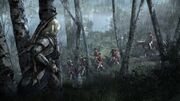 Connor watching a British patrol
 -
 Connor fighting three British soldiers in the snow
 -
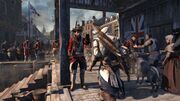 Connor being halted by a British soldier in the Boston docks
 -
 Connor killing two British soldiers
 -
 A British Army encampment in Boston

.jpg)
.jpg)
.jpg)


-
 British Regular
Early 18th cen. -
 British Grenadier
Early 18th cen. -
 British Gunner
Early 18th cen. -
 British Scout
Early 18th cen. -
 British Captain
Early 18th cen. -
 British Regular
Mid-18th cen. -
 British Grenadier
Mid-18th cen. -
 British Gunner
Mid-18th cen. -
 British Scout
Mid-18th cen. -
 British Captain
Mid-18th cen. -
 British Regulars
Late 18th cen. -
 British Grenadier
Late 18th cen. -
 British Officer
Late 18th cen.


Appearances[edit | edit source]
- Assassin's Creed III (first appearance)
- Assassin's Creed III: Liberation
- Assassin's Creed IV: Black Flag
- Assassin's Creed: Rogue
- Assassin's Creed: Syndicate
- Assassin's Creed Chronicles: India
- Assassin's Creed: Conspiracies
- Assassin's Creed: Fragments – The Blade of Aizu
- Assassin's Creed: Fragments – The Highlands Children
- Assassin's Creed: The Engine of History – The Magus Conspiracy
- Assassin's Creed: The Engine of History – The Resurrection Plot (mentioned only)
- Assassin's Creed: Forgotten Temple (mentioned only)
- Assassin's Creed: Nexus VR
References[edit | edit source]
- ↑
 Horse Guards (building) on Wikipedia
- ↑ 2.0 2.1 Assassin's Creed III
| |||||||||||||||||||||||||||||||||||||||||||
| ||||||||||||||||||||||||||||||||||
| |||||||||||||||||||||||||||||||||||||
| |||||||||||||||||||||||||||||||
| ||||||||||||||||||||||||||||
| |||||||||||||||||||||||||||||||
| ||||||||||||||||||||||||||||