


Wei Bin
Wei Bin (魏彬; 1461 – 1529), also known as The Snake, was one of the Eight Tigers, a group of powerful Templar eunuchs who controlled the Ming imperial court during the reign of the Zhengde Emperor. As the right-hand man of Zhang Yong, Wei Bin was placed in charge of the purge of the Chinese Assassins after the ascendance of the Jiajing Emperor in 1521.
Biography[edit | edit source]
Hunting the Assassins[edit | edit source]
Among the Eight Tigers, Wei Bin was renowned for his skills as a counter-spy, specializing in tracking, profiling, and corruption.[3] After Zhang Yong became the leader of the Tigers upon engineering Liu Jin's execution in 1510,[4] Wei Bin took a position as his right-hand man.[5]
Following the death of the Zhengde Emperor and the ascendance of his cousin Zhu Houcong to the throne, the Tigers influenced the newly-crowned Jiajing Emperor into launching a purge against his enemies, known as the Great Rites Controversy.[4]
The Templars used this purge as a cover to wipe out the Chinese Brotherhood of Assassins,[4] and Wei Bin was placed in charge of hunting down Assassins in the Forbidden City. He was able to identify and capture countless Assassins blending in with the population, who were subsequently tortured and executed.[3]
Death[edit | edit source]
Because of his actions during the purge, Wei Bin became a target of Shao Jun, one of the last surviving Chinese Assassins, who infiltrated the Tiger's stronghold in Nan'an in 1529.[5] Aware that Shao Jun had killed his fellow Tiger Gu Dayong three years prior, Wei Bin hoped that by eliminating her, he would rise up in the Templars' ranks, securing his and his wife's financial future and allowing them to live like royalty.[6]
.jpg)
In anticipation of Shao Jun's arrival, Wei Bin doubled the number of guards at his stronghold, but despite the increased security, the Assassin reached the Tiger's personal quarters and confronted him. Wei Bin pulled out his sword and dueled Shao Jun, but was eventually defeated when the Assassin slit his throat with her Hidden Footblade.[6]
In his final moments, Wei Bin taunted Shao Jun with the knowledge that Zhang Yong and Qiu Ju had lured her Mentor, Wang Yangming, into a trap,[6] and that Yangming was likely already dead, making Shao Jun the "last of her kind."[2]
Behind the scenes[edit | edit source]
Wei Bin is a historical character introduced as an antagonist and assassination target in the 2015 video game Assassin's Creed Chronicles: China. Historically, Wei Bin was made to retire from the Imperial court upon the Jiajing Emperor's ascension and died in his home on 15 July 1539.[1]
In Chinese, Wèi Bīn's name is 魏彬. The surname Wèi (魏) originates from the ancient Chinese state Wèi (魏) of the Warring States period and is largely meaningless. It was shared by several other later regimes, notably Cáo Wèi (曹魏) of the Three Kingdoms period and the Xianbei Tuòbá Wèi (拓跋魏) of the Northern and Southern dynasties period. The personal name, Bīn (彬), means 'cultured', 'elegant', and 'refined'.
In Assassin's Creed: Blade of Shao Jun, the 2019 manga adaptation of Chronicles: China, Wei Bin's death is portrayed slightly differently from the game. Rather than assassinate him on a balcony, Shao Jun confronts the Tiger and his wife in their chambers and engages Wei Bin in a duel that ends with his death.
Gallery[edit | edit source]
-
 Development concept
 -
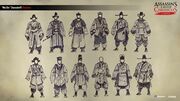 Concept sketches
 -
 Wei Bin flanked by two guards
 -
 Wei Bin's final moments
 -
 Wei Bin in Blade of Shao Jun


.jpg)

Appearances[edit | edit source]
- Assassin's Creed Chronicles: China (first appearance)
- Assassin's Creed: Blade of Shao Jun
- Assassin's Creed: The Ming Storm (non-canon)
- Assassin's Creed: Turbulence in the Ming Dynasty (non-canon)
References[edit | edit source]
- ↑ 1.0 1.1
 Wei Bin on Wikipedia
- ↑ 2.0 2.1 Assassin's Creed Chronicles: China – The Snake
- ↑ 3.0 3.1 Assassin's Creed Chronicles: China – Database: Wei Bin
- ↑ 4.0 4.1 4.2 Assassin's Creed Chronicles: China – Database: Zhang Yong
- ↑ 5.0 5.1 Assassin's Creed Chronicles: China – The Search
- ↑ 6.0 6.1 6.2 Assassin's Creed: Blade of Shao Jun – Trap
| |||||||||||||||||||||||||
| ||||||||||||||||||||||||||||