

Leon Trotsky
Leon Trotsky (Russian and Ukrainian: Лев Давидович Троцкий (Троцький); 1879 – 1940), born Lev Davidovich Bronstein (Russian and Ukrainian: Лев (Лейба) Давидович Бронштейн), was a Marxist revolutionary and theorist, a Soviet politician, and the founder of the Red Army. Trotsky's ideas formed the basis of Trotskyism, a major school of Marxism.[1]
Biography[edit | edit source]
Early life[edit | edit source]
Prior to becoming a revolutionary, Trotsky spent time in prison in 1898 for propagating revolutionary ideas and pamphlets during the Romanov dynasty. He soon joined the Bolsheviks before the start of the Russian Revolution and quickly became one of their leaders in the first Politburo founded in 1917, along with Vladimir Lenin and Joseph Stalin.[2]
During this time, Trotsky became a friend of the Russian Assassin Nikolai Orelov and was aware of the war between the Templars and Assassins, but he was not part of either order.[3] He also became the first leader of the Red Army after receiving the title of "People's Commissariat for Military and Naval Affairs."[2]
Kazan Operation[edit | edit source]
.jpg)
In September 1918, while overseeing the Kazan Operation, which had the goal of reclaiming the city of Kazan from the Czechoslovak Legion and the People's Army of Komuch, Trotsky was caught by surprise when Nikolai entered his home unannounced. Having heard rumors that Nikolai had rescued Tsar Nicholas II's daughter Anastasia from her family's execution, Trotsky asked if they were true, to which Nikolai revealed that Anastasia was under his protection.[3]
The Assassin then requested transportation to Moscow for himself and Anastasia, but Trotsky insisted that Nikolai bring the girl. When the latter refused, Trotsky remorsefully sold his friend to the Templars, who proceeded to take him captive and interrogate him for Anastasia's location.[3]
As Nikolai was being dragged away, Trotsky claimed that he did not care about the Assassins' conflict with the Templars and that the Revolution was all that mattered. Since Anastasia represented the last symbol of the Tsarist autocracy, Trotsky believed that she needed to die for the Revolution to succeed.[3] In the end, however, the Templars failed to find and kill Anastasia, who rescued Nikolai and escaped Kazan with him.[4]
Gallery[edit | edit source]
-
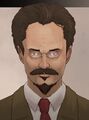 Concept art
 -
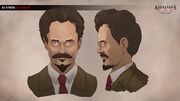 Moodboard Concept
 -
 Trotsky insisting that Nikolai bring Anastasia
 -
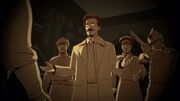 Trotsky betraying Nikolai to the Templars
 -
 Trotsky declaring the necessity of Anastasia's death


.jpg)
.jpg)
.jpg)
Appearances[edit | edit source]
References[edit | edit source]
