

Koh-i-Noor: Difference between revisions
imported>Soranin m already linked |
imported>Gener4l Cl4ank4 No edit summary |
||
| Line 1: | Line 1: | ||
{{Era|Technology|TWCB}}{{WP-REAL}} | {{Era|Technology|TWCB}}{{WP-REAL}} | ||
{{Quote| | {{Quote|He who owns this diamond will own the world, but will also know all its misfortunes. Only God, or a woman can wear it with impunity.|Hamid explaining the Koh-i-Noor's cursed legacy, 1839.|Assassin's Creed: Brahman}} | ||
{{Item Infobox | {{Item Infobox | ||
|name = Koh-i-Noor | |name = Koh-i-Noor | ||
|image = ACBM Koh-I-Noor Render.png | |image = ACBM Koh-I-Noor Render.png | ||
|type = [[Pieces of Eden|Piece of Eden]] | |type = [[Pieces of Eden|Piece of Eden]] | ||
|powers = * | |powers = *Binding other Pieces of Eden's fates | ||
* | *Harboring the consciousness of Durga | ||
* | *Generating tangible holograms and blats of energy | ||
*Locating other Pieces of Eden | *Locating other Pieces of Eden | ||
*Shield projection | *Shield projection | ||
*Ability to rebuild itself | *Ability to rebuild itself<ref name="tE.G2.0">''[[Assassin's Creed: The Essential Guide]]''</ref> | ||
|current = With [[Elijah]] | |current = With [[Elijah]] | ||
|period = *Prehistory | |period = *Prehistory | ||
*[[ | *[[Ottoman Empire]] | ||
*[[Sikh Empire]] | *[[Sikh Empire]] | ||
*[[ | *[[Spanish Civil War]] | ||
*[[Modern times]] | *[[Modern times]] | ||
|created = [[Isu]] | |created = [[Isu]] | ||
| Line 23: | Line 22: | ||
*[[Nāder Shāh]] | *[[Nāder Shāh]] | ||
*[[Ahmad Shāh Durrānī]] | *[[Ahmad Shāh Durrānī]] | ||
*[[Selim III]] | |||
*[[Jan van der Graff]] | |||
*[[Ranjit Singh]] | *[[Ranjit Singh]] | ||
*[[Arbaaz Mir]] | *[[Arbaaz Mir]] | ||
| Line 35: | Line 36: | ||
*[[Durga]] (? – ?)<ref name="Brahman" /> | *[[Durga]] (? – ?)<ref name="Brahman" /> | ||
*[[Shah Jahan]] (? – ?)<ref name="ACI">''[[Assassin's Creed: Initiates]]'' – [[Database: The Fiend Nadir Shah]]</ref> | *[[Shah Jahan]] (? – ?)<ref name="ACI">''[[Assassin's Creed: Initiates]]'' – [[Database: The Fiend Nadir Shah]]</ref> | ||
*[[Nāder Shāh]] (1739 – 1747)<ref name="Brahman" /> | *[[Nāder Shāh]] (1739 – 20 June 1747)<ref name="Brahman" /> | ||
*[[Ahmad Shāh Durrānī]] (1747 – ?)<ref name="Rogue">''[[Assassin's Creed: Rogue]]''</ref> | *[[Ahmad Shāh Durrānī]] (1747 – ?)<ref name="Rogue">''[[Assassin's Creed: Rogue]]'' – [[War Letters]]</ref> | ||
*[[Selim III]] (? – 1808)<ref name="Cross of War">''[[Assassin's Creed: Templars]]'' – [[Assassin's Creed Templars Volume 2: Cross of War|Volume 2: Cross of War]]</ref> | *[[Selim III]] (? – July 1808)<ref name="Cross of War">''[[Assassin's Creed: Templars]]'' – [[Assassin's Creed Templars Volume 2: Cross of War|Volume 2: Cross of War]]</ref> | ||
*[[Ahkbar]] (1808)<ref name="Cross of War" /> | *[[Ahkbar]] (July 1808)<ref name="Cross of War" /> | ||
*[[Jan van der Graff]] (1808 – ?)<ref name="Cross of War" /> | *[[Jan van der Graff]] (July 1808 – ?)<ref name="Cross of War" /> | ||
*[[Shah Shujah Durrani]] (? – 1830)<ref name="ACI" /> | *[[Shah Shujah Durrani]] (? – 1830)<ref name="ACI" /> | ||
*[[Ranjit Singh]] (1830 – 1839)<ref name="Brahman" /> | *[[Ranjit Singh]] (1830 – 27 June 1839)<ref name="Brahman" /> | ||
*[[Arbaaz Mir]] (1839)<ref name="Brahman" /> | *[[Arbaaz Mir]] (27 June 1839)<ref name="Brahman" /> | ||
*[[Raza Soora]] (1839)<ref name="Brahman" /> | *[[Raza Soora]] (27 June 1839)<ref name="Brahman" /> | ||
*[[Pyara Kaur]] (1839)<ref name="Brahman" /> | *[[Pyara Kaur]] (27 June 1839)<ref name="Brahman" /> | ||
* | *Arbaaz Mir (1839)<ref name="Chronicles India">''[[Assassin's Creed Chronicles: India]]''</ref> | ||
*[[Hamid (Amritsar)|Hamid]] (1839 – 1841)<ref name="Chronicles India" /> | |||
*[[William Sleeman]] and [[Alexander Burnes]] (1841)<ref name="Chronicles India" /> | *[[William Sleeman]] and [[Alexander Burnes]] (1841)<ref name="Chronicles India" /> | ||
*Arbaaz Mir (1841)<ref name="Chronicles India" /> | *Arbaaz Mir (1841)<ref name="Chronicles India" /> | ||
*[[Ethan Frye]] (1841 – ?)<ref name="Chronicles India" /> | *[[Ethan Frye]] (1841 – ?)<ref name="Chronicles India" /> | ||
*[[Albert Bolden]] (? – 1937)<ref name=" | *[[Albert Bolden]] (? – 1937)<ref name="ACUp" /> | ||
*[[Rufus Grosvenor]] (1937)<ref name="ACUp" /> | *[[Rufus Grosvenor]] (1937)<ref name="ACUp" /> | ||
*[[Instruments of the First Will]] ( | *[[Instruments of the First Will]] (August 2018)<ref name="ACUp" /> | ||
*[[Charlotte de la Cruz]] (2018)<ref name="ACUp" /> | *[[Charlotte de la Cruz]] (August 2018)<ref name="ACUp" /> | ||
*[[Elijah]] (2018 – | *[[Jasdip Dhami]] (August 2018)<ref name="ACUp" /> | ||
*Instruments of the First Will (August 2018)<ref name="ACUp" /> | |||
*[[Elijah]] (August 2018 – present)<ref name="ACUp" /> | |||
==History== | ==History== | ||
===Early history=== | ===Early history=== | ||
[[File:ACUp Juno & Koh-i-Noor.jpg|left|thumb|250px|Juno using the Koh-i-Noor]] | |||
During the [[Human-Isu War]], the Koh-i-Noor belonged to [[Juno]]. When her father's [[human]] [[Slavery|servants]] revolted and killed [[Saturn]], an enraged Juno used the artifact to burn to a cinder all the humans around them with blasts of blue energy.<ref name="ACUp"/> | During the [[Human-Isu War]], the Koh-i-Noor belonged to [[Juno]]. When her father's [[human]] [[Slavery|servants]] revolted and killed [[Saturn]], an enraged Juno used the artifact to burn to a cinder all the humans around them with blasts of blue energy.<ref name="ACUp"/> | ||
At some point the Koh-i-Noor | At some point, the Koh-i-Noor ended up in the possession of the Isu [[Durga]], who somehow imprinted her consciousness into the artifact.<ref name="Brahman" /> | ||
Following the extinction of the Isu civilization, the Koh-i-Noor passed through the hands of many dynasties on the [[India]]n subcontinent.<ref name="Brahman" /> | Following the [[Great Catastrophe|extinction]] of the Isu civilization, the Koh-i-Noor passed through the hands of many dynasties on the [[India]]n subcontinent. In 1730, it was acquired by [[Nāder Shāh]], the ruler of [[Iran]], after he sacked the {{Wiki|Taj Mahal}}.<ref name="Brahman" /> In June 1747, Nāder Shāh was killed by a group of [[Assassins]] led by [[Salah Bey]], and the Koh-i-Noor subsequently fell into the hands of [[Ahmad Shāh Durrānī|Ahmad Shāh]], an [[Afghanistan|Afghan]] chief.<ref name="Rogue" /> | ||
===Ottoman Empire=== | ===Ottoman Empire=== | ||
By the early 19th century, the Koh-i-Noor had ended up in the possession of the [[Ottoman Brotherhood of Assassins|Ottoman]] Sultan [[Selim III]]. At some point, the [[Black Cross]] [[Tavis Olier]] discovered the existence of the diamond and tried to recover the artifact but he disappeared and was presumed dead.<ref name="Cross of War" /> | |||
In 1805, [[Napoleon Bonaparte|Napoleon]] sent one of his agents, [[Jan van der Graff]], to steal the Koh-i-Noor from Selim but despite making an alliance with the new Black Cross, [[Solomon Bolden]], van der Graff failed and was captured. Thrown into the same cell as Olier, the Flemish was trained by the old [[Templars|Templar]] during the three years they spent together, until his escape in 1808. During his escape, van der Graff stole the Koh-i-Noor from under the nose of the [[Assassins]] sent to recover the Piece of Eden.<ref name=" | [[File:ACT Akhbar Koh-i-Noor.jpg|thumb|250px|Akhbar using the Koh-i-Noor]] | ||
In 1805, Emperor [[Napoleon Bonaparte|Napoleon]] of [[France]] sent one of his agents, the [[Belgium|Flemish]] [[Jan van der Graff]], to steal the Koh-i-Noor from Selim but despite making an alliance with the new Black Cross, [[Solomon Bolden]], van der Graff failed and was captured. Thrown into the same cell as Olier, the Flemish was trained by the old [[Templars|Templar]] during the three years they spent together in captivity, until his escape in July 1808. During his escape, van der Graff stole the Koh-i-Noor from under the nose of the [[Libyan Brotherhood of Assassins|Libyan Assassins]] sent to recover the Piece of Eden.<ref name="Cross of War" /> | |||
===Sikh Empire=== | ===Sikh Empire=== | ||
Eventually, the diamond found its way back to India, into the hands of [[Ranjit Singh]], the founder of the [[Sikh Empire]]. Wary of the artifact's curse and its power, Singh decided to hide it in an ancient [[Amritsar Temple|temple]] located beneath his [[Ranjit Singh's summer palace|summer palace]].<ref name="Brahman" /> | {{Quote|Take good care of it, Ethan. It is truly unique; it would be a shame if its fate was to remain hidden in a safe.|Arbaaz Mir to Ethan Frye, after giving him the Koh-i-Noor, 1841.|Assassin's Creed Chronicles: India|The Rescue (India)}} | ||
Eventually, the diamond found its way back to India, into the hands of [[Ranjit Singh]], the founder of the [[Sikh Empire]]. Wary of the artifact's curse and its power, Singh decided to hide it in an ancient [[Amritsar Temple|temple]] located beneath his [[Ranjit Singh's summer palace|summer palace]] in [[Anbar]]. In June 1839, the Piece of Eden was stolen by the Assassin [[Arbaaz Mir]] and hidden on [[Raza Soora]]'s person, who later gave it to Singh's granddaughter [[Pyara Kaur]]. As Pyara attempted to leave the palace palace after her grandfather's assassination, the princess was set upon by the [[British Rite of the Templar Order|British Templar]] [[Francis Cotton]].<ref name="Brahman" /> | |||
[[File:Durga Koh-i-Noor.jpg|left|thumb|250px|Durga appearing from the Koh-i-Noor]] | |||
To defend her, Raza clawed at Cotton's forehead with his nails, giving Pyara enough time to activate the Piece of Eden. Suddenly possessed by Durga's spirit, the being gave a statement referring to [[Humans|humanity]] as "splintered", but that the race was guided through messages left behind by their own across time. Horrified at the appearance of the Isu, Cotton fired multiple shots at Durga, though upon striking the Koh-i-Noor with a bullet, the diamond shattered and severed Pyara's connection to the Isu.<ref name="Brahman" /> | |||
As Arbaaz shielded Raza from the blast, the force of the energy's release gave form to a tiger, which brutally savaged Cotton, leading to the Templar's demise. After the Koh-i-Noor reconstructed itself,<ref name="Brahman" /> the Piece of Eden was claimed by Arbaaz, who on Pyara's advice later gave it to his [[Mentor]], [[Hamid (Amritsar)|Hamid]], for safekeeping.<ref name="Chronicles India" /> | |||
In 1841, Hamid was captured by the Templars [[William Sleeman]] and [[Alexander Burnes]], who sought to use the Koh-i-Noor to power a [[Precursor boxes|Precursor box]] in their possession and uncover the locations of various [[Temple (Isu)|Isu temples]]. Both artifacts were eventually reclaimed by Arbaaz at the [[Katasraj Temple]] in [[Pakistan]], but in response, Sleeman laid siege to the summer palace in Amritsar, taking Pyara hostage. During the subsequent confrontation, the Precursor box ended up back in the Templar's hands, but Arbaaz and Pyara were able to escape unharmed with the Koh-i-Noor in their possession.<ref name="Chronicles India" /> | |||
[[File:ACCI Rescue (9).jpg|thumb|250px|Arbaaz giving the Koh-i-Noor to Ethan Frye]] | |||
Arbaaz would later hand over the diamond to the [[British Brotherhood of Assassins|British Assassin]] [[Ethan Frye]], trusting him to keep it safe.<ref name="Chronicles India" /> Ethan hid the artifact somewhere in India where it remained until the end of the 19th century.<ref name="TLM">''[[Assassin's Creed: Syndicate]]'' – ''[[The Last Maharaja]]'' – [[The Great Jewel Heist]]</ref> | |||
In 1850, a replica of the diamond was confiscated by the British [[East India Company]] and became part of the British Crown Jewels when [[Victoria, Queen of the United Kingdom|Queen Victoria]] was proclaimed Empress of India in 1877.<ref name="Brahman" /> Another replica was stolen from the [[Tower of London]] in 1868 by the Assassins [[Jacob Frye|Jacob]] and [[Evie Frye]] at the request of [[Duleep Singh]], the last Maharaja of the Sikh Empire, before [[Jayadeep Mir|Henry Green]] informed them that the real Koh-i-Noor had never left India thanks to his father Arbaaz's efforts.<ref name="TLM" /> | |||
===Spanish Civil War=== | |||
By the early 20th century, the Koh-i-Noor was in the possession of the Black Cross [[Albert Bolden]], who secreted the artifact in a [[Switzerland|Swiss]] bank. After Bolden's 'death' in 1927,<ref name="Black Cross">''[[Assassin's Creed: Templars]]'' – [[Assassin's Creed Templars Volume 1: Black Cross|Volume 1: Black Cross]]</ref> his fellow Templar [[Rufus Grosvenor]], a member of the [[Instruments of the First Will]], discovered that he was in fact alive and tried to blackmail Bolden into giving him the diamond but to no avail. Eventually, Grosvenor stole the Koh-i-Noor from Bolden in 1937, after killing his family and luring him into a trap.<ref name="ACUp" /> | |||
[[File:ACU Koh-i-Noor powers.jpg|left|thumb|230px|Cardona unleashing the Koh-i-Noor's power]] | |||
Grosvenor fled to [[Spain]], which was in the middle of a [[Spanish Civil War|civil war]], where the Templar hoped to manipulate the Spanish Assassin [[Ignacio Cardona]] into unlocking the powers of Koh-i-Noor thanks to the Assassin's great concentration of Isu DNA. However, after an initial success, despite Cardona being almost consummed by the unleashed powers of the artifact, Grosvenor's progress were halted by the intervention of a vengeful Bolden, whom hunted him to Spain.<ref name="ACUp" /> | |||
Bolden, together with Cardona, eventually confronted Grosvernor in a wrecked church, who convinced the latter to use the jewel and unleash its powers. However, Grosvernor's plan backfired when the Assassin directed the jewel towards him, unleashing a series of energy beams which engulfed the village and caused the church to collapse above them.<ref name="ACUp" /> | |||
Though the Koh-i-Noor was thought to have been destroyed, it was in fact still intact, as Cardona had created an illusion to make it seemed that it was destroyed. With the collapse of the church, the artifact remained buried deep within the ruins for the next century.<ref name="ACUp" /> | |||
=== | ===Modern times=== | ||
In 2013, after his raid on the Assassin hideout in [[Mumbai]], the Templar [[Juhani Otso Berg]] discovered that Bolden | In November 2013, after his raid on the Assassin hideout in [[Mumbai]],<ref name="Brahman" /> the Templar [[Juhani Otso Berg]] discovered that Albert Bolden had come into contact with the Koh-i-Noor at some point during his life. The Order then tried to find one of his descendants to learn more about the artifact and its location.<ref name="Black Cross" /> | ||
In 2016, the Templars found [[André Bolden]] in [[Philadelphia, United States|Philadelphia]] and convinced the old man to work with them to explore the memory of his ancestor during the 19th century. However, Juno's [[Instruments of the First Will|followers]] who had infiltrated the ranks of the Templars tried to kill Bolden to prevent the Order from recovering the Piece of Eden before them. He was saved by Berg, who, realizing that a fifth column was attacking the Templars from within, put the search for the diamond on hold while tracking the moles as the new [[Black Cross]].<ref name=" | In 2016, the Templars found [[André Bolden]] in [[Philadelphia, United States|Philadelphia]] and convinced the old man to work with them to explore the memory of his ancestor during the 19th century. However, Juno's [[Instruments of the First Will|followers]] who had infiltrated the ranks of the Templars tried to kill Bolden to prevent the Order from recovering the Piece of Eden before them. He was saved by Berg, who, realizing that a fifth column was attacking the Templars from within, put the search for the diamond on hold while tracking the moles as the new [[Black Cross]].<ref name="Cross of War" /> | ||
In March 2017, Juno, who wanted to recover the Koh-i-Noor, infiltrated the Animus in which [[Charlotte de la Cruz]] was rendered catatonic after [[Guernica Moneo]], an Instrument mole among the Assassins, sabotaged the device. Exploring the Assassin's bloodline, the disembodied Isu discovered that the diamond was last seen during the | In March 2017, Juno, who wanted to recover the Koh-i-Noor, infiltrated the Animus in which [[Charlotte de la Cruz]] was rendered catatonic after [[Guernica Moneo]], an Instrument mole among the Assassins, sabotaged the device. Exploring the Assassin's bloodline, the disembodied Isu discovered that the diamond was last seen during the Spanish Civil War. A race against the clock then began between the Assassins, the Instruments but also the Templars to find the diamond first.<ref name="ACUp" /> | ||
Eventually, the location of the artifact was found by Berg, who had relived Albert Bolden's memories during his time in the Spanish Civil War. In 2018, together with Charlotte and the Assassins, he made his way to the resting place of the jewel, intending to | [[File:ACU Charlotte Activates Koh-i-Noor.jpg|thumb|270px|Charlotte activating the Koh-i-Noor]] | ||
Eventually, the location of the artifact was found by Berg, who had relived Albert Bolden's memories during his time in the Spanish Civil War. In August 2018, together with Charlotte and the Assassins, he made his way to the resting place of the jewel, intending to retrieve it before the Instruments. However, the group were forced to fight the guardians appointed by Ignacio Cardona and Bolden to protect the site, and ultimately lost the artifact to the former Assassin [[Jasdip Dhami]], who had defected to the Instruments.<ref name="ACUp" /> | |||
Dhami took the Koh-i-Noor to the [[Phoenix Project]] [[Abstergo Industries Australia facility|facility]] in [[Australia]], which had been taken over by the Instruments with the goal of resurrecting Juno in a new body created from the DNA of [[Elijah]], a young [[Sage]]. Ultimately, [[Violet da Costa]]'s fears that Elijah was not to be trusted were proven right when the boy took revenge on the Instruments for murdering his [[Elijah's mother|mother]] by assisting the Assassins and Berg during their attack on the facility. Using the Koh-i-Noor, Elijah created an illusion of [[Consus]] to distract Juno, allowing her to be assassinated by Charlotte. He then fled with the diamond, moments before the facility was destroyed by Berg to eliminate any remaining Instruments.<ref name="ACUp" /> | |||
==Precursor statement== | ==Precursor statement== | ||
{{Quote|We are one of many but essential to the unity of all. Splintered though we may appear within the limited notion of this moment, we exist as one, as we always have and always will. You have been fragmented, children, but know that you are also whole. Do not allow your concept of time to act as a paralyzing veil when the fate of all you hold dear rests in your hands. We speak through this vessel to you, this time and medium and anchor that we might commune. We must exist freely at all points for your race, our children, to exist and to remain free. Shroud this intelligent lens until you become united and can realize this heart, our heart, to be the one that endowed your precious breath. And never doubt the lengths to which we will go to protect what is precious to us.|Durga, whilst possessing Pyara Kaur, 1839.}} | {{Quote|We are one of many but essential to the unity of all. Splintered though we may appear within the limited notion of this moment, we exist as one, as we always have and always will. You have been fragmented, children, but know that you are also whole. Do not allow your concept of time to act as a paralyzing veil when the fate of all you hold dear rests in your hands. We speak through this vessel to you, this time and medium and anchor that we might commune. We must exist freely at all points for your race, our children, to exist and to remain free. Shroud this intelligent lens until you become united and can realize this heart, our heart, to be the one that endowed your precious breath. And never doubt the lengths to which we will go to protect what is precious to us.|Durga, whilst possessing Pyara Kaur, 1839.|Assassin's Creed: Brahman}} | ||
==Behind the scenes== | ==Behind the scenes== | ||
At the end of ''[[Assassin's Creed: Brahman]]'', [[Jot Soora]] is shown giving a diamond engagement ring to [[Monima Das]] as a reference to the Koh-i-Noor. However, [[Karl Kerschl]], one of the comic's writers, confirmed the objects are unrelated.<ref>{{Twitter|karlkerschl|status/622484039597821953|Karl Kerschl|quote=@Tomi282 just a reference. Jot would have to have been extremely lucky to stumble across a real piece. :)|image=File:Karl Kerschl Twitter - Koh-i-Noor Jot Soora.png}}</ref> | At the end of ''[[Assassin's Creed: Brahman]]'', [[Jot Soora]] is shown giving a diamond engagement ring to [[Monima Das]] as a reference to the Koh-i-Noor. However, [[Karl Kerschl]], one of the comic's writers, confirmed the objects are unrelated.<ref>{{Twitter|karlkerschl|status/622484039597821953|Karl Kerschl|quote=@Tomi282 just a reference. Jot would have to have been extremely lucky to stumble across a real piece. :)|image=File:Karl Kerschl Twitter - Koh-i-Noor Jot Soora.png}}</ref> | ||
Historically the Koh-i-Noor stayed in the possession of the Durrani dynasty from 1747 until 1813 when Ahmad Shah's grandson Shah Shujah Durrani lost it to Ranjit Singh. | Historically, the Koh-i-Noor stayed in the possession of the Durrani dynasty from 1747 until 1813 when Ahmad Shah's grandson Shah Shujah Durrani lost it to Ranjit Singh.<ref name="Wiki">{{WP|Koh-i-Noor}}</ref> | ||
Even if the diamond can project solid illusions as well as voices, the copies do not fully interact with the environment. Jan van der Graff used this to his advantage when Akhbar created several copies of himself, by hearing the noises made by the rogue Assassin's shoes on the floor and determining which of the Akhbars was the original. He then killed Akhbar and the illusions disappeared.<ref name=" | Even if the diamond can project solid illusions as well as voices, the copies do not fully interact with the environment. Jan van der Graff used this to his advantage when Akhbar created several copies of himself, by hearing the noises made by the rogue Assassin's shoes on the floor and determining which of the Akhbars was the original. He then killed Akhbar and the illusions disappeared.<ref name="Cross of War" /> <!---(Needs to be incorporated into the actual article) !---> | ||
==Gallery== | ==Gallery== | ||
<gallery captionalign="center" position="center | <gallery captionalign="center" position="center" widths="180"> | ||
ACS Koh-I-Noor Brooch Exploration Sketches.jpg|Concept artwork | |||
NadirShah.jpg| | NadirShah.jpg|Nāder Shāh observing the Koh-i-Noor | ||
ACBH Pyara with Koh-i-Noor.jpg|Pyara Kaur activating the Koh-i-Noor | ACBH Pyara with Koh-i-Noor.jpg|Pyara Kaur activating the Koh-i-Noor | ||
ACBM-Koh-i-Noor destroyed.jpg|The Koh-i-Noor shattering | |||
ACCI Quest Begins (3).jpg|William Sleeman holding the Koh-i-Noor | |||
ACCI Rescue (8).jpg|Arbaaz and Pyara with the Koh-i-Noor | ACCI Rescue (8).jpg|Arbaaz and Pyara with the Koh-i-Noor | ||
ACUprising Ignacio using the Koh-i-Noor.jpg| | ACUprising Ignacio using the Koh-i-Noor.jpg|Ignacio Cardona using the Koh-i-Noor against Rufus Grosvenor | ||
ACUprising Koh-i-Noor's projections.jpg|The Koh-i-Noor projecting animal-like apparitions | ACUprising Koh-i-Noor's projections.jpg|The Koh-i-Noor projecting animal-like apparitions | ||
</gallery> | </gallery> | ||
| Line 131: | Line 140: | ||
*''[[Assassin's Creed Chronicles: India]]'' | *''[[Assassin's Creed Chronicles: India]]'' | ||
*''[[Assassin's Creed: Underworld]]'' {{Mo}} | *''[[Assassin's Creed: Underworld]]'' {{Mo}} | ||
*''[[Assassin's Creed: Syndicate]]'' – ''[[The Last Maharaja]]'' {{ | *''[[Assassin's Creed: Syndicate]]'' – ''[[The Last Maharaja]]'' {{c|replica only}} | ||
*''[[Assassin's Creed: Templars]]'' | *''[[Assassin's Creed: Templars]]'' | ||
*''[[Assassin's Creed: Uprising]]'' | *''[[Assassin's Creed: Uprising]]'' | ||
| Line 139: | Line 148: | ||
==References== | ==References== | ||
{{Reflist}} | {{Reflist}} | ||
{{Isu}} | |||
{{ACBM}} | {{ACBM}} | ||
{{ACC}} | {{ACC}} | ||
{{ACTemplars}} | {{ACTemplars}} | ||
{{ACUprising}} | {{ACUprising}} | ||
[[fr:Koh-I-Noor]] | |||
[[zh:光之山]] | [[zh:光之山]] | ||
[[Category:Pieces of Eden]] | [[Category:Pieces of Eden]] | ||
[[Category:Hindu mythology]] | [[Category:Hindu mythology]] | ||
Revision as of 00:04, 8 April 2024
- "He who owns this diamond will own the world, but will also know all its misfortunes. Only God, or a woman can wear it with impunity."
- ―Hamid explaining the Koh-i-Noor's cursed legacy, 1839.[src]
The Koh-i-Noor (English: Mountain of Light), or Syamantaka Mani as it was formerly known, is a Piece of Eden in the form of a diamond that holds such an immense amount of power that it can bind all of the other Pieces' fates. It was rumored that only God or women could control its power.[2] The artifact is also capable of locating other Pieces of Eden.[3]
Owners
- Isu (? – ?)[2]
- Juno (c. 75010 BC)[4]
- Durga (? – ?)[2]
- Shah Jahan (? – ?)[5]
- Nāder Shāh (1739 – 20 June 1747)[2]
- Ahmad Shāh Durrānī (1747 – ?)[6]
- Selim III (? – July 1808)[7]
- Ahkbar (July 1808)[7]
- Jan van der Graff (July 1808 – ?)[7]
- Shah Shujah Durrani (? – 1830)[5]
- Ranjit Singh (1830 – 27 June 1839)[2]
- Arbaaz Mir (27 June 1839)[2]
- Raza Soora (27 June 1839)[2]
- Pyara Kaur (27 June 1839)[2]
- Arbaaz Mir (1839)[8]
- Hamid (1839 – 1841)[8]
- William Sleeman and Alexander Burnes (1841)[8]
- Arbaaz Mir (1841)[8]
- Ethan Frye (1841 – ?)[8]
- Albert Bolden (? – 1937)[4]
- Rufus Grosvenor (1937)[4]
- Instruments of the First Will (August 2018)[4]
- Charlotte de la Cruz (August 2018)[4]
- Jasdip Dhami (August 2018)[4]
- Instruments of the First Will (August 2018)[4]
- Elijah (August 2018 – present)[4]
History
Early history

During the Human-Isu War, the Koh-i-Noor belonged to Juno. When her father's human servants revolted and killed Saturn, an enraged Juno used the artifact to burn to a cinder all the humans around them with blasts of blue energy.[4]
At some point, the Koh-i-Noor ended up in the possession of the Isu Durga, who somehow imprinted her consciousness into the artifact.[2]
Following the extinction of the Isu civilization, the Koh-i-Noor passed through the hands of many dynasties on the Indian subcontinent. In 1730, it was acquired by Nāder Shāh, the ruler of Iran, after he sacked the Taj Mahal.[2] In June 1747, Nāder Shāh was killed by a group of Assassins led by Salah Bey, and the Koh-i-Noor subsequently fell into the hands of Ahmad Shāh, an Afghan chief.[6]
Ottoman Empire
By the early 19th century, the Koh-i-Noor had ended up in the possession of the Ottoman Sultan Selim III. At some point, the Black Cross Tavis Olier discovered the existence of the diamond and tried to recover the artifact but he disappeared and was presumed dead.[7]

In 1805, Emperor Napoleon of France sent one of his agents, the Flemish Jan van der Graff, to steal the Koh-i-Noor from Selim but despite making an alliance with the new Black Cross, Solomon Bolden, van der Graff failed and was captured. Thrown into the same cell as Olier, the Flemish was trained by the old Templar during the three years they spent together in captivity, until his escape in July 1808. During his escape, van der Graff stole the Koh-i-Noor from under the nose of the Libyan Assassins sent to recover the Piece of Eden.[7]
Sikh Empire
Eventually, the diamond found its way back to India, into the hands of Ranjit Singh, the founder of the Sikh Empire. Wary of the artifact's curse and its power, Singh decided to hide it in an ancient temple located beneath his summer palace in Anbar. In June 1839, the Piece of Eden was stolen by the Assassin Arbaaz Mir and hidden on Raza Soora's person, who later gave it to Singh's granddaughter Pyara Kaur. As Pyara attempted to leave the palace palace after her grandfather's assassination, the princess was set upon by the British Templar Francis Cotton.[2]

To defend her, Raza clawed at Cotton's forehead with his nails, giving Pyara enough time to activate the Piece of Eden. Suddenly possessed by Durga's spirit, the being gave a statement referring to humanity as "splintered", but that the race was guided through messages left behind by their own across time. Horrified at the appearance of the Isu, Cotton fired multiple shots at Durga, though upon striking the Koh-i-Noor with a bullet, the diamond shattered and severed Pyara's connection to the Isu.[2]
As Arbaaz shielded Raza from the blast, the force of the energy's release gave form to a tiger, which brutally savaged Cotton, leading to the Templar's demise. After the Koh-i-Noor reconstructed itself,[2] the Piece of Eden was claimed by Arbaaz, who on Pyara's advice later gave it to his Mentor, Hamid, for safekeeping.[8]
In 1841, Hamid was captured by the Templars William Sleeman and Alexander Burnes, who sought to use the Koh-i-Noor to power a Precursor box in their possession and uncover the locations of various Isu temples. Both artifacts were eventually reclaimed by Arbaaz at the Katasraj Temple in Pakistan, but in response, Sleeman laid siege to the summer palace in Amritsar, taking Pyara hostage. During the subsequent confrontation, the Precursor box ended up back in the Templar's hands, but Arbaaz and Pyara were able to escape unharmed with the Koh-i-Noor in their possession.[8]
.jpg)
Arbaaz would later hand over the diamond to the British Assassin Ethan Frye, trusting him to keep it safe.[8] Ethan hid the artifact somewhere in India where it remained until the end of the 19th century.[9]
In 1850, a replica of the diamond was confiscated by the British East India Company and became part of the British Crown Jewels when Queen Victoria was proclaimed Empress of India in 1877.[2] Another replica was stolen from the Tower of London in 1868 by the Assassins Jacob and Evie Frye at the request of Duleep Singh, the last Maharaja of the Sikh Empire, before Henry Green informed them that the real Koh-i-Noor had never left India thanks to his father Arbaaz's efforts.[9]
Spanish Civil War
By the early 20th century, the Koh-i-Noor was in the possession of the Black Cross Albert Bolden, who secreted the artifact in a Swiss bank. After Bolden's 'death' in 1927,[10] his fellow Templar Rufus Grosvenor, a member of the Instruments of the First Will, discovered that he was in fact alive and tried to blackmail Bolden into giving him the diamond but to no avail. Eventually, Grosvenor stole the Koh-i-Noor from Bolden in 1937, after killing his family and luring him into a trap.[4]
Grosvenor fled to Spain, which was in the middle of a civil war, where the Templar hoped to manipulate the Spanish Assassin Ignacio Cardona into unlocking the powers of Koh-i-Noor thanks to the Assassin's great concentration of Isu DNA. However, after an initial success, despite Cardona being almost consummed by the unleashed powers of the artifact, Grosvenor's progress were halted by the intervention of a vengeful Bolden, whom hunted him to Spain.[4]
Bolden, together with Cardona, eventually confronted Grosvernor in a wrecked church, who convinced the latter to use the jewel and unleash its powers. However, Grosvernor's plan backfired when the Assassin directed the jewel towards him, unleashing a series of energy beams which engulfed the village and caused the church to collapse above them.[4]
Though the Koh-i-Noor was thought to have been destroyed, it was in fact still intact, as Cardona had created an illusion to make it seemed that it was destroyed. With the collapse of the church, the artifact remained buried deep within the ruins for the next century.[4]
Modern times
In November 2013, after his raid on the Assassin hideout in Mumbai,[2] the Templar Juhani Otso Berg discovered that Albert Bolden had come into contact with the Koh-i-Noor at some point during his life. The Order then tried to find one of his descendants to learn more about the artifact and its location.[10]
In 2016, the Templars found André Bolden in Philadelphia and convinced the old man to work with them to explore the memory of his ancestor during the 19th century. However, Juno's followers who had infiltrated the ranks of the Templars tried to kill Bolden to prevent the Order from recovering the Piece of Eden before them. He was saved by Berg, who, realizing that a fifth column was attacking the Templars from within, put the search for the diamond on hold while tracking the moles as the new Black Cross.[7]
In March 2017, Juno, who wanted to recover the Koh-i-Noor, infiltrated the Animus in which Charlotte de la Cruz was rendered catatonic after Guernica Moneo, an Instrument mole among the Assassins, sabotaged the device. Exploring the Assassin's bloodline, the disembodied Isu discovered that the diamond was last seen during the Spanish Civil War. A race against the clock then began between the Assassins, the Instruments but also the Templars to find the diamond first.[4]
Eventually, the location of the artifact was found by Berg, who had relived Albert Bolden's memories during his time in the Spanish Civil War. In August 2018, together with Charlotte and the Assassins, he made his way to the resting place of the jewel, intending to retrieve it before the Instruments. However, the group were forced to fight the guardians appointed by Ignacio Cardona and Bolden to protect the site, and ultimately lost the artifact to the former Assassin Jasdip Dhami, who had defected to the Instruments.[4]
Dhami took the Koh-i-Noor to the Phoenix Project facility in Australia, which had been taken over by the Instruments with the goal of resurrecting Juno in a new body created from the DNA of Elijah, a young Sage. Ultimately, Violet da Costa's fears that Elijah was not to be trusted were proven right when the boy took revenge on the Instruments for murdering his mother by assisting the Assassins and Berg during their attack on the facility. Using the Koh-i-Noor, Elijah created an illusion of Consus to distract Juno, allowing her to be assassinated by Charlotte. He then fled with the diamond, moments before the facility was destroyed by Berg to eliminate any remaining Instruments.[4]
Precursor statement
- "We are one of many but essential to the unity of all. Splintered though we may appear within the limited notion of this moment, we exist as one, as we always have and always will. You have been fragmented, children, but know that you are also whole. Do not allow your concept of time to act as a paralyzing veil when the fate of all you hold dear rests in your hands. We speak through this vessel to you, this time and medium and anchor that we might commune. We must exist freely at all points for your race, our children, to exist and to remain free. Shroud this intelligent lens until you become united and can realize this heart, our heart, to be the one that endowed your precious breath. And never doubt the lengths to which we will go to protect what is precious to us."
- ―Durga, whilst possessing Pyara Kaur, 1839.[src]
Behind the scenes
At the end of Assassin's Creed: Brahman, Jot Soora is shown giving a diamond engagement ring to Monima Das as a reference to the Koh-i-Noor. However, Karl Kerschl, one of the comic's writers, confirmed the objects are unrelated.[11]
Historically, the Koh-i-Noor stayed in the possession of the Durrani dynasty from 1747 until 1813 when Ahmad Shah's grandson Shah Shujah Durrani lost it to Ranjit Singh.[12]
Even if the diamond can project solid illusions as well as voices, the copies do not fully interact with the environment. Jan van der Graff used this to his advantage when Akhbar created several copies of himself, by hearing the noises made by the rogue Assassin's shoes on the floor and determining which of the Akhbars was the original. He then killed Akhbar and the illusions disappeared.[7]
Gallery
-
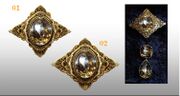 Concept artwork
 -
 Nāder Shāh observing the Koh-i-Noor
 -
 Pyara Kaur activating the Koh-i-Noor
 -
 The Koh-i-Noor shattering
 -
 William Sleeman holding the Koh-i-Noor
 -
 Arbaaz and Pyara with the Koh-i-Noor
 -
 Ignacio Cardona using the Koh-i-Noor against Rufus Grosvenor
 -
 The Koh-i-Noor projecting animal-like apparitions


.jpg)
.jpg)


Appearances
- Assassin's Creed: Brahman (first appearance)
- Assassin's Creed: Rogue (mentioned only)
- Assassin's Creed: Initiates (mentioned in Database entry only)
- Assassin's Creed Chronicles: India
- Assassin's Creed: Underworld (mentioned only)
- Assassin's Creed: Syndicate – The Last Maharaja (replica only)
- Assassin's Creed: Templars
- Assassin's Creed: Uprising
- Assassin's Creed: The Official Collection
- Assassin's Creed: Odyssey (mentioned only)
References
- ↑ Assassin's Creed: The Essential Guide
- ↑ 2.00 2.01 2.02 2.03 2.04 2.05 2.06 2.07 2.08 2.09 2.10 2.11 2.12 2.13 2.14 Assassin's Creed: Brahman
- ↑ Assassin's Creed: The Official Collection - Issue 17
- ↑ 4.00 4.01 4.02 4.03 4.04 4.05 4.06 4.07 4.08 4.09 4.10 4.11 4.12 4.13 4.14 4.15 Assassin's Creed: Uprising
- ↑ 5.0 5.1 Assassin's Creed: Initiates – Database: The Fiend Nadir Shah
- ↑ 6.0 6.1 Assassin's Creed: Rogue – War Letters
- ↑ 7.0 7.1 7.2 7.3 7.4 7.5 7.6 Assassin's Creed: Templars – Volume 2: Cross of War
- ↑ 8.0 8.1 8.2 8.3 8.4 8.5 8.6 8.7 Assassin's Creed Chronicles: India
- ↑ 9.0 9.1 Assassin's Creed: Syndicate – The Last Maharaja – The Great Jewel Heist
- ↑ 10.0 10.1 Assassin's Creed: Templars – Volume 1: Black Cross
- ↑
 Karl Kerschl (@karlkerschl) on Twitter "@Tomi282 just a reference. Jot would have to have been extremely lucky to stumble across a real piece. :)" (screenshot)
- ↑
 Koh-i-Noor on Wikipedia


| |||||||||||||||||||||||||
| |||||||||||||||||||||||||||||||
| ||||||||||||||||||||||||||||
| ||||||||||||||||||||||||||||||||||