-
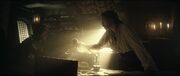 Aguilar giving the Apple to Christoffa
 -
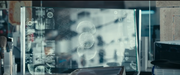 Abstergo Industries' HUD analysis of the Apple
 -
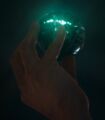 Alan Rikkin holding the Apple with its shell open
 -
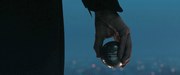 Callum holding the Apple
 -
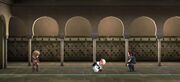 Torquemada dropping the Apple, as depicted in Rebellion
Welcome to Assassin's Creed Wiki! Log in and join the community.


Aguilar's Apple of Eden
Jump to navigation
Jump to search

|
I wanted to ask you something. Which is... what's your name? This article title is conjecture. Although the article subject is canon, no official name for it has been given. |
- "If the Apple falls into their hands, the Templars will destroy everything that stands in their way. Protest, dissent... our right to think for ourselves."
- ―Benedicto, 1492.[src]
Aguilar's Apple of Eden is one of several Apples of Eden, ancient pieces of technology created by the Isu, primarily to control their workforce, the humans.
This particular Apple was recovered by the Spanish Assassin Aguilar de Nerha during the Reconquista, after preventing the Spanish Templars under Tomás de Torquemada from acquiring it. It was then given to the navigator Christoffa Corombo, who would ultimately be buried with it, and recovered in modern times by Abstergo Industries, until Aguilar's descendant Callum Lynch retrieved it.
Owners[edit | edit source]
- Isu (until 75,000 BCE)[1]
- Muhammad XII (until 1492)[2]
- Tomás de Torquemada (1492)[2]
- Aguilar de Nerha (1492)[2]
- Christoffa Corombo (1492 – 1506)[2]
- Alan Rikkin (2016)[2]
- Callum Lynch (since 2016)[2]
Description[edit | edit source]
The Apple of Eden that came into Aguilar de Nerha's possession is a small, metallic sphere encased within a large protective shell that in proper light resembles amber and is semi-transparent. Even with this protective shell removed, the artifact is fully functional, except that onlookers can still see the Apple opening when it activates.[2]
History[edit | edit source]
Reconquista[edit | edit source]
The first known human to possess this Apple was the Sultan of the Emirate of Granada, Muhammad XII, an ally of the Spanish Assassins.[3] The Sultan did not make overt use of the Apple and risked losing both the artifact and his kingdom during his conflict against the Christian kingdoms of Iberia, Castile and Aragon.[2]

In 1492, the Templars, led by the Grand Inquisitor and Master Templar Tomás de Torquemada, kidnapped the young prince Ahmed. They tried to ransom Ahmed for the Apple,[2][3] intending to combine it with the Shattered Staff of Eden that they also searched for and gain control of all of Spain.[4] Fearing for his son's safety, Muhammad XII accepted the deal and set up a meeting with the Templars after the fall of Granada.[2]
Before the exchange could take place, the Assassins Aguilar de Nerha and María intervened and battled Torquemada's guards. This ultimately led to the death of María and Ojeda, Torquemada's right-hand man, and Aguilar seizing the artifact.[2][3] Aguilar in turn gave the Apple to the Italian explorer Christoffa Corombo, another ally of the Brotherhood, for safekeeping. Christoffa swore to take the artifact to his grave and eventually did so, being interred with it in the Seville Cathedral.[2]
Modern times[edit | edit source]
In October 2016, the Apple was among the many Pieces of Eden sought by the Templars. They hoped that this particular Apple could provide the means to suppress humanity's violent tendencies, eliminate the free will of humanity altogether, and finally eradicate the last remnants of the Assassin Brotherhood. To this end, the Templars, under their guise of Abstergo Industries, captured several descendants of different Assassins, among them Callum Lynch, a descendant of Aguilar, and used them to explore their ancestors' memories.[2]

Though Alan Rikkin, CEO of Abstergo Industries and a member of the Templar Inner Sanctum, successfully recovered the Apple from Christoffa's tomb, Callum and other Abstergo prisoners managed to break out. Callum then hunted down Rikkin, reaching him in London, where Rikkin was presenting the Apple to the Council of Elders at the Holborn Hall. Callum used the skills he had learned via the Bleeding Effect to sneak up on the Grand Master and kill him with his Hidden Blade, reclaiming the Apple for the Assassins.[2]
Behind the scenes[edit | edit source]
When Alan Rikkin presents the Apple of Eden to the Council of Elders, it emits an eerie bright green energy, which is a stark contrast to the golden yellow energy emitted by the Apples previously seen in the franchise. An in-universe explanation for this discrepancy has yet to be given.
During the film's production, the Apple underwent an intricate design evolution under director Justin Kurzel's vision, reflecting its ancient yet advanced nature. Initially its protective layer was conceptualized with a volcanic rock texture, but was later set as a glowing, amber-like resin layer protection, featuring star charts and runes. The core was made of Gallium, a rare, heat-sensitive metal.[5]
Its primary function differed from other Apples. This one was capable of transforming digital data into organic matter, and, when activated by human touch, it would project a map of the human DNA intertwined with proteins. This not only linked the Apple to the technology and mythology behind the Isu, but also served as a narrative platform, highlighting its mysterious yet destructive potential.[5] With plans for continuing the story of the Assassin's Creed film most likely abandoned, this unusual function and its background remain to be clarified.
Gallery[edit | edit source]


-
 An Apple prop and its stand
 -
 The Apple and its chest
 -
 The Apple in its open chest (front)
 -
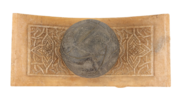 The Apple with weakened resin shell on its base (top)
 -
 The Apple on its base (orthographic)
 -
 The Apple on its base (front)
 -
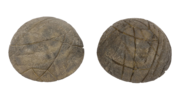 The Apple's halves
 -
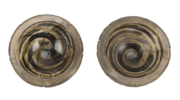 The Apple's halves inverted
 -
 The Apple's resin shell
 -
 The Apple in its chest
(left orthographic) -
 The Apple in its chest (front)
 -
 The Apple in its chest
(right orthographic) -
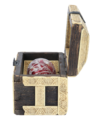 The Apple in its chest (right)
 -
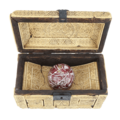 The Apple in its chest (top)
 -
 The Apple's sealed chest
(left orthographic) -
 The Apple's sealed chest (top)
 -
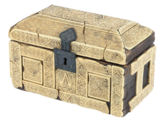 The Apple's sealed chest
(right orthographic) -
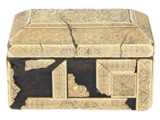 The Apple's sealed chest (back)


Appearances[edit | edit source]
- Assassin's Creed film (first appearance)
- Assassin's Creed: The Official Movie Novelization
- Assassin's Creed: Rebellion
- Assassin's Creed: The Essential Guide (2nd edition)
References[edit | edit source]
- ↑ Assassin's Creed: Initiates – Timeline
- ↑ 2.00 2.01 2.02 2.03 2.04 2.05 2.06 2.07 2.08 2.09 2.10 2.11 2.12 2.13 Assassin's Creed film
- ↑ 3.0 3.1 3.2 Assassin's Creed: Rebellion – The Fall of Granada
- ↑ Assassin's Creed: Rebellion – The Forge
- ↑ 5.0 5.1 Assassin's Creed: Into the Animus: "Chapter 6: The Artifact", pg. 152

| ||||||||||||||||||||||||||||
| |||||||||||||||||||||||||||||||||||||||||||||||||||||||||||