

Piece of Eden

|
You cannot know anything. Only suspect. This article contains content from pre-release sources that may or may not be reflective of canon upon release. This article therefore likely contains spoilers. |
- "These were remnants of beings older than even the most ancient human civilizations. A race that evolved and established a society that reached its heyday tens of thousands of years in the distant past. The relics of Those Who Came Before. They were known as Pieces of Eden."
- ―Edward Kenway, 1725.[src]-[m]

A Piece of Eden is a type of sophisticated technology created by the Isu. Named after the Isu's city of Eden, where they kept early humanity as slaves[1] and which later free humans would mythologize as a paradisal garden where they had regular contact with the divine,[2] the Pieces vary greatly in design and function, with some serving more mundane uses than others.
Some of the most common Pieces, like the Apples and Staves of Eden, were created for the primary purpose of mentally and physically controlling human thoughts, emotions, and behavior. Made from a substance alternately referred to as "adamant"[3] or "pathorica",[4] an energy-channeling[5] synthetic metal that affected the neurotransmitter network engineered into human brains[6] by restructuring the emotion-processing[3] limbic system, these Pieces were the main instrument by which the Isu enforced their subjugation of humanity. Other classes of Pieces served different roles, being utilized as weapons of war, instruments of healing, or recording devices, among other functions.
While wider Isu society viewed the Pieces as little more than "refuse" due to how commonplace they were,[7] their diverse powers have mystified humanity over millennia, enough for them to conflate them with "magic" throughout history. The Isu's extinction following the Great Catastrophe only reinforced this, as memories of the Isu faded into legends and myths. Since humans lack the technological expertise to reproduce these devices, they have long been the subject of innumerable conflicts between rival human factions seeking them for their own ends. In particular, they are a central obsession for the Templars, who have devoted much of their resources to searching and seizing these artifacts in their quest for world domination.
Description[edit | edit source]

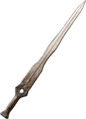
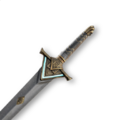
Although most classes of Pieces of Eden, such as the Apples and Staves, were utilized as tools by which humanity could be controlled, others deviated from this purpose. For example, the Swords of Eden are primarily weapons capable of emitting energy blasts, though they can also enhance the wielder's charisma and leadership abilities;[8][9] the Shrouds of Eden are medical in nature, designed for healing even the most mortal of wounds,[10][11][12] but they cannot revive the dead,[13] only briefly reanimate corpses,[14][15] and can kill a healthy user by tearing them apart in an attempt to "fix" non-existent damage.[16]
The devices' assorted functions extend further: many are capable of bending the thoughts of one or more individuals to that of the user, projecting illusions, or concealing the user's presence. The Precursor boxes, powered by other Pieces of Eden, can imprint the memories of its users onto others[17] and decode Isu script, like the Voynich manuscript.[18] Other functions are more mundane relative to modern human technology, such as hologram projection or the Crystal Skulls which serve dual purposes as long-distance communication and surveillance devices, but these nevertheless appeared supernatural to ancient peoples.[19][20]
Since the Isu's extinction, these devices, appearing sporadically in the hands of humans, have acquired a status as legendary relics of phenomenal properties. Greatly eclipsing the technological level of human civilization, even into modern times, Pieces of Eden bestow tremendous power over society to those who come to possess them. Their employment has therefore had immense impacts on human history; some of the most influential leaders such as Alexander the Great, Genghis Khan, Napoleon Bonaparte, and Mahatma Gandhi were aided by their use of a Piece of Eden.[21]
Recognizing their significance, the Pieces of Eden have been at the forefront of the Templars' goals for centuries as they hope that by exploiting the artifacts, they could achieve their vision of a New World Order. The contest for the Pieces of Eden between the Templars and their archenemies, the Assassins, who traditionally seek to safeguard them, has been a hallmark of their millennia-long war.[22]
History[edit | edit source]
- Main article: History of the Pieces of Eden
Characteristics and attributes[edit | edit source]

Amongst the greatest tools known to man, the Apples of Eden can control the human mind by interacting with a neurotransmitter located deep in the human brain.[6] Other Pieces of Eden are capable of warping reality, creating illusions, ensuring total obedience,[21] and healing physical injuries.[16][10][11] Both the Templars and the Assassins believe that the Pieces of Eden were responsible for many mythohistorical events, such as the expulsion of humanity from Eden, the Biblical plagues that ravaged Egypt, the parting of the Red Sea, the Trojan War, and Jesus of Nazareth's miracles.[2]
Abilities of a Piece[edit | edit source]
Some Pieces of Eden were known to interact with and change the passage of time, possibly creating paradoxes. Others were able to "speak" to those who wielded them, as was the case with the Italian Assassins Ezio Auditore with his Apple,[23] and both Perotto Calderon[10] and Giovanni Borgia with a Shroud.[11]
When activated, Apples of Eden are capable of extending a pulse of energy that can drive those in the surrounding area to insanity and death. Doing so has a detrimental effect on the physical health of the wielder if they are unskilled in the Apples' use, but a capable user is not as easily afflicted.[24] The Levantine Assassins' Mentor Altaïr Ibn-La'Ahad, for example, was able to use one Apple for a limited duration without adverse affects at the age of 92.[25] Using the Pieces' powers in short bursts can also minimize the negative effects dealt by the artifacts, though to what extent is unknown.[21]
Destruction of a Piece[edit | edit source]
Following the destruction of an Apple of Eden during an experiment at the Denver International Airport, the Templars found themselves in need of another artifact with similar properties. To that end, their front company Abstergo Industries kidnapped the American bartender and former Assassin Desmond Miles in order to explore the memories of his ancestor Altaïr[26] and ultimately saw a holographic map that Altaïr had discovered in 1191 of various Piece locations.[27]

Each Piece of Eden contains a great deal of potential energy, and the destruction of one can cause an explosion on the scale of a nuclear blast. One such explosion occurred in 1908, in the region of Tunguska, Russia. The Imperial Sceptre, a Staff of Eden, was seemingly destroyed when Nikola Tesla fired at the Tunguska facility with his wireless Wardenclyffe Tower, attempting to strike a blow against the Templars.[21][28][29]
However, the blast failed to totally destroy the Staff and at least one shard remained.[30] The Staff shard still possessed powers of mind control, as demonstrated by Grigori Rasputin. While he was in possession of the shard, he brainwashed Tsar Nicholas II's wife Alexandra Feodorovna as well as several disciples like Khioniya Guseva.[31]
Resistance[edit | edit source]
- "I KNOW WHAT YOU'RE DOING. I KNOW WHAT YOU DID. I SAW HIM. HE HAD A METAL BALL. IT OPENED. THEY WENT CRAZY. SHOOTING. STABBING. TORE EACH OTHER TO PIECES. I KNOW IT WAS YOU PEOPLE. SAW THE LOGO. HEARD THE NAME. I'M GOING TO TELL. ANYONE WHO WILL LISTEN. YOU'LL BE EXPOSED. THEY'LL KNOW THE TRUTH. AND THEN YOU WILL PAY. YOU CRAZY BASTARDS. YOU'LL PAY."
- ―An unidentified individual's e-mail to Dr. Warren Vidic.[src]-[m]

Although the Isu created humanity to be susceptible to the Pieces of Eden, eventual cross-breeding between them and their slaves led to the birth of a hybrid species. These new humans possessed some of the natural abilities of their creators and were free of the neurotransmitter necessary for the Pieces of Eden to control them. The first two known hybrids were Adam and Eve, who later stole one of the Apples of Eden and instigated the Human-Isu War.[21]
Members of their lineage inherited these natural abilities and immunity to the Pieces, although the Pieces' ability to physically manipulate them remained.[27] These traits were passed down through generations.[21] By the early 21st century, the Templars were aware that some humans were immune to the Pieces' mind control. On at least one occasion, Dr. Warren Vidic received an email from one such individual who had witnessed the mishap in Denver and threatened to expose what they had seen when an Apple was used on others.[32]
Known Pieces of Eden[edit | edit source]
Unless otherwise noted, current status of the item is unknown.
Apples of Eden[edit | edit source]
-

-
 Apple of Eden 2
(destroyed) -

-
 Apple of Eden 4
(presumed destroyed) -
-

-
 Apple of Eden 7
(destroyed) -
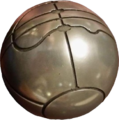
-

-

-
 Treasure Hunter's Apple of Eden
(destroyed) -
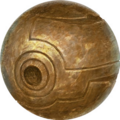
 Isle of Skye's Apple of Eden
(presumed destroyed) -
-
 Isabel's Apple of Eden
(presumed destroyed)
Atlantis artifacts[edit | edit source]
-

-
 Prize of the Medusa
(in the Gateway to the Lost City) -
Prize of the Minotaur
(in the Gateway to the Lost City) -
Prize of the Sphinx
(in the Gateway to the Lost City) -
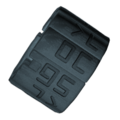
Rings of Eden[edit | edit source]


Shrouds of Eden[edit | edit source]
-
 Shroud of Eden 1
(destroyed) -
 Shroud of Eden 2
(destroyed) -

Southeast Asian Pieces of Eden[edit | edit source]
-

-
 Lantern
(at the Forgotten Temple) -
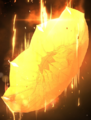 Lotus disk
(at the Forgotten Temple)
Spears of Eden[edit | edit source]


Staves of Eden[edit | edit source]
-

-
 Imperial Sceptre
(destroyed) -

-
 Staff of Hermes Trismegistus
(with Basim ibn Ishaq) -
 Shattered Staff of Eden
(destroyed) -
-
Swords of Eden[edit | edit source]


Other Pieces of Eden[edit | edit source]
-

-
 Codex of Eden
(destroyed) -
 Crystal Balls
(one Ball destroyed) -
 Crystal Skulls
(several Skulls in Abstergo custody) -

-
-

-
-

-
 Hugr-Rip
(vision only) -
-

-
 Lia Fáil
(destroyed) -

-

-

-

-
 Precursor boxes
(one box destroyed) -
 The Pyramid
(destroyed) -
-
-

-
-

-
-

Other Isu artifacts[edit | edit source]
Unless otherwise noted, current status of the item is unknown.
-

-
-

-
 Blood vials
(several vials in Abstergo custody) -
-

-
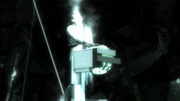 Global aurora borealis device
(intact) -
 Iron Man
(in Abstergo custody) -
 Power sources
(in the Grand Temple) -
 Pyramid fragments
(adorned in the Spear of Leonidas) -

-
 Salakar
(vision only) -
-

Armor[edit | edit source]
-

-
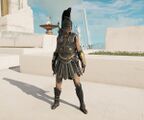 Armor of the Dikastes
(simulation only) -
 Armor of the Fallen
(simulation only) -

-
 First Civilization Set
(simulation only) -

-

-

Crowns of the Sister Realms[edit | edit source]
-
 Crown of Hades
(simulation only) -
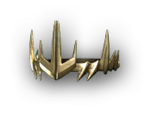 Crown of Poseidon
(simulation only) -
 Prototype Crown
(simulation only)
Keys and Cores[edit | edit source]
-
 Grand Temple Key
(in the Grand Temple) -
Heart
(in Abstergo Industries custody) -

-

-

-

-


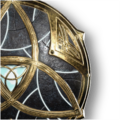
Shields[edit | edit source]
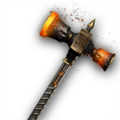
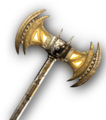
Weapons[edit | edit source]
-

-

-

-

-
-

-
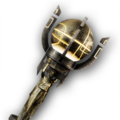
 Mace of Atlantis
(simulation only) -
-

-

-
-
 Staff of the Dikastes
(simulation only) -
-

-

-
Trivia[edit | edit source]
- During his battle with Rodrigo Borgia in the Sistine Chapel, Ezio created copies of himself, much like Al Mualim did against Altaïr. If Ezio's robes were customized, or if the Armor of Altaïr was worn, his copies appeared with different sets of armor and colors. If he was not customized, each copy would be perfectly identical to the real Ezio, besides his weapon.[21]
- Both the map in Altaïr's Codex and the map projected by his Apple of Eden showed that there were around fifty known Pieces of Eden scattered around the globe at that time. However, in the Glyph puzzles, Clay Kaczmarek identified the Shroud as Piece of Eden #66, implying that there are more Pieces still undiscovered or unaccounted for.
- In the French and German versions of Assassin's Creed II, the Shroud was referred to as Piece of Eden #36 instead, though this was likely an oversight.
- The Chalice was initially thought to be a Piece of Eden; however, besides the Shroud, all other artifacts linked to Jesus were confirmed to be merely literary tools.[28]
References[edit | edit source]
