

London

|
Ezio, my friend! How may I be of service? This article is in desperate need of a revamp. Please improve it in any way necessary in order for it to achieve a higher standard of quality in accordance with our Manual of Style. |

|
Patience, brothers. Soon we will reveal the secrets of Assassin's Creed: Syndicate, Assassin's Creed: Underworld and Assassin's Creed: Conspiracies. This article has been identified as being out of date. Please update the article to reflect recent releases and then remove this template once done. |
London is a city in southern England, and the current capital of the United Kingdom.
History
Roman Era
During the 1st CE, the Romans settled the town of Londinium. The wall that ran around the settlement had six gates built into it; one of them was named after King Lud, who ruled pre-Roman Britain around 66 CE. The adjoining hill was also named Ludgate.[1]
Middle Age
In 604, the first St Paul' church was built but burn down 71 years later.[2]
During the 10th century, King Edgar the Peaceful gave to King Kenneth III of Scotland a plot of land and the castle to serve as the residence for the Scottish monarchy whenever they visited London.[3]
When Edward the Confessor successfully drove the Danes from England in the 11 century, he rebuilt a Saxon church of Westminster in the Romanesque style to show his gratitude to God and the Pope.[4] Edward also built St. Margaret's church to accommodate the growing populace.[5]
When the Normans conquered England in 1066, William the Conqueror was coronated the day of Christmas in Westminster church which became the personal church of English monarchy and the site of their coronations.[4] In 1087, the chaplain to William the Conqueror built the St. Paul's Cathedral out of stone.[2]
At the end of the 11th century, King William II built a palace at Westminster which became the royal residence.[6]
In 1123, the Anglo-Roman monk Rahere fell ill while on a pilgrimage to Rome and vowed to found a hospital if he survived. His vow led to the construction of the St. Bartholomew's Hospital, the oldest of the city.[7]
In 1185, the Temple Church was built and was consecrated by Heraclius, the Patriarch of Jerusalem Vault. The church was originally part of a larger monastic complex that included residences, military training grounds, and places for recreation. The Knight Templars used the church for initiation ceremonies, which would be held in a crypt beneath the nave. The church also served as a bank for the nobility, and this, combined with an influx of gifts from the royal family, made the Knights Templar very wealthy.[8]
In 1197, the hospital of St. Mary's Spittle was built in Spitalfields.[9]
During the 13th century, Lambeth Palace became the London residence of the Archbishop of Canterbury, leader of the Church of England. The first Archbishop to take up residency in Lambeth Palace was Stephen Langton, a key player in the signing of the Magna Carta in 1215.[10]
When King Henry III took the throne, he rebuilt the Westminster church in a Gothic style as a tribute to Edward the Confessor. To pay for the project, Henry had to divert funds from the kingdom, which people at the time didn't appreciate.[4]
In 1267, St. James's Hospital specialized in treating female lepers. The patients worked on the marshy land around the hospital as a part of their treatment, primarily raising hogs for the hospital to sell.[11]
In 1286, a white chapel was built, giving the name of Whitechapel to the borough. It was reconstructed in 1329, when it was officially named St. Mary Matfelon.[12]
Renaissance
During the time of the mid-Renaissance, London was ruled by King Henry VII of England. During the late 15th century, the Templars made attempts to obtain the English throne. However, their plans were thwarted by Henry VII, as he imprisoned Lambert Simnel and had Perkin Warbeck hanged. In 1503, Ezio Auditore da Firenze, Mentor of the Italian Assassins, sent a group of his apprentices to London in order to aid King Henry VII. They subsequently killed Warbeck and Simnel's co-conspirator Margaret of York in November of 1503.[13][14]
Afterwards, the apprentices killed several Templars instigating riots over Margaret's death. One such Templar revealed that their Order had infiltrated Henry's Star Chamber, to which the apprentices quickly searched for the infiltrators; they found a group of Englishmen signing Borgia documents and eliminated them. As a reward, King Henry offered the Assassins a seat in the Star Chamber.[13][14]
During the 16th century, the Ludgate was renovated and enhanced by sculptures of King Lud and his sons.[1]
In 1530, Henry VIII moved the royal residence from Westminster Palace to Whitehall. Westminster became the permanent location for the country's two houses of parliament, the House of Commons and the House of Lords. The Courts of Law were also established in Westminster.[6]
In 1532, Henry acquired the land of the former St. James's Hospital to use it as a hunting ground, making the oldest of London's Royal Parks.[11]
In 1534, when Henry severed ties with the Catholic Church, St. Paul's became a Protestant cathedral, and although it went back to Catholic worship under Mary I St. Paul's became Protestant once and for all under Queen Elizabeth I in 1559.[2]
During her reign, Elizabeth used St. James's Park to host her lavish parties.[11]
In 1594, Queen Elizabeth's chief physician Roderigo Lopez was arrested after attempting to poison the Queen. He was hanged, drawn, and quartered in June of that year.[7]
King James invested in the St. James's Park, adding gardens and a menagerie of exotic animals.[11]
In 1605, the Catholic extremist Guy Fawkes attempted to blow up the Houses of Parliament. He was arrested and tried in the very place he tried to destroy before being executed.[6]
In 1610, the Lambeth Palace opened its library to the public.[10]
Since 1614, the House of Commons and the Speaker have attended mass at St. Margaret's and sermons were traditionally given by the Speaker's chaplain.[5]
After the unification of the crown of England and Scotland, the palace of Great Scotland Yard was demolished and a series of government buildings and residences were built in its place. Christopher Wren and John Milton each lived for a time in this neighbourhood.[3]
English Civil War
During the English Civil War, London was the place of political turmoil between the King Charles I and the Parliament. In 1643, parliamentarian Edmund Waller plotted to return King Charles to London, an act of betrayal to the Long Parliament. Waller's Plot was discovered by Long Parliament leader John Pym during a sermon at St. Margaret's. Pym immediately ordered the arrest of Waller and his co-conspirators from the church, and Waller was ultimately banished for his crimes.[5]
In 1648, Charles was tried for treason at Westminster Palace.[6] Charles made his final procession from St. James Park to Whitehall Palace, where he was executed[11] by Richard Brandon.[12]
As the Puritanism movement increased in the city, the heads of the statues of King Lud and his sons were chopped off by vandals.[1] The Lambeth Palace was also damaged.[10]
Restoration era

In 1660, Charles Stuart was invited to London to be crowned King after having been exiled by Oliver Cromwell for several years. At his crowning, Stuart noticed a man holding a sphere wrapped in a thick piece of cloth talking with his General, George Monck.[15]
London later burned to the ground from September 2-5 1666, in what is now known as the Great Fire of London, which gutted the medieval City of London inside the old Roman city wall. It threatened, but did not reach, the aristocratic district of Westminster, Charles II's Palace of Whitehall, and most of the suburban slums. It consumed 13,200 houses, 87 parish churches, St. Paul's Cathedral, and most of the buildings of the City authorities. It is estimated to have destroyed the homes of 70,000 of the City's 80,000 inhabitants. The death toll is unknown but traditionally thought to have been small, as only six verified deaths were recorded. This reasoning has recently been challenged on the grounds that the deaths of poor and middle-class people were not recorded, while the heat of the fire may have cremated many victims leaving no recognizable remains.
After the Great Fire, the architect Christopher Wren was commissioned to redesign many monuments of London, like St. Paul's Cathedral.[2] He also installed an organ and altar screen in the Temple Church, but more notably, he whitewashed the church's paintings and applied plaster to the marble columns in an attempt to fit aesthetic tastes of the time.[8]
In the late 17th century, as Spitalfields became less of a field and more of a developed neighbourhood, a silk-thrower named John Balch acquired the rights to hold a market in the area every Thursday and Saturday. The market, which sold only fruits and vegetables, was a quick success. London experienced a wave of incoming French Huguenots who had just been expelled from France for their religious beliefs. Many of the French Huguenots who settles in Spitalfields were skilled silkweavers, and sold their wares at the Spitalfields Market. It wasn't long before the market became synonymous with its luxurious silk, and all of Spitalfields gained a very positive reputation as a result.[9]
In 1685, St. Mary Matfelon was rebuilt despite the fact that it was one of only a few buildings to survive the Great Fire.[12]
After the death of Charles II, St. James's Park gained a reputation for criminal activity and prostitution.[11]
When Queen Mary II took the throne, the heads of the statues of King Lud and his sons were replaced at Ludgate.[1]
Georgian Era
In 1710, a scandal took place in St. Mary Matfelon, as the rector of the church set up an altarpiece depicting the Last Supper, and had the figure of Judas made to look exactly like a personal enemy of his, the Dean of Peterborough.[12]
Following his time as a privateer-turned-pirate in the Caribbean, the Assassin Edward Kenway retired to a spacious mansion on Queen Anne's Square, in Bloomsbury, with his wife Tessa, son Haytham, and daughter Jenny. On 3 December, 1735, mercenaries hired by the Templar – and family friend – Reginald Birch attacked their home, murdering Edward and kidnapping Jenny. Birch then took Haytham in, training him to become a Templar.[16]
In 1754, Haytham attended a performance of The Beggar's Opera at the Theatre Royal to find and kill the Assassin Miko,[17] an act which saw Assassin influence in the city collapse entirely for the next 114 years.[18] Haytham recovered an artifact for Birch, who believed it was a key to a Precursor site in North America: Haytham set sail for Boston on the Providence. Meanwhile, Miko's murder became public news and left many civilians wondering whether to leave the city or not.[17]
Four years later, Jenny returned to Queen Anne's Square after Haytham found her and rescued her from a palace in Damascus.[16]
During the 18th century, the Templars were able to gain complete control of the city and kept it under their thumb well into the 19th century.[19]
In 1760, the Ludgate was demolished and replaced years later by a circular junction.[1]
In 1812, Prime Minister Spencer Percival was assassinated in the lobby of the House of Commons.[6]
Around 1820, the architect Edward Blore called restored the Lambeth Palace, which qualified as "miserably deficient." before his work.[10]
In 1829, Prime Minister Robert Peel created the Metropolitan Police Service. As their headquarters' rear entrance stood on Great Scotland Yard, therefore the police force became commonly known around the world as Scotland Yard.[3]
In 1831, when the cholera epidemic hit London, St. Bartholomew's Hospital refused to admit cholera patients. Instead, cholera patients were kept in a nearby house which was demolished following the outbreak. A medical school was built as an extension of the hospital a few years later. The facilities were state-of-the-art, and featured a library, medical and chemical theatres, an anatomy museum, and dissection rooms.[7]
Victorian Era
- "Today, Starrick sits at the helm of the most sophisticated Templar infrastructure known in the western world. Every class, every borough, the gangs, the industries - his reach extends all across London. [...] Look at what Starrick has done to this city. Whitechapel is riddled with crime. Child labor, despite regulations. A gang known as the Blighters overruns the streets. And Templars manipulating behind the scenes. As in all the other boroughs. We need to return this city to the people who built it in the first place."
- ―Henry Green describing the state of London, 1868.[src]

By the 19th century, under Queen Victoria's rule, London became the global capital of invention with its technological advancement. It was divided into seven boroughs - the City of London, Lambeth, The Strand, Westminster, Southwark, Whitechapel, and the River Thames - each with a different culture but with a single commonality. As country folk moved in to the city for employment, however, it resulted in a sudden increase in population and decrease in wages, in addition to most businessmen abusing workers. These actions became a spark for the Industrial Revolution.[20]
In 1841, the Temple Church was restored by architects Sydney Smirke and Decimus Burton. Smirke and Burton's work gave the church a Victorian Gothic look that not only fit the tastes of the time but fit closely with the church's original design.[8]
St. Paul's had once again lost its lustre. Queen Victoria remarked that the cathedral was "dreary, dingy, and undevotional." Funds were raised to improve the cathedral by such philanthropists as Maria Hackett and William Weldon Champneys.[2]
By 1860, London had fell under the control of the Templar Grand Master Crawford Starrick, who used his network of Templar agents to control the city and oppress the working classes to keep the Templars in power. The British Assassins, particularly Henry Green worked to reclaim power in the city. He enlisted the aid of the fraternal twins Jacob and Evie Frye, who created the gang known as the Rooks to remove the influence of the Templar-backed gangs throughout London.[21][18]
In 1875, St. Mary Matfelon was rebuilt again in order to more closely resemble the church as it was in 1329.[12]
In 1875, the Spitalfields market lease passed to a developer named Robert Horner. Horner fought regularly with the Whitechapel District Board of Works over how the market could be expanded without disturbing traffic around the market. An iron and glass roof was built in 1883, and the surrounding shops were built over the next century.[9]
By the nineteenth century, the silkmakers of Spitalfields market had long moved on, and overpopulation and poverty led to a rise in crime. The market remained an important fixture, providing the food needed to get through the day to those who could afford it.[9]
20th century
In 1916 during the First World War, a German individual and a Sage known as the Master Spy infiltrated London, setting up a spy network near the Tower Bridge as well as a localized cult in service of Juno. Winston Churchill caught wind of his activities and enlisted the help of the Assassin Lydia Frye, who succeeded in repelling the enemy planes and eliminating the spy cell.[18]
During World War II, London was greatly destroyed by the Blitz. St. Mary Matfelon was hit hard during the conflict.[12]
In 1952, St. Mary Matfelon was demolished.[12]
21st century
In October 2016, Simon Hathaway was inducted into the Templar's Inner Sanctum.[22] Simon used an Animus to relive the memories of his ancestor, Gabriel Laxart, in order to find a way to repair the Sword of Eden Rikkin had in his possession.[23] Ten days later, Hathaway was brought to trial for going behind the Order's back. However all the charges brought against him were dropped after his speech and that his shady actions were in fact carried out for the benefit of the Templar Order.[24] In December, after discovering Aguilar's Apple, Alan Rikkin called a meeting with the Council of Elders in London at the Grand Templar Hall. While presenting the Apple's abilities, Alan was assassinated by Callum Lynch who took the Apple and fled.[25]

In late-2018, Layla Hassan and her team were stationed in a loft apartment in London while searching the memories of the Spartan misthios Kassandra in order to locate more Isu artifacts before Abstergo could. Kiyoshi Takakura, a member of the team kept watching from outside. Eventually, the cell's location was identified by Abstergo and so they were forced to flee, though not before Layla left a USB drive at the apartment that could be remotely scanned and infect secure computer systems, such as that held by the Head of Operations at Abstergo.[26]
Districts
During the Industrial Revolution, London was divided into seven boroughs.
City of Lodon
- Main article: City of London
On the right bank of the Thames, with its high and elegant buildings, the City is the financial center of London comprising the Bank of England and the Royal Exchange. One of its most notable landmarks are the St. Paul's Cathedral and the Monument to the Great Fire of London.
Lambeth
- Main article: Lambeth
The most rural borough of London, the district of Lambeth is composed of many small houses and market places in the South of London. Its most notable monuments are the Lambeth Palace and the Asylum.
River Thames
- Main article: River Thames
The River Thames has an economic value as many Riverboats transported products and merchandise between the docks and markets. The left and right banks of the Thames are connected by many bridges as the London Bridge and the Westminster Bridge.
Southwark
- Main article: Southwark
As the industrial heart of London, Southwark as many factories, docks and brick houses for the workers. One of its most notable landmarks is the Waterloo station.
The Strand
- Main article: The Strand
The Strand is the cultural district of London with the British Museum and the Alhambra Music Hall. It is also an important place for shopping activities. It has an elegant architecture and a lot of parks. The Metropolitan Police Service has its headquarters located at Scotland Yard.
Westminster
- Main article: Westminster
One of the richest districts, Westminster his the political center of London with the Royal Residence of Buckingham Palace, the Prime Minister house at the 10 Downing Street and the Chamber of the Parliament at the Palace of Westminster. Westminster has also many religious monuments as Westminster Abbey and the Temple Church. The Slum of Devil's Acre contrast with the green parks and the wealth of the district.
Whitechapel
- Main article: Whitechapel
Named after a chapel St. Mary Matfelon, Whitechapel is the poorest district of London, with slums, prostitution and thievery. During the year 1888, the district became infamous for the murders of the serial killer Jack the Ripper. One of its most notable infrastructure is the Spitalfields Market.
Trivia
- There are light bulb advertisement signs on some buildings in Assassin's Creed: Syndicate, though this is anachronistic as electric lighting was first used in 1883 in Holborn.[27] The first light bulb advertisement signs didn't appear until at least the 1890s.[28]
- Many of the roofs of the buildings in Assassin's Creed: Syndicate, are in the Mansard style. This style spread to Britain in the 18th century.[29][30][31] Some of the roofs are covered with metal tiles, either lead, corrugated iron, a method originally patented in England in 1829 or zinc galvanized metal, a method developed in France in 1837[32] and which became popular in Victorian times, because of its cheapness when compared with lead.[33]
- The sewers of London share the same model as the sewers of Paris from Unity.
Gallery
-
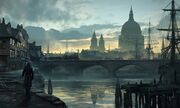 Concept art of the City of London borough
 -
 Concept art of the Whitechapel borough
 -
 Concept art of an industrial area
 -
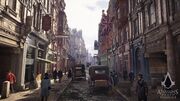 The City of London borough
 -
 The Strand borough
 -
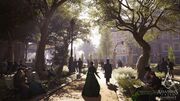 The Westminster borough
 -
 The Southwark borough
 -
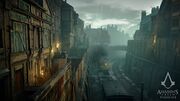 The Whitechapel borough
 -
 The Lambeth borough
 -
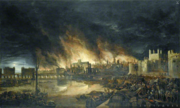 The Great Fire of London
 -
 London in 2017


Appearances
- Assassin's Creed: Project Legacy
- Assassin's Creed: Brotherhood (mentioned only)
- Assassin's Creed III (first appearance)
- Assassin's Creed: Forsaken
- Assassin's Creed: Syndicate
- Assassin's Creed: Underworld
- Assassin's Creed: Heresy
- Assassin's Creed: The Movie
- Assassin's Creed: Conspiracies
- Assassin's Creed: Odyssey
- Assassin's Creed: Gold
- Assassin's Creed: Valhalla
References
- ↑ 1.0 1.1 1.2 1.3 1.4 Assassin's Creed: Syndicate – Database: Ludgate Circus
- ↑ 2.0 2.1 2.2 2.3 2.4 Assassin's Creed: Syndicate – Database: St. Paul's Cathedral
- ↑ 3.0 3.1 3.2 Assassin's Creed: Syndicate – Database: Scotland Yard
- ↑ 4.0 4.1 4.2 Assassin's Creed: Syndicate – Database: Westminster Abbey
- ↑ 5.0 5.1 5.2 Assassin's Creed: Syndicate – Database: St. Margaret's, Westminster
- ↑ 6.0 6.1 6.2 6.3 6.4 Assassin's Creed: Syndicate – Database: Houses of Parliament
- ↑ 7.0 7.1 7.2 Assassin's Creed: Syndicate – Database: St. Bartholomew's Hospital
- ↑ 8.0 8.1 8.2 Assassin's Creed: Syndicate – Database: Temple Church
- ↑ 9.0 9.1 9.2 9.3 Assassin's Creed: Syndicate – Database: Temple Church
- ↑ 10.0 10.1 10.2 10.3 Assassin's Creed: Syndicate – Database: Lambeth Palace
- ↑ 11.0 11.1 11.2 11.3 11.4 11.5 Assassin's Creed: Syndicate – Database: St. James's Park
- ↑ 12.0 12.1 12.2 12.3 12.4 12.5 12.6 Assassin's Creed: Syndicate – Database: St. Mary Matfelon
- ↑ 13.0 13.1 Assassin's Creed: Brotherhood – Contracts
- ↑ 14.0 14.1 Assassin's Creed: Project Legacy – Contracts
- ↑ Assassin's Creed: Project Legacy – Holidays: Chapter 1 – Ghosts of Christmas Past
- ↑ 16.0 16.1 Assassin's Creed: Forsaken
- ↑ 17.0 17.1 Assassin's Creed III
- ↑ 18.0 18.1 18.2 Assassin's Creed: Syndicate
- ↑ The Network Podcast - Episode 13
- ↑ Assassin's Creed official website
- ↑ GameInformer: Five Things to Know About Assassin's Creed: Syndicate
- ↑ Assassin's Creed: Heresy – Chapter 1
- ↑ Assassin's Creed: Heresy – Chapter 3
- ↑ Assassin's Creed: Heresy – Chapter 35
- ↑ Assassin's Creed: The Movie
- ↑ Assassin's Creed: Odyssey
- ↑ A Brief History of London, England. www.localhistories.org. Accessed 1 October 2017.
- ↑ See Photos Of London When Queen Victoria Was Ruling. Londonist Ltd. Accessed 1 October 2017.
- ↑ ROOFS A Guide to Alterations and Extensions on Domestic Buildings. City of Westminster Department of Planning and City Development, Development Planning Services, March 1995. Accessed 22 October 2017.
- ↑ London Terrace Houses 1660-1860. English Heritage, 23 Savile Row, London W1X 1AB 0171 973 3434 February 1996. Accessed 22 October 2017.
- ↑ London: An Architectural History by Anthony Sutcliffe. Yale University Press New Haven and London. Accessed 22 October 2017.
- ↑ Preservation Bried 4: Roofing for Historic Buildings by Sarah M. Sweetser. www.nps.gov. Accessed 22 October 2017.
- ↑ Understanding Housing Defects by Duncan Marshall, Derek Worthing, Roger Heath, Nigel Dann. Routledge 2 Park Square, Milton Park, Abingdon, Oxon OX14 4RN. Accessed 22 October 2017.
| ||||||||||||||||||||||||||||||||||||||||
| |||||||||||||||||||||||||||||||||||||
| |||||||||||||||||||||||||
| ||||||||||||||||||||||||||||
| ||||||||||||||||||||||||||||
| ||||||||||||||||||||||||||||
| ||||||||||||||||||||||||||||||||||||||||||||||
| |||||||||||||||||||||||||
de:London
es:Londres
fr:Londres
it:Londra
nl:Londen
pl:Londyn
pt-br:Londres
ru:Лондон
zh:伦敦