

Kleon
- "The steps to the Parthenon are long and built on corpses."
- ―Kleon[src]
Kleon (died 422 BCE), also called Kleon the Everyman, was an Athenian general during the Peloponnesian War. He was also a Sage of the Cult of Kosmos, leading a branch that had infiltrated the Delian League. He was the first prominent representative of the commercial class in Athenian politics.
A political opponent of Perikles, the then-leader of Athens who had adopted a defensive stance in combating the Peloponnesian League, Kleon sought to adopt a more aggressive approach against their opponents. After Perikles died, Kleon assumed control of the city. He was largely supported by the people of Athens until the Athenians Sokrates, Aristophanes, the misthios Kassandra and others led a social uprising against him.[1]
Ultimately, he met his end at the hands of Kassandra during the Battle of Amphipolis, which also saw the death of his opponent, the Spartan general Brasidas.
Biography[edit | edit source]
Opposing Perikles[edit | edit source]

During Peloponnesian War, Kleon came to prominence as an opponent against Perikles, opposing his strategy on holding out rather than facing the Spartans in battle, who were already drawing near the city. Kleon's membership within the Cult of Kosmos also aided his position and increased his influence.[1] In 431 BCE, he and Perikles gathered at the Pnyx to debate about their strategies and garner the crowd's support. Despite Perikles' speeches, Kleon was ultimately able to gain much favor from the crowd.[2]
After the debate, Kleon met and gained the acquaintance of the misthios Kassandra, who had come to meet Perikles based on Herodotos' suggestion.[2] Kleon asked Kassandra to carry out several errands for him in order to strengthen Athen's defences: destroying several Spartan camps outside the city,[3] rescuing one of his agents,[4] and escorting said agent to safety.[5]
Tensions continued to escalate between Perikles and Kleon, but by 429 BCE, Kleon had much of the favor from the Athenians. That year, a plague devastated the city, with Perikles soon contracting the disease. Kleon took the chance to further draw support from the crowd in an attempt to turn the population against Perikles.[6] Ultimately, Perikles died at the hands of the Cult of Kosmos' enforcer, Deimos, giving Kleon an opportunity to seize power in Athens.[7]
Leading Athens[edit | edit source]
In 425 BCE, Kassandra was captured by Athenian forces during the Battle of Pylos and brought back to Athens, where she was imprisoned within a cell. As Kassandra spoke with her brother Deimos, Kleon arrived and interrupted their conversation, revealing his ties to the Cult in the process. After dismissing Deimos, Kleon talked to Kassandra, trying to explain that Perikles' death had been necessary and that he would lead Athens to a brighter future with the Cult's backing.[8]

When the misthios pointed out that Kleon's rule was not a true democracy, as he oppressed any who spoke against him, the latter gave up his efforts to explain his goals. Instead, he resolved to dispose of Kassandra, who posed a serious threat to the Cult, and left his guards to kill her. However, shortly after Kleon departed, Kassandra defeated the guards and broke out of prison with the help of her allies, Barnabas and Sokrates.[8]
In 424 BCE, at the suggestion of the Ghost of Kosmos, Kleon took to punishing the citizens of Mytilene, which previously revolted against Athens and the Delian League. He did so by ordering the execution of thousands of Mytileneans.[9]
Later that year, Kleon was publicly mocked in plays directed by Aristophanes. Noting that one of his actors was enamored with some girl, Kleon ordered his subordinate and fellow Cultist Rhexenor to threaten her to delay or stop one of the plays' production.[10] Rhexenor ultimately failed, being killed by Kassandra, and the play was a success, causing the people of Athens to begin losing faith in Kleon's leadership.[11]
Battle of Amphipolis and death[edit | edit source]

Around 422 BCE, Kleon was deployed to Makedonia to attack Amphipolis, a city occupied by Spartan forces led by Brasidas. During the battle, he saw Kassandra dueling Deimos and shot an arrow into the latter's back before fleeing. However, he was soon cornered by Kassandra on a nearby beach, where he was defeated after a brief duel. Begging for his life, Kleon tried to convince Kassandra to spare him and join the Cult, but his pleas fell on deaf hears as the misthios drowned and killed him.[12]
Simulation[edit | edit source]
In a simulation created by the Isu Aletheia, a simulated Kleon was brought to the realm of the Underworld, where he was greeted by the hounds belonging to the realm's ruler. A terrified Kleon was eventually dragged away by the hounds as Kassandra arrived.[13]
Behind the scenes[edit | edit source]
Kleon is a historical character appearing in Assassin's Creed: Odyssey, where he is voiced by Australian-Greek actor Yorgos Pirpassopoulos. Historically, Kleon was killed by a peltast when his army was routed at the Battle of Amphipolis.
Kleon's portrayal in the game appears to be partially inspired by American president Donald Trump. His promise to "Make Athens Great Again", as well as his hawkish nature, his populist rhetoric, and his representation of the commercial class, are all obvious references to Trump, who was known for his promise to "Make America Great Again", as well as for his own fiery rhetoric, populism, and representation of the business class.
Etymology[edit | edit source]
Kleon is a Greek name derived from the word κλεος (kleos), which means 'glory'.
Gallery[edit | edit source]
-
 Concept art of Kleon's final battle by Hugo Puzzuoli
 -
 Head models of Kleon
 -
 Kleon rallying Athenian citizens during the plague
 -
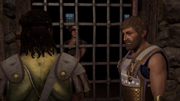 Kleon giving orders to Deimos
 -
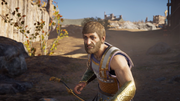 Kleon panicking after hitting Deimos with an arrow
 -
 Kleon's corpse during the Battle of Amphipolis
 -
 Kleon in Hades


Appearances[edit | edit source]
- Assassin's Creed: Odyssey (first appearance)
- The Fate of Atlantis: Torment of Hades (simulation only)
References[edit | edit source]
- ↑ 1.0 1.1 Assassin's Creed: Odyssey – Cultists: Kleon the Everyman
- ↑ 2.0 2.1 Assassin's Creed: Odyssey – Welcome to Athens
- ↑ Assassin's Creed: Odyssey – For the People
- ↑ Assassin's Creed: Odyssey – He Who Stops
- ↑ Assassin's Creed: Odyssey – The Liberator
- ↑ Assassin's Creed: Odyssey – Abandoned By the Gods
- ↑ Assassin's Creed: Odyssey – Athens's Last Hope
- ↑ 8.0 8.1 Assassin's Creed: Odyssey – Doing Time
- ↑ Assassin's Creed: Odyssey – Cult of Kosmos clues: The Ghost's whisper to Kleon
- ↑ Assassin's Creed: Odyssey – Cult of Kosmos clues: Sages's note to Rhexenor
- ↑ Assassin's Creed: Odyssey – A-Musing Tale
- ↑ Assassin's Creed: Odyssey – We Will Rise
- ↑ Assassin's Creed: Odyssey – The Fate of Atlantis: Torment of Hades – Labors of the Keeper