

Medusa
| This article is about the mythical gorgon. You may be looking for the weapon from Ptolemaic Egypt. |
Medusa was the most famous incarnation of the Writhing Dread, and by extension, the gorgons, a type of hybrid beast created by the Isu as part of the Olympos Project. Medusa was originally a human but taken over by an Atlantis artifact known as the Prize of the Medusa, to act as a guardian for it in order to seal the Gates of Atlantis.[1]
History[edit | edit source]
Myths[edit | edit source]
In Greek mythology, she was described as having had hair composed of live venomous snakes, wings and a gaze so deadly that all who faced it turned into stone. She was slain by the hero Perseus with a Sword of Eden,[2] a harpe according to legend, given to him by Hermes Trismegistus. Hermes also helped Perseus by giving him winged sandals, and the goddess Athena gave Perseus a bronze shield polished mirror-bright.[3]
After Perseus cut off her head, the winged foal Pegasos sprung from Medusa's neck,[3] along with his brother Chrysaor.[4]
Influence and legacy[edit | edit source]
In Korinthia, the story of Medusa inspired someone to carve a monumental statue of her grimacing head, known as the Cyclopean Head of Medusa, though later its creation was attributed to the Cyclopes.[5]
It was also said that after Perseus had brought Medusa's head to Argos, the head was found in a mound of earth near Argos' agora.[6]
During the Peloponnesian War, the Spartan noblewoman Damia asked the misthios Kassandra to tell the story of Perseus to her children Danae, Kristos, and their friends.[3]
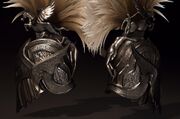
In 47 BCE, the Medjay Bayek of Siwa acquired a rare heavy weapon named after Medusa, owing to her ferocity.[7]
Behind the scenes[edit | edit source]
The mural depicting Perseus and Medusa in Assassin's Creed: Odyssey is based on a painting on a hydria from the 6th century BCE. Though the creature fought in Odyssey memory "Writhing Dead" is in dialogue consistently referred to as the "Writhing Dread", during the battle the creature bears the name "Medusa".[8]
Gallery[edit | edit source]
-
 Concept art of the Cyclopean Head of Medusa by Hugo Puzzuoli
 -
 The Head with the Kephisos' Sanctuary Ruins behind
 -
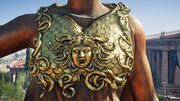 Gorgon, possibly Medusa, as part of the Aegis on the Statue of Athena in Athens
 -
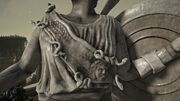 Gorgon, possibly Medusa, as part of the Aegis on a marble statue of Athena
 -
 The face of a gorgon, possibly Medusa, on a shield
 -
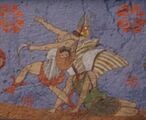 A 5th century BCE mural depicting Perseus beheading Medusa
 -


Appearances[edit | edit source]
- Assassin's Creed III: Liberation (first mentioned)
- Assassin's Creed: Origins (mentioned only)
- Assassin's Creed: Odyssey (sculpture only) (painting only)
- Assassin's Creed: Valhalla (painting only)
- Assassin's Creed: Mirage – Valley of Memory (mentioned in Database entry only)
References[edit | edit source]
- ↑
 🆓Zero-ELEC🆓 (@ZeroELEC) on Twitter "@Melqartiii @AJoDumont @crypticjordan Hi! Thanks for the amazing game that is ACOdyssey! I have a quick question if you can answer: is it safe to assume that Medusa (the gorgon killed by Perseus) was a previous person taken over by "The Writhing Dread" artefact?" (screenshot)
↑ Mel MacCoubrey (@melqartiii) on Twitter "@ZeroELEC @AJoDumont @crypticjordan Yeah it's a person that comes in contact with the artifact and then their image manifests as one of the guardians based on which artifact they hold." (screenshot)
- ↑ Assassin's Creed II – Glyph #5: "Instruments of Power"
- ↑ 3.0 3.1 3.2 Assassin's Creed: Odyssey – A Treasury of Legends
- ↑ Discovery Tour: Ancient Greece – Arkadia: The Cattle of Geryon
- ↑ Assassin's Creed: Odyssey – Historical Locations – Korinthia: Cyclopean Head of Medusa
- ↑ Assassin's Creed: Odyssey – Historical Locations – Argolis: Buried Head of Medusa
- ↑ Assassin's Creed: Origins
- ↑ Assassin's Creed: Odyssey
