

-
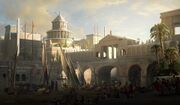 Concept art of Alexandria's rich district
 -
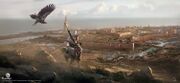 Concept art of an overview of Alexandria
 -
 Concept art
 -
 Sailor suburb in the city
 -
 Ptolemy XIII addresing the crowds of Alexandria concept art
 -
 Alexandria streets concept art
 -
 Alexandria streets concept art
 -
 Alexandria streets concept art
 -
 Alexandria streets concept art
 -
 Alexandria streets concept art
 -
 Alexandria streets concept art
 -
 Alexandria streets concept art
 -
 Alexandria canals concept art
 -
 Alexandria architecture concept art
Welcome to Assassin's Creed Wiki! Log in and join the community.
Alexandria: Difference between revisions
Jump to navigation
Jump to search
imported>Joe Blaze123 |
imported>Gener4l Cl4ank4 Added missing information |
||
| Line 1: | Line 1: | ||
{{Era|Locations}}{{WP-REAL}} | {{Era|Locations}}{{WP-REAL}} | ||
{{Update|'' | {{Update|''[[Discovery Tour: Ancient Egypt]]''}} | ||
{{Quote|Alexandria is where the whole world meets, where every language under the sun is spoken on its streets, where Greeks and Egyptians walk together, where the Jews have their own temples even—and scholars from around the world come to study at the great Museum and Library.| | {{Quote|Alexandria is where the whole world meets, where every language under the sun is spoken on its streets, where Greeks and Egyptians walk together, where the Jews have their own temples even—and scholars from around the world come to study at the great Museum and Library.|Aya, c. 70 BCE.|Assassin's Creed: Origins – Desert Oath}} | ||
{{Location_Infobox | {{Location_Infobox | ||
|name = Alexandria | |name = Alexandria | ||
|image = ACO Alexandria.png | |image = ACO Alexandria.png | ||
|state = [[Egypt]] | |state = [[Egypt]] | ||
|rulers = | |rulers = [[Alexander the Great]]'s Empire {{C|331 BCE – 305 BCE}} | ||
[[Alexander the Great]]'s Empire {{C|331 BCE – 305 BCE}} | |||
[[Ptolemaic dynasty]] {{C|305 BCE – 30 BCE}}<br> | [[Ptolemaic dynasty]] {{C|305 BCE – 30 BCE}}<br> | ||
[[Roman Empire]] {{C|30 BCE – 330/395 CE}}<br> | [[Roman Empire]] {{C|30 BCE – 330/395 CE}}<br> | ||
| Line 24: | Line 23: | ||
|date = 331 BCE | |date = 331 BCE | ||
|landmark = [[Lighthouse of Alexandria]]<br>[[Library of Alexandria]] | |landmark = [[Lighthouse of Alexandria]]<br>[[Library of Alexandria]] | ||
|targets = [[ | |targets = [[Raia]]<br>[[Actaeon]]<br>[[Ktesos]]<br>[[Eudoros]]<br>[[Gennadios]]<br>[[Sophronios]]<br>[[Cleopatra]] | ||
}} | }} | ||
'''Alexandria''' is the second largest city of [[Egypt]], located along the northern coastline of Egypt along the [[Mediterranean Sea]]. It is named after the [[Makedonia|Macedonian]] king [[Alexander the Great]], who founded the city around 331 BCE. A [[Greece|Hellenistic]] city, it served as the capital of Egypt throughout the [[Ptolemaic dynasty]]. It had so much commercial and intellectual development, that it became the most flourished city of the Ptolemaic era. | '''Alexandria''' is the second largest city of [[Egypt]], located along the northern coastline of Egypt along the [[Mediterranean Sea]]. It is named after the [[Makedonia|Macedonian]] king [[Alexander the Great]], who founded the city around 331 BCE. A [[Greece|Hellenistic]] city, it served as the capital of Egypt throughout the [[Ptolemaic dynasty]]. It had so much commercial and intellectual development, that it became the most flourished city of the Ptolemaic era. | ||
| Line 30: | Line 29: | ||
==History== | ==History== | ||
===Ptolemaic era=== | ===Ptolemaic era=== | ||
Founded by Alexander the Great in 331 BCE, the ''[[polis]]'' of Alexandria was incorporated into the fledgling kingdom of [[Ptolemy I Soter]] in 323 BCE. During that year, Ptolemy hijacked Alexander's sarcophagus, which was being transported to Makedonia at the time, and later buried the king in a [[Tomb of Alexander the Great|tomb]] in the city | Founded by Alexander the Great in 331 BCE, the ''[[polis]]'' of Alexandria was incorporated into the fledgling kingdom of [[Ptolemy I Soter]] in 323 BCE. During that year, Ptolemy hijacked Alexander's sarcophagus, which was being transported to Makedonia at the time, and later buried the king in a [[Tomb of Alexander the Great|tomb]] in the city.<ref name="Aya: Blade of the Goddess" /> | ||
At some point after its founding, Alexandria was visited by the [[Sparta]]n ''[[Mercenary|misthios]]'' [[Kassandra]]. Heading to the city's [[Library of Alexandria|library]] under the cover of night, Kassandra placed a scroll given to her by her friend [[Herodotos]] on a shelf, thus preserving his writings among the other works in the library.<ref name="A New Horizon">''[[Assassin's Creed: Odyssey]]'' – ''[[Assassin's Creed Crossover Stories]]'' – [[A New Horizon]]</ref> | |||
In the early 1st century BCE, Kassandra's descendant<ref name="Legacy of the First Blade">''[[Assassin's Creed: Odyssey]]'' – ''[[Legacy of the First Blade: Bloodline]]'' – [[Legacy of the First Blade (memory)|Legacy of the First Blade]]</ref> [[Amunet|Aya]] was born and raised in Alexandria until eventually moving to the [[Siwa]] oasis. Around 56 BCE, [[Raia]], a member of the [[Order of the Ancients]] living in Alexandria, was assassinated in his own home by the [[Medjay]] [[Bayek]] of Siwa, in retaliation for sending the [[mercenary]] [[Bion]] to kill Bayek's father [[Sabu]] and wipe out the Medjay bloodline.<ref name="Desert Oath">''[[Assassin's Creed: Origins – Desert Oath]]''</ref> | |||
Sometime during the reign of [[Ptolemy XII Auletes]], an earthquake struck the city, causing considerable damage to Alexander the Great's tomb.<ref name="Aya: Blade of the Goddess" /> In 49 BCE, the [[pharaoh]] [[Cleopatra]] was exiled by her brother and co-ruler [[Ptolemy XIII]] with the help of the Order of the Ancients. [[Apollodorus]], one of Cleopatra's loyal followers, helped her to escape the city through the canals.<ref name="Co-rule with Ptolemy XIII & Exile">''[[Discovery Tour: Ancient Egypt]]'' – [[Tours: Cleopatra, Queen of Egypt]]: "Co-rule with Ptolemy XIII & Exile"</ref> | |||
A year later, Aya, seeking revenge for the death of her son [[Khemu]], returned to her hometown and killed the Order members [[Actaeon]] and [[Ktesos]], who were operating in Alexandria.<ref name="Aya Memory">''[[Assassin's Creed: Origins]]'' – [[Aya (memory)|Aya]]</ref> Following this, her husband Bayek killed another Ancient, the Royal Scribe [[Eudoros]], in the bathhouse of Alexandria,<ref name="End of the Snake">''[[Assassin's Creed: Origins]]'' – [[End of the Snake]]</ref> as well as the city's [[Phylakitai]] [[Gennadios]], who was hunting Aya in retaliation for the murders of Actaeon and Ktesos.<ref name="Gennadios the Phylakitai">''[[Assassin's Creed: Origins]]'' – [[Gennadios the Phylakitai]]</ref> | |||
In 30 BCE, the [[Roman army]] led by [[Octavian]] invaded Alexandria.<ref>[[Assassin's Creed: Origins (comic)|''Assassin's Creed: Origins'']] – [[Assassin's Creed: Origins 1|Issue #01]]</ref> | [[File:DTAE Alexandria Ship Attack - Concept Art by Martin Deschambault.png|thumb|250px|left|Alexandria under siege]] | ||
In September 48 BCE, the [[Rome|Roman]] general [[Gaius Julius Caesar|Julius Caesar]] travelled to Alexandria in pursuit of his rival [[Pompey]], who had fled to Egypt. There, Caesar was received by Ptolemy XIII, who presented the head of the deceased Pompey to the general. Their meeting was interrupted with the arrival of Cleopatra, who infiltrated the city with the help of Aya, Bayek, and Apollodorus and managed to secure an alliance with Caesar.<ref name="Aya: Blade of the Goddess">''[[Assassin's Creed: Origins]]'' – [[Aya: Blade of the Goddess]]</ref> | |||
In early 47 BCE, Ptolemy [[Siege of Alexandria|besieged]] Alexandria with his army in an attempt to trap Cleopatra and the Romans. Bayek and Aya helped Caesar to defend the city.<ref name="Battle of the Nile">''[[Assassin's Creed: Origins]]'' – [[The Battle of the Nile]]</ref> Following the Romans' victory and Ptolemy's death, Cleopatra was crowned as the sole pharaoh of Egypt in Alexandria and, under the Ancients' influence, cut ties with Bayek and Aya, leading them to establish the [[Assassins|Hidden Ones]] as a means to continue protecting Egypt and its people from the shadows.<ref name="The Aftermath">''[[Assassin's Creed: Origins]]'' – [[The Aftermath]]</ref> | |||
In 46 BCE, the Order of the Ancients member and [[Gabiniani]] commander [[Lucius Septimius]] travelled to Alexandria with Alexander the Great's [[Scepter of Alexander the Great|Staff of Eden]] after accompanying [[Flavius Metellus]] to Siwa. He was pursued by Aya but managed to set sail to Rome. In response, Aya decided to expand the Hidden Ones' influence to Rome, and recruited the senators [[Marcus Junius Brutus]] and [[Gaius Cassius Longinus]]. Before her departure, Aya met with Bayek one last time on the beach near Alexandria, where they officially laid the foundations of their brotherhood's [[The Creed|Creed]].<ref name="Last of the Medjay">''[[Assassin's Creed: Origins]]'' – [[Last of the Medjay]]</ref> | |||
[[File:ACO Aya Cleopatra poison.jpg|thumb|250px|Amunet giving Cleopatra the poison]] | |||
In 30 BCE, the [[Roman army]] led by [[Augustus|Octavian]] invaded Alexandria.<ref name="ACO 1">[[Assassin's Creed: Origins (comic)|''Assassin's Creed: Origins'']] – [[Assassin's Creed: Origins 1|Issue #01]]</ref> While her son [[Caesarion]] trained with a guard, Cleopatra watched as the Romans approached the palace.<ref name="ACO 2">[[Assassin's Creed: Origins (comic)|''Assassin's Creed: Origins'']] – [[Assassin's Creed: Origins 2|Issue #02]]</ref> With Octavian's men closing in, Cleopatra and Caesarion were attacked while taking a walk outside, but the latter killed their assailant, as well as a guard who had betrayed them.<ref name="ACO 3">[[Assassin's Creed: Origins (comic)|''Assassin's Creed: Origins'']] – [[Assassin's Creed: Origins 3|Issue #03]]</ref> Shortly after, Aya, now known as Amunet, confronted Cleopatra in the palace, handing her a vial of [[Snake|asp]] extract and urging her to take her life and spare the city further violence. Cleopatra complied while Amunet took Caesarion to Rome in order to train him as a Hidden One.<ref name="AC2">''[[Assassin's Creed II]]''</ref><ref name="ACO 4">[[Assassin's Creed: Origins (comic)|''Assassin's Creed: Origins'']] – [[Assassin's Creed: Origins 4|Issue #04]]</ref> | |||
Later that year, the Egyptian Hidden Ones held their final synod in Alexandria, which was presided over by Amunet. During the synod, Amunet was asked several questions about the Creed and its ironies by the [[acolyte]] [[Magas]], prompting an open discussion in front of all assembled. After Amunet concluded the synod by declaring that the Hidden Ones were to formally retreat into the shadows to continue [[Assassin-Templar War|their mission]], Magas was informed of Amunet's identity by a fellow acolyte. Magas would later write a document about his encounter with the legendary [[Mentor]], which became known as [[The Magas Codex]].<ref name="The Magas Codex">''[[Assassin's Creed: Valhalla]]'' – [[The Magas Codex]]</ref> | |||
===Roman era=== | ===Roman era=== | ||
| Line 48: | Line 57: | ||
===Islamic era=== | ===Islamic era=== | ||
By 870, the Egyptian Hidden Ones were still active in Alexandria. That year, four Hidden Ones – [[Jessamyn]], [[Kalim]], [[Rashid]] and [[Sihem]] – answered a call for help from [[Basim Ibn Ishaq]], the leader of the Hidden Ones in Constantinople, who had discovered the Order of the Ancients to be operating in [[Antioch]]. The group left Alexandria to help Basim and his apprentice [[Hytham]] investigate the Order's activities, and returned to the city once their mission was complete.<ref name="The Silk Road">''[[Assassin's Creed: The Silk Road]]''</ref> | |||
During the 1240s, the widow of the [[Levantine Brotherhood of Assassins|Levantine Assassin]] [[Sef Ibn-La'Ahad]] moved to the city with their children, after having spent some time in exile in [[Alamut]].<ref>''[[Assassin's Creed: The Secret Crusade]]''</ref> In 1257, Sef's brother [[Darim Ibn-La'Ahad|Darim]] moved to Alexandria to be with his family, after the [[Mongol Empire|Mongols]] started [[Fall of Masyaf|besieging]] the Assassins' fortress of [[Masyaf]].<ref name="Darim and Sef">''[[Assassin's Creed: Revelations]]'' – [[Database: Darim and Sef]]</ref> | During the 1240s, the widow of the [[Levantine Brotherhood of Assassins|Levantine Assassin]] [[Sef Ibn-La'Ahad]] moved to the city with their children, after having spent some time in exile in [[Alamut]].<ref>''[[Assassin's Creed: The Secret Crusade]]''</ref> In 1257, Sef's brother [[Darim Ibn-La'Ahad|Darim]] moved to Alexandria to be with his family, after the [[Mongol Empire|Mongols]] started [[Fall of Masyaf|besieging]] the Assassins' fortress of [[Masyaf]].<ref name="Darim and Sef">''[[Assassin's Creed: Revelations]]'' – [[Database: Darim and Sef]]</ref> | ||
Years later, a descendant of Altaïr named [[Iskender]] became the [[Mentor]] of the [[Egyptian Brotherhood of Assassins|Egyptian Assassins]] and was headquartered in Alexandria.<ref name="The Mentor Vanishes">''[[Assassin's Creed: Revelations]]'' – [[Mediterranean Defense]]: "The Mentor Vanishes"</ref> The [[Byzantine Rite of the Templar Order|Byzantine Templar]] [[Odai Dunqas]] also relocated to the city sometime around 1505, after being driven away from his home by his family.<ref name="Odai Dunqas">''[[Assassin's Creed: Revelations]]'' – [[Database: Odai Dunqas]]</ref> | Years later, a descendant of [[Altaïr Ibn-La'Ahad]] named [[Iskender]] became the [[Mentor]] of the [[Egyptian Brotherhood of Assassins|Egyptian Assassins]] and was headquartered in Alexandria.<ref name="The Mentor Vanishes">''[[Assassin's Creed: Revelations]]'' – [[Mediterranean Defense]]: "The Mentor Vanishes"</ref> The [[Byzantine Rite of the Templar Order|Byzantine Templar]] [[Odai Dunqas]] also relocated to the city sometime around 1505, after being driven away from his home by his family.<ref name="Odai Dunqas">''[[Assassin's Creed: Revelations]]'' – [[Database: Odai Dunqas]]</ref> | ||
In 1511, during an excavation of the destroyed [[Library of Alexandria]], the [[Mamluks|Mamluk Sultanate]]'s soldiers discovered two [[Memory Seals]] in a chest from 331 BCE. The [[Italian Brotherhood of Assassins|Italian | In 1511, during an excavation of the destroyed [[Library of Alexandria]], the [[Mamluks|Mamluk Sultanate]]'s soldiers discovered two [[Memory Seals]] in a chest from 331 BCE. The [[Italian Brotherhood of Assassins|Italian Assassins]]' Mentor [[Ezio Auditore da Firenze|Ezio Auditore]] sent several apprentices from Constantinople to Alexandria to retrieve the artifacts.<ref name="The Memory Seals, Part I">''[[Assassin's Creed: Revelations]]'' – Mediterranean Defense: "The Memory Seals, Part I"</ref> After the seals were recovered, [[Templars|Templar]] soldiers launched an offensive on the Assassin headquarters. The Assassins fought hard to protect the initiate decoding the seals.<ref name="The Memory Seals, Part II">''[[Assassin's Creed: Revelations]]'' – Mediterranean Defense: "The Memory Seals, Part II"</ref> However, the Templars eventually managed to take the seals. A search party was sent out, authorized to use maximum force.<ref name="The Memory Seals, Part III">''[[Assassin's Creed: Revelations]]'' – Mediterranean Defense: "The Memory Seals, Part III"</ref> Sometime later, Iskender was captured by Templars and scheduled for execution, though a team of Assassins sent by Ezio managed to save him.<ref name="The Mentor Vanishes" /> | ||
===Victorian era=== | ===Victorian era=== | ||
In June 1852, the British Army deserter [[Simeon Price]], then going by the alias "Jack Straw", spent a few weeks in Alexandria performing odd jobs, gathering enough money to | In June 1852, the [[British Army]] deserter [[Simeon Price]], then going by the alias "Jack Straw", spent a few weeks in Alexandria performing odd jobs, gathering enough money to sail to [[Athens]], [[Greece]]. Having saved enough to travel, he instead made for [[Vienna]], [[Austria]] on the instructions of the mysterious [[Henri Escoffier|stranger]] who had previously saved him from drowning aboard the [[HMS Birkenhead|HMS ''Birkenhead'']].<ref>''[[Assassin's Creed: The Engine of History – The Magus Conspiracy]]'' – Chapter 3</ref> In 1882, an English fleet was sent to bomb Alexandria.<ref name ="CH28">''[[Assassin's Creed: The Engine of History – The Resurrection Plot]]'' – Chapter 28</ref> | ||
==Locations== | ==Locations== | ||
| Line 110: | Line 121: | ||
Overview of Alexandria.jpg|Overview of Alexandria | Overview of Alexandria.jpg|Overview of Alexandria | ||
ACO Alexandria 2.jpg | ACO Alexandria 2.jpg | ||
AC Origins Alexandria City Street 1.png| | |||
ACO Alexandria 3.jpg | ACO Alexandria 3.jpg | ||
ACO Alexandria 4.jpg | ACO Alexandria 4.jpg | ||
| Line 132: | Line 143: | ||
*''[[Assassin's Creed: Rebellion]]'' {{Mdat}} | *''[[Assassin's Creed: Rebellion]]'' {{Mdat}} | ||
*''[[Assassin's Creed: Odyssey]] – [[Assassin's Creed Crossover Stories]]'' | *''[[Assassin's Creed: Odyssey]] – [[Assassin's Creed Crossover Stories]]'' | ||
*''[[Assassin's Creed: Valhalla]]'' {{Mo}} | |||
*''[[Assassin's Creed: Where's the Assassin?]]'' {{c|non-canonical appearance}} | *''[[Assassin's Creed: Where's the Assassin?]]'' {{c|non-canonical appearance}} | ||
*''[[Echoes of History]]'' {{Mo}} | *''[[Echoes of History]]'' {{Mo}} | ||
*''[[Assassin's Creed: The Silk Road]]'' | |||
*''[[Assassin's Creed: The Engine of History – The Magus Conspiracy]]'' | *''[[Assassin's Creed: The Engine of History – The Magus Conspiracy]]'' | ||
*''[[Assassin's Creed: The Engine of History – The Resurrection Plot]]'' {{Mo}} | *''[[Assassin's Creed: The Engine of History – The Resurrection Plot]]'' {{Mo}} | ||
| Line 140: | Line 153: | ||
==References== | ==References== | ||
{{Reflist}} | {{Scroll box|content={{Reflist}}}} | ||
{{ACO}} | {{ACO}} | ||
{{ACDO}} | {{ACDO}} | ||
{{ACOC}} | {{ACOC}} | ||
{{ACSR}} | |||
{{ACTEH}} | {{ACTEH}} | ||
[[es:Alejandría]] | [[es:Alejandría]] | ||
Revision as of 10:29, 23 December 2024

|
Patience, brothers. Soon we will reveal the secrets of Discovery Tour: Ancient Egypt. This article has been identified as being out of date. Please update the article to reflect recent releases and then remove this template once done. |
- "Alexandria is where the whole world meets, where every language under the sun is spoken on its streets, where Greeks and Egyptians walk together, where the Jews have their own temples even—and scholars from around the world come to study at the great Museum and Library."
- ―Aya, c. 70 BCE.[src]
Alexandria is the second largest city of Egypt, located along the northern coastline of Egypt along the Mediterranean Sea. It is named after the Macedonian king Alexander the Great, who founded the city around 331 BCE. A Hellenistic city, it served as the capital of Egypt throughout the Ptolemaic dynasty. It had so much commercial and intellectual development, that it became the most flourished city of the Ptolemaic era.
History
Ptolemaic era
Founded by Alexander the Great in 331 BCE, the polis of Alexandria was incorporated into the fledgling kingdom of Ptolemy I Soter in 323 BCE. During that year, Ptolemy hijacked Alexander's sarcophagus, which was being transported to Makedonia at the time, and later buried the king in a tomb in the city.[1]
At some point after its founding, Alexandria was visited by the Spartan misthios Kassandra. Heading to the city's library under the cover of night, Kassandra placed a scroll given to her by her friend Herodotos on a shelf, thus preserving his writings among the other works in the library.[2]
In the early 1st century BCE, Kassandra's descendant[3] Aya was born and raised in Alexandria until eventually moving to the Siwa oasis. Around 56 BCE, Raia, a member of the Order of the Ancients living in Alexandria, was assassinated in his own home by the Medjay Bayek of Siwa, in retaliation for sending the mercenary Bion to kill Bayek's father Sabu and wipe out the Medjay bloodline.[4]
Sometime during the reign of Ptolemy XII Auletes, an earthquake struck the city, causing considerable damage to Alexander the Great's tomb.[1] In 49 BCE, the pharaoh Cleopatra was exiled by her brother and co-ruler Ptolemy XIII with the help of the Order of the Ancients. Apollodorus, one of Cleopatra's loyal followers, helped her to escape the city through the canals.[5]
A year later, Aya, seeking revenge for the death of her son Khemu, returned to her hometown and killed the Order members Actaeon and Ktesos, who were operating in Alexandria.[6] Following this, her husband Bayek killed another Ancient, the Royal Scribe Eudoros, in the bathhouse of Alexandria,[7] as well as the city's Phylakitai Gennadios, who was hunting Aya in retaliation for the murders of Actaeon and Ktesos.[8]

In September 48 BCE, the Roman general Julius Caesar travelled to Alexandria in pursuit of his rival Pompey, who had fled to Egypt. There, Caesar was received by Ptolemy XIII, who presented the head of the deceased Pompey to the general. Their meeting was interrupted with the arrival of Cleopatra, who infiltrated the city with the help of Aya, Bayek, and Apollodorus and managed to secure an alliance with Caesar.[1]
In early 47 BCE, Ptolemy besieged Alexandria with his army in an attempt to trap Cleopatra and the Romans. Bayek and Aya helped Caesar to defend the city.[9] Following the Romans' victory and Ptolemy's death, Cleopatra was crowned as the sole pharaoh of Egypt in Alexandria and, under the Ancients' influence, cut ties with Bayek and Aya, leading them to establish the Hidden Ones as a means to continue protecting Egypt and its people from the shadows.[10]
In 46 BCE, the Order of the Ancients member and Gabiniani commander Lucius Septimius travelled to Alexandria with Alexander the Great's Staff of Eden after accompanying Flavius Metellus to Siwa. He was pursued by Aya but managed to set sail to Rome. In response, Aya decided to expand the Hidden Ones' influence to Rome, and recruited the senators Marcus Junius Brutus and Gaius Cassius Longinus. Before her departure, Aya met with Bayek one last time on the beach near Alexandria, where they officially laid the foundations of their brotherhood's Creed.[11]

In 30 BCE, the Roman army led by Octavian invaded Alexandria.[12] While her son Caesarion trained with a guard, Cleopatra watched as the Romans approached the palace.[13] With Octavian's men closing in, Cleopatra and Caesarion were attacked while taking a walk outside, but the latter killed their assailant, as well as a guard who had betrayed them.[14] Shortly after, Aya, now known as Amunet, confronted Cleopatra in the palace, handing her a vial of asp extract and urging her to take her life and spare the city further violence. Cleopatra complied while Amunet took Caesarion to Rome in order to train him as a Hidden One.[15][16]
Later that year, the Egyptian Hidden Ones held their final synod in Alexandria, which was presided over by Amunet. During the synod, Amunet was asked several questions about the Creed and its ironies by the acolyte Magas, prompting an open discussion in front of all assembled. After Amunet concluded the synod by declaring that the Hidden Ones were to formally retreat into the shadows to continue their mission, Magas was informed of Amunet's identity by a fellow acolyte. Magas would later write a document about his encounter with the legendary Mentor, which became known as The Magas Codex.[17]
Roman era
In 295 CE, the Roman Emperor Diocletian attacked the city, which fell after eight months of relentless assault.[18]
In 357, Constantius II had an obelisk built by Thutmose III in Karnak pilfered and transported to Alexandria. After remaining there for 40 years, Emperor Theodosius I transferred it to Constantinople.[19]
Islamic era
By 870, the Egyptian Hidden Ones were still active in Alexandria. That year, four Hidden Ones – Jessamyn, Kalim, Rashid and Sihem – answered a call for help from Basim Ibn Ishaq, the leader of the Hidden Ones in Constantinople, who had discovered the Order of the Ancients to be operating in Antioch. The group left Alexandria to help Basim and his apprentice Hytham investigate the Order's activities, and returned to the city once their mission was complete.[20]
During the 1240s, the widow of the Levantine Assassin Sef Ibn-La'Ahad moved to the city with their children, after having spent some time in exile in Alamut.[21] In 1257, Sef's brother Darim moved to Alexandria to be with his family, after the Mongols started besieging the Assassins' fortress of Masyaf.[22]
Years later, a descendant of Altaïr Ibn-La'Ahad named Iskender became the Mentor of the Egyptian Assassins and was headquartered in Alexandria.[23] The Byzantine Templar Odai Dunqas also relocated to the city sometime around 1505, after being driven away from his home by his family.[24]
In 1511, during an excavation of the destroyed Library of Alexandria, the Mamluk Sultanate's soldiers discovered two Memory Seals in a chest from 331 BCE. The Italian Assassins' Mentor Ezio Auditore sent several apprentices from Constantinople to Alexandria to retrieve the artifacts.[25] After the seals were recovered, Templar soldiers launched an offensive on the Assassin headquarters. The Assassins fought hard to protect the initiate decoding the seals.[26] However, the Templars eventually managed to take the seals. A search party was sent out, authorized to use maximum force.[27] Sometime later, Iskender was captured by Templars and scheduled for execution, though a team of Assassins sent by Ezio managed to save him.[23]
Victorian era
In June 1852, the British Army deserter Simeon Price, then going by the alias "Jack Straw", spent a few weeks in Alexandria performing odd jobs, gathering enough money to sail to Athens, Greece. Having saved enough to travel, he instead made for Vienna, Austria on the instructions of the mysterious stranger who had previously saved him from drowning aboard the HMS Birkenhead.[28] In 1882, an English fleet was sent to bomb Alexandria.[29]
Locations
Military locations
Papyrus locations
Treasure locations
- Aya's Home
- Armory
- Emporion Berthed Trireme
- Mareia Military Storage
- Mareia Trireme
- Narrow Crevice
- Pharos Military Storage
- Ptolemaic Royal Palace
- South Wall Guard Post
Behind the scenes
In Assassin's Creed: Origins, the rich district houses have wall paintings that are actually characteristic of Roman wall painting.[30] The in-game patterns resemble the ones found on the terrace houses of ancient Ephesus. The city has Roman style raised stone pedestrian crosswalks.
Gallery


-
 Map of Alexandria
 -
 Hieroglyph
 -
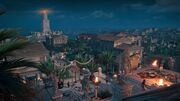 Alexandria at night as seen from the Serapeum
 -
 Overview of Alexandria
 -

-

-

-

-

-

-

-
-

-


Appearances
- Assassin's Creed II (first mentioned)
- Assassin's Creed: Revelations (mentioned only)
- Assassin's Creed: The Secret Crusade (mentioned only)
- Assassin's Creed: Origins (first appearance)
- Assassin's Creed: Origins – Desert Oath
- Assassin's Creed: Origins comic
- Discovery Tour: Ancient Egypt
- Assassin's Creed: Rebellion (mentioned in Database entry only)
- Assassin's Creed: Odyssey – Assassin's Creed Crossover Stories
- Assassin's Creed: Valhalla (mentioned only)
- Assassin's Creed: Where's the Assassin? (non-canonical appearance)
- Echoes of History (mentioned only)
- Assassin's Creed: The Silk Road
- Assassin's Creed: The Engine of History – The Magus Conspiracy
- Assassin's Creed: The Engine of History – The Resurrection Plot (mentioned only)
- Assassin's Creed Roleplaying Game (mentioned only)
- Assassin's Creed: Mirage (mentioned only)
References
| |||||||||||
| |||||||||||||||||||||||||
| ||||||||||||||
| |||||||||||||||||||||||||||||||
es:Alejandría fr:Alexandrie hu:Alexandria pt-br:Alexandria ru:Александрия uk:Александрія zh:亚历山大