


Persephone: Difference between revisions
imported>Sadelyrate No edit summary |
m Text replacement - ">''Assassin's Creed: Odyssey''" to ">''Assassin's Creed: Odyssey''" |
||
| (54 intermediate revisions by 19 users not shown) | |||
| Line 1: | Line 1: | ||
{{Era|Individuals}} | {{Era|Individuals|Isu}}{{WP-REAL}} | ||
{{WP-REAL}} | {{Youmay|the Greek goddess|the [[Kore|wife]] of Leiandros}} | ||
{{ | {{Update|''[[Assassin's Creed: Odyssey]]'' – ''[[The Fate of Atlantis: Fields of Elysium]]''}} | ||
{{ | {{Character Infobox | ||
| name = Persephone | |||
| image = File:ACOD FOA FOE Persephone fullbody render.png | |||
| active = [[Isu Era]] | |||
| species = [[Isu]] | |||
| affiliates = [[Sister Realms]] | |||
*[[Elysium]] | |||
| voice = [[Kate Drummond]] | |||
}} | |||
'''Persephone''' (Περσεφόνη) also called '''Kore''' (Κόρη, lit. "the Girl")<ref>{{WP}}</ref> was an [[Isu]], revered as the [[Greece|Greek]] goddess of the [[underworld]], springtime, flowers, and blooming. | |||
The daughter of [[Demeter]] and [[Jupiter|Zeus]], she was the spouse of [[Hades]], who gave her the [[Sister Realms|realm]] of [[Elysium]] to rule from alongside her friend [[Hekate]].<ref>''[[Assassin's Creed: Odyssey]]'' – ''[[The Fate of Atlantis: Fields of Elysium]]''</ref> | |||
==Biography== | |||
===Mythology=== | |||
In time, Persephone and other Isu came to be revered in the Greek pantheon as gods and goddesses. | |||
As the daughter of Demeter, Persephone was known simply as Kore. When Hades, the Greek god of the underworld, stole Persephone to marry her, she came to be known as Persephone.<ref>''[[Assassin's Creed: Odyssey]]'' – [[Historical Locations]]: "Attika: Entrance to the Underworld"</ref> | |||
== | ===Simulation=== | ||
During the 5th century BCE, Persephone and Elysium were recreated from the memories of the Isu [[Aletheia]] in order for [[Kassandra]] the [[Eagle]]-Bearer to master the [[Staff of Hermes Trismegistus]]. Upon meeting Kassandra, the simulant Persephone reacted to the intrusion into her realm, telling the ''[[Mercenary|misthios]]'' that she did not belong, but otherwise left her be.<ref>''[[Assassin's Creed: Odyssey]]'' – ''The Fate of Atlantis: Fields of Elysium'' – [[Welcome to Elysium]]</ref> | |||
== | ==Legacy and influence== | ||
The [[Sanctuary of Eleusis]] within the [[Sacred Plains of Demeter]] in [[Attika]] was a central location for the worship of Persephone and Demeter,<ref>''[[Assassin's Creed: Odyssey]]'' – Historical Locations: "Attika: Sanctuary of Eleusis"</ref> and in the [[Eleusis Telesterion|Telesterion]], people annually participated in the [[Eleusinian Mysteries]], initiation practices into their cult.<ref>''[[Assassin's Creed: Odyssey]]'' – Historical Locations: "Attika: Eleusis Telesterion"</ref><ref>''[[Discovery Tour: Ancient Greece]]'' – [[Discovery Sites: Lokris]]: "Salt"</ref> In [[Athens]], a [[Statue of Demeter and Kore|statue]] featuring Persephone and her mother stood watch over the [[Sacred Way, Attika|road]] leading from the [[Akropolis Sanctuary|acropolis]] to the Sanctuary of Eleusis.<ref>''[[Assassin's Creed: Odyssey]]'' – Historical Locations: "Attika: Statue of Demeter and Kore"</ref> | |||
After imbibing [[lotus]] flower wine, [[Barnabas]] had three visions concerning his wife [[Leda (Barnabas' wife)|Leda]]. In one of these, he swore that Persephone led him [[Tomb of Polybotes|where]] mythical [[Siren (mythology)|sirens]] dwelled.<ref>''[[Assassin's Creed: Odyssey]]'' – [[Odyssey Into the Past]]</ref> | |||
==Behind the scenes== | |||
Persephone is a mythological character in ''[[Assassin's Creed: Odyssey]]'', where she was voiced by Canadian actress [[Kate Drummond]]. | |||
The [[Persephone's Helmet|headgear]] Persephone wears in the Elysium simulation is based on the {{Wiki|Attic helmet}}. | |||
The statue representing Persephone as Kore especially in Attika and Sanctuary of Eleusis in ''[[Assassin's Creed: Odyssey]]'' is based on the restored {{Wiki|Phrasikleia Kore}}, made by Aristion of Paros in 6th century BCE. | |||
==Gallery== | |||
<gallery position="center" widths="180" captionalign="center"> | |||
ACOD Persephone closeup.png|Closeup of Persephone | |||
ACOD_FoE_Persephone.jpg|Persephone on her throne in Elysium | |||
ACOd-TFoA-Persephonebust-StephanieChafe.jpg|Bust model | |||
ACOd-TFoA-Persephonecrownless-StephanieChafe.jpg|Models of Persephone without her headgear | |||
Athens-KoreDemeter.jpg|The statue of Kore and Demeter in Athens | |||
ACOd-mural-PersephoneHades.jpg|A 5th century BCE mural depicting Persephone and Hades | |||
</gallery> | |||
==Appearances== | |||
*''[[Assassin's Creed: Odyssey]]'' {{1st}} {{Io|paint}} | |||
**''[[The Fate of Atlantis: Fields of Elysium]]'' {{C|simulation}} | |||
*''[[Discovery Tour: Ancient Greece]]'' {{Mo}} | |||
==References== | |||
{{Reflist}} | |||
{{ACOD}} | {{ACOD}} | ||
{{Isu}} | |||
[[Category:Individuals]] | [[Category:Individuals]] | ||
[[Category:Isu]] | |||
[[Category:Elysians]] | |||
[[Category:Greek deities]] | [[Category:Greek deities]] | ||
[[Category: | [[Category:Isu heads of state]] | ||
Latest revision as of 05:47, 22 September 2026
| This article is about the Greek goddess. You may be looking for the wife of Leiandros. |

|
Patience, brothers. Soon we will reveal the secrets of Assassin's Creed: Odyssey – The Fate of Atlantis: Fields of Elysium. This article has been identified as being out of date. Please update the article to reflect recent releases and then remove this template once done. |
Persephone (Περσεφόνη) also called Kore (Κόρη, lit. "the Girl")[1] was an Isu, revered as the Greek goddess of the underworld, springtime, flowers, and blooming.
The daughter of Demeter and Zeus, she was the spouse of Hades, who gave her the realm of Elysium to rule from alongside her friend Hekate.[2]
Biography[edit | edit source]
Mythology[edit | edit source]
In time, Persephone and other Isu came to be revered in the Greek pantheon as gods and goddesses.
As the daughter of Demeter, Persephone was known simply as Kore. When Hades, the Greek god of the underworld, stole Persephone to marry her, she came to be known as Persephone.[3]
Simulation[edit | edit source]
During the 5th century BCE, Persephone and Elysium were recreated from the memories of the Isu Aletheia in order for Kassandra the Eagle-Bearer to master the Staff of Hermes Trismegistus. Upon meeting Kassandra, the simulant Persephone reacted to the intrusion into her realm, telling the misthios that she did not belong, but otherwise left her be.[4]
Legacy and influence[edit | edit source]
The Sanctuary of Eleusis within the Sacred Plains of Demeter in Attika was a central location for the worship of Persephone and Demeter,[5] and in the Telesterion, people annually participated in the Eleusinian Mysteries, initiation practices into their cult.[6][7] In Athens, a statue featuring Persephone and her mother stood watch over the road leading from the acropolis to the Sanctuary of Eleusis.[8]
After imbibing lotus flower wine, Barnabas had three visions concerning his wife Leda. In one of these, he swore that Persephone led him where mythical sirens dwelled.[9]
Behind the scenes[edit | edit source]
Persephone is a mythological character in Assassin's Creed: Odyssey, where she was voiced by Canadian actress Kate Drummond.
The headgear Persephone wears in the Elysium simulation is based on the Attic helmet.
The statue representing Persephone as Kore especially in Attika and Sanctuary of Eleusis in Assassin's Creed: Odyssey is based on the restored Phrasikleia Kore, made by Aristion of Paros in 6th century BCE.
Gallery[edit | edit source]
-
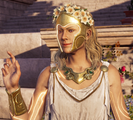 Closeup of Persephone
 -
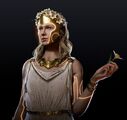
 Persephone on her throne in Elysium
 -
 Bust model
 -
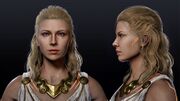 Models of Persephone without her headgear
 -
 The statue of Kore and Demeter in Athens
 -
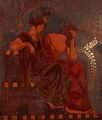 A 5th century BCE mural depicting Persephone and Hades


Appearances[edit | edit source]
- Assassin's Creed: Odyssey (first appearance) (painting only)
- The Fate of Atlantis: Fields of Elysium (simulation)
- Discovery Tour: Ancient Greece (mentioned only)
References[edit | edit source]
- ↑
 Persephone on Wikipedia
- ↑ Assassin's Creed: Odyssey – The Fate of Atlantis: Fields of Elysium
- ↑ Assassin's Creed: Odyssey – Historical Locations: "Attika: Entrance to the Underworld"
- ↑ Assassin's Creed: Odyssey – The Fate of Atlantis: Fields of Elysium – Welcome to Elysium
- ↑ Assassin's Creed: Odyssey – Historical Locations: "Attika: Sanctuary of Eleusis"
- ↑ Assassin's Creed: Odyssey – Historical Locations: "Attika: Eleusis Telesterion"
- ↑ Discovery Tour: Ancient Greece – Discovery Sites: Lokris: "Salt"
- ↑ Assassin's Creed: Odyssey – Historical Locations: "Attika: Statue of Demeter and Kore"
- ↑ Assassin's Creed: Odyssey – Odyssey Into the Past
| ||||||||||||||||||||||||||||||||||||||||||||||||||||||||||||||||||
