

Cleopatra: Difference between revisions
imported>Soranin |
imported>Gener4l Cl4ank4 mNo edit summary |
||
| (26 intermediate revisions by 8 users not shown) | |||
| Line 1: | Line 1: | ||
{{Era|Individuals}}{{WP-REAL}} | {{Era|Individuals}}{{WP-REAL}} | ||
{{Quote|I loved it all. The power, the challenge, everything. But above all, I loved Egypt. Believed in it. And still do.|Cleopatra to Amunet, 30 BCE.|Assassin's Creed: Origins (comic) |Assassin's Creed: Origins 4}} | {{Update|''[[Echoes of History]]''}} | ||
{{Quote|I loved it all. The power, the challenge, everything. But above all, I loved Egypt. Believed in it. And still do.|Cleopatra to Amunet, shortly before her death, 30 BCE.|Assassin's Creed: Origins (comic) |Assassin's Creed: Origins 4}} | |||
{{Character Infobox | {{Character Infobox | ||
|name = Cleopatra | |name=Cleopatra | ||
|native = Hieroglyph-Cleopatra.png | |native=ACO Hieroglyph-Cleopatra.png | ||
|image = Cleopatra Render.png | |image=ACO Cleopatra Render.png | ||
|birth = 69 BCE<br>[[Alexandria]], [[Ptolemaic Kingdom]] | |birth=69 BCE<br>[[Alexandria]], [[Ptolemaic Kingdom]] | ||
|death = 12 August 30 BCE {{c|aged 39}}<br>Alexandria, Ptolemaic Kingdom | |death=12 August 30 BCE {{c|aged 39}}<br>Alexandria, Ptolemaic Kingdom | ||
|species=[[Human]] | |||
|species = [[Human]] | |database=[[Database: Cleopatra|Cleopatra]] | ||
|database = [[Database: Cleopatra|Cleopatra]] | |affiliates=*[[Ptolemaic dynasty]] | ||
|affiliates = [[Ptolemaic dynasty]] | *[[Order of the Ancients]] {{c|defected}} | ||
}} | }} | ||
'''Cleopatra VII Thea Philopator''' (69 BCE – 30 BCE), or simply '''Cleopatra''', was the last effective pharaoh of [[Egypt]], ruling from 51 BCE | '''Cleopatra VII Thea Philopator''' (Κλεοπάτρα Θεά Φιλοπάτωρ; 69 BCE – 30 BCE), or simply '''Cleopatra''', was the last effective [[pharaoh]] of [[Egypt]], ruling from 51 BCE until her death. | ||
Born as the daughter of [[Ptolemy XII Auletes]], Cleopatra ascended to the throne following her father's death, ruling Egypt with her younger brother and spouse [[Ptolemy XIII]], whom she married as per Egyptian custom. In 49 BCE, Cleopatra was exiled by her brother in a scheme orchestrated by the [[Order of the Ancients]] to bring the kingdom under their control. | Born as the daughter of [[Ptolemy XII Auletes]], Cleopatra ascended to the throne following her father's death, ruling Egypt with her younger brother and spouse [[Ptolemy XIII]], whom she married as per Egyptian custom. In 49 BCE, Cleopatra was exiled by her brother in a scheme orchestrated by the [[Order of the Ancients]] to bring the kingdom under their control. | ||
With the aid of her most trusted follower [[Apollodorus]], and later agents [[Amunet|Aya]] and | With the aid of her most trusted follower [[Apollodorus]], and later her agents [[Amunet|Aya]] and [[Bayek]], Cleopatra worked to eliminate the Order within her brother's court. After a failed attempt to ally with the [[Roman Republic|Roman]] general [[Pompey]], Cleopatra consummated a liaison with [[Gaius Julius Caesar|Julius Caesar]] to defeat Ptolemy at the [[Battle of the Nile]] in 47 BCE. Unwittingly backed by the Order of the Ancients, Cleopatra's grip on the throne was solidified and with Caesar, she had a son named [[Caesarion]] whom she raised in [[Rome]]. | ||
After Caesar's [[Assassination of Julius Caesar|assassination]] in 44 BCE that sparked a | After Caesar's [[Assassination of Julius Caesar|assassination]] in 44 BCE that sparked a [[Liberators' civil war|civil war]] in the Roman Republic, Cleopatra allied herself with Caesar's trusted friend and supporter [[Marcus Antonius]], competing against Caesar's adopted son and heir [[Octavian]]. | ||
In the final days of the civil war, Cleopatra retreated to [[Alexandria]] with her son following | In the final days of the civil war, Cleopatra retreated to [[Alexandria]] with her son following Antonius' defeat and suicide at the [[Battle of Actium]]. With Octavian's army marching onto the city, Cleopatra was confronted by her former friend and agent Aya, who now served as a [[Mentor]] of the [[Assassins|Hidden Ones]] under the alias "Amunet" and persuaded the queen to commit suicide via [[poison]]. In exchange, Cleopatra made a final request that Amunet take her son Caesarion away from Egypt and train him as a Hidden One. | ||
==Biography== | ==Biography== | ||
===Early life and exile | ===Early life and exile=== | ||
{{Quote|Eudoros was a member of the Order of the Ancients, they are responsible for my exile. They tore me from my throne.|Cleopatra on her exile, 48 BCE.|Assassin's Creed: Origins|Egypt's Medjay}} | {{Quote|Eudoros was a member of the Order of the Ancients, they are responsible for my exile. They tore me from my throne.|Cleopatra on her exile, 48 BCE.|Assassin's Creed: Origins|Egypt's Medjay}} | ||
Cleopatra was born in 69 BCE in [[Alexandria]] to Ptolemy XII Auletes. Following her father's death in 51 BCE, a then eighteen-year-old Cleopatra succeeded him as the next pharaoh of Egypt,<ref name="DT Intro">''[[Discovery Tour: Ancient Egypt]]'' – [[ | Cleopatra was born in 69 BCE in [[Alexandria]] to the pharaoh [[Ptolemy XII Auletes]]. Following her father's death in 51 BCE, a then eighteen-year-old Cleopatra succeeded him as the next pharaoh of Egypt,<ref name="DT Intro">''[[Discovery Tour: Ancient Egypt]]'' – [[Tours: Cleopatra, Queen of Egypt]]: "Introduction"</ref> co-jointly ruling the country alongside her younger brother [[Ptolemy XIII]].<ref name="DT Co-rule">''[[Discovery Tour: Ancient Egypt]]'' – [[Tours: Cleopatra, Queen of Egypt]]: "Co-rule with Ptolemy XIII & Exile"</ref> | ||
In the early years of their reign between 50 and 48 BCE, the land was aggravated by extreme droughts and floods.<ref name="DT Co-rule" /> In 49 BCE, Cleopatra was exiled by her younger brother Ptolemy XIII, who had | In the early years of their reign between 50 and 48 BCE, the land was aggravated by extreme droughts and floods.<ref name="DT Co-rule" /> In 49 BCE, Cleopatra was exiled by her younger brother Ptolemy XIII, who had secretly allied himself with the [[Order of the Ancients]], causing her to flee [[Alexandria]] with the help of her loyal follower, [[Apollodorus]]. During her years in exile, Cleopatra lived in Apollodorus' personal [[Apollodorus' Estate|estate]].<ref name="ACO">''[[Assassin's Creed: Origins]]''</ref> She later made the acquaintance of [[Amunet|Aya]], a former [[Medjay]] who was introduced to her by Apollodorus. The two shared a bond and became close friends, with Aya acting as Cleopatra's personal agent.<ref name="Prima" /> | ||
=== | ===Attempts to reclaim the throne=== | ||
{{Quote|You are my Medjay now! Protector of the true Pharaoh of Egypt.|Cleopatra appointing Bayek to serve as her agent, 48 BCE.|Assassin's Creed: Origins|Egypt's Medjay}} | {{Quote|You are my Medjay now! Protector of the true Pharaoh of Egypt.|Cleopatra appointing Bayek to serve as her agent, 48 BCE.|Assassin's Creed: Origins|Egypt's Medjay}} | ||
In 48 BCE, Cleopatra was introduced to [[Bayek]] of [[Siwa]], Aya's husband who had hunted various members of the Order responsible for her exile. Cleopatra revealed to Bayek that the Snake, whom he thought to be [[Eudoros]], was actually the Order itself and that | [[File:Origins Quest09Egypt'sMedjay Part06.PNG|thumb|250px|left|Apollodorus introducing Cleopatra to Bayek]] | ||
In 48 BCE, Cleopatra was introduced to [[Bayek]] of [[Siwa]], Aya's husband who had hunted various members of the Order responsible for her exile. Cleopatra revealed to Bayek that the Snake, whom he thought to be [[Eudoros]], was actually the Order itself and that their influence was far from vanquished. Cleopatra appointed Bayek as her personal Medjay, tasking him to eliminate the members of the Order across Upper Egypt, namely the [[Taharqa|Scarab]], the [[Khaliset|Hyena]], the [[Berenike|Crocodile]], and the [[Hetepi|Lizard]].<ref name="Egypt's Medjay">''[[Assassin's Creed: Origins]]'' – [[Egypt's Medjay]]</ref> | |||
Soon after Bayek's departure to hunt down the Ancients, Cleopatra appointed Aya and [[Phoxidas]] to the [[Aegean Sea]] to seek out [[Pompey]], a [[Rome|Roman]] general who had been defeated by [[Gaius Julius Caesar]] in the midst of a [[Caesar's civil war|civil war]], hoping to secure his support against her brother. The two were ultimately successful in their task, convincing Pompey to ally with Cleopatra and bring his fleet to Egypt.<ref name="Pompeius Magnus">''[[Assassin's Creed: Origins]]'' – [[Pompeius Magnus]]</ref> | |||
Bayek soon | Sometime thereafter, Cleopatra, accompanied by Apollodorus and her personal guards, travelled to [[Memphis]] ahead of the upcoming [[Apis]] festival. During this time, she resided at the [[Palace of Apries]], on one occasion giving a speech to the city's displeased residents in an attempt to gain their support. Aya and Bayek later arrived with the clues surrounding the identity of the Lizard, who was revealed to be a priest of [[Anubis]] under [[Pasherenptah]].<ref name="TLF">''[[Assassin's Creed: Origins]]'' – [[The Lizard's Face]]</ref> | ||
[[File:Origins Quest15TheLizard'sFace Part02.PNG|thumb|250px|Cleopatra ordering Aya and Bayek to eliminate the Lizard]] | |||
When it was made apparent that the twin priestesses [[Tawe]] and [[Taous]] had played a part in poisoning the Apis bull, thereby possibly putting the festival in jeopardy, Cleopatra called for their execution. However, she was stopped by Aya, who stated the priestesses had been coerced into doing so by the Lizard, who had captured their brother [[Panchrates]]. Cleopatra later called for the assassination of the Lizard to be done as soon as possible before her departure to [[Herakleion]].<ref name="TLF" /> | |||
Bayek soon killed the Lizard and returned with his mask, thus ending the Order's reign of terror in Memphis. At the same time, the Apis bull recovered and the festival was thus able to continue. Cleopatra participated in the festival before departing to Herakleion, while Bayek continued his hunt of the Order members across Egypt.<ref name="TLF" /> | |||
===Alliance with Caesar=== | ===Alliance with Caesar=== | ||
{{Quote|Great lady. Your audacity is equaled only by your beauty.|Caesar upon his first meeting with Cleopatra, | {{Quote|Great lady. Your audacity is equaled only by your beauty.|Caesar upon his first meeting with Cleopatra, 48 BCE.|Assassin's Creed: Origins|Aya: Blade of the Goddess}} | ||
In late 48 BCE, Cleopatra arrived and resided in a palace in Herakleion, awaiting the arrival of Pompey and his fleet. While residing there, she sent Aya and Phoxidas out to the sea once again to defend against the [[Gabiniani]], a group of Romans who resided in Egypt and supported her brother Ptolemy.<ref name="ATS">''[[Assassin's Creed: Origins]]'' – [[Ambush At Sea]]</ref> | |||
In late 48 BCE, Cleopatra arrived and resided in a palace in Herakleion, awaiting the arrival of Pompey and his | |||
[[File:ACO Way of the Gabiniani 3.PNG|thumb|250px|left|Cleopatra speaking to Bayek]] | |||
During this time, Apollodorus captured [[Livius]], an informant of the Ancients caught spying on Cleopatra. Interrogating him, Apollodorus uncovered a plot by the Gabiniani led by [[Venator]] and [[Lucius Septimius]] to assassinate Cleopatra. When Bayek arrived in Herakleion after eliminating all of his targets, Cleopatra gave him two more cryptonyms of the Ancients to hunt down: the Jackal and the [[Pothinus|Scorpion]]. She then brought the brutalized Livius in front of Bayek and allowed the Medjay to beat him up, before tasking Bayek to investigate and thwart the assassination plot against her.<ref name="WOTG">''[[Assassin's Creed: Origins]]'' – [[Way of the Gabiniani]]</ref> | |||
Bayek found and eliminated all the conspirators involved in the plot before returning to the palace, where he was reunited with Aya, who had just returned from her naval mission. The reunion was interrupted by an ambush from Venator and his remaining followers, though Bayek, Aya and Cleopatra's guards were able to defeat all the assailants. The queen then tasked Aya and Bayek to meet with Pompey's forces west of the city in [[Herakleion Nome]], fearing that the Order would try to ambush them to deprive Cleopatra of her alliance.<ref name="WOTG" /> | |||
Cleopatra's fears proved to be justified, as Pompey and his men had been slaughtered by Septimius, who decapitated the general and brought his head back to Alexandria. Having lost her support, Cleopatra resolved to make an alliance with Caesar, who had arrived in Egypt in pursuit of Pompey.<ref name="WOTG" /> Cleopatra and her followers boarded Phoxidas' ship and set sail to Alexandria. Despite attacks from Ptolemy's fleet en route, they successfully arrived in the port of Alexandria.<ref name="ABOTG">''[[Assassin's Creed: Origins]]'' – [[Aya: Blade of the Goddess]]</ref> | |||
[[File:ACO Aya Blade of the Goddess | [[File:ACO Aya Blade of the Goddess 21.png|thumb|250px|Cleopatra meeting Caesar]] | ||
As Cleopatra would be recognized and attacked right away, she wrapped herself in a carpet and allowed Apollodorus to carry her into the palace while he posed as the phylakitai of [[Hermopolis]]. In the meantime, Aya and Bayek posed as servants to Apollodorus. Guided by the [[Rome|Roman]] guards, they made their way into the [[Ptolemaic Royal Palace|palace]], interrupting a meeting between Ptolemy and Caesar. As Caesar was mesmerized by Cleopatra's beauty, he called for a private meeting to speak with her alone, an act which deeply infuriated Ptolemy. The | As Cleopatra would be recognized and attacked right away, she wrapped herself in a carpet and allowed Apollodorus to carry her into the palace while he posed as the [[phylakitai]] of [[Hermopolis]]. In the meantime, Aya and Bayek posed as servants to Apollodorus. Guided by the [[Rome|Roman]] guards, they made their way into the [[Ptolemaic Royal Palace|palace]], interrupting a meeting between Ptolemy and Caesar. As Caesar was mesmerized by Cleopatra's beauty, he called for a private meeting to speak with her alone, an act which deeply infuriated Ptolemy. The pharaoh left with his men while Apollodorus, Aya and Bayek remained outside the palace.<ref name="ABOTG" /> | ||
Cleopatra soon began a secretive relationship with Caesar. To further gain his support against Ptolemy, she sought to use the [[Tomb of Alexander the Great]] as a means. To this end, she | Cleopatra soon began a secretive relationship with Caesar. To further gain his support against Ptolemy, she sought to use the [[Tomb of Alexander the Great]] as a means to impress him. To this end, she tasked Aya to locate an alternative entrance to the tomb, as the main entrance had been damaged by an earthquake during her father's reign. Aya and Bayek navigated through an opening within the tomb walls and unlocked the tomb from within, allowing Apollodorus, Caesar and Cleopatra to enter.<ref name="ABOTG" /> | ||
[[File:ACO Aya Blade of the Goddess 35.png|thumb|250x250px|left|Cleopatra and Caesar inside Alexander the Great's tomb]] | |||
As Cleopatra and Caesar were reminiscing the glory of [[Alexander the Great]], they were interrupted by the latter's lieutenant [[Flavius Metellus]], who reported that their emissaries had been captured and brought to the [[Akra Garrison]]. Cleopatra remarked that she would send her guards to investigate, since the Alexandreans were less receptive towards the Romans. However, Aya volunteered herself and Bayek to investigate instead.<ref name="ABOTG" /> | |||
Later, Aya reported back to the palace about her findings, having discovered that the Order and Ptolemy's army were planning to trap Caesar and Cleopatra in the city. As the [[Siege of Alexandria]] began, Cleopatra tasked Aya to eliminate Ptolemy if she ever had the chance. Thanks to Aya, Bayek and the Romans' efforts, the siege was successfully broken, leading to a decisive [[Battle of the Nile|battle]] at the [[Nile]] delta. During the battle, Ptolemy was eaten by a [[crocodile]] while attempting to flee across the Nile, Pothinus was killed by Bayek, and Septimius was captured by Caesar's men following his defeat by Bayek.<ref name="BOTN">''[[Assassin's Creed: Origins]]'' – [[The Battle of the Nile]]</ref> | |||
The | ===Reign as Pharaoh=== | ||
{{Quote|Everything for which we have worked for so long is now ours. We have defeated our enemies! Only I can lead Egypt into a new era of prosperity.|Cleopatra addressing the crowd at her coronation, 47 BCE.|Assassin's Creed: Origins|The Battle of the Nile}} | |||
[[File:ACO The Battle of the Nile 30.png|thumb|250px|Cleopatra being crowned as Pharaoh]] | |||
With Ptolemy and his followers dead, Cleopatra gained sole control of Egypt and was formally crowned as pharaoh at the [[Serapeum of Alexandria]], where Flavius Metellus presented her with Alexander the Great's [[Scepter of Alexander the Great|Scepter]], which was secretly a [[Staves of Eden|Staff of Eden]]. Through her alliance with Caesar, the queen began to be secretly influenced by the Order, who convinced Caesar to spare Septimius from execution.<ref name="BOTN" /> Consequently, both Septimius and Flavius entered Cleopatra and Caesar's inner circle and convinced the queen to relinquish the services of Aya and Bayek, effectively cutting all ties with them.<ref name="Aftermath">''[[Assassin's Creed: Origins]]'' – [[The Aftermath]]</ref> | |||
Three days later, Aya confronted the queen in her | Perceiving this as an act of betrayal, Aya and Bayek formed an [[Hidden Ones|organization]] alongside a group of like-minded individuals to fight against the Order, who now controlled both Egypt and the [[Roman Republic]].<ref name="Aftermath" /> While Flavius was later assassinated by Bayek,<ref name="TFW">''[[Assassin's Creed: Origins]]'' – [[The Final Weighing]]</ref> Septimus returned to Rome to serve as Caesar's advisor, ending the Order's influence in Egypt for the time being.<ref name="LOTM">''[[Assassin's Creed: Origins]]'' – [[Last of the Medjay]]</ref> | ||
As a result of her relationship with Caesar, Cleopatra gave birth to his son in June 47 BCE, naming him [[Caesarion]]. The queen and her infant son then moved to Rome, where they served as Caesar's guests.<ref name="ACO" /> Three years later, on 15 March 44 BCE, Caesar was assassinated in the [[Theatre of Pompey]] as a result of a [[Assassination of Julius Caesar|conspiracy]] led by Aya, who had recruited [[Marcus Junius Brutus]], [[Gaius Cassius Longinus]] and other Roman senators, calling themselves the [[Assassins|Hidden Ones]].<ref name="FOAE ROA">''[[Assassin's Creed: Origins]]'' – [[Fall of an Empire, Rise of Another]]</ref> | |||
[[File:ACO Fall of an Empire, Rise of Another 34.jpg|thumb|250px|left|Aya threatening Cleopatra]] | |||
Three days later, Aya confronted the queen in her villa in the outskirts of Rome. Angered, Cleopatra remarked that her son would have sat on the throne of Rome had Caesar not been murdered. When she tried to strike her former agent and friend, Aya drew her [[Hidden Blade]], choosing to spare Cleopatra out of respect for her former employer and her son Caesarion. Aya then warned Cleopatra to be the pharaoh Egypt needed, or she would return to assassinate her.<ref name="FOAE ROA" /> | |||
===War against Octavian and death=== | ===War against Octavian and death=== | ||
{{Quote|And Akila? Thank you. For all you have done. We have no friend but resolution and the briefest end.|Cleopatra | {{Quote|And Akila? Thank you. For all you have done. We have no friend but resolution and the briefest end.|Cleopatra to her servant in her final moments, 30 BCE.|Assassin's Creed: Origins (comic)|Assassin's Creed: Origins 4}} | ||
With the death of Caesar, his adopted son [[Octavian]] became his heir instead of Caesarion. Fearing his power, Cleopatra allied herself with [[Marcus Antonius]], a friend of Caesar, in 41 BCE. A political and romantic relationship followed, and in the winter of that year, Cleopatra gave Antonious a sumptuous tour of Egypt by boat.<ref name="DT Antony">''[[Discovery Tour: Ancient Egypt]]'' – [[Tours: Cleopatra, Queen of Egypt]]: "Cleopatra & Antony"</ref> By 38 BCE, she was introduced to [[Gaius Julius Rufio]], a former general under Caesar and secretly a member of the Order of the Ancients. On one occasion, she was seemingly disrespected by Rufio, leading Antonius to later reprimand the general in a letter.<ref name="SST">''[[Assassin's Creed: Origins]]'' – ''[[The Hidden Ones (DLC)|The Hidden Ones]]'' – [[Sic Semper Tyrannis]]</ref> | |||
With the death of Caesar, his adopted son [[Octavian]] became | |||
Eventually, a civil war broke out between Antonius and Octavian in | [[File:ACO Aya Cleopatra poison.jpg|thumb|240px|Amunet giving Cleopatra the poison]] | ||
Eventually, a [[War of Actium|civil war]] broke out between Antonius and Octavian in March 32 BCE. Fearing for her and her son's safety, Cleopatra moved back to Alexandria. In 31 BCE, Antonius was defeated at the [[Battle of Actium]] and committed suicide. With Antonious dead and her fate sealed, Cleopatra made her final stand in Alexandria, where she trained Caesarion to fight when the time came to defend himself.<ref name="ACOC 1">[[Assassin's Creed: Origins (comic)|''Assassin's Creed: Origins'' comic]] – [[Assassin's Creed: Origins 1|Issue #01]]</ref> | |||
On 12 August 30 BCE, as Octavian's army seized Alexandria, Cleopatra survived an assassination attempt by one of Octavian's messengers and had her killed.<ref name="ACOC 1" /> Later, Cleopatra watched as her son trained with a soldier and was knocked down. She comforted her son by telling him that every defeat was a chance to learn towards a victory. They were then interrupted by the sight of fires in the distance, as Octavian closed in further.<ref name="ACOC 2">[[Assassin's Creed: Origins (comic)|''Assassin's Creed: Origins'' comic]] – [[Assassin's Creed: Origins 2|Issue #02]]</ref> | |||
That evening, Cleopatra found Caesarion looking to the horizon, as Octavian's men closed in. As their bodyguard advised them to stay in place, Caesarion walked away to investigate a noise. Suddenly, an assailant rushed towards Cleopatra, leaving Caesarion to defend her and ultimately kill the would-be assassin. The bodyguard returned shortly after, and believing him to have been partly behind the assassination attempt, Cleopatra goaded her son into killing the guard too.<ref name="ACOC 3">[[Assassin's Creed: Origins (comic)|''Assassin's Creed: Origins'' comic]] – [[Assassin's Creed: Origins 3|Issue #03]]</ref> | |||
[[File:Cleopatra's Death.png|thumb|230px|left|Cleopatra's suicide]] | |||
As Octavian rapidly approached the palace, Cleopatra was confronted one last time by Aya, now known as "Amunet". Her former friend implored her to resign to Octavian's victory, to which the pharaoh acquiesced on the condition that Amunet take Caesarion with her and train him as a Hidden One. Amunet then handed Cleopatra a vial of [[poison]] and left with Caesarion. Once the queen was certain that her son had escaped to safety, she thanked [[Akila]] for her servitude before consuming the poison. Within mere moments, Cleopatra, the last pharaoh of Egypt, was dead.<ref name="ACOC 4">[[Assassin's Creed: Origins (comic)|''Assassin's Creed: Origins'' comic]] – [[Assassin's Creed: Origins 4|Issue #04]]</ref> | |||
===Legacy=== | |||
Though Amunet had not directly killed Cleopatra,<ref name="ACOC 4" /> later Assassins romanticized her role in her death with the legend that she had assassinated the queen with a venomous [[poison|asp]]. Statues of Amunet with a serpent coiled around her were erected in the [[Sanctuary]] under the [[Villa Auditore]] in [[Monteriggioni]] and in her [[Assassin Tombs|cenotaph]] in [[Venice]]'s [[Basilica di San Marco]], reinforcing the popular account.<ref name="A Change of Plans">''[[Assassin's Creed II]]'' – [[A Change of Plans]]</ref><ref name="San Marco's Secret">''[[Assassin's Creed II]]'' – [[San Marco's Secret]]</ref> | |||
In 2012, the Assassin [[Clay Kaczmarek]] collected details on Cleopatra's death while [[Abstergo Industries]] held him captive at their [[Animus Project laboratory]] in [[Rome]]. He then hid the information within the [[Animus|Animus 1.28]] in [[Glyphs|Glyph]] puzzles for his successor, [[Desmond Miles]], to find.<ref>''[[Assassin's Creed II]]''</ref> Sometime in early September,<ref name="Initiates">''[[Assassin's Creed: Initiates]]'' – [[The Desmond Files]]</ref> Desmond solved the puzzle set titled "Bloodlines", in which Cleopatra was excluded from a list of historic individuals who were known to have consorted with gods,<ref name="Glyphs">''[[Assassin's Creed II]]'' – [[Glyphs|Glyph]] #14: "Bloodlines"</ref> though Clay also included her in the puzzle set "Guardians", in which she was included in a list of historic individuals whom the Assassins had killed.<ref name="glyph15">''[[Assassin's Creed II]]'' – [[Glyphs|Glyph]] #15: "Guardians"</ref> That same year, Cleopatra was also included in a [[Mnemonic sets|mnemonic set]] in [[Abstergo Industries]]' [[Project Legacy]].<ref name="ACPL">''[[Assassin's Creed: Project Legacy]]''</ref> | |||
Cleopatra was a | |||
However, beneath her charmingly hedonistic exterior was a ruthless, seductive, and determined political manipulator willing to get rid of anyone in the way of her obtaining rulership and going through any means of securing her path to power. To that end she allied herself with | ==Personality and traits== | ||
{{Quote|I am Queen until a sword plunges through my heart. And even then, my blood will stay on my throne.|Cleopatra, 48 BCE.|Assassin's Creed: Origins|Aya: Blade of the Goddess}} | |||
[[File:Origins Quest15TheLizard'sFace Part01.PNG|thumb|250px|Cleopatra addressing the people of Memphis]] | |||
Cleopatra was a figure who often displayed an irreverent and whimsical exterior, lavishing in wealth and indulging in all the aristocratic pleasures of life. She was shown to be quite charismatic, easily swaying the Egyptian crowds into accepting her as a ruling figure. This was mostly because she had a very charming voice that could make even a lovesick man become enamored with the sweet tones of her voice.<ref name="ACO" /> | |||
Because her voice was her most defining feature, she was able to sway Julius Caesar to her side after a single meeting by appealing to his desire for greatness. To that end, she cultivated the image of being a goddess among her people to gain their admiration and loyalty.<ref name="ACO" /> | |||
However, beneath her charmingly hedonistic exterior was a ruthless, seductive, and determined political manipulator willing to get rid of anyone in the way of her obtaining rulership and going through any means of securing her path to power. To that end, she allied herself with Bayek and Aya before betraying them by siding with the Order of the Ancients in order to consolidate her rule over Egypt and Rome via her relationship with Caesar. She also tried to use her Caesar-spawned son Caesarion to strengthen her control of Rome, a plan which was ultimately thwarted by Caesar's assassination by the Hidden Ones.<ref name="ACO" /> | |||
[[File:Origins Quest15TheLizard'sFace Part07.PNG|thumb|250px|left|Cleopatra gazing upon the people of Memphis]] | |||
Cleopatra was also shown to be quite cruel, initially demanding the twin priestesses of [[Amun]] to be boiled to death inside a Bronze Bull after learning of their role in poisoning the ceremonial Apis bull.<ref name="TLF" /> She also sought to have her brother slain to eliminate any obstacles to her birthright to the throne.<ref name="ABOTG" /> | |||
That being said, Cleopatra considered that all of her actions were ultimately done in service of Egypt, as the queen genuinely loved her country and her subjects and sought to ensure their safety and prosperity. In her final moments, she agreed to take her own life at Amunet's request to spare Egypt from Octavian's wrath, and also reflected on her love and admiration for Egypt,<ref name="ACOC 4" /> believing that the nation had the potential to become one of the most powerful empires in the world;<ref name="ABOTG" /> a dream that was seemingly crushed by Octavian's conquest of Egypt.<ref name="ACOC 4" /> | |||
===Skills=== | ===Skills=== | ||
Cleopatra was the only Ptolemaic | Cleopatra was the only Ptolemaic pharaoh to speak the Egyptian language as well as Greek.<ref name="DT Intro" /> Cleopatra was regarded as being one of the most educated women of her time, speaking nine languages by the time she was 20.<ref name="Prima">''[[Assassin's Creed Origins: Official Game Guide]]''</ref> | ||
==Behind the scenes== | ==Behind the scenes== | ||
Cleopatra is a historical | Cleopatra is a historical character first introduced in the 2009 video game ''[[Assassin's Creed II]]'' in the [[Glyphs|Glyph]] puzzles via paintings. She made her proper debut in the 2017 game ''[[Assassin's Creed: Origins]]'', where she was voiced by the [[England|English]] actress [[Zora Bishop]], who returned the next year to reprise her role in the [[Assassin's Creed: Origins downloadable content|downloadable]] educational expansion ''[[Discovery Tour: Ancient Egypt]]''. | ||
The name Cleopatra is derived from the Greek name Κλεοπάτρα (Kleopatra) | The name Cleopatra is derived from the Greek name Κλεοπάτρα (''Kleopatra''), meaning "she who comes from glorious father" or "glory of the father" in the feminine form, derived from [[wikt:κλέος|κλέος]] (''kleos'', "glory") combined with [[wikt:πατήρ|πατήρ]] (''pater'', "father"). The name is also shared with numerous Greco-Macedonian princesses, {{Wiki|queen consort}}s, and {{Wiki|queen regnant}}s. In-game, her {{Wiki|cartouche}} is written with [[Egyptian hieroglyphs]] to include only her {{Wiki|Nomen (ancient Egypt)|nomen}} or given name and its epithet "''Cleopatra netjeret mer ites''" meaning "The goddess Cleopatra who is beloved of her father"; there is no record of her having a {{Wiki|Prenomen (Ancient Egypt)|prenomen}} or throne name due to how short her reign was and the fact that Egypt became a {{Wiki|Roman Egypt|province}} of the new [[Roman Empire]] under Octavian following her death. | ||
==Gallery== | ==Gallery== | ||
<gallery position="center | <gallery position="center" widths="180" captionalign="center"> | ||
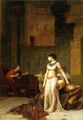
Cleopatra and Caesar by Jean-Leon-Gerome.jpg|''Cleopatra and Caesar'' by {{Wiki|Jean-Léon Gérôme}} | Cleopatra and Caesar by Jean-Leon-Gerome.jpg|''{{Wiki|Cleopatra and Caesar (painting)|Cleopatra and Caesar}}'' by {{Wiki|Jean-Léon Gérôme}} | ||
515px-Cleopatra - John William Waterhouse.jpg|''Cleopatra'' by {{Wiki|John William Waterhouse}} | 515px-Cleopatra - John William Waterhouse.jpg|''{{Wiki|File:Cleopatra - John William Waterhouse.jpg|Cleopatra}}'' by {{Wiki|John William Waterhouse}} | ||
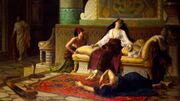
Louis-Marie Baader - Death of Cleopatra.jpg|''Death of Cleopatra'' by {{Wiki|Louis-Marie Baader}} | Louis-Marie Baader - Death of Cleopatra.jpg|''{{Wiki|File:Louis-Marie Baader - Death of Cleopatra.jpg|Death of Cleopatra}}'' by {{Wiki|Louis-Marie Baader}} | ||
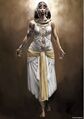
ACO Cleopatra Concept Art.jpg|Concept art by [[Vincent Gaigneux]] | ACO Cleopatra Concept Art.jpg|Concept art by [[Vincent Gaigneux]] | ||
Iset - Concept art.jpg|Concept art for [[Isis]] by [[Jeff Simpson]], used for Cleopatra | |||
ACO Cleopatra Promotional Art.jpg|Promotional art of Cleopatra | ACO Cleopatra Promotional Art.jpg|Promotional art of Cleopatra | ||
ACO DT Cleopatra.PNG|Cleopatra in '' | ACO DT Cleopatra.PNG|Cleopatra in ''Discovery Tour'' | ||
ACReb Cleopatra.png|Cleopatra as she appears in ''Rebellion'' | |||
ACReb Cleopatra.png|Cleopatra in ''Rebellion'' | |||
ACRebellion Profile - Cleopatra.png|Cleopatra's avatar in ''Rebellion''{{'}}s character menu | ACRebellion Profile - Cleopatra.png|Cleopatra's avatar in ''Rebellion''{{'}}s character menu | ||
ACReb Cleopatra Concept Art.jpg|Concept model of Cleopatra in ''Rebellion'' | |||
</gallery> | </gallery> | ||
==Appearances== | ==Appearances== | ||
*''[[Assassin's Creed II]]'' {{ | *''[[Assassin's Creed II]]'' {{1stm}} | ||
*''[[Assassin's Creed Revelations]]'' {{Mo}} | *''[[Assassin's Creed Revelations]]'' {{Mo}} | ||
*''[[Assassin's Creed: Project Legacy]]'' {{c|mnemonic sets}} | *''[[Assassin's Creed: Project Legacy]]'' {{c|mnemonic sets}} | ||
*''[[Assassin's Creed: Initiates]]'' {{Mo}} | |||
*''[[Assassin's Creed: Origins]]'' {{1st}} | *''[[Assassin's Creed: Origins]]'' {{1st}} | ||
**''[[The Hidden Ones (DLC)|The Hidden Ones]]'' {{Mo}} | **''[[The Hidden Ones (DLC)|The Hidden Ones]]'' {{Mo}} | ||
*[[Assassin's Creed: Origins (comic)|''Assassin's Creed: Origins'' comic]] | *[[Assassin's Creed: Origins (comic)|''Assassin's Creed: Origins'' comic]] | ||
*''[[Discovery Tour: Ancient Egypt]]'' | |||
*''[[Assassin's Creed: Valhalla]]'' {{Mo}} | *''[[Assassin's Creed: Valhalla]]'' {{Mo}} | ||
*''[[Assassin's Creed: Rebellion]]'' | *''[[Assassin's Creed: Rebellion]]'' | ||
*''[[Assassin's Creed: Where's the Assassin?]]'' {{c|non-canonical appearance}} | *''[[Assassin's Creed: Where's the Assassin?]]'' {{c|non-canonical appearance}} | ||
*''[[Echoes of History]]'' {{Mo}} | |||
*''[[Assassin's Creed Roleplaying Game]]'' {{Mo}} | |||
==References== | ==References== | ||
{{Reflist}} | {{Scroll box|content={{Reflist}}}} | ||
{{Templars nav}} | {{Templars nav}} | ||
{{ACPL}} | {{ACPL}} | ||
{{ACO}} | {{ACO}} | ||
{{ACOC}} | {{ACOC}} | ||
{{ACRebellion}} | |||
[[de:Kleopatra]] | [[de:Kleopatra]] | ||
[[es:Cleopatra VII]] | [[es:Cleopatra VII]] | ||
| Line 139: | Line 169: | ||
[[Category:Ethnic Greeks]] | [[Category:Ethnic Greeks]] | ||
[[Category:Pharaohs of Egypt]] | [[Category:Pharaohs of Egypt]] | ||
[[Category:Politicians]] | |||
[[Category:Royal consorts]] | [[Category:Royal consorts]] | ||
[[Category:Ptolemaic dynasty]] | [[Category:Ptolemaic dynasty]] | ||
Latest revision as of 23:15, 5 October 2025

|
Patience, brothers. Soon we will reveal the secrets of Echoes of History. This article has been identified as being out of date. Please update the article to reflect recent releases and then remove this template once done. |
Cleopatra VII Thea Philopator (Κλεοπάτρα Θεά Φιλοπάτωρ; 69 BCE – 30 BCE), or simply Cleopatra, was the last effective pharaoh of Egypt, ruling from 51 BCE until her death.
Born as the daughter of Ptolemy XII Auletes, Cleopatra ascended to the throne following her father's death, ruling Egypt with her younger brother and spouse Ptolemy XIII, whom she married as per Egyptian custom. In 49 BCE, Cleopatra was exiled by her brother in a scheme orchestrated by the Order of the Ancients to bring the kingdom under their control.
With the aid of her most trusted follower Apollodorus, and later her agents Aya and Bayek, Cleopatra worked to eliminate the Order within her brother's court. After a failed attempt to ally with the Roman general Pompey, Cleopatra consummated a liaison with Julius Caesar to defeat Ptolemy at the Battle of the Nile in 47 BCE. Unwittingly backed by the Order of the Ancients, Cleopatra's grip on the throne was solidified and with Caesar, she had a son named Caesarion whom she raised in Rome.
After Caesar's assassination in 44 BCE that sparked a civil war in the Roman Republic, Cleopatra allied herself with Caesar's trusted friend and supporter Marcus Antonius, competing against Caesar's adopted son and heir Octavian.
In the final days of the civil war, Cleopatra retreated to Alexandria with her son following Antonius' defeat and suicide at the Battle of Actium. With Octavian's army marching onto the city, Cleopatra was confronted by her former friend and agent Aya, who now served as a Mentor of the Hidden Ones under the alias "Amunet" and persuaded the queen to commit suicide via poison. In exchange, Cleopatra made a final request that Amunet take her son Caesarion away from Egypt and train him as a Hidden One.
Biography[edit | edit source]
Early life and exile[edit | edit source]
Cleopatra was born in 69 BCE in Alexandria to the pharaoh Ptolemy XII Auletes. Following her father's death in 51 BCE, a then eighteen-year-old Cleopatra succeeded him as the next pharaoh of Egypt,[1] co-jointly ruling the country alongside her younger brother Ptolemy XIII.[2]
In the early years of their reign between 50 and 48 BCE, the land was aggravated by extreme droughts and floods.[2] In 49 BCE, Cleopatra was exiled by her younger brother Ptolemy XIII, who had secretly allied himself with the Order of the Ancients, causing her to flee Alexandria with the help of her loyal follower, Apollodorus. During her years in exile, Cleopatra lived in Apollodorus' personal estate.[3] She later made the acquaintance of Aya, a former Medjay who was introduced to her by Apollodorus. The two shared a bond and became close friends, with Aya acting as Cleopatra's personal agent.[4]
Attempts to reclaim the throne[edit | edit source]

In 48 BCE, Cleopatra was introduced to Bayek of Siwa, Aya's husband who had hunted various members of the Order responsible for her exile. Cleopatra revealed to Bayek that the Snake, whom he thought to be Eudoros, was actually the Order itself and that their influence was far from vanquished. Cleopatra appointed Bayek as her personal Medjay, tasking him to eliminate the members of the Order across Upper Egypt, namely the Scarab, the Hyena, the Crocodile, and the Lizard.[5]
Soon after Bayek's departure to hunt down the Ancients, Cleopatra appointed Aya and Phoxidas to the Aegean Sea to seek out Pompey, a Roman general who had been defeated by Gaius Julius Caesar in the midst of a civil war, hoping to secure his support against her brother. The two were ultimately successful in their task, convincing Pompey to ally with Cleopatra and bring his fleet to Egypt.[6]
Sometime thereafter, Cleopatra, accompanied by Apollodorus and her personal guards, travelled to Memphis ahead of the upcoming Apis festival. During this time, she resided at the Palace of Apries, on one occasion giving a speech to the city's displeased residents in an attempt to gain their support. Aya and Bayek later arrived with the clues surrounding the identity of the Lizard, who was revealed to be a priest of Anubis under Pasherenptah.[7]

When it was made apparent that the twin priestesses Tawe and Taous had played a part in poisoning the Apis bull, thereby possibly putting the festival in jeopardy, Cleopatra called for their execution. However, she was stopped by Aya, who stated the priestesses had been coerced into doing so by the Lizard, who had captured their brother Panchrates. Cleopatra later called for the assassination of the Lizard to be done as soon as possible before her departure to Herakleion.[7]
Bayek soon killed the Lizard and returned with his mask, thus ending the Order's reign of terror in Memphis. At the same time, the Apis bull recovered and the festival was thus able to continue. Cleopatra participated in the festival before departing to Herakleion, while Bayek continued his hunt of the Order members across Egypt.[7]
Alliance with Caesar[edit | edit source]
In late 48 BCE, Cleopatra arrived and resided in a palace in Herakleion, awaiting the arrival of Pompey and his fleet. While residing there, she sent Aya and Phoxidas out to the sea once again to defend against the Gabiniani, a group of Romans who resided in Egypt and supported her brother Ptolemy.[8]

During this time, Apollodorus captured Livius, an informant of the Ancients caught spying on Cleopatra. Interrogating him, Apollodorus uncovered a plot by the Gabiniani led by Venator and Lucius Septimius to assassinate Cleopatra. When Bayek arrived in Herakleion after eliminating all of his targets, Cleopatra gave him two more cryptonyms of the Ancients to hunt down: the Jackal and the Scorpion. She then brought the brutalized Livius in front of Bayek and allowed the Medjay to beat him up, before tasking Bayek to investigate and thwart the assassination plot against her.[9]
Bayek found and eliminated all the conspirators involved in the plot before returning to the palace, where he was reunited with Aya, who had just returned from her naval mission. The reunion was interrupted by an ambush from Venator and his remaining followers, though Bayek, Aya and Cleopatra's guards were able to defeat all the assailants. The queen then tasked Aya and Bayek to meet with Pompey's forces west of the city in Herakleion Nome, fearing that the Order would try to ambush them to deprive Cleopatra of her alliance.[9]
Cleopatra's fears proved to be justified, as Pompey and his men had been slaughtered by Septimius, who decapitated the general and brought his head back to Alexandria. Having lost her support, Cleopatra resolved to make an alliance with Caesar, who had arrived in Egypt in pursuit of Pompey.[9] Cleopatra and her followers boarded Phoxidas' ship and set sail to Alexandria. Despite attacks from Ptolemy's fleet en route, they successfully arrived in the port of Alexandria.[10]

As Cleopatra would be recognized and attacked right away, she wrapped herself in a carpet and allowed Apollodorus to carry her into the palace while he posed as the phylakitai of Hermopolis. In the meantime, Aya and Bayek posed as servants to Apollodorus. Guided by the Roman guards, they made their way into the palace, interrupting a meeting between Ptolemy and Caesar. As Caesar was mesmerized by Cleopatra's beauty, he called for a private meeting to speak with her alone, an act which deeply infuriated Ptolemy. The pharaoh left with his men while Apollodorus, Aya and Bayek remained outside the palace.[10]
Cleopatra soon began a secretive relationship with Caesar. To further gain his support against Ptolemy, she sought to use the Tomb of Alexander the Great as a means to impress him. To this end, she tasked Aya to locate an alternative entrance to the tomb, as the main entrance had been damaged by an earthquake during her father's reign. Aya and Bayek navigated through an opening within the tomb walls and unlocked the tomb from within, allowing Apollodorus, Caesar and Cleopatra to enter.[10]

As Cleopatra and Caesar were reminiscing the glory of Alexander the Great, they were interrupted by the latter's lieutenant Flavius Metellus, who reported that their emissaries had been captured and brought to the Akra Garrison. Cleopatra remarked that she would send her guards to investigate, since the Alexandreans were less receptive towards the Romans. However, Aya volunteered herself and Bayek to investigate instead.[10]
Later, Aya reported back to the palace about her findings, having discovered that the Order and Ptolemy's army were planning to trap Caesar and Cleopatra in the city. As the Siege of Alexandria began, Cleopatra tasked Aya to eliminate Ptolemy if she ever had the chance. Thanks to Aya, Bayek and the Romans' efforts, the siege was successfully broken, leading to a decisive battle at the Nile delta. During the battle, Ptolemy was eaten by a crocodile while attempting to flee across the Nile, Pothinus was killed by Bayek, and Septimius was captured by Caesar's men following his defeat by Bayek.[11]
Reign as Pharaoh[edit | edit source]

With Ptolemy and his followers dead, Cleopatra gained sole control of Egypt and was formally crowned as pharaoh at the Serapeum of Alexandria, where Flavius Metellus presented her with Alexander the Great's Scepter, which was secretly a Staff of Eden. Through her alliance with Caesar, the queen began to be secretly influenced by the Order, who convinced Caesar to spare Septimius from execution.[11] Consequently, both Septimius and Flavius entered Cleopatra and Caesar's inner circle and convinced the queen to relinquish the services of Aya and Bayek, effectively cutting all ties with them.[12]
Perceiving this as an act of betrayal, Aya and Bayek formed an organization alongside a group of like-minded individuals to fight against the Order, who now controlled both Egypt and the Roman Republic.[12] While Flavius was later assassinated by Bayek,[13] Septimus returned to Rome to serve as Caesar's advisor, ending the Order's influence in Egypt for the time being.[14]
As a result of her relationship with Caesar, Cleopatra gave birth to his son in June 47 BCE, naming him Caesarion. The queen and her infant son then moved to Rome, where they served as Caesar's guests.[3] Three years later, on 15 March 44 BCE, Caesar was assassinated in the Theatre of Pompey as a result of a conspiracy led by Aya, who had recruited Marcus Junius Brutus, Gaius Cassius Longinus and other Roman senators, calling themselves the Hidden Ones.[15]

Three days later, Aya confronted the queen in her villa in the outskirts of Rome. Angered, Cleopatra remarked that her son would have sat on the throne of Rome had Caesar not been murdered. When she tried to strike her former agent and friend, Aya drew her Hidden Blade, choosing to spare Cleopatra out of respect for her former employer and her son Caesarion. Aya then warned Cleopatra to be the pharaoh Egypt needed, or she would return to assassinate her.[15]
War against Octavian and death[edit | edit source]
With the death of Caesar, his adopted son Octavian became his heir instead of Caesarion. Fearing his power, Cleopatra allied herself with Marcus Antonius, a friend of Caesar, in 41 BCE. A political and romantic relationship followed, and in the winter of that year, Cleopatra gave Antonious a sumptuous tour of Egypt by boat.[16] By 38 BCE, she was introduced to Gaius Julius Rufio, a former general under Caesar and secretly a member of the Order of the Ancients. On one occasion, she was seemingly disrespected by Rufio, leading Antonius to later reprimand the general in a letter.[17]

Eventually, a civil war broke out between Antonius and Octavian in March 32 BCE. Fearing for her and her son's safety, Cleopatra moved back to Alexandria. In 31 BCE, Antonius was defeated at the Battle of Actium and committed suicide. With Antonious dead and her fate sealed, Cleopatra made her final stand in Alexandria, where she trained Caesarion to fight when the time came to defend himself.[18]
On 12 August 30 BCE, as Octavian's army seized Alexandria, Cleopatra survived an assassination attempt by one of Octavian's messengers and had her killed.[18] Later, Cleopatra watched as her son trained with a soldier and was knocked down. She comforted her son by telling him that every defeat was a chance to learn towards a victory. They were then interrupted by the sight of fires in the distance, as Octavian closed in further.[19]
That evening, Cleopatra found Caesarion looking to the horizon, as Octavian's men closed in. As their bodyguard advised them to stay in place, Caesarion walked away to investigate a noise. Suddenly, an assailant rushed towards Cleopatra, leaving Caesarion to defend her and ultimately kill the would-be assassin. The bodyguard returned shortly after, and believing him to have been partly behind the assassination attempt, Cleopatra goaded her son into killing the guard too.[20]

As Octavian rapidly approached the palace, Cleopatra was confronted one last time by Aya, now known as "Amunet". Her former friend implored her to resign to Octavian's victory, to which the pharaoh acquiesced on the condition that Amunet take Caesarion with her and train him as a Hidden One. Amunet then handed Cleopatra a vial of poison and left with Caesarion. Once the queen was certain that her son had escaped to safety, she thanked Akila for her servitude before consuming the poison. Within mere moments, Cleopatra, the last pharaoh of Egypt, was dead.[21]
Legacy[edit | edit source]
Though Amunet had not directly killed Cleopatra,[21] later Assassins romanticized her role in her death with the legend that she had assassinated the queen with a venomous asp. Statues of Amunet with a serpent coiled around her were erected in the Sanctuary under the Villa Auditore in Monteriggioni and in her cenotaph in Venice's Basilica di San Marco, reinforcing the popular account.[22][23]
In 2012, the Assassin Clay Kaczmarek collected details on Cleopatra's death while Abstergo Industries held him captive at their Animus Project laboratory in Rome. He then hid the information within the Animus 1.28 in Glyph puzzles for his successor, Desmond Miles, to find.[24] Sometime in early September,[25] Desmond solved the puzzle set titled "Bloodlines", in which Cleopatra was excluded from a list of historic individuals who were known to have consorted with gods,[26] though Clay also included her in the puzzle set "Guardians", in which she was included in a list of historic individuals whom the Assassins had killed.[27] That same year, Cleopatra was also included in a mnemonic set in Abstergo Industries' Project Legacy.[28]
Personality and traits[edit | edit source]

Cleopatra was a figure who often displayed an irreverent and whimsical exterior, lavishing in wealth and indulging in all the aristocratic pleasures of life. She was shown to be quite charismatic, easily swaying the Egyptian crowds into accepting her as a ruling figure. This was mostly because she had a very charming voice that could make even a lovesick man become enamored with the sweet tones of her voice.[3]
Because her voice was her most defining feature, she was able to sway Julius Caesar to her side after a single meeting by appealing to his desire for greatness. To that end, she cultivated the image of being a goddess among her people to gain their admiration and loyalty.[3]
However, beneath her charmingly hedonistic exterior was a ruthless, seductive, and determined political manipulator willing to get rid of anyone in the way of her obtaining rulership and going through any means of securing her path to power. To that end, she allied herself with Bayek and Aya before betraying them by siding with the Order of the Ancients in order to consolidate her rule over Egypt and Rome via her relationship with Caesar. She also tried to use her Caesar-spawned son Caesarion to strengthen her control of Rome, a plan which was ultimately thwarted by Caesar's assassination by the Hidden Ones.[3]

Cleopatra was also shown to be quite cruel, initially demanding the twin priestesses of Amun to be boiled to death inside a Bronze Bull after learning of their role in poisoning the ceremonial Apis bull.[7] She also sought to have her brother slain to eliminate any obstacles to her birthright to the throne.[10]
That being said, Cleopatra considered that all of her actions were ultimately done in service of Egypt, as the queen genuinely loved her country and her subjects and sought to ensure their safety and prosperity. In her final moments, she agreed to take her own life at Amunet's request to spare Egypt from Octavian's wrath, and also reflected on her love and admiration for Egypt,[21] believing that the nation had the potential to become one of the most powerful empires in the world;[10] a dream that was seemingly crushed by Octavian's conquest of Egypt.[21]
Skills[edit | edit source]
Cleopatra was the only Ptolemaic pharaoh to speak the Egyptian language as well as Greek.[1] Cleopatra was regarded as being one of the most educated women of her time, speaking nine languages by the time she was 20.[4]
Behind the scenes[edit | edit source]
Cleopatra is a historical character first introduced in the 2009 video game Assassin's Creed II in the Glyph puzzles via paintings. She made her proper debut in the 2017 game Assassin's Creed: Origins, where she was voiced by the English actress Zora Bishop, who returned the next year to reprise her role in the downloadable educational expansion Discovery Tour: Ancient Egypt.
The name Cleopatra is derived from the Greek name Κλεοπάτρα (Kleopatra), meaning "she who comes from glorious father" or "glory of the father" in the feminine form, derived from κλέος (kleos, "glory") combined with πατήρ (pater, "father"). The name is also shared with numerous Greco-Macedonian princesses, queen consorts, and queen regnants. In-game, her cartouche is written with Egyptian hieroglyphs to include only her nomen or given name and its epithet "Cleopatra netjeret mer ites" meaning "The goddess Cleopatra who is beloved of her father"; there is no record of her having a prenomen or throne name due to how short her reign was and the fact that Egypt became a province of the new Roman Empire under Octavian following her death.
Gallery[edit | edit source]
-
-

-
-
 Concept art by Vincent Gaigneux
 -
 Concept art for Isis by Jeff Simpson, used for Cleopatra
 -
 Promotional art of Cleopatra
 -
 Cleopatra in Discovery Tour
 -
 Cleopatra as she appears in Rebellion
 -
 Cleopatra's avatar in Rebellion's character menu
 -
 Concept model of Cleopatra in Rebellion


Appearances[edit | edit source]
- Assassin's Creed II (first mentioned)
- Assassin's Creed Revelations (mentioned only)
- Assassin's Creed: Project Legacy (mnemonic sets)
- Assassin's Creed: Initiates (mentioned only)
- Assassin's Creed: Origins (first appearance)
- The Hidden Ones (mentioned only)
- Assassin's Creed: Origins comic
- Discovery Tour: Ancient Egypt
- Assassin's Creed: Valhalla (mentioned only)
- Assassin's Creed: Rebellion
- Assassin's Creed: Where's the Assassin? (non-canonical appearance)
- Echoes of History (mentioned only)
- Assassin's Creed Roleplaying Game (mentioned only)
References[edit | edit source]


| ||||||||||||||||||||||||||||||||||
| ||||||||||||||||||||||||||||||||||||||||
| |||||||||||||||||||||||||
| |||||||||||||||||||||||||||||||||||||||||||||||||||||||||||
de:Kleopatra es:Cleopatra VII fr:Cléopâtre hu:Kleopátra it:Cleopatra pl:Kleopatra pt-br:Cleópatra ru:Клеопатра zh:克利奥帕特拉七世