


Apples of Eden
The Apples of Eden are sphere-shaped pieces of Isu technology. Having long outlasted their creators, the Apples are featured prominently, although cryptically, throughout recorded history as the cause of several "divine" and "superhuman" events, including Adam and Eve being cast out of Eden, the parting of the Red Sea, and the Trojan War.
Throughout human history, the Apples of Eden have been known by several other names. During ancient times, the Order of the Ancients and the Hidden Ones referred to one Apple in particular as the Orb.
History[edit | edit source]

Long before humanity existed, the Isu, a civilization of technologically advanced beings, inhabited Earth. They created humanity, and enslaved them by modifying their brains to be obedient in the presence of a Piece of Eden. For some time there was a forced peace, until two human-Isu hybrids, Adam and Eve, stole an Apple[21] and incited the Human-Isu War.[4]
As all were too preoccupied by the war to see any other threat, a major solar flare impacted the Earth, triggering the Great Catastrophe and significantly damaging both mankind and their makers. The Isu slowly became extinct, while mankind grew and populated the Earth, remembering their predecessors in myths as gods.[10][4][22]
The Pieces of Eden were not destroyed by the blast, and throughout time humans began recovering them, also causing an ideological divide, resulting in the formation of two groups, now referred to as the Templars and the Assassins. It is the Templars' aim to restore peace in the way the Isu had once done—forced by the Pieces—whereas the Assassins, who fight for freedom and a flawed but unshackled humanity, put free will above order. Many centuries have gone by as their covert war continues, both knowing the importance of the Pieces of Eden, especially the Apples, to reach their goal.[1][4]
To date, the Apples are featured as the most recognizable of the Pieces of Eden, being favored by Abstergo Industries in their plan of establishing a New World Order, as some other Pieces were known to be able to create time paradoxes.[23]
Powers and capabilities[edit | edit source]

The Apples were designed to be able to project images, conjure realistic illusions, and even turn thought into reality; hence, they were used by many great rulers throughout human history, proving the efficacy of their powers.[4]
When the Isu created humanity, they bred within their brains hidden neurotransmitters. The Apples can interface with these neurotransmitters to issue commands to the brain, thus allowing them mental control over humans. However, humans with traces of Isu genes were not born with the neurotransmitters and thus were immune to the Apples' mental manipulation powers, but they were still susceptible to their physical effects.[1][4]
At times, those with mixed genes showed immense resistance—ranging from minor resistance to the point of outright total immunity—to physical control after coming into contact with an Apple. This was seen in the case of Altaïr Ibn-La'Ahad who, after being temporarily restrained by Al Mualim using an Apple, was completely unmoved and unharmed by its effects.[1] In modern times, humans themselves had already started research on the brain, comparing them to those of other animals, seeing that they were not like the other animals, but not knowing the reason why.[4]

At least one Apple, as exemplified through George Washington using it as king in an alternate reality, was capable of emitting energy blasts similar to the Swords of Eden, albeit on a weaker scale. The illusions created by the Apple could also cause physical harm to opponents, stunning them with a blast of energy upon contact. Furthermore, the artifact seemed to possess a mind of its own and could influence people even when no one was using it, projecting an apparition of another man in an attempt to manipulate Washington.[9]
One Apple in particular was shown to be able to imbue objects with mystical power, giving the Head of Saint Denis the ability to cast terrifying illusions.[2] During the Mongol assault on Masyaf, Altaïr used his Apple's energy to conjure golden tangible-holographic apparitions of Assassins to repel the Mongol attack.[6] During the alternative timeline of King Washington, he was able to use the Apple to manipulate spherical balls of energy and project blasts of energy.[9]

All Apples could presumably be used in conjunction with a Staff of Eden, though there has been only one solid example of this, when the Italian Assassin Ezio Auditore combined an Apple of Eden with the Papal Staff to open the Vatican Vault,[4] before taking the Apple and losing the Staff as it was pulled into the ground.[10]
The Apples also contained technological knowledge used by the Isu. Like many other Pieces of Eden, they were able to "communicate" with people, showing them advanced technology and what was needed in their construction.[10] A good example of this was Leonardo da Vinci, who studied one of the Apples and created war machines and several other weapons ahead of his time.[10]
While quite durable and unable to be damaged through normal means, the Apples are not indestructible and can become highly unstable when not handled properly. One Apple in Abstergo Industries' possession was destroyed under unknown circumstances during the DIA satellite accident,[15] while another detonated after being exposed to high voltages of electricity.[24]
Known Apples of Eden[edit | edit source]
"Unclaimed" Apples of Eden[edit | edit source]
Apple of Eden #1[edit | edit source]
- Main article: Apple of Eden 1
Located in the Saint-Denis Temple in France, this Apple was first acquired by Saint Denis of Paris, a Roman bishop during the 3rd century CE. After his death, one of his successors created the Head of Saint Denis to house the artifact before returning it to the Temple.[25] In the 12th century, the Abbot Suger of Saint-Denis recovered the Apple and used the knowledge gained from it to create a sword.[2]

During the French Revolution, the Apple was sought by Napoleon Bonaparte, who employed raiders to retrieve it from the Saint-Denis Temple. However, the former French Assassin Arno Dorian recovered the artifact and had it delivered to the Egyptian Assassins in Cairo, Egypt.[2] Napoleon later travelled to Egypt to claim the Apple and was successful in his endeavor, using the artifact's power to become Emperor of France in 1804.[26]
By the early 20th century, the Apple had ended up in the possession of Harry Houdini, a magician who used it to create his "impossible" stunts. In 1926, he was assassinated by Templars who sought to acquire the artifact, though his death was commonly believed to have been caused by a ruptured appendix.[27]
Later, the Apple was used in the assassination of John F. Kennedy, as a means of producing a "Phantom on the Hill" effect, making the prosecution of Lee Harvey Oswald more difficult, and disguising the intentions of the assassination. The current location of this Apple is unknown.[14]
Apple of Eden #3[edit | edit source]
- Main article: Apple of Eden 3

The earliest known human possessors of this Apple were the Freemasons, who brought it over from Europe to the New World.[27] General George Washington, a Freemason, recovered the artifact during the Siege of Yorktown at the end of American Revolutionary War. It began to give him nightmares of an alternate timeline where he used its power to rule America as a king, so he gave it to the Assassin Ratonhnhaké:ton, who later dropped it into the sea.[9]
By the 20th century, the Apple of Eden had been recovered, and President Franklin D. Roosevelt had it in his possession.[27] He, along with Winston Churchill and Joseph Stalin, were later manipulated by the Templars into starting World War II.[28]

By the 1960s, the Apple was in the possession of John F. Kennedy, who was assassinated by the Templar William King Harvey through the proxy of the Assassin Bloodstone Unit. One of the unit's members, William Greer, had been trained using the Apple of Eden 2 and drove Kennedy into a trap in Dallas. Greer then took the President's Apple but was confronted by Alekseï Gavrani, a former member of the Bloodstone Unit. Gavrani took the artifact and entrusted it to Harvey, unaware of his treachery as Harvey was also an Assassin.[17]
The Apple of Eden 3 was then given to Kennedy's Presidential successor, Lyndon B. Johnson, who was secretly a Templar. Johnson pushed for the Apollo 11 project, which saw the successful retrieval of another Apple from the Moon.[29]
Apple of Eden #5[edit | edit source]
- Main article: Apple of Eden 5

The Apple of Eden 5 was one of many artifacts sent into space by the Isu as part of their efforts to prevent the Great Catastrophe, but their attempts ultimately failed.[3] This particular Apple veered of its course and landed on the Moon's surface, where it remained until 1969, when it was recovered by the Templars through NASA's Apollo 11 mission. Its current whereabouts are unknown.[29]
Apple of Eden #6[edit | edit source]
- Main article: Apple of Eden 6
This Apple was possessed by the Ottoman Sultan Mehmet II during his conquest of Constantinople. His son Cem subsequently hid it in the Templar Archive on Cyprus, where it came into Templar and then Assassin possession at the end of the 15th century, before falling into the hands of Girolamo Savonarola.[30] The Apple was retaken by Ezio Auditore in 1498, who later used it in conjunction with the Papal Staff to open the Vatican Vault, where he spoke to a hologram of the Isu Minerva.[4]
During the Siege of Monteriggioni, Ezio lent the Apple to his uncle Mario, who kept it safe as Ezio protected the town. However, Mario was captured and killed by the Templar Cesare Borgia, who would take the Apple and give it to Leonardo da Vinci for study so the inventor could supply him with war machines.[10]

The Apple was eventually stolen once more by Rodrigo Borgia, who hid it within the courtyard of St. Peter's Basilica, where Ezio found it and used it to exterminate Cesare's followers before defeating Cesare himself.[10] Later in his life, Ezio, instructed by the Apple to hide it,[31] stored the artifact in a vault beneath Santa Maria in Aracoeli. The Apple would remain there until October 2012, when Desmond Miles and his fellow Assassins uncovered its location.[10]
However, upon retrieving the Apple, Desmond was forced by Juno to kill his fellow Assassin Lucy Stillman, who was secretly a Templar double agent. He subsequently fell into a coma, with the artifact being kept safe until his eventual awakening.[10] Desmond and the other Assassins later used the Apple to open the door to the Grand Temple, and then to assault Abstergo's facility in Rome.[3]
While Desmond initially planned to use the Apple to ransom for his captive father, William, he ended up using its power to force both Warren Vidic and any guards standing in his way to shoot themselves. Following Desmond's sacrifice to prevent the Second Disaster,[3] the Apple was taken by William and currently remains in Assassin possession.[16]
"Claimed" Apples of Eden[edit | edit source]
Aguilar's Apple of Eden[edit | edit source]
- Main article: Aguilar's Apple of Eden

The first known human to possess this Apple of Eden was Emir Muhammad XII of Granada, who was forced to hand it over to the Grand Inquisitor and Master Templar Tomás de Torquemada in 1492, when the latter captured Muhammad's son, Prince Ahmed. The artifact did not stay in Torquemada's possession for long, however, as the Assassins Aguilar de Nerha and María immediately launched an attack to take back the artifact.[18]
While María died in the ensuing battle, Aguilar was able to escape with the Apple and later gave it to the Assassin ally Christoffa Corombo, who took it with him as he set sail for the New World. The Apple would stay with Corombo until his death, at which point the Piece of Eden accompanied his remains back to the Seville Cathedral in Spain, where they were buried.[18]
In 2016, the Templars found and recovered the Apple after using Aguilar's descendant Callum Lynch to relive his memories. However, when Alan Rikkin unveiled the artifact in front of the Council of Elders in London, Callum assassinated him, took the Apple, and escaped alongside fellow Assassins Moussa and Lin.[18]
Akhenaten's Apple of Eden[edit | edit source]
- Main article: Akhenaten's Apple of Eden

This Apple of Eden was found by Pharaoh Akhenaten at some point during his reign. Believing that the relic was Aten himself, he and his wife Nefertiti introduced a monotheistic religion centered around the artifact. After both Akhenaten's and Nefertiti's death, the Apple was handed down to their son Tutankhamun. Refusing to continue the worship of the Aten, Tutankhamun charged the High Priests of Amun in Thebes with the Apple's care.[11]
By the 1st century BCE, the Apple was still in the possession of the God's Wife of Amun. As a result of numerous tomb robberies during her tenure, the God's Wife of Amun Nitokris attempted to use the Piece of Eden to deter the robbers. However, she was killed before she could do so, and the Apple passed to her daughter, Isidora.[11]
In 34 BCE, Isidora, now the God's Wife of Amun, used the Apple to conjure apparitions of several deceased pharaohs as revenge against the ones responsible for her mother's death. When the Thebans dubbed this a curse, the Hidden One Mentor Bayek, on Amunet's advice, travelled to the city to investigate. He eventually discovered Isidora's involvement, killed her, and recovered the Apple, giving it to Sutekh, a descendant of Ramesses II, for safekeeping.[11]
Sometime later, however, Sutekh died under unknown circumstances. Bayek came across his corpse in the Waset Desert, with the Apple nowhere to be found.[11]
Gull's Apple of Eden[edit | edit source]
- Main article: Gull's Apple of Eden

This Apple was held within the Temple of Heimdall in Rygjafylke, Norway, high atop the Feiknstafir mountains. In 870, it was retrieved by the thrall Gull, who used it to break free of her mental and physical chains and remember her past life as the Isu Idun. She then used its mind-control powers on the Raven Clan shieldmaiden Eivor Varinsdottir, stopping her in her tracks.[13]
As the decrepit temple began to fall apart around them, Gull told Eivor to leave and save her village of Stavanger from an attack by Kjotve the Cruel and members of his clan. The Viking did so, abandoning both Gull and the Apple inside the collapsing temple and leaving their fates uncertain.[13]
Mihšihkinaahkwa's Apple of Eden[edit | edit source]
- Main article: Mihšihkinaahkwa's Apple of Eden
By 1791, this Apple was held by Chief Mihšihkinaahkwa of the Miami people. When Major-General Arthur St. Clair, a Templar, learned about Mihšihkinaahkwa's possession of the artifact, he ambushed the chief near the Wabash River to acquire the Piece of Eden, but the American troops were defeated by a combined force of Miami, Shawnee, and Lenape people. While St. Clair retreated to Fort Jefferson, Assassins led by Ratonhnhaké:ton infiltrated the general's camp and stole his research on the Apple.[19]
Destroyed Apples of Eden[edit | edit source]
Apple of Eden #2[edit | edit source]
- Main article: Apple of Eden 2

This Apple of Eden, also called the Oracle's Relic or the Light of Amun-Ra by Bayek, was initally held by the Order of the Ancients member Medunamun. While confronting Medunamun inside Siwa's Temple of Amun, Bayek took the Apple of Eden from him and bludgeoned Medunamun to death with it for mocking the loss of his son Khemu and Bayek's failure to save him.[5]
Bayek would carry the Apple with him until leaving it in the hands of his ally Apollodorus, who later lost it to Flavius Metellus, the de facto leader of the Order in Egypt. Bayek tracked Flavius to Cyrene's Temple of Mars and overcame the Apple's powers to eliminate the Roman. He then took the Apple and stored it in the Hidden Ones' hideout underneath the Library of Alexandria, where he hoped it would never be found.[5]
The Apple was eventually recovered by the Knights Templar and hidden in Solomon's Temple until 1191, when Al Mualim tasked his Assassins to steal the "Templar treasure". Although the mission was a partial failure, resulting in the death of one of the Assassins sent to retrieve the artifact, Kadar Al-Sayf, his brother Malik managed to escape with the Apple and returned to Masyaf.[1]

Following this, the Apple remained in the possession of Al Mualim, who eventually used it to mind-control the town's population. The Master Assassin Altaïr Ibn-La'Ahad, being partially resistant to the Apple's powers, killed Al Mualim for his treachery, following which he claimed both the Apple and the title of Mentor.[1] Altaïr kept the Piece of Eden until his death in 1257, using it several times for either his own safety or for its advanced knowledge.[6]
In 1512, the Assassin Ezio Auditore da Firenze found Altaïr's library where the Apple had been locked away, but chose to leave the artifact there.[6] The Apple would eventually be removed from the library and given to Queen Elizabeth I, who favored a Protestant England over the Catholic religion of her forebears. She notably used the Apple to help reverse the Catholic influences of her predecessor, Queen Mary I.[26]
The Apple eventually passed into the hands of Mahatma Gandhi, who most likely used it to acquire a large religious mass of followers in India in the early 20th century. However, the Templars became aware of Gandhi's possession of the artifact and assassinated him in 1948 to take the Piece of Eden for themselves.[27]
By 1963, the Templars had both the first and second known Apples in their possession and used them during the assassination of John F. Kennedy.[14] The Apple was eventually destroyed during the DIA satellite accident in the early 21st century, forcing the Templars to track down another Apple.[15]
Apple of Eden #4[edit | edit source]
- Main article: Apple of Eden 4

The fourth Apple of Eden was first depicted in 10th-century Chinese art, as a golden ball held by a small demon, and presumably played a role in the development of the first firearms.[32]
The first known human to possess the Apple was Nikola Tesla,[33] who found it in his home country of Croatia. He likely used it to develop his inventions, intending to make electricity available worldwide.[34] The Templars started campaigning against him, using Thomas Edison to publicly slander Tesla and to videotape the electrocution of an elephant to prove the dangers of electricity.[33]
Later, the Templars broke into Tesla's lab, stealing his Apple and using it to drive him insane.[33] Edison then lent it to Henry Ford, who manipulated assembly line workers for profit. Henry, "as per instructions", shipped the Apple to Adolf Hitler, just before the Nazi Party took power in Germany and began World War II.[34]

By 1943, Hitler granted the Apple to the Templar and Obergruppenführer Gero Kramer, who used it in different projects. He abducted Tesla and forced him to use the artifact to build Die Glocke, a device that allowed users to relive their ancestors' genetic memories. The Assassins Eddie Gorm and Julia Dusk eventually killed Kramer and recovered the Apple for their superior, Boris Pash.[35]
As Pash had formed an alliance with the Templar John von Neumann and sought to use the artifact to travel back in time and prevent the war, Dusk committed suicide with a hand grenade in an attempt to destroy the Apple, but failed. Pash and Neumann subsequently brought the Apple to the USS Eldridge for the Philadelphia Project, but Gorm sabotaged the project by killing Tesla and then committed suicide.[35] After the project's failure, Neumann kept the Apple.[17]
In 1957, Pash visited a dying Neumann at the Walter Reed Medical Center in Washington, D.C. and took possession the Apple. In 1964, Pash made a deal with William King Harvey, giving the Apple to save his pregnant lover Zenia. Harvey entrusted the Apple and Pash's newborn daughter Nathalie to Dr. Warren Vidic, who experimented on them over the next several years.[17]
In 1977, Nathalie escaped from Abstergo with both the artifact and blueprints of an early Animus. While she later gave the blueprints to William Miles, she kept the Apple, intending to use it to restart her father's life work, Project BLUEBIRD, by brainwashing patients and overwriting their personalities with the memories of long-dead Assassins. In 2017, the Assassin Tomo Sakagawa discovered Nathalie's plans and sabotaged the project, killing Nathalie in an explosion which presumably also destroyed the Apple.[17]
Apple of Eden #7[edit | edit source]
- Main article: Apple of Eden 7

In 1862, the British Templars discovered this Apple of Eden buried in London, but it was retrieved by the solicitor Charles Pearson before they could claim it. The Templar Cavanagh later assassinated Pearson and took possession of the Apple, intending to use it to overthrow Grand Master Crawford Starrick. However, he was killed by another Templar, Marchant, for his treachery, and the artifact was subsequently delivered to the Order.[36]
By 1868, the Apple had been given to the Templar David Brewster, who experimented on it at his underground laboratory in Croydon. When the Assassin Evie Frye infiltrated the laboratory to eliminate Brewster, she saw the Apple and intended to retrieve it. Before she had the chance to do so, however, the Apple was overloaded and detonated, destroying the laboratory and leaving Evie as the sole survivor.[24]
Treasure Hunter's Apple of Eden[edit | edit source]
- Main article: Treasure Hunter's Apple of Eden
This Apple of Eden was found by a famed treasure hunter sometime between 1100 and 950 BCE, who hid it on the island of Korfu. After his death, he left behind clues for his son to find his buried stash, including the Apple, but the son died before he could find it and so the tale of Korfu's treasure passed into legend.[7]

In 420 BCE, a group of pirates began searching for the hidden treasure on Korfu and ran into the Spartan mercenary Kassandra, who was vacationing on the island at the time. Teaming up with her friends Herodotos and Barnabas, Kassandra followed the treasure hunter's clues to find his stash before the pirates, but was forced to hand over the Apple to the pirates' captain after he captured Herodotos.[7]
Upon fighting and killing the Apple-empowered captain, Kassandra moved to pick up the artifact. However, it reacted to her Spear of Leonidas and depowered it, before launching itself away. Barnabas later sought to recover the Apple for Kassandra, but became corrupted by its influence, forcing Kassandra to fight her friend. Ultimately, she managed to remove the Apple from his hands and destroyed it not long after.[7]
Isle of Skye's Apple of Eden[edit | edit source]
- Main article: Isle of Skye's Apple of Eden

In the late 9th century CE, Kassandra arrived on Scotland's Isle of Skye to search for an Apple of Eden she had tracked to the island. However, her presence activated the artifact, which began influencing the island's population and giving them intense nightmares. When the Viking shieldmaiden Eivor Varinsdottir arrived to investigate the source of the nightmares, she encountered Kassandra and the two warriors teamed up to find the Apple.[12]
Eventually, Eivor and Kassandra discovered the Apple hidden within an Isu temple known as the Cave of Gold. Jointly, both warriors took hold of the artifact and deactivated it, ending the nightmares plaguing the islanders. Eivor then handed the inert Apple to Kassandra, who presumably destroyed it.[12]
Isabel's Apple of Eden[edit | edit source]
- Main article: Isabel's Apple of Eden

Hidden in the jungles of Cambodia, this Apple of Eden was recovered around the year 1524 by the former Assassin Isabel. Alongside her all-female group of warriors, the Furies, Isabel used the Apple to terrorize the local population as "Colubra", altering the flora and fauna around the Mekong river.[20]
In response to Colubra's actions, two separate Assassin expeditions were sent to the Mekong to put a stop to Colubra and the Furies' reign of terror. The second expedition succeeded in reaching Colubra's sanctuary, where the former Assassin realized the error of her ways and decided to sacrifice herself to destroy the Apple. While the Assassins fought an apparition of the giant snake Sesha, Colubra took the Apple to a nearby Isu temple, from where neither she nor the artifact would ever come out again.[20]
Other Apples of Eden[edit | edit source]
- An Apple was stolen by Adam and Eve, possibly igniting the Human-Isu War. This is presumably the same Apple that motivated Cain to murder his brother Abel, as suggested in a Glyph puzzle left behind by Clay Kaczmarek.[37]
- Al Mualim once remarked that Apples had been used to create powerful illusions across history. Among these were Moses, who made use of his Apple to turn his staff into a snake and made the Egyptian army believe that he was capable of parting and closing the Red Sea; and Jesus, who used his Apple to turn water into wine. Al Mualim also mentioned that the Apple of Discord cast by the Greek goddess Eris was actually an Apple of Eden,[38] though some of these miracles were later revealed to have been the doing of Pieces of Eden other than Apples.
- According to Greek mythology, the legendary hero Herakles had to steal the apples from the garden of the Hesperides as the eleventh of his twelve labours.[39] These were hinted to have been Apples of Eden in one of the Glyph puzzles left behind by Clay Kaczmarek.[40]
- According to Norse mythology, the Æsir Idun was the caretaker of golden apples, fruit which ensured the gods' vigor and immortality. These were hinted to have been Apples of Eden in one of the Glyph puzzles left behind by Clay Kaczmarek.[40]
- The ancient Greek athlete Kyros of Zarax discovered an Apple in a temple of Aphrodite. He used this to win a race as an older man so as to gain the Arkadian princess Atalanta's hand in marriage.[41]
- The 15th-century Assassin Li Tong possessed an Apple, which she protected from falling into the hands of the Yongle Emperor during his purge of the Chinese Assassins.[42]
- In 1515, the Templar Dei Petrucci was given an Apple of Eden to transport through Florence. He was ambushed by the Assassins Giovanni Borgia and Hiram Stoddard, who sought to recover the artifact, but managed to escape.[43] The following year, the Brotherhood succeeded in retrieving the Apple and sent it to a hideout in Greece, where Hiram, who had since abandoned the Assassins, tried to steal it.[44] However, Giovanni stopped him and took the Apple, transporting it to another location.[45]
- During the coronation of Charles II of England, he noticed his general George Monck speaking to a man holding a sphere wrapped in a cloth, but had to bow his head to receive his crown before he could look any further.[46]
- In 1839, the Assassin Arbaaz Mir and his servant Raza Soora explored the Isu ruins in the caverns beneath Ranjit Singh's summer palace. Amongst these ruins was a statue of Durga holding several Pieces of Eden, including an Apple.[47]
- In the mid-19th century, the Assassin turncoat Oscar Kane gave an unidentified Apple of Eden to the Austrian Templar and Countess Konstanze von Visler for her experiments before his death.[48] By 1889, Konstanze had given the Apple to her alleged daughter Gisela.[49]
Behind the scenes[edit | edit source]
The Apples of Eden are by far the most common Pieces of Eden featured in the Assassin's Creed franchise, having appeared in every main installment of the video game series with the exception of Assassin's Creed IV: Black Flag, Assassin's Creed: Rogue, Assassin's Creed: Mirage, and Assassin's Creed: Shadows. Even then, Rogue still features a drawing of an Apple, which can be seen alongside other Isu artifacts on a notice board inside the Davenport Homestead's manor.
In Assassin's Creed, Al Mualim attributed the Apple as the catalyst for certain events that it was later revealed not have been a part of. This is possibly because at the time Shrouds and Staves of Eden such as the ones possessed by Jesus and Moses, respectively, had not yet been conceived as Pieces of Eden. Alternatively, Al Mualim could have been referring to Pieces of Eden in general and not the Apple in particular with that quote. He also described it as a "piece of silver", mostly in response to Altaïr's skeptical remark but also alluding to the tempting powers of the thirty pieces of silver paid to Judas Iscariot to betray Jesus.
In the 2016 film, it was revealed that the Apples consist of an outer cover and an inner core. The outer cover can be removed without affecting the function of the device. This was added to explain the different model of the Apple found by Arno Dorian in Assassin's Creed: Unity's downloadable expansion Dead Kings.
Far Cry New Dawn became the first Ubisoft game outside the Assassin's Creed series to feature an Apple of Eden. Whereas in Assassin's Creed they are ancient relics which have advanced functions, the Apples in New Dawn are legitimately supernatural in nature. Upon consumption, pure souls would acquire some supernatural abilities whereas sinful souls would transform into demonic creatures.
If players asked the virtual Personal Gaming Assistant "Sam" about Apples of Eden on the Ubisoft Connect mobile app, its response referenced the Isu's failed plan to launch Apples into orbit to shield Earth from the Great Catastrophe, saying that "About twenty Apples were recovered and lost throughout history. Of these, 12 were detonated in the atmosphere to protect the Earth from a solar flare".
Gallery[edit | edit source]
-
 The internal structure of an Apple of Eden
 -
 An Apple of Eden being used to control humans
 -
 Eve holding the Apple stolen from Eden
 -

-
 An Apple as seen in Assassin's Creed: Forgotten Temple
 -
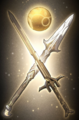 An Apple with the Spear of Leonidas and Excalibur
 -
 An ancient Egyptian mural depicting an Apple
 -
 Various Apples alongside a Shroud and Staff of Eden
 -
 The Treasure Hunter's Apple on Korfu
 -
 An Egyptian mural depicting the Aten
 -
 Bayek hiding the Apple recovered from Flavius
 -
 The Isle of Skye's Apple atop its pedestal
 -
 A holographic map projected by an Apple
 -
 Altaïr Ibn-La'Ahad holding an Apple of Eden
 -
 Altaïr sealing the Apple beneath Masyaf
 -
 Leonardo da Vinci observing symbols from Ezio's Apple
 -
 Ezio using his Apple against two Papal Guards
 -
 Tomás de Torquemada holding Aguilar's Apple
 -
 Ezio discovering Altaïr's Apple
 -
 Giovanni Borgia holding an Apple
 -
 Diagrams of an Apple among Achilles Davenport's notes
 -
 George Washington giving his Apple to Ratonhnhaké:ton
 -
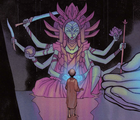 Durga's statue holding an Apple
 -
 Nikola Tesla and Mark Twain experimenting on an Apple
 -
 Tesla's Apple inside Die Glocke
 -
 William King Harvey holding Tesla's Apple
 -
 Desmond Miles and the others recovering Ezio's Apple
 -
 Desmond using Ezio's Apple in the Grand Temple
 -
 Desmond using Ezio's Apple on Abstergo guards


Appearances[edit | edit source]
References[edit | edit source]
