

Cleopatra

|
He who increaseth knowledge, increaseth sorrow. This article contains spoilers, meaning it has information and facts concerning recent or upcoming releases from the Assassin's Creed series. If you do not want to know about these events, it is recommended to read on with caution, or not at all. |

Cleopatra VII Thea Philopator (69 BCE – 30 BCE), known to history simply as Cleopatra, was the last effective pharaoh of the Ptolemaic dynasty of Egypt, ruling from 51 BCE to 30 BCE. She was the daughter of Ptolemy XII Auletes and the elder sister of Ptolemy XIII. After her reign, Egypt became a province of the recently established Roman Empire. Cleopatra was a member of the Ptolemaic dynasty, a ethnically Greek family of Macedonian origin that ruled Egypt after Alexander the Great's death during the Hellenistic period. The Ptolemies spoke Greek and kept their customs throughout their dynasty, and refused to speak Demotic Egyptian, which is the reason that Greek as well as Egyptian were used on official court documents such as the Rosetta Stone. By contrast, Cleopatra did learn to speak Egyptian and represented herself as the reincarnation of the Egyptian goddess Isis.
Cleopatra originally ruled jointly with her father, and later with her brothers, Ptolemy XIII Theos Philopator and Ptolemy XIV, whom she married as per Egyptian custom, but eventually she became sole ruler. As queen, she consummated a liaison with Julius Caesar that solidified her grip on the throne. She later elevated Caesarion, her son with Caesar, to co-ruler in name.
After the assassination of Caesar in 44 BC, she aligned with Mark Antony in opposition to Caesar's legal heir, Gaius Julius Caesar Octavianus (later known as Augustus). With Antony, she bore the twins Cleopatra Selene II and Alexander Helios, and son Ptolemy Philadelphus (her unions with her brothers had produced no children). Antony committed suicide after losing the Battle of Actium to Octavian's forces, and Cleopatra followed suit. According to a popular belief, she killed herself by means of an asp bite on August 12, 30 BC.[7] She was outlived by Caesarion, who was declared pharaoh by his supporters, but he was soon killed on Octavian's orders. Egypt then became the Roman province of Aegyptus.
Biography
Early life and exile from Egypt
Cleopatra was born in 69 BCE in Alexandria to Ptolemy XII Auletes. Following her father's death in 51 BCE, a then eighteen-year-old Cleopatra succeeded him as the next pharoah of Egypt, co-jointly ruling the country alongside her younger brother, Ptomlemy XIII.[1]
In 49 BCE, Cleopatra was exiled by her younger brother Ptolemy XIII, who had been supported by the Order of the Ancients, causing her to flee Alexandria. During her years in exile, Cleopatra made the acquaintance of Bayek, a Medjay, whose wife, Aya, served Cleopatra.[2] Following this, Cleopatra began a liaison with Julius Caesar, who aided Cleopatra in her struggle against her younger brother.[3] Through his aid, Cleopatra eventually gained sole control of Egypt under the watchful eye of the Order of the Ancients.[4]
Life with Caesar
Around this same time, the civil war between Julius Caesar and Pompey was consuming Rome. Pompey eventually sought refuge in Egypt, but on orders by Ptolemy, was killed.
In pursuit of his rival, Julius Caesar followed Pompey into Egypt, where he met and eventually fell in love with Cleopatra. With Caesar, Cleopatra now had access to enough military muscle to dethrone her brother and solidify her grip on Egypt as the sole ruler. Following Caesar's defeat of Ptolemy's forces at the Battle of the Nile, Caesar restored Cleopatra to the throne. Soon after, Ptolemy XIII fled and drowned in the Nile.
In 47 B.C. Cleopatra bore Caesar a son, whom she named Caesarion. However, Caesar never acknowledged the boy was his offspring, and historical debate continues over whether he was indeed his father.
Cleopatra eventually followed Caesar back to Rome, but returned to Egypt in 44 B.C., following his assassination.
Marcus Antonius
In 41 B.C., Marcus Antonius, part of the Second Triumvirate that ruled Rome following the murder of Caesar, sent for Cleopatra so that she could answer questions about her allegiance to the empire's fallen leader.
Cleopatra agreed to his request and made a lavish entrance into the city of Tarsus. Captivated by her beauty and personality, Antony plunged into a love affair with Cleopatra that would eventually produce three children, including twins named Alexander Helios and Cleopatra Selene.
Just like Caesar before him, Antony was embroiled in a battle over Rome's control. His rival was Caesar's own great-nephew, Gaius Octavius, also known as Octavian (who became the future Emperor Caesar Augustus). Gaius Octavius, along with Marcus Aemilius Lepidus, rounded out the Second Triumvirate. Antony, who presided over Rome's eastern areas, detested Gaius Octavius and saw in Cleopatra the chance for financial and military support to secure his own rule over the empire.
Cleopatra had her own motivations, as well. In exchange for her help, she sought the return of Egypt's eastern empire, which included large areas of Lebanon and Syria.
In the year 34 B.C., Antony returned with Cleopatra to Alexandria with a triumphant flair. Crowds swarmed to the Gymnasium to catch a glimpse of the couple seated on golden thrones that were elevated on silver platforms. Beside them sat their children.
Antony antagonized his rival by declaring Caesarion as Caesar’s real son and legal heir, rather than Octavian, whom the revered Roman leader had adopted. Octavian, however, fought back, declaring he’d seized Antony’s will, and told the Roman people that Antony had turned over Roman possessions to Cleopatra and that there were plans to make Alexandria the Roman capital.
By 31 BCE, Cleopatra and Antony combined armies to try to defeat Octavian in a raging sea battle at Actium, on Greece’s west coast. The clash, however, proved to be a costly defeat for the Egyptians, forcing Antony and Cleopatra to flee back to Egypt.
Antony soon returned to the battlefield, only to be misinformed that Cleopatra had died. Upon hearing this, he committed suicide by stabbing himself. [5]
Death
- "And Akila? Thank you. For all you have done. We have no friend but resolution and the briefest end."
- ―Cleopatra's final moments[src]
With Antony dead and her fate sealed, Cleopatra was confronted one last time by Amunet back at her palace in Alexandria. There, her former servant implored her to resign to Octavian's victory, to which the pharaoh acquiesced on the condition that Amunet take Caesarion with her to be inducted into the Hidden Ones. Amunet handed her poison by which to commit suicide and left with Caesarion, and once Cleopatra was certain that her son was gone and far away, she thanked Akila for her servitude before consuming the poison. Within mere moments, Cleopatra, the last Pharaoh of Egypt, was dead.[6]
Legacy
Though Amunet had not directly killed Cleopatra,[6] later Assassins romanticized her role in her death with the legend that she had assassinated the queen with a venomous asp. Statues of Amunet with a serpent coiled around her were erected in the Sanctuary under the Villa Auditore in Monteriggioni and in her cenotaph in Venice's St. Mark's Basilica, reinforcing the popular account.[7]
In 2012, Cleopatra was included in a mnemonic set in Abstergo Industries' Project Legacy.[3]
Physical Appearance
Though there is speculation as to what Cleopatra might have looked like, she is often described as a great beauty, even by the standards of the ancient world. She had olive-toned skin, which looked paler due to the geographical location of Alexandria on a map of Egypt. She also had dark, black hair that is depicted in various styles with equally lavish accessories. She is also described as having a tall, but slightly curvy figure.
Personality and characteristics
- "I am Queen until a sword plunges through my heart. And even then, my blood will stay on my throne."
- ―Cleopatra[src]
Cleopatra was a figure who often displayed an irreverent and whimsical exterior, lavishing in wealth and indulging in all the aristocratic pleasures of life. She was shown to be quite charismatic, easily swaying the Egyptian crowds into accepting her as a ruling figure. This was mostly because she had a very charming voice that could make even a lovesick man become enamored with the sweet tones of her voice. Because her voice was her most defining feature, she was able to sway Julius Caesar to her side after a single meeting by appealing to his desire for greatness. To that end, she cultivated the image of being a goddess among her people to gain their admiration and loyalty.
However, beneath her charmingly hedonistic exterior was a ruthless, seductive, and determined political manipulator willing to get rid of anyone in the way of her obtaining rulership and going through any means of securing her path to power. To that end she allied herself with the Medjay of Siwa and his wife before betraying them to join the Order of the Ancients to consolidate her rule over Egypt and Rome via a marriage to Caesar and tried to use her Caesar-spawned son Caesarion to strengthen her control of Rome. She was also shown to be quite cruel, initially demanding the Twin Priestesses to be boiled to death inside a Bronze Bull after she was initially told they poisoned the ceremonial Apis Bull and wanting to have her brother slain to eliminate any obstacles to her birthright.
Etymology
The name Cleopatra is derived from the Greek name Κλεοπάτρα (Kleopatra) which meant "she who comes from glorious father" or "glory of the father" in the feminine form, derived from κλέος (kleos) "glory" combined with πατήρ (pater) "father" (the masculine form would be written either as Kleopatros (Κλεόπατρος), or Patroklos (Πάτροκλος))
Trivia
- Cleopatra was regarded as being one of the most educated women of her time—speaking nine languages by the time she was 20.[1]
- In regards to her ancestry, Cleopatra had mostly Greek roots in Macedonia, which means she does not possess any Egyptian roots.
- The most famous representation of Cleopatra's life has been dramatized in William Shakespeare's tragedy, Antony and Cleopatra, which was published around 1606.
- Cleopatra was a rich ruler of the Ptolemaic Kingdom, so it is no surprise that she was forced to seek out innovative ways to spend all her money. One of the best-known stories connected to her lavishness revolves around a bet she made with her lover, and later husband, Mark Antony, claiming to be able to spend 10 million sestertii on one single dinner. He, of course, accepted the bet and Cleopatra organized the dinner for the following evening. But the dinner was far from spectacular – the food served was quite common. However, for the second course, Cleopatra ordered a cup of strong vinegar, dissolved a majestic pearl in it, and drank the solution, supposedly winning the bet.
- Contrary to popular belief, the things that made Cleopatra "attractive" was her wit, charm and power, and not her facial features or body attributes.
- Cleopatra was famous for changing her appearance according to the politics of the moment. For example, in ceremonial events, she appeared dressed as the goddess Isis, it was common for Egyptian rulers to identify with some deities.
- It is believed that Cleopatra often took frequent baths in donkey milk to preserve the youth of her skin. She also used a variety of other cosmetic products, which were made from rocks, minerals and plants at the time. Her cosmetics consisted of minerals and rocks such as malachite, pyrite, lead sulfide and red ochre. Cleopatra’s nail polish was most likely made from henna, a dye that comes from the Egyptian privet tree.
Gallery
-
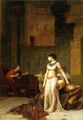 Cleopatra and Caesar, by Jean-Léon Gérôme
 -
 Cleopatra, by John William Waterhouse
 -
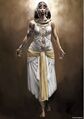 Concept art by Vincent Gaigneux
 -
Close up of Cleopatra in Assassin's Creed: Origins
-
3D model of Cleopatra from Discovery Tour
-
An ancient Roman bust of Cleopatra VII of Egypt; dated to the mid-1st century BC (around the time of her visit to Rome)


Appearances
- Assassin's Creed II (mentioned only)
- Assassin's Creed Revelations (mentioned only)
- Assassin's Creed: Project Legacy (Mnemonic sets)
- Assassin's Creed: Origins (first appearance)
- Assassin's Creed: Origins (comic)
References


| |||||||||||||||||||||||||||||||||||||||||||||||||||||||


| ||||||||||||||||||||||||||||||||||
| ||||||||||||||||||||||||||||||||||||||||
| |||||||||||||||||||||||||
de:Kleopatra
es:Cleopatra VII
fr:Cléopâtre
hu:Kleopátra
it:Cleopatra
pl:Kleopatra
pt-br:Cleópatra
ru:Клеопатра