


Cleopatra

|
He who increaseth knowledge, increaseth sorrow. This article contains spoilers, meaning it has information and facts concerning recent or upcoming releases from the Assassin's Creed series. If you do not want to know about these events, it is recommended to read on with caution, or not at all. |

|
Patience, brothers. Soon we will reveal the secrets of Assassin's Creed: Origins. This article has been identified as being out of date. Please update the article to reflect recent releases and then remove this template once done. |

Cleopatra VII Thea Philopator (69 BCE – 30 BCE), known to history simply as Cleopatra, was the last effective pharaoh of the Ptolemaic dynasty of Egypt, ruling from 51 BCE to 30 BCE. She was the daughter of Ptolemy XII Auletes and the elder sister of Ptolemy XIII. After her reign, Egypt became a province of the recently established Roman Empire.
Biography
Early life
Born in Alexandria, Cleopatra was raised as royalty from birth, becoming one of the most intelligent and educated women of her time—speaking nine languages by the time she was 20.[1]
Following her father's death, she succeeded him as the next pharaoh, co-jointly ruling Egypt along her younger brother Ptolemy XIII.[1]
Exile from Egypt
In 49 BCE, Cleopatra was exiled by her younger brother Ptolemy XIII, who had been supported by the Order of the Ancients, causing her to flee Alexandria. During her years in exile, Cleopatra made the acquaintance of Bayek, a Medjay, whose wife, Aya, served Cleopatra.[2] Following this, Cleopatra began a liaison with Julius Caesar, who aided Cleopatra in her struggle against her younger brother.[3] Through his aid, Cleopatra eventually gained sole control of Egypt under the watchful eye of the Order of the Ancients.[4]
Years later in 30 BCE, Cleopatra died inside her palace after being poisoned by a venomous asp used by Aya, now known as Amunet.[5]
In 2012, she was included in a mnemonic set in Abstergo Industries' Project Legacy.[3]
Gallery
-
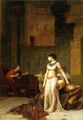 Cleopatra and Caesar, by Jean-Léon Gérôme
 -
 Cleopatra, by John William Waterhouse
 -
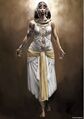 Concept art by Vincent Gaigneux


Appearance
- Assassin's Creed II (mentioned only)
- Assassin's Creed Revelations (mentioned only)
- Assassin's Creed: Project Legacy (Mnemonic sets)
- Assassin's Creed: Origins
References


| |||||||||||||||||||||||||||||||||||||||||||||||||||||||


| ||||||||||||||||||||||||||||||||||
| ||||||||||||||||||||||||||||||||||||||||