

Cleopatra: Difference between revisions
imported>Cristophorus35 New Image added |
imported>Lady Kyashira Some very much needed expansion |
||
| Line 22: | Line 22: | ||
In 49 BCE, Cleopatra was exiled by her younger brother Ptolemy XIII, who had been supported by the [[Order of the Ancients]], causing her to flee [[Alexandria]] with the help of her loyal follower, [[Apollodorus]]. During her years in exile, Cleopatra lived in Apollodorus' personal [[Apollodorus' Estate|estate]]. She later made the acquaintance of [[Amunet|Aya]], a former [[Medjay]] who was introduced to her by Apollodorus. The two shared a bond and became close friends, with Aya becoming her agent.<ref name="Prima" /> | In 49 BCE, Cleopatra was exiled by her younger brother Ptolemy XIII, who had been supported by the [[Order of the Ancients]], causing her to flee [[Alexandria]] with the help of her loyal follower, [[Apollodorus]]. During her years in exile, Cleopatra lived in Apollodorus' personal [[Apollodorus' Estate|estate]]. She later made the acquaintance of [[Amunet|Aya]], a former [[Medjay]] who was introduced to her by Apollodorus. The two shared a bond and became close friends, with Aya becoming her agent.<ref name="Prima" /> | ||
In 48 BCE, Cleopatra was introduced to [[Bayek]] of [[Siwa]], Aya's husband who had hunted various members of the Order responsible for her exile. Cleopatra revealed to Bayek that the Snake, whom he thought to be [[Eudoros]], was actually the Order itself and that he was known by the cryptonym, the Hippo.<ref | In 48 BCE, Cleopatra was introduced to [[Bayek]] of [[Siwa]], Aya's husband who had hunted various members of the Order responsible for her exile. Cleopatra revealed to Bayek that the Snake, whom he thought to be [[Eudoros]], was actually the Order itself and that he was known by the cryptonym, the Hippo. Cleopatra appointed Bayek as her personal Medjay, tasking her to eliminate the members of the Order across Upper Egypt, namely the [[Taharq|Scarab]], the [[Khaliset|Hyena]], the [[Berenike|Crocodile]], and the [[Hetepi|Lizard]].<ref>''Assassin's Creed: Origins'' – [[Egypt's Medjay]]</ref> Soon after Bayek's departure to hunt down the Ancients, Cleopatra appointed Aya and [[Phoxidas]] to the [[Aegean Sea]] to seek out [[Pompey]], a [[Rome|Roman]] general who had been defeated by Julius Caesar in the midst of a {{Wiki|Caesar's Civil War|civil war}}, hoping to secure his support against her brother.<ref>''Assassin's Creed: Origins'' – [[Pompeius Magnus]]</ref> | ||
[[File:Origins Quest15TheLizard'sFace Part01.PNG|thumb|left|250px|Cleopatra addressing the residents of Memphis]] | |||
Sometime thereafter, Cleopatra, accompanied by Apollodorus and her personal guards, travelled to [[Memphis]] ahead of the upcoming [[Apis]] festival. During this time, she resided at the [[Palace of Apries]], on one occasion giving a speech to the city's displeased residents in an attempt to gain their support. Aya and Bayek later arrived with the clues surrounding the identity of the Lizard, who was later revealed to be a priest of [[Anubis]] under [[Pasherenptah]]. When it was made apparent the twin priestesses [[Tawe]] and [[Taous]] played a part in poisoning the Apis bull, thereby possibly putting the festival in jeopardy, Cleopatra called for them to be boiled to them but was stopped by Aya, who stated they were coerced into doing so by the Lizard, who had captured their brother [[Panchrates]]. Cleopatra later called for the elimination of Lizard to be done as soon as possible before her departure to [[Herakleion]].<ref name="TLF">''Assassin's Creed: Origins'' – [[The Lizard's Face]]</ref> | |||
Bayek soon assassinated the Lizard and returned with his mask, thus ending the Order's reign of terror in the city. At the same time, the Apis bull recovered and the festival was thus able to continue. Cleopatra participated in the festival before departing to Herakleion, while Bayek continued to hunt down the supposed last member, the Crocodile.<ref name="TLF" /> | |||
In late 48 BCE, Cleopatra arrived and resided in a palace in Herakleion, awaiting the arrival of Pompey and his army. While residing there, she sent Aya and Phoxidas out to the sea once again to defend against the [[Gabiniani]], a group of Romans who resided in Egypt and supported her brother Ptolemy.<ref>''Assassin's Creed: Origins'' – [[Ambush At Sea]]</ref> | |||
===Alliance with Caesar=== | |||
Following this, Cleopatra began a liaison with Julius Caesar 47 BCE, who aided Cleopatra in her struggle against her younger brother.<ref name="ACPL">''[[Assassin's Creed: Project Legacy]]''</ref> Through his aid, Cleopatra eventually gained sole control of Egypt under the watchful eye of the Order of the Ancients.<ref name="Abstergo Files">''[[Assassin's Creed: Revelations]]'' – [[Abstergo Files]]</ref> | Following this, Cleopatra began a liaison with Julius Caesar 47 BCE, who aided Cleopatra in her struggle against her younger brother.<ref name="ACPL">''[[Assassin's Creed: Project Legacy]]''</ref> Through his aid, Cleopatra eventually gained sole control of Egypt under the watchful eye of the Order of the Ancients.<ref name="Abstergo Files">''[[Assassin's Creed: Revelations]]'' – [[Abstergo Files]]</ref> | ||
===War against Octavian and death=== | ===War against Octavian and death=== | ||
{{Quote|And Akila? Thank you. For all you have done. We have no friend but resolution and the briefest end.|Cleopatra's final moments|Assassin's Creed: Origins (comic)}}[[File:Cleopatra's Death.png|thumb|250px|Cleopatra commits suicide | {{Quote|And Akila? Thank you. For all you have done. We have no friend but resolution and the briefest end.|Cleopatra's final moments|Assassin's Creed: Origins (comic)}} | ||
[[File:Cleopatra's Death.png|thumb|250px|Cleopatra commits suicide]] | |||
With Antony dead and her fate sealed, Cleopatra was confronted one last time by Amunet back at her palace in Alexandria. There, her former servant implored her to resign to Octavian's victory, to which the pharaoh acquiesced on the condition that Amunet take [[Caesarion]] with her and train him as a [[Hidden One]]. Amunet handed her a [[poison]] by which to commit suicide and left with Caesarion. Once Cleopatra was certain that her son was gone and far away, she thanked [[Akila]] for her servitude before consuming the poison. Within mere moments, Cleopatra, the last pharaoh of Egypt, was dead.<ref name="ACO Comics">[[Assassin's Creed: Origins (comic)|''Assassin's Creed: Origins'' comic]]</ref> | With Antony dead and her fate sealed, Cleopatra was confronted one last time by Amunet back at her palace in Alexandria. There, her former servant implored her to resign to Octavian's victory, to which the pharaoh acquiesced on the condition that Amunet take [[Caesarion]] with her and train him as a [[Hidden One]]. Amunet handed her a [[poison]] by which to commit suicide and left with Caesarion. Once Cleopatra was certain that her son was gone and far away, she thanked [[Akila]] for her servitude before consuming the poison. Within mere moments, Cleopatra, the last pharaoh of Egypt, was dead.<ref name="ACO Comics">[[Assassin's Creed: Origins (comic)|''Assassin's Creed: Origins'' comic]]</ref> | ||
==Legacy== | |||
Though Amunet had not directly killed Cleopatra,<ref name="ACO Comics" /> later Assassins romanticized her role in her death with the legend that she had assassinated the queen with a venomous [[poison|asp]]. Statues of Amunet with a serpent coiled around her were erected in the [[Sanctuary]] under the [[Villa Auditore]] in [[Monteriggioni]] and in her [[Assassin Tombs|cenotaph]] in [[Venice]]'s [[St. Mark's Basilica]], reinforcing the popular account.<ref name="AC2">''[[Assassin's Creed II]]''</ref> | Though Amunet had not directly killed Cleopatra,<ref name="ACO Comics" /> later Assassins romanticized her role in her death with the legend that she had assassinated the queen with a venomous [[poison|asp]]. Statues of Amunet with a serpent coiled around her were erected in the [[Sanctuary]] under the [[Villa Auditore]] in [[Monteriggioni]] and in her [[Assassin Tombs|cenotaph]] in [[Venice]]'s [[St. Mark's Basilica]], reinforcing the popular account.<ref name="AC2">''[[Assassin's Creed II]]''</ref> | ||
| Line 42: | Line 51: | ||
==Trivia== | ==Trivia== | ||
*The name Cleopatra is derived from the Greek name Κλεοπάτρα (Kleopatra) which meant "she who comes from glorious father" or "glory of the father" in the feminine form, derived from κλέος (kleos) "glory" combined with πατήρ (pater) "father" (the masculine form would be written either as Kleopatros (Κλεόπατρος), or Patroklos (Πάτροκλος)). | *The name Cleopatra is derived from the Greek name Κλεοπάτρα (Kleopatra) which meant "she who comes from glorious father" or "glory of the father" in the feminine form, derived from κλέος (kleos) "glory" combined with πατήρ (pater) "father" (the masculine form would be written either as Kleopatros (Κλεόπατρος), or Patroklos (Πάτροκλος)). | ||
**The name is also shared with numerous Greco-[[Makedonia|Macedonian]] princesses, queen consorts and/or queen regnants. | |||
*Cleopatra was regarded as being one of the most educated women of her time—speaking nine languages by the time she was 20.<ref name="Prima">''[[Assassin's Creed Origins: Official Game Guide]]''</ref> | *Cleopatra was regarded as being one of the most educated women of her time—speaking nine languages by the time she was 20.<ref name="Prima">''[[Assassin's Creed Origins: Official Game Guide]]''</ref> | ||
*In regards to her ancestry, Cleopatra had mostly Greek roots in Macedonia, which means she does not possess any Egyptian roots. | *In regards to her ancestry, Cleopatra had mostly Greek roots in Macedonia, which means she does not possess any Egyptian roots. | ||
Revision as of 15:45, 21 January 2019

|
Ezio, my friend! How may I be of service? This article is in desperate need of a revamp. Please improve it in any way necessary in order for it to achieve a higher standard of quality in accordance with our Manual of Style. |

|
Patience, brothers. Soon we will reveal the secrets of Assassin's Creed: Origins and Assassin's Creed: Origins comic. This article has been identified as being out of date. Please update the article to reflect recent releases and then remove this template once done. |
Cleopatra VII Thea Philopator (69 BCE – 30 BCE), known to history simply as Cleopatra, was the last effective pharaoh of Egypt, ruling from 51 BCE to 30 BCE. She was the daughter of Ptolemy XII Auletes and the elder sister of Ptolemy XIII.
A member of the Ptolemaic dynasty, a ethnically Greek family of Macedonian origin, Cleopatra originally ruled jointly with her father, and later with Ptolemy XIII, whom she married as per Egyptian custom. As queen, she consummated a liaison with Julius Caesar that solidified her grip on the throne.
Biography
Early life and exile from Egypt
Cleopatra was born in 69 BCE in Alexandria to Ptolemy XII Auletes.[1] Following her father's death in 51 BCE, a then eighteen-year-old Cleopatra succeeded him as the next pharoah of Egypt, co-jointly ruling the country alongside Ptolemy XIII.[2]
In 49 BCE, Cleopatra was exiled by her younger brother Ptolemy XIII, who had been supported by the Order of the Ancients, causing her to flee Alexandria with the help of her loyal follower, Apollodorus. During her years in exile, Cleopatra lived in Apollodorus' personal estate. She later made the acquaintance of Aya, a former Medjay who was introduced to her by Apollodorus. The two shared a bond and became close friends, with Aya becoming her agent.[2]
In 48 BCE, Cleopatra was introduced to Bayek of Siwa, Aya's husband who had hunted various members of the Order responsible for her exile. Cleopatra revealed to Bayek that the Snake, whom he thought to be Eudoros, was actually the Order itself and that he was known by the cryptonym, the Hippo. Cleopatra appointed Bayek as her personal Medjay, tasking her to eliminate the members of the Order across Upper Egypt, namely the Scarab, the Hyena, the Crocodile, and the Lizard.[3] Soon after Bayek's departure to hunt down the Ancients, Cleopatra appointed Aya and Phoxidas to the Aegean Sea to seek out Pompey, a Roman general who had been defeated by Julius Caesar in the midst of a civil war, hoping to secure his support against her brother.[4]

Sometime thereafter, Cleopatra, accompanied by Apollodorus and her personal guards, travelled to Memphis ahead of the upcoming Apis festival. During this time, she resided at the Palace of Apries, on one occasion giving a speech to the city's displeased residents in an attempt to gain their support. Aya and Bayek later arrived with the clues surrounding the identity of the Lizard, who was later revealed to be a priest of Anubis under Pasherenptah. When it was made apparent the twin priestesses Tawe and Taous played a part in poisoning the Apis bull, thereby possibly putting the festival in jeopardy, Cleopatra called for them to be boiled to them but was stopped by Aya, who stated they were coerced into doing so by the Lizard, who had captured their brother Panchrates. Cleopatra later called for the elimination of Lizard to be done as soon as possible before her departure to Herakleion.[5]
Bayek soon assassinated the Lizard and returned with his mask, thus ending the Order's reign of terror in the city. At the same time, the Apis bull recovered and the festival was thus able to continue. Cleopatra participated in the festival before departing to Herakleion, while Bayek continued to hunt down the supposed last member, the Crocodile.[5]
In late 48 BCE, Cleopatra arrived and resided in a palace in Herakleion, awaiting the arrival of Pompey and his army. While residing there, she sent Aya and Phoxidas out to the sea once again to defend against the Gabiniani, a group of Romans who resided in Egypt and supported her brother Ptolemy.[6]
Alliance with Caesar
Following this, Cleopatra began a liaison with Julius Caesar 47 BCE, who aided Cleopatra in her struggle against her younger brother.[7] Through his aid, Cleopatra eventually gained sole control of Egypt under the watchful eye of the Order of the Ancients.[8]
War against Octavian and death
- "And Akila? Thank you. For all you have done. We have no friend but resolution and the briefest end."
- ―Cleopatra's final moments[src]
With Antony dead and her fate sealed, Cleopatra was confronted one last time by Amunet back at her palace in Alexandria. There, her former servant implored her to resign to Octavian's victory, to which the pharaoh acquiesced on the condition that Amunet take Caesarion with her and train him as a Hidden One. Amunet handed her a poison by which to commit suicide and left with Caesarion. Once Cleopatra was certain that her son was gone and far away, she thanked Akila for her servitude before consuming the poison. Within mere moments, Cleopatra, the last pharaoh of Egypt, was dead.[9]
Legacy
Though Amunet had not directly killed Cleopatra,[9] later Assassins romanticized her role in her death with the legend that she had assassinated the queen with a venomous asp. Statues of Amunet with a serpent coiled around her were erected in the Sanctuary under the Villa Auditore in Monteriggioni and in her cenotaph in Venice's St. Mark's Basilica, reinforcing the popular account.[10]
In 2012, Cleopatra was included in a mnemonic set in Abstergo Industries' Project Legacy.[7]
Personality and characteristics
- "I am Queen until a sword plunges through my heart. And even then, my blood will stay on my throne."
- ―Cleopatra[src]
Cleopatra was a figure who often displayed an irreverent and whimsical exterior, lavishing in wealth and indulging in all the aristocratic pleasures of life. She was shown to be quite charismatic, easily swaying the Egyptian crowds into accepting her as a ruling figure. This was mostly because she had a very charming voice that could make even a lovesick man become enamored with the sweet tones of her voice. Because her voice was her most defining feature, she was able to sway Julius Caesar to her side after a single meeting by appealing to his desire for greatness. To that end, she cultivated the image of being a goddess among her people to gain their admiration and loyalty.
However, beneath her charmingly hedonistic exterior was a ruthless, seductive, and determined political manipulator willing to get rid of anyone in the way of her obtaining rulership and going through any means of securing her path to power. To that end she allied herself with the Medjay of Siwa and his wife before betraying them to join the Order of the Ancients to consolidate her rule over Egypt and Rome via a marriage to Caesar and tried to use her Caesar-spawned son Caesarion to strengthen her control of Rome. She was also shown to be quite cruel, initially demanding the Twin Priestesses to be boiled to death inside a Bronze Bull after she was initially told they poisoned the ceremonial Apis Bull and wanting to have her brother slain to eliminate any obstacles to her birthright.
Trivia
- The name Cleopatra is derived from the Greek name Κλεοπάτρα (Kleopatra) which meant "she who comes from glorious father" or "glory of the father" in the feminine form, derived from κλέος (kleos) "glory" combined with πατήρ (pater) "father" (the masculine form would be written either as Kleopatros (Κλεόπατρος), or Patroklos (Πάτροκλος)).
- The name is also shared with numerous Greco-Macedonian princesses, queen consorts and/or queen regnants.
- Cleopatra was regarded as being one of the most educated women of her time—speaking nine languages by the time she was 20.[2]
- In regards to her ancestry, Cleopatra had mostly Greek roots in Macedonia, which means she does not possess any Egyptian roots.
- The most famous representation of Cleopatra's life has been dramatized in William Shakespeare's tragedy, Antony and Cleopatra, which was published around 1606.
- Cleopatra was a rich ruler of the Ptolemaic Kingdom, so it is no surprise that she was forced to seek out innovative ways to spend all her money. One of the best-known stories connected to her lavishness revolves around a bet she made with her lover, and later husband, Mark Antony, claiming to be able to spend 10 million sestertii on one single dinner. He, of course, accepted the bet and Cleopatra organized the dinner for the following evening. But the dinner was far from spectacular – the food served was quite common. However, for the second course, Cleopatra ordered a cup of strong vinegar, dissolved a majestic pearl in it, and drank the solution, supposedly winning the bet.
- Contrary to popular belief, the things that made Cleopatra "attractive" was her wit, charm and power, and not her facial features or body attributes.
- Cleopatra was famous for changing her appearance according to the politics of the moment. For example, in ceremonial events, she appeared dressed as the goddess Isis, it was common for Egyptian rulers to identify with some deities.
- It is believed that Cleopatra often took frequent baths in donkey milk to preserve the youth of her skin. She also used a variety of other cosmetic products, which were made from rocks, minerals and plants at the time. Her cosmetics consisted of minerals and rocks such as malachite, pyrite, lead sulfide and red ochre. Cleopatra’s nail polish was most likely made from henna, a dye that comes from the Egyptian privet tree.
Gallery
-
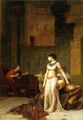 Cleopatra and Caesar, by Jean-Léon Gérôme
 -
 Cleopatra, by John William Waterhouse
 -
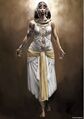 Concept art by Vincent Gaigneux
 -
3D model of Cleopatra from Discovery Tour
-
Close up of Cleopatra in Assassin's Creed: Origins
-
 Apollodorus introducing Cleopatra to Bayek
 -
 Gathering at Apollodorus' estate
 -
 Cleopatra gazing upon the people of Memphis.
 -
Cleopatra speaking with Bayek
-
Cleopatra with Ptolemy and Caesar
-
Cleopatra facing Aya, with Caesarion
-
Aya and Cleopatra


Appearances
- Assassin's Creed II (mentioned only)
- Assassin's Creed Revelations (mentioned only)
- Assassin's Creed: Project Legacy (Mnemonic sets)
- Assassin's Creed: Origins (first appearance)
- Assassin's Creed: Origins comic
References
- ↑ Assassin's Creed: Origins – Discovery Tour
- ↑ 2.0 2.1 2.2 Assassin's Creed Origins: Official Game Guide
- ↑ Assassin's Creed: Origins – Egypt's Medjay
- ↑ Assassin's Creed: Origins – Pompeius Magnus
- ↑ 5.0 5.1 Assassin's Creed: Origins – The Lizard's Face
- ↑ Assassin's Creed: Origins – Ambush At Sea
- ↑ 7.0 7.1 Assassin's Creed: Project Legacy
- ↑ Assassin's Creed: Revelations – Abstergo Files
- ↑ 9.0 9.1 Assassin's Creed: Origins comic
- ↑ Assassin's Creed II


| |||||||||||||||||||||||||||||||||||||||||||||||||||||||


| ||||||||||||||||||||||||||||||||||
| ||||||||||||||||||||||||||||||||||||||||
| |||||||||||||||||||||||||
de:Kleopatra
es:Cleopatra VII
fr:Cléopâtre
hu:Kleopátra
it:Cleopatra
pl:Kleopatra
pt-br:Cleópatra
ru:Клеопатра