


Scepter of Alexander the Great
The Scepter of Alexander the Great[1] was a Piece of Eden, a piece of leftover Isu technology and one of several known Staves of Eden in existence. This particular Staff was notably wielded by the Macedonian king Alexander the Great, who used its power to create his Macedonian Empire.
Owners[edit | edit source]
- Isu (until 75,000 BCE)[2]
- Order of the Ancients (4th century BCE)
- Alexander the Great (until 323 BCE)
- Flavius Metellus (47 BCE)
- Cleopatra (47 BCE)
- Flavius Metellus (47 BCE)
- Lucius Septimius (47 BCE)
- Order of the Ancients (c. 44 BCE)
History[edit | edit source]
By the 4th century BCE, the Staff had been acquired by the Order of the Ancients, who entrusted it to their ally, the Macedonian king Alexander the Great.[3] Alexander was also in possession of the Trident of Eden,[4] and using the two Pieces of Eden, he was able to become an undefeated military commander and establish one of the largest empires of the ancient world.[3]
In 323 BCE, Alexander was fatally poisoned by the proto-Assassin Iltani, resulting in his empire's collapse.[5] His body was interred alongside his Staff in a tomb in Alexandria, the city he had founded in Egypt following his conquest of the land and which became the capital of Ptolemy I Soter's new Ptolemaic Kingdom after Alexander's death.[6]
In 47 BCE, following the Battle of the Nile, the Order of the Ancients' leader in Egypt, Flavius Metellus, took the Staff from Alexander's sarcophagus,[7] after the entrance to the tomb had been unlocked earlier by the Medjay Bayek and his wife Aya.[8] Flavius then presented the Staff to Queen Cleopatra during her coronation as Pharaoh of Egypt, as a sign of the Order's alliance with the new ruler.[9]

After taking back the Staff, Flavius traveled to Siwa with fellow Order member Lucius Septimius. There, the two combined the Staff with an Apple of Eden to access the Isu vault hidden beneath the village's Temple of Amun and activate its holographic map mechanism. Having discovered the vault's contents, Flavius later took the Apple with him to Cyrene[10] while Septmius left with the Staff for Rome.[11]
While Bayek hunted down Flavius and recovered the Apple,[10] Aya pursued Septimius to Rome. On 15 March 44 BCE, Aya confronted and defeated Septimius at the Theatre of Pompey, where she demanded to know the location of Alexander's Staff. The dying Gabiniani only revealed that he had given it to the Order in Rome before succumbing to his wounds.[11]
By the 19th century, Alexander's Staff was rumored to be located in Afghanistan. The British Templar Alexander Burnes conducted a search for the artifact, but was ultimately unable to find it.[12]
Gallery[edit | edit source]
-
 Alexander's Staff concept art
 -
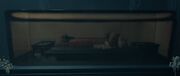 The Staff inside Alexander's sarcophagus
 -
 Top view of Alexander's sarcophagus and his Staff of Eden
 -
 Flavius presenting the Staff to Cleopatra at her coronation
 -
 Flavius wielding the Staff
 -
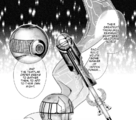 The Staff alongside other Pieces of Eden
 -
 The Staff in Assassin's Creed Roleplaying Game


Appearances[edit | edit source]
- Assassin's Creed II (Glyphs only)
- Assassin's Creed: Initiates (indirect mention only)
- Assassin's Creed: Last Descendants (mentioned only)
- Assassin's Creed Chronicles: India (mentioned in Database entry only)
- Assassin's Creed: Origins (first appearance)
- Assassin's Creed: Blade of Shao Jun (cameo)
- Assassin's Creed Roleplaying Game
References[edit | edit source]
- ↑ Assassin's Creed: The Essential Guide (2nd ed.) – Chapter 2: The Precursor Civilization: "Staves of Eden"
- ↑ Assassin's Creed: Initiates – Timeline
- ↑ 3.0 3.1 Assassin's Creed Encyclopedia
- ↑ Assassin's Creed: Last Descendants
- ↑ Assassin's Creed II
- ↑ Assassin's Creed: Origins
- ↑ Assassin's Creed: Origins – The Aftermath
- ↑ Assassin's Creed: Origins – Aya: Blade of the Goddess
- ↑ Assassin's Creed: Origins – The Battle of the Nile
- ↑ 10.0 10.1 Assassin's Creed: Origins – The Final Weighing
- ↑ 11.0 11.1 Assassin's Creed: Origins – Fall of an Empire, Rise of Another
- ↑ Assassin's Creed Chronicles: India – Database: Alexander Burnes

| ||||||||||||||||||||||||||||||||||||||||