

Shanghai Rite of the Templar Order: Difference between revisions
imported>Maxattac Created page with "{{Era|ACCC|Templars}} {{Spoilerhd}} {{Stub}} {{Faction Infobox |image = |founder = |leader = Grand Master |headquarters = |locations = Beijing |related = [[Templars]..." |
mNo edit summary |
||
| (170 intermediate revisions by 30 users not shown) | |||
| Line 1: | Line 1: | ||
{{Era| | {{Era|Organizations|Templars}} | ||
{{ | {{Update|''[[Assassin's Creed: Dynasty]]''}} | ||
{{ | {{Quote|The Ming dynasty is but a fragment of the greater world we seek. No more than a stepping stone toward the peace and prosperity we create.|Zhang Yong during his final confrontation with Shao Jun, 1532.|Assassin's Creed: Blade of Shao Jun|Culmination}} | ||
{{Faction Infobox | {{Faction Infobox | ||
|image = | |image = Demon Fire China (4).jpg | ||
|leader = [[Grand Master of the Templar Order|Grand Master]] | |||
|leader = [[Grand Master]] | |headquarters = *[[Chang'an]] {{c|8th century}} | ||
|headquarters = | *[[Beijing]] {{c|16th century}} | ||
| | *[[Shanghai]] {{c|20th century}} | ||
| | |locations = [[China]] | ||
| | |subsidiaries=*[[Golden Turtles]] | ||
*[[Yeluohe]] | |||
The '''Chinese Templars'' | *[[Eight Tigers]] | ||
|active = c. 3rd century BCE – present | |||
}} | |||
The '''Shanghai Rite of the Templar Order''', as it was known in the years leading up to the {{Wiki|Chinese Civil War}},<ref name="Black Cross">''[[Assassin's Creed: Templars – Volume 1: Black Cross]]''</ref> is the rite of the [[Templars|Templar Order]] operating in [[China]] since at least the [[Qin dynasty]], when it was known as the '''[[Order of the Ancients]]'''. | |||
During the | During that first imperial dynasty, the Ancients were allies of the first Emperor of China, [[Qin Shi Huang]], helping him consolidate his power over China. Despite the emperor's death at the hands of the ''[[youxia]]'' [[Wei Yu]], the Ancients continued to operate in China until as late as the [[Tang dynasty]]. | ||
Adopting the name of the '''[[Golden Turtles]]''', the Ancients influenced the reign of [[Li Longji|Emperor Xuanzong]], with many of their members holding high-ranking positions in the imperial court. However, an internal conflict between the Order members [[Yang Guozhong]] and [[An Lushan]] led the latter to form his own faction, the [[Yeluohe]], and [[An Lushan Rebellion|rebel]] against the Emperor, establishing the state of [[Yan]]. | |||
By the time of the [[Ming dynasty]], the Chinese Templars had become immensely powerful through their influence over the regime's rulers such as the [[Zhu Di|Yongle Emperor]] and the [[Zhu Houcong|Jiajing Emperor]]. Their grip over the Chinese government allowed them to enact multiple purges on the [[Chinese Brotherhood of Assassins|Chinese Assassins]] throughout this period. Under the Jiajing Emperor, the Templar [[eunuch]]s known as the [[Eight Tigers]] dealt a particularly vicious blow, [[Great Rites Controversy|exterminating]] their archenemies down to a lone [[Assassins|Assassin]]: [[Shao Jun]]. | |||
Nevertheless, their foes were restored to their former prominence thanks to Shao Jun's efforts, and their [[Assassin-Templar War|secret war]] over China persisted into the 20th century. Led by [[Sun Yat-sen]], the founder of the [[Kuomintang|Nationalist Party of China]], until his death in 1925, the Shanghai Rite struggled to maintain their hold over the nation when it splintered into [[Warlord Era|warlordism]]. Against the protests of Sun's wife [[Soong Ching-ling]], the rite placed their hopes in [[Chiang Kai-shek]], only to have their invitation rejected by the Nationalist military leader who desired to bring the country under his own, personal rule. | |||
==History== | |||
===Qin dynasty=== | |||
In the 3rd century BCE, the [[Order of the Ancients]] supported the reign of the first emperor of a unified China, [[Qin Shi Huang]]. Through their support, Qin Shi Huang was able to undertake several construction projects, such as the [[Great Wall of China]].<ref name="Encyclopedia">''[[Assassin's Creed Encyclopedia]]''</ref> After surviving an assassination attempt by [[Jing Ke]] in 227 BCE prior to his ascension as emperor, Qin Shi Huang became paranoid of the [[Assassins]].<ref name="ACD">''[[Assassin's Creed: Dynasty]]''</ref> In 210 BCE, Qin Shi Huang was eventually killed by [[Wei Yu]]<ref name="AC2">''[[Assassin's Creed II]]''</ref> with a [[spear]] [[Jing Ke (spear)|named]] in Jing Ke's honor.<ref name="ACD" /> | |||
===Tang dynasty=== | |||
{{Main|Golden Turtles}} | |||
[[File:ACD Golden Turtles.png|thumb|250px|The Golden Turtles]] | |||
The Order of the Ancients continued to operate in China well into the 8th century CE, where they influenced the reign of [[Li Longji|Emperor Xuanzong]]. At this time, the Chinese branch of the Order was known as the [[Golden Turtles]] and exerted an influence in the imperial court through Empress [[Yang Yuhuan]], who placed her trust in the officials and Order members [[Yang Guozhong]] and [[An Lushan]].<ref name="ACD" /> | |||
However, internal friction between the two members led to the formation of a splinter faction called the [[Yeluohe]], which was personally headed by An Lushan. Eventually, Lushan [[An Lushan Rebellion|rebelled]] against the Emperor and established his own state, proclaiming himself Emperor of [[Yan]].<ref name="ACD" /> | |||
===Ming dynasty=== | |||
====Purging the Chinese Assassins==== | |||
In 1402, the Templars played a key role in the ascension of the [[Zhu Di|Yongle Emperor]], who started his reign with a [[1402 Chinese Assassin purge|purge]] of the Chinese Assassins that resulted in the deaths of thousands of Chinese [[civilian]]s including the [[Assassin leader]] [[Fang Xiaoru]]. In 1424, one of the purge's survivors, the Assassin [[Li Tong]], killed the Emperor in the [[Gobi Desert]].<ref name="DYL">''[[Assassin's Creed: Revelations – Discover Your Legacy]]'' – Bloodlines: "Li Tong"</ref> | |||
====The Eight Tigers' rule==== | |||
{{Quote|That is how we wiped out your kind! So trusting of others, so weak and pathetic!|Zhang Yong to Shao Jun, 1530.|Assassin's Creed Chronicles: China|Demon Fire}} | |||
By the reign of the [[Zhu Houzhao|Zhengde Emperor]], the Chinese imperial court was ruled by the [[Eight Tigers]], a group of powerful Templar [[eunuch]]s. After [[Zhang Yong]] usurped leadership of the group upon framing [[Liu Jin]] for an assassination plot against the Emperor, resulting in his [[Lingchi|execution]],<ref name="Liu Jin DB">''[[Assassin's Creed Chronicles: China]]'' – [[Database: Liu Jin]]</ref> the Tigers began making plans to purge their archenemies, the [[Chinese Brotherhood of Assassins|Chinese Assassins]], from the imperial capital of [[Beijing]]. They were eventually given a chance to do so after the Zhengde Emperor died heir-less in 1521, allowing the Tigers to place their own puppet, the [[Zhu Houcong|Jiajing Emperor]], on the throne.<ref name="Jiajing DB">''[[Assassin's Creed Chronicles: China]]'' – [[Database: The Jiajing Emperor]]</ref> | |||
[[File:AC Blade Of Shao Jun - Purged Chinese Brotherhood.png|left|thumb|240px|Assassins killed in the Templars' purge]] | |||
When the imperial [[concubine]] [[Shao Jun]] caught wind of the Templars' plan to ambush the Assassins, she was able to warn their [[Mentor]], [[Wang Yangming]],<ref name="Scroll 6">''[[Assassin's Creed Chronicles: China]]'' – [[Database: Scroll 6 (China)|Scroll 6]]</ref> who subsequently called his best agents into Beijing to mount a counter-attack. However, the Assassins were ultimately defeated, and the Templars used the momentum from this critical victory to enact a city-wide purge, capturing and executing many Assassins, their associates, and any innocents with tangential ties to them.<ref name="Scroll 7">''[[Assassin's Creed Chronicles: China]]'' – [[Database: Scroll 7 (China)|Scroll 7]]</ref> | |||
Three years later, the Templars manipulated the Jiajing Emperor into initiating what would become known as the [[Great Rites Controversy]],<ref name="Scroll 9">''[[Assassin's Creed Chronicles: China]]'' – [[Database: Scroll 9 (China)|Scroll 9]]</ref> which they used as a pretext to purge any remaining opponents to their rule. Virtually all Assassins across China were hunted down and executed by the Tigers [[Wei Bin]], [[Qiu Ju]] and [[Ma Yongcheng]],<ref name="Scroll 10">''[[Assassin's Creed Chronicles: China]]'' – [[Database: Scroll 10 (China)|Scroll 10]]</ref> and their old stronghold at the [[Maijishan Grottoes]] was captured by the Templars, who converted it into a secret prison for their enemies, overseen by [[Gao Feng]].<ref name="The Escape">''[[Assassin's Creed Chronicles: China]]'' – [[The Escape (China)|The Escape]]</ref> | |||
However, some Assassins managed to escape the purge, including Wang Yangming, who went into hiding,<ref name="Scroll 10" /> and Shao Jun and her Mentor [[Zhu Jiuyuan]], who traveled to [[Italy]] to seek aid from the legendary [[Master Assassin]] [[Ezio Auditore da Firenze]].<ref name="Scroll 13">''[[Assassin's Creed Chronicles: China]]'' – [[Database: Scroll 13 (China)|Scroll 13]]</ref> Sending several soldiers to hunt them down, the Templar agents succeeded in killing Jiuyan in [[Venice]],<ref name="Scroll 14">''[[Assassin's Creed Chronicles: China]]'' – [[Database: Scroll 14 (China)|Scroll 14]]</ref> but Shao Jun escaped and met Ezio, who trained her and gifted her a [[Precursor box]].<ref name="Embers">''[[Assassin's Creed: Embers]]''</ref> Following her return to China in 1526, Shao Jun regrouped with Wang Yangming and the two Assassins began their mission to rebuild their Brotherhood and exact revenge on the Eight Tigers.<ref name="Scroll 18">''[[Assassin's Creed Chronicles: China]]'' – [[Database: Scroll 18 (China)|Scroll 18]]</ref> | |||
====Return of the Assassins==== | |||
{{Quote|I will rebuild the Brotherhood and recruit those who wish to make our land a place of freedom, those ready to die to fight men like you. Your Templar world will not happen. The Assassins will rise again.|Shao Jun to a dying Zhang Yong, 1532.|Assassin's Creed Chronicles: China|Vengeance}} | |||
[[File:The Escape China (1).jpg|thumb|250px|Gao Feng interrogating a captive Shao Jun about the Precursor box]] | |||
Using the Precursor box as bait, Shao Jun allowed herself to be captured by the Templars and imprisoned in the Maijishan Grottoes, whereupon she escaped and killed Gao Feng.<ref name="The Escape" /> Meanwhile, Yangming tracked down and eliminated Ma Yongcheng, though the Assassins failed to recover the box,<ref name="The Return">''[[Assassin's Creed Chronicles: China]]'' – [[The Return]]</ref> as it had been given to the Tiger [[Gu Dayong]], who oversaw the [[Slavery|slave]] trade in [[Macau]].<ref name="The Port">''[[Assassin's Creed Chronicles: China]]'' – [[The Port]]</ref> | |||
Shao Jun later infiltrated Dayong's fortress in Macau, freeing many of his slaves,<ref name="The Port" /> including a young boy named [[Kotetsu]],<ref name="Port">''[[Assassin's Creed: Blade of Shao Jun]]'' – [[Port]]</ref> and killed the Templar, reclaiming the box in the process.<ref name="The Slaver">''[[Assassin's Creed Chronicles: China]]'' – [[The Slaver]]</ref> However, in retaliation for Dayong's murder, Qiu Ju ordered his men to arrest innocents and set the port of Macau [[1526 Macau fires|ablaze]].<ref name="Consequences 1">''[[Assassin's Creed Chronicles: China]]'' – [[Consequences (China)|Consequences]]</ref> Although Shao Jun managed to escape the city and saved as many civilians as she could from the fire, the incident deeply traumatized her.<ref name="Consequences 2">''[[Assassin's Creed: Blade of Shao Jun]]'' – [[Consequences (manga)|Consequences]]</ref> | |||
In 1529, Shao Jun assassinated Wei Bin in [[Nan'an]]<ref name="The Snake">''[[Assassin's Creed Chronicles: China]]'' – [[The Snake]]</ref> while Wang Yangming went to meet a contact who possessed knowledge about the [[Piece of Eden|Pieces of Eden]] in the hopes of uncovering the Precursor box's secrets.<ref name="The Search">''[[Assassin's Creed Chronicles: China]]'' – [[The Search]]</ref> However, Yangming was ambushed by Zhang Yong and Qiu Ju,<ref name="Reunion">''[[Assassin's Creed: Blade of Shao Jun]]'' – [[Reunion (manga)|Reunion]]</ref> who killed the Mentor and reclaimed the box. Shao Jun, alerted to the ambush, tried to save her Mentor,<ref name="Hunted">''[[Assassin's Creed Chronicles: China]]'' – [[Hunted]]</ref> but arrived too late and was nearly killed herself until a [[Scholar|monk]] from a nearby [[Buddhism|Buddhist]] temple ordered Qiu Ju and his men to leave.<ref name="Funeral Pyre">''[[Assassin's Creed: Blade of Shao Jun]]'' – [[Funeral Pyre]]</ref> | |||
[[File:An Old Friend China (6).jpg|left|thumb|250px|Zhang Yong and Qiu Ju luring Shao Jun into a trap]] | |||
The following year, Zhang Yong and Qiu Ju learned about Shao Jun's friendship with Empress [[Zhang Qijie]] and used this information to lure the Assassin into a trap at the [[Forbidden City]].<ref name="Old Friend">''[[Assassin's Creed Chronicles: China]]'' – [[An Old Friend]]</ref> While Zhang Yong fled, Qiu Ju dueled Shao Jun, but was ultimately bested by the Assassin, who dropped several [[lantern]]s on him, setting him and the surrounding chamber on fire.<ref name="Demon Fire">''[[Assassin's Creed Chronicles: China]]'' – [[Demon Fire]]</ref> After the Templar was crushed by a falling pillar, Shao Jun and Empress Zhang were able to escape from the fire.<ref name="Arena">''[[Assassin's Creed: Blade of Shao Jun]]'' – [[To Each Her Own Arena]]</ref> | |||
By 1532, Zhang Yong, as the last surviving Tiger, was desperate to maintain his grip on power and allied with the [[Mongolia|Mongols]] led by [[Altan Khan]], agreeing to help them invade China.<ref name="The Betrayal">''[[Assassin's Creed Chronicles: China]]'' – [[The Betrayal (China)|The Betrayal]]</ref> However, his plan to let the Mongols through the Great Wall was thwarted by Shao Jun and her apprentice Kotetsu, who closed back the Wall's gates and eliminated the Mongol scouts.<ref name="Great Wall">''[[Assassin's Creed: Blade of Shao Jun]]'' – [[The Great Wall]]</ref> Believing Zhang Yong had betrayed their alliance, Altan Khan ordered a full-scale assault of the Great Wall and, in the resulting chaos, Shao Jun assassinated Zhang Yong, marking the end of the Eight Tigers' rule.<ref name="Vengeance">''[[Assassin's Creed Chronicles: China]]'' – [[Vengeance]]</ref> | |||
===Qing dynasty=== | |||
{{Quote|Imagine, the Queen of Pirates, Jing Lang, defeated for a fake map.|Jing Lang in her final moments, 1717.|Assassin's Creed IV: Black Flag|Queen of Pirates, King of Fools}} | |||
By the early 18th century, the Chinese Templars still operated in the country and held positions in government, such as [[Jing Lang]], who became a diplomatic advisor. However, a change in regime later forced Lang to flee China and turn to [[piracy]], earning a reputation as the "Queen of Pirates".<ref name="Jing Lang DB">''[[Assassin's Creed IV: Black Flag]]'' – [[Database: Jing Lang]]</ref> | |||
[[File:Queen of Pirates, King of Fools 6.png|thumb|250px|Jing Lang fighting Edward Kenway]] | |||
By 1717, Jing Lang had joined the [[West Indies Rite of the Templar Order|West Indies Rite]] in the [[Caribbean]], where she was given one of five unique [[Templar keys]] to guard and began manipulating the [[Nassau]]-based [[West Indies Brotherhood of Assassins|West Indies Assassin]] [[Vance Travers]]. Lang hoped to convince Vance to kill his brother [[Upton Travers|Upton]] and acquire his half of a treasure map,<ref name="Brother">''[[Assassin's Creed IV: Black Flag]]'' – [[The Other Brother]]</ref> but her plan was thwarted by the pirate [[Edward Kenway]], who helped Upton assassinate both Vance and Lang in exchange for the latter's Templar key.<ref name="Queen of Pirates">''[[Assassin's Creed IV: Black Flag]]'' – [[Queen of Pirates, King of Fools]]</ref> | |||
===Republic era=== | |||
{{Quote|If they want to come here and see all the squabbling nation-states we have to deal with... the warlords in the countryside -- the communists and gangsters in the back alleys... let them see how bloody easy it is to keep order in this cesspool, I say!|Master Coxworth regarding the difficulties of the Rite in the early 20th century.|Assassin's Creed: Templars}} | |||
By 1927, tensions were growing between the Chinese Templars and the [[Inner Sanctum of the Templar Order|Inner Sanctum]] due to their inability to appease the growing conflict between the [[Chinese Communist Party]] and the government of the Nationalists following the death of [[Grand Master of the Templar Order|Grand Master]] [[Sun Yat-sen]].<ref name="Templars 2">''[[Assassin's Creed: Templars]]'' – [[Assassin's Creed: Templars 2|Issue #2]]</ref> | |||
[[File:ACT Fessenden.jpg|left|thumb|170px|Stirling Fessenden, Grand Master of the Shanghai Rite]] | |||
At the time led by the Shanghai Rite and Grand Master [[Stirling Fessenden]], the Chinese Templars accepted the pact made between their leaders and General [[Chiang Kai-shek]]: in exchange for their support, he would join them as their new Grand Master.<ref name="Templars 4">''[[Assassin's Creed: Templars]]'' – [[Assassin's Creed: Templars 4|Issue #4]]</ref> To conclude the deal, the young Britishman [[Darius Gift]] was sent to unknowingly deliver his late father's [[Templar ring]] to Chiang while the feared [[Black Cross]] [[Albert Bolden]] was also sent to eliminate Chiang's enemies.<ref name="Templars 1">''[[Assassin's Creed: Templars]]'' – [[Assassin's Creed: Templars 1|Issue #1]]</ref> | |||
While the Order's intent was to ensure that through Chiang, peace would be restored in China under their rule, the General betrayed them, having no intent to share his power with the Templars. Indeed, during their meeting, Chiang revealed to a dumbfounded Fessenden that he had used the Templars all along before launching a [[Shanghai massacre of 1927|purge]] against the [[Communism|communists]] with the help of [[Du Yuesheng]] and his [[Gang|criminal syndicate]], the [[Green Gang]].<ref name="Templars 4" /> | |||
==Members== | |||
===Order of the Ancients=== | |||
;Tang dynasty | |||
;;Eight Zhuguo | |||
* Dugu Jialuo | |||
*Emperor Gaozu of Sui | |||
*Empress Zhangsun | |||
*Wang | |||
*Yang Su | |||
*Yuwen Tai | |||
*[[Zhangsun Wuji]] | |||
<div style="float:left; width:48;"> | |||
;;Golden Turtles | |||
{{Main|Golden Turtles}} | |||
*[[An Lushan]] {{c|defected}} | |||
*[[Bian Lingcheng]] | |||
*[[Gao Lishi]] | |||
*[[Li Linfu]] {{c|leader; until 753}} | |||
*[[Wang Chengye]] | |||
*[[Wei Fangjin]] | |||
*[[Yan Zhuang]] | |||
*[[Yang Guozhong]] {{c|leader; 753 – 756}} | |||
*[[Zhang Yizhi]] | |||
</div> | |||
<div style="float:right; width:48%;"> | |||
;;Yeluohe | |||
{{Main|Yeluohe}} | |||
*[[An Lushan]] {{c|leader; 755 – 757}} | |||
*[[Duan Ziguang]] | |||
*[[Gao Miao]] | |||
*[[He Qiannian]] | |||
*[[Li Qincou]] | |||
*[[Shi Siming]] | |||
*[[Sun Xiaozhe]] | |||
*[[Yan Zhuang]] | |||
</div> | |||
{{-}} | |||
===Shanghai Rite=== | |||
;Ming dynasty | |||
*[[Gao Feng]] | |||
*[[Gu Dayong]] | |||
*[[Luo Xiang]] | |||
*[[Ma Yongcheng]] | |||
*[[Qiu Ju]] | |||
*[[Wei Bin]] | |||
*[[Zhang Yong]] {{c|leader; until 1532}} | |||
;Qing dynasty | |||
*[[Jing Lang]] {{c|[[West Indies Rite of the Templar Order|West Indies Rite]]}} | |||
;Republic era | |||
*[[Coxworth]] | |||
*[[Joffre]] | |||
*[[Soong Ching-ling]] | |||
*[[Stirling Fessenden]] {{c|Grand Master; began 1925}} | |||
*[[Sun Yat-sen]] {{c|Grand Master; until 1925}} | |||
*[[Tatsumi]] | |||
{{-}} | |||
===Allies and puppets=== | |||
;Qin dynasty | |||
*[[Qin Shi Huang]] | |||
;Tang dynasty | |||
*[[Li Longji|Emperor Xuanzong]] | |||
*[[Yang Guanghui]] | |||
*[[Yang Guifei]] | |||
;Ming dynasty | |||
*[[Zhu Di|Yongle Emperor]] | |||
*[[Liu Jin]] | |||
*[[Zhu Houcong|Jiajing Emperor]] | |||
*[[Yan Song]] | |||
*[[Zhang Qijie|Empress Zhang]] | |||
*[[Altan Khan]] | |||
;Qing dynasty | |||
*[[Vance Travers]] {{c|[[West Indies Brotherhood of Assassins|West Indies Brotherhood]]}} | |||
;Republic era | |||
*[[Tsai]] | |||
==Behind the scenes== | |||
In the 2023 comic ''[[Assassin's Creed: Forgotten Temple]]'', Edward Kenway mentioned that he never heard of a Templar branch operating in China, despite his encounter a few years earlier with Jing Lang, a Chinese Templar.<ref name="FT 19">''[[Assassin's Creed: Forgotten Temple]]'' – [[Assassin's Creed: Forgotten Temple Episode 19|Episode 19]]</ref> | |||
==Gallery== | |||
<gallery captionalign="center" position="center" widths="180"> | |||
AC Dynasty Chapter 26.jpg|A Golden Turtles meeting | |||
ACD Golden Turtles badge.png|The turtle shell badges held by members of the Golden Turtles | |||
</gallery> | |||
==Appearances== | |||
*''[[Assassin's Creed: Revelations – Discover Your Legacy]]'' {{1st}} | |||
*''[[Assassin's Creed: Embers]]'' {{Mo}} | |||
*''[[Assassin's Creed IV: Black Flag]]'' {{Mo}} | |||
*''[[Assassin's Creed Chronicles: China]]'' | |||
*''[[Assassin's Creed: Templars – Volume 1: Black Cross]]'' {{c|first identified as "Shanghai Rite"}} | |||
*''[[Assassin's Creed: Blade of Shao Jun]]'' | |||
*''[[Assassin's Creed: Dynasty]]'' | |||
*''[[Assassin's Creed: The Imperial Jade Seal]]'' | |||
*''[[Assassin's Creed: Forgotten Temple]]'' {{Imo}} | |||
===Non-canonical appearances=== | |||
*''[[Assassin's Creed: The Ming Storm]]'' | |||
*''[[Assassin's Creed: The Desert Threat]]'' | |||
*''[[Assassin's Creed: Turbulence in the Ming Dynasty]]'' | |||
==References== | ==References== | ||
{{Scroll box|content={{Reflist|2}}}} | |||
{{Templars nav}} | |||
{{ACC}} | |||
{{ACTemplars}} | |||
{{ACMS}} | |||
{{ACBoSJ}} | |||
[[Category:Templar Rites]] | |||
[[Category:Abstergo Industries]] | |||
Latest revision as of 14:49, 5 May 2026

|
Patience, brothers. Soon we will reveal the secrets of Assassin's Creed: Dynasty. This article has been identified as being out of date. Please update the article to reflect recent releases and then remove this template once done. |
The Shanghai Rite of the Templar Order, as it was known in the years leading up to the Chinese Civil War,[1] is the rite of the Templar Order operating in China since at least the Qin dynasty, when it was known as the Order of the Ancients.
During that first imperial dynasty, the Ancients were allies of the first Emperor of China, Qin Shi Huang, helping him consolidate his power over China. Despite the emperor's death at the hands of the youxia Wei Yu, the Ancients continued to operate in China until as late as the Tang dynasty.
Adopting the name of the Golden Turtles, the Ancients influenced the reign of Emperor Xuanzong, with many of their members holding high-ranking positions in the imperial court. However, an internal conflict between the Order members Yang Guozhong and An Lushan led the latter to form his own faction, the Yeluohe, and rebel against the Emperor, establishing the state of Yan.
By the time of the Ming dynasty, the Chinese Templars had become immensely powerful through their influence over the regime's rulers such as the Yongle Emperor and the Jiajing Emperor. Their grip over the Chinese government allowed them to enact multiple purges on the Chinese Assassins throughout this period. Under the Jiajing Emperor, the Templar eunuchs known as the Eight Tigers dealt a particularly vicious blow, exterminating their archenemies down to a lone Assassin: Shao Jun.
Nevertheless, their foes were restored to their former prominence thanks to Shao Jun's efforts, and their secret war over China persisted into the 20th century. Led by Sun Yat-sen, the founder of the Nationalist Party of China, until his death in 1925, the Shanghai Rite struggled to maintain their hold over the nation when it splintered into warlordism. Against the protests of Sun's wife Soong Ching-ling, the rite placed their hopes in Chiang Kai-shek, only to have their invitation rejected by the Nationalist military leader who desired to bring the country under his own, personal rule.
History[edit | edit source]
Qin dynasty[edit | edit source]
In the 3rd century BCE, the Order of the Ancients supported the reign of the first emperor of a unified China, Qin Shi Huang. Through their support, Qin Shi Huang was able to undertake several construction projects, such as the Great Wall of China.[2] After surviving an assassination attempt by Jing Ke in 227 BCE prior to his ascension as emperor, Qin Shi Huang became paranoid of the Assassins.[3] In 210 BCE, Qin Shi Huang was eventually killed by Wei Yu[4] with a spear named in Jing Ke's honor.[3]
Tang dynasty[edit | edit source]
- Main article: Golden Turtles

The Order of the Ancients continued to operate in China well into the 8th century CE, where they influenced the reign of Emperor Xuanzong. At this time, the Chinese branch of the Order was known as the Golden Turtles and exerted an influence in the imperial court through Empress Yang Yuhuan, who placed her trust in the officials and Order members Yang Guozhong and An Lushan.[3]
However, internal friction between the two members led to the formation of a splinter faction called the Yeluohe, which was personally headed by An Lushan. Eventually, Lushan rebelled against the Emperor and established his own state, proclaiming himself Emperor of Yan.[3]
Ming dynasty[edit | edit source]
Purging the Chinese Assassins[edit | edit source]
In 1402, the Templars played a key role in the ascension of the Yongle Emperor, who started his reign with a purge of the Chinese Assassins that resulted in the deaths of thousands of Chinese civilians including the Assassin leader Fang Xiaoru. In 1424, one of the purge's survivors, the Assassin Li Tong, killed the Emperor in the Gobi Desert.[5]
The Eight Tigers' rule[edit | edit source]
By the reign of the Zhengde Emperor, the Chinese imperial court was ruled by the Eight Tigers, a group of powerful Templar eunuchs. After Zhang Yong usurped leadership of the group upon framing Liu Jin for an assassination plot against the Emperor, resulting in his execution,[6] the Tigers began making plans to purge their archenemies, the Chinese Assassins, from the imperial capital of Beijing. They were eventually given a chance to do so after the Zhengde Emperor died heir-less in 1521, allowing the Tigers to place their own puppet, the Jiajing Emperor, on the throne.[7]

When the imperial concubine Shao Jun caught wind of the Templars' plan to ambush the Assassins, she was able to warn their Mentor, Wang Yangming,[8] who subsequently called his best agents into Beijing to mount a counter-attack. However, the Assassins were ultimately defeated, and the Templars used the momentum from this critical victory to enact a city-wide purge, capturing and executing many Assassins, their associates, and any innocents with tangential ties to them.[9]
Three years later, the Templars manipulated the Jiajing Emperor into initiating what would become known as the Great Rites Controversy,[10] which they used as a pretext to purge any remaining opponents to their rule. Virtually all Assassins across China were hunted down and executed by the Tigers Wei Bin, Qiu Ju and Ma Yongcheng,[11] and their old stronghold at the Maijishan Grottoes was captured by the Templars, who converted it into a secret prison for their enemies, overseen by Gao Feng.[12]
However, some Assassins managed to escape the purge, including Wang Yangming, who went into hiding,[11] and Shao Jun and her Mentor Zhu Jiuyuan, who traveled to Italy to seek aid from the legendary Master Assassin Ezio Auditore da Firenze.[13] Sending several soldiers to hunt them down, the Templar agents succeeded in killing Jiuyan in Venice,[14] but Shao Jun escaped and met Ezio, who trained her and gifted her a Precursor box.[15] Following her return to China in 1526, Shao Jun regrouped with Wang Yangming and the two Assassins began their mission to rebuild their Brotherhood and exact revenge on the Eight Tigers.[16]
Return of the Assassins[edit | edit source]
.jpg)
Using the Precursor box as bait, Shao Jun allowed herself to be captured by the Templars and imprisoned in the Maijishan Grottoes, whereupon she escaped and killed Gao Feng.[12] Meanwhile, Yangming tracked down and eliminated Ma Yongcheng, though the Assassins failed to recover the box,[17] as it had been given to the Tiger Gu Dayong, who oversaw the slave trade in Macau.[18]
Shao Jun later infiltrated Dayong's fortress in Macau, freeing many of his slaves,[18] including a young boy named Kotetsu,[19] and killed the Templar, reclaiming the box in the process.[20] However, in retaliation for Dayong's murder, Qiu Ju ordered his men to arrest innocents and set the port of Macau ablaze.[21] Although Shao Jun managed to escape the city and saved as many civilians as she could from the fire, the incident deeply traumatized her.[22]
In 1529, Shao Jun assassinated Wei Bin in Nan'an[23] while Wang Yangming went to meet a contact who possessed knowledge about the Pieces of Eden in the hopes of uncovering the Precursor box's secrets.[24] However, Yangming was ambushed by Zhang Yong and Qiu Ju,[25] who killed the Mentor and reclaimed the box. Shao Jun, alerted to the ambush, tried to save her Mentor,[26] but arrived too late and was nearly killed herself until a monk from a nearby Buddhist temple ordered Qiu Ju and his men to leave.[27]
.jpg)
The following year, Zhang Yong and Qiu Ju learned about Shao Jun's friendship with Empress Zhang Qijie and used this information to lure the Assassin into a trap at the Forbidden City.[28] While Zhang Yong fled, Qiu Ju dueled Shao Jun, but was ultimately bested by the Assassin, who dropped several lanterns on him, setting him and the surrounding chamber on fire.[29] After the Templar was crushed by a falling pillar, Shao Jun and Empress Zhang were able to escape from the fire.[30]
By 1532, Zhang Yong, as the last surviving Tiger, was desperate to maintain his grip on power and allied with the Mongols led by Altan Khan, agreeing to help them invade China.[31] However, his plan to let the Mongols through the Great Wall was thwarted by Shao Jun and her apprentice Kotetsu, who closed back the Wall's gates and eliminated the Mongol scouts.[32] Believing Zhang Yong had betrayed their alliance, Altan Khan ordered a full-scale assault of the Great Wall and, in the resulting chaos, Shao Jun assassinated Zhang Yong, marking the end of the Eight Tigers' rule.[33]
Qing dynasty[edit | edit source]
By the early 18th century, the Chinese Templars still operated in the country and held positions in government, such as Jing Lang, who became a diplomatic advisor. However, a change in regime later forced Lang to flee China and turn to piracy, earning a reputation as the "Queen of Pirates".[34]

By 1717, Jing Lang had joined the West Indies Rite in the Caribbean, where she was given one of five unique Templar keys to guard and began manipulating the Nassau-based West Indies Assassin Vance Travers. Lang hoped to convince Vance to kill his brother Upton and acquire his half of a treasure map,[35] but her plan was thwarted by the pirate Edward Kenway, who helped Upton assassinate both Vance and Lang in exchange for the latter's Templar key.[36]
Republic era[edit | edit source]
- "If they want to come here and see all the squabbling nation-states we have to deal with... the warlords in the countryside -- the communists and gangsters in the back alleys... let them see how bloody easy it is to keep order in this cesspool, I say!"
- ―Master Coxworth regarding the difficulties of the Rite in the early 20th century.[src]
By 1927, tensions were growing between the Chinese Templars and the Inner Sanctum due to their inability to appease the growing conflict between the Chinese Communist Party and the government of the Nationalists following the death of Grand Master Sun Yat-sen.[37]

At the time led by the Shanghai Rite and Grand Master Stirling Fessenden, the Chinese Templars accepted the pact made between their leaders and General Chiang Kai-shek: in exchange for their support, he would join them as their new Grand Master.[38] To conclude the deal, the young Britishman Darius Gift was sent to unknowingly deliver his late father's Templar ring to Chiang while the feared Black Cross Albert Bolden was also sent to eliminate Chiang's enemies.[39]
While the Order's intent was to ensure that through Chiang, peace would be restored in China under their rule, the General betrayed them, having no intent to share his power with the Templars. Indeed, during their meeting, Chiang revealed to a dumbfounded Fessenden that he had used the Templars all along before launching a purge against the communists with the help of Du Yuesheng and his criminal syndicate, the Green Gang.[38]
Members[edit | edit source]
Order of the Ancients[edit | edit source]
- Tang dynasty
- Eight Zhuguo
- Dugu Jialuo
- Emperor Gaozu of Sui
- Empress Zhangsun
- Wang
- Yang Su
- Yuwen Tai
- Zhangsun Wuji
- Golden Turtles
- Main article: Golden Turtles
- An Lushan (defected)
- Bian Lingcheng
- Gao Lishi
- Li Linfu (leader; until 753)
- Wang Chengye
- Wei Fangjin
- Yan Zhuang
- Yang Guozhong (leader; 753 – 756)
- Zhang Yizhi
- Yeluohe
- Main article: Yeluohe
- An Lushan (leader; 755 – 757)
- Duan Ziguang
- Gao Miao
- He Qiannian
- Li Qincou
- Shi Siming
- Sun Xiaozhe
- Yan Zhuang
Shanghai Rite[edit | edit source]
- Ming dynasty
- Gao Feng
- Gu Dayong
- Luo Xiang
- Ma Yongcheng
- Qiu Ju
- Wei Bin
- Zhang Yong (leader; until 1532)
- Qing dynasty
- Republic era
- Coxworth
- Joffre
- Soong Ching-ling
- Stirling Fessenden (Grand Master; began 1925)
- Sun Yat-sen (Grand Master; until 1925)
- Tatsumi
Allies and puppets[edit | edit source]
- Qin dynasty
- Tang dynasty
- Ming dynasty
- Qing dynasty
- Republic era
Behind the scenes[edit | edit source]
In the 2023 comic Assassin's Creed: Forgotten Temple, Edward Kenway mentioned that he never heard of a Templar branch operating in China, despite his encounter a few years earlier with Jing Lang, a Chinese Templar.[40]
Gallery[edit | edit source]
-
 A Golden Turtles meeting
 -
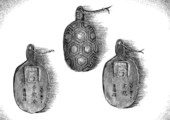 The turtle shell badges held by members of the Golden Turtles


Appearances[edit | edit source]
- Assassin's Creed: Revelations – Discover Your Legacy (first appearance)
- Assassin's Creed: Embers (mentioned only)
- Assassin's Creed IV: Black Flag (mentioned only)
- Assassin's Creed Chronicles: China
- Assassin's Creed: Templars – Volume 1: Black Cross (first identified as "Shanghai Rite")
- Assassin's Creed: Blade of Shao Jun
- Assassin's Creed: Dynasty
- Assassin's Creed: The Imperial Jade Seal
- Assassin's Creed: Forgotten Temple (indirect mention only)
Non-canonical appearances[edit | edit source]
- Assassin's Creed: The Ming Storm
- Assassin's Creed: The Desert Threat
- Assassin's Creed: Turbulence in the Ming Dynasty
References[edit | edit source]


| |||||||||||||||||||||||||||||||
| ||||||||||||||||||||||||||||
| ||||||||||||||||||||||||||||
| |||||||||||||||||||||||||