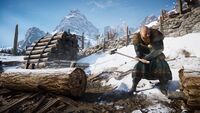
200 unique weapon models were designed for AC Valhalla.
After thorough historical research, Modeling Artists had the difficult task of designing realistic but spectacular weapons. Talk about a brain-twister!
The flail was also added to the arsenal as a unique form of weaponry, een though flails weren't used by soldiers in battle but by peasants during harvest.
To enjoy these weapons even more, new fighting styles were created. Players can now fight with a weapon in each hand - the dual-wielding - or hit foes with their shield!
Production insights kindly provided by Assistant Artistic Director Vladimir Eskandari (Ubisoft Montréal) and Art Director John-Paul Tan (Ubisoft Phillipines).
|-|The Music of AC Valhalla=
|-|The Music of AC Valhalla=
|-|Use Protection=
|-|Use Protection=
Shields played an important role in the Viking and Anglo-Saxon fighting techniques, and in AC Valhalla as well.
Used in the game to differentiate clans and factions, each one has its own shape, paint model, colour pattern and emblem.
A new gameplay element was also added: the shield degradation. With each hit, an enemy's shield loses a piece until it's destroyed, and players can also now attack using their shields.
Little known fact: it was common for vendors to walk around the battlefield, supplying clients with replacements shields and weapons! What an we say, Vikings were resourceful!
Production insights kindly provided by Modeler Benoit Lebel (Ubisoft Montréal).
|-|Welcome to Asgard=
|-|Welcome to Asgard=
</tabber>
</tabber>
Revision as of 18:38, 29 December 2021
This article is about the Discovery Tour for Norway and England. You may be looking for for other Discovery Tours.
He who increaseth knowledge, increaseth sorrow.
This article contains spoilers, meaning it has information and facts concerning recent or upcoming releases from the Assassin's Creed series. If you do not want to know about these events, it is recommended to read on with caution, or not at all.
This template should be removed from the article 19 January 2022.
Where are the paintings?
This article is in need of more images and/or better quality pictures from official media in order to achieve a higher status. You can help the Assassin's Creed Wiki by uploading better images on this page.
Patience, brothers. Soon we will reveal the secrets of this painting.
This article has been identified as being out of date. Please update the article to reflect recent releases and then remove this template once done.
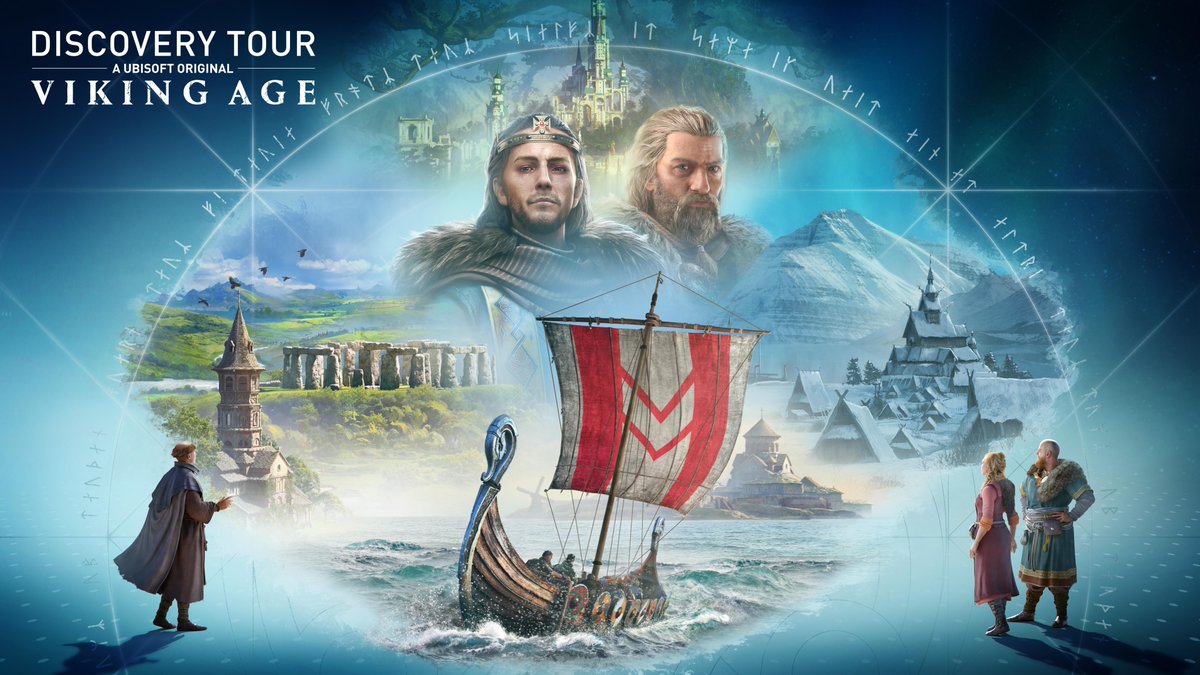
Promotional banner
Discovery Tour: Viking Age is the Discovery Tour mode for Assassin's Creed: Valhalla. It was released as a free downloadable add-on on 19 October 2021[1] and is available for free to those who own the base game, or for purchase as a stand-alone version on PC.
In the game, players are able to freeroam and explore the maps of Norway and Anglo-SaxonEngland and learn about both countries' histories. Unlike previous installments which employed the use of guided tours, Discovery Tour: Viking Age will see players assume the roles of various characters and take on quests with the aim of bringing them closer to the material by putting them at the center of it.[2]
Jorvik - now called York - is a great example of how Anglo-Saxon and Norse civilizations merged over time. Its multiple docks and narrow streets filled with exotic supplies welcomed international traders year-round
To represent this thriving hub, Level Artists and Level Designers used Coppergate one of the city's most notorious landmarks.
Known at the time as the "Cup Street" - where merchants sold handmade cups and pots - it was taken as a reference and extended to the rest of the town. With its small wooden houses and stalls built tightly together Jorvik cotrasts with stone-built Anglo-Saxon towns.
Production insights kindly provided by Associate Level Design Director Junjie Lie, Level Artist Danny Hung and Level Designers Israel Chua and Julien Koch (Ubisoft Singapore).
To replicate England's diverse flora was no small feat. The developers wanted it to be accurate and help players navigate the map.
First, the World Design team created a Season Map: England was divided into four areas, each allocated a season.
Each season had its own variety of vegetation, from grass to trees, and its own Humidity Layer, which helped determine the type of soil in each area: lush, dry or wetland.
With these in hand the Level Artists and Designers could implement the right type of flora in the world, and created different landscapes using rocks and trees. Therefore, each region has diverse but coherent scenery, engaging players to explore the map meticulously.
Production insights provided by Level Artists Joël Pelletant and Adrien Paguet-Brunella, Technical Artist Pierre-Alexandre and Assistant Artistic Director Vladimir Eskandari (Ubisoft Montréal).
Rumor has it York is one of England's most haunted cities!
Built by the Romans, it is said that ghosts of fallen soldiers still roam the city, inspiring a locally-brewered beverage - the Centurion's Ghost.
To emulate this mystical atmosphere, Level Designers took the opportunity to place an underground location reusing Roman-era abandoned sewers. It's a way for players to walk around unnoticed...
But what if the ghost rumors are true?
Immersion
200 unique weapon models were designed for AC Valhalla.
After thorough historical research, Modeling Artists had the difficult task of designing realistic but spectacular weapons. Talk about a brain-twister!
The flail was also added to the arsenal as a unique form of weaponry, een though flails weren't used by soldiers in battle but by peasants during harvest.
To enjoy these weapons even more, new fighting styles were created. Players can now fight with a weapon in each hand - the dual-wielding - or hit foes with their shield!
Production insights kindly provided by Assistant Artistic Director Vladimir Eskandari (Ubisoft Montréal) and Art Director John-Paul Tan (Ubisoft Phillipines).
Shields played an important role in the Viking and Anglo-Saxon fighting techniques, and in AC Valhalla as well.
Used in the game to differentiate clans and factions, each one has its own shape, paint model, colour pattern and emblem.
A new gameplay element was also added: the shield degradation. With each hit, an enemy's shield loses a piece until it's destroyed, and players can also now attack using their shields.
Little known fact: it was common for vendors to walk around the battlefield, supplying clients with replacements shields and weapons! What an we say, Vikings were resourceful!
Production insights kindly provided by Modeler Benoit Lebel (Ubisoft Montréal).
Research
The castles of England were meant to be seen from afar by anyone seeking refuge.
Except, rulers didn't really account for their castles also attracing Vikings!
All fortified areas in AC Valhalla were inspired by the castles the development team visited while in England: Portchester Derby, Goodrich, Housesteads the Roman Fort at Hadrian's Wall... The Castle Trefaldwyn in Wales inspired the factional Caustow Castle a fort in the Scriopescire region.
In AC Valhalla, castles are a telltale sign of great bounty to collect during raids, and lords will often retreat behind a castle's protective wealls when fleeing from Eivor.
They can run but they can't hide!
Production insights kindly provided by Raphaël Lacoste, Vladimir Eskandari and Oliver Carignan (Ubisoft Montrëal).
It seems that Vikings and Ango-Saxons could roughly understand each other at the time, as both of their languages sounded similar and had diverged only a few centures before.
To help actors during records, the Voice Design team relied on linguists, such as Runoloist Maja Bäckvall (Uppsala University).
Lines were then written in three versions: in English or context, in the original language (Latin, Old Norse, Old English), and in phonetics for accurate pronunciation.
Interestingly, it felt quite natural for Icelandic actors pronounce Old Norse. They wouldn't need a dictionary if their great-reat-great-great-grandparents were around to translate!
Production insights kindly provided by Voice Designer Nicholas rimwood (Ubisoft Montréal).
AC Valhalla is set during a tense political climate. English kingdoms were fighting one another as well as trying to ward off Viking attacks.
Hence, maps are displayed in the game as battle plans. To help plapyers visualize friends and foes, chess pieces were designed.
The 3D Modeling team firstd created items inspired by an early Scandinavian chess set, the Hnefatafl, which was combined with the Lewis chess pieces. Found in Scotland, they were crafeted out of walrus tusks and whale teeeth in the 12th century.
This design merged English and Scandinavian heritage into a unique item.
Production insights kindly provied by 3D Modelers Audrey Murray, Katy Bouvier, Gabriel Blanchard and Benoît Lebel (Ubisoft Montreal).
As King Aelfred is a historical figure, Artists and Modelers had a lot of documentation to help with his design.
With pre-established features (age, height, backstory) kept as accurate as possible, his appearance had to represent his royal demeano but also his weakened state - he suffered from Chron's disease.
This contrast was made through the design of his clothes,, hair,, and facial features.
As one of the main characters in AC Valhalla, seen up-close in multiple cinematics, it was imperative to design every detail meticulously. So much so that it took ten days to design his hair!
Production insights kindly provided by Artists Jeff Simpson, Yelim Kim, and Pierre Raveneau (Ubisoft Montreal).
As the monastery of Ely has been destroyed. Level Designers and Artists had to draw their inspiration elsewhere. More specifically, from the Saint-Martin-du-Canigou Abbey in France.
Despite the construction being two centuries older than AC Valhalla's time period, it offered interesting architecture for the players to enjoy: atop a hill for great scenery, a cloister to clear the perspective, and the bell tower to privde an inconic viewpoint.
Finally, an underground tunnel was added, a unique feat perfect for a surprise attack.
But some things remain accurate! Several eels were placed in the waters circling the monastery - a nod to the feature that gae tits name.
Production insights kindly provided by Level Artists Sébastien Maingot and Sébastien Genest (Ubisoft Montreal).
Even warriors get some playtime.
Indeed, it seems that Vikings played board games that involved throwing small objects, such as carved wooden figures. HOwever, the team couldn't find any clear rules for these games.
But all hope wasn't lost; the developers at Singapore Vengdu and Montreal studios all came together to invent new rules and mocked-up their prototypes in a tabletop simulator.
Everyone on the team could experience (and enjoy!) the evolving versions of the Orlog 2.0.
A first physical prototype was also made, using real dice that were painted over. The game of Orlog was (re)born.
AC Valhalla's version of the Orlog was so loved by fans that Ubisoft partnered with PureArts to produce real life Orlog sets!
Prouction insights kindly provided by Game Director Benoit Richer, Technical Design Director Oliver Bodwell, and Game Director Eric Baptizat (Ubisoft Montreal).
As longhouses were at the centre of Norse communities, it was only natural that they'd be at the forefront of AC Valhalla.
Just like any true Viking, Eivor hosts feats, plans battles, and sleeps in her longhouse. But what about its design?
The ARt Direction team first took a scouting trip to Lofoten, Norway, to immerse themselves in the land and bring back references. From these pictures, Modelers and Artists designed variations of paint patterns, carved animals, frescos etc. for players to enjoy and use to customize their settlement.
Ango-Saxon longhouses, on the other hand, were designed with different materials, such as hay and lime, and less detailed engravings. Can't have them steal the show!
Production insights kindly provided by Brand Artistic Director Raphaël Lacoste, Assistant Artistic Director Vladimire Eskandari (Ubisoft Montreal), Level Artist Janice Leng (Ubisoft Singapore), and Environment Artist Martin BOnev (Ubisoft Sofia).
To make it short: Vikings did not, in fact, wear horned helmets.
The misconception came from the Wagnerian opera The Ring of the Nibelung (1876). Horned and winged helemets were then part of the actor's costumes, a way for the warriors to seem more grandiose on stage.
Ever since then, depictions of Vikings wearing big horned helmets were in plentiful supply, and this wrongful image has persisted to this day.
Beside the fact that horned helmets would have been anything but practical on the battlefield, it seems that the very few ones found by archeologists were only used for ritual purposes.
- Who's ready to be the party pooper come Halloween?
Production insights kindly provided by Historian Patrice Hamel (Ubisoft Montreal).
Scandinavia
Can't make a Viking game without an awesome longship!
After all, Norsemen are renowned for their boat-building craftsmanshipto this day.
To do it justice, Modelers (Montreal) built the dimensions and shapes, while Artists (Singapore) created 48 different variations of longboats with stunning designs inspired by Norse Mythology.
The outcome speaks foritself: a slick, clinker-built hull for hydrodynamism,shallow keels to sail in low waters, and even a removable mast to pass under bridges!
May you have fair winds and following seas!
Production insightskindly provide by modelerKaty Bouvier (Ubisoft Montréal) Art Director YeauChoong Yap (Ubisoft Singapore).
Stavanger, as with many cities in Assasin's Creed Valhalla, is based on an existing city.
To reconstruct it, Level Designers and Artists used maps, pictures and drawings by Archaelogist Jean-Claude Golvin as references, adding alterationsfor gameplay purposes.
While not all towns resembled Golvin's drawings, some iconicdetails helped give a"scandinavian signature" to the towns and settlements ofthe game, easily recognizable by plaers.
Narrow streets,docks, and a salient longhouse in the distance... They all incite exploration and the need for adventure.
Production insights kindly provided by Brand Artistic Director Raphael Lacosteand Assistant Artistic Director Vladimir Eskandari (Ubisoft Montréal).
It's difficult to set oneself apart in a sea of Viking-themed media. But it was the challenge Marketing and Art teams faced when creating AC Valhalla's visual identity. Together, they designed logos and creasts, and selected fonts, colours, and interfaces.
As a result,fifty different logos were created for the brand to find the right fit: the two-axes logo on the bottom right of this picture.
The turquoise colour was added early-on, as a nod to the aurorra borealis that illuminate the Norwegian skies.
Two axes (for dual-wielding)) form the the A of Assasin's Creed.
At their end, the outline of a longhouse rooftop, with delicate engravings to underline Norse crafting skills.
Finally, the faded grid in the background serves as a reminder of the Animus simulation.
Production insights kindly provided by Artistic Director - Visual Conception Nicolas Riward (Ubisoft <ontréal).
Every detail matters when designing a main character. Personality, backstory, mannerisms... Eivor the "Wolf-Kissed" must have a noticeable scar and tattoos to represent past events, beliefs, and clan affiliation.
A mood board was made with various references,from Mad Max's Furiosa to Major Motoko Kusanagai in Ghost in the Sheell, which allowed Concept Artists to create composition (silhouttes, shapes) and concepts.
Then, the Character Modelers designed the details (hair styles, tattoos, outfits, an even leather stiching), while Animators focused on body movemenet and facial expressions.
Finally, acotrs Magnus Bruun Nielessen and Cecile Stenspil were cast to give Eivor a voice, tailored to her or his personality.
- It's alive! Alive!
For player's to recognize their surroundings eassily, developers wanted to create a clash betweenthe English and Norwegian maps.
Thus, Norwegian landcapes are covered with ice andsnow, with little road to travel by land. While ancient Scandinavia wasn't as barren as we're made to believe, the harsh and uninviting land depicted in AC Valhalla means to push the players towards England and continue Eivor's journey.
To do so, Level Artists, Tech Artists, and Level Designers used the Lofoten Islands as a visual reference to emulate its rough landscapes. Through shapes and outlines, the designers made the world feel treacherous, while England's flora is lush and lively.
The grass is always greener on the other side of the sea!