

Apple of Eden 1: Difference between revisions
No edit summary |
mNo edit summary |
||
| (One intermediate revision by the same user not shown) | |||
| Line 34: | Line 34: | ||
*[[Arno Dorian]] (August 1794)<ref name="DK" /> | *[[Arno Dorian]] (August 1794)<ref name="DK" /> | ||
*[[Al Mualim (1794)|Al Mualim]] (1794 – c. 1799)<ref name="DK" /> | *[[Al Mualim (1794)|Al Mualim]] (1794 – c. 1799)<ref name="DK" /> | ||
*[[Napoleon Bonaparte]] (c. 1799)<ref>''[[Assassin's Creed II]]'' – [[Glyphs|Glyph]] #2: "Sixty- | *[[Napoleon Bonaparte]] (c. 1799)<ref>''[[Assassin's Creed II]]'' – [[Glyphs|Glyph]] #2: "Sixty-Four Squares"</ref> | ||
*[[Harry Houdini]] (until 1926)<ref name="Glyph3">''[[Assassin's Creed II]]'' – [[Glyphs|Glyph]] #3: "Descendants"</ref> | *[[Harry Houdini]] (until 1926)<ref name="Glyph3">''[[Assassin's Creed II]]'' – [[Glyphs|Glyph]] #3: "Descendants"</ref> | ||
*[[Templars]] (1926 – ?)<ref name="Glyph3" /><ref name="Glyph9">''[[Assassin's Creed II]]'' – [[Glyphs|Glyph]] | *[[Templars]] (1926 – ?)<ref name="Glyph3" /><ref name="Glyph9">''[[Assassin's Creed II]]'' – [[Glyphs|Glyph]] #9: "Hat Trick"</ref> | ||
==History== | ==History== | ||
===Early history=== | ===Early history=== | ||
Like the other Apples of Eden, this artifact was created by the Isu to control the minds of their [[Slavery|slave]] race, | Like the other Apples of Eden, this artifact was created by the Isu to control the minds of their [[Slavery|slave]] race, the humans.<ref>''[[Assassin's Creed III]]'' – [[21st century conversations|Modern day]]</ref> At some point prior to the [[Great Catastrophe]] in 75,000 BCE,<ref name="ACI" /> which resulted in the near-total extinction of the Isu,<ref>''[[Assassin's Creed II]]'' – [[In Bocca al Lupo]]</ref> this particular Apple was locked away within a [[Saint-Denis Temple|temple]] underneath the modern-day town of [[Saint-Denis]], [[France]]. | ||
===3rd century=== | ===3rd century=== | ||
| Line 56: | Line 56: | ||
Unwilling to let the artifact fall into Napoleon's or anyone else's hands, Arno later removed the Apple from the lantern and passed it to a member of the French Brotherhood with instructions to deliver it to the leader of the [[Egyptian Brotherhood of Assassins|Egyptian Assassins]], [[Al Mualim (1794)|Al Mualim]], in [[Cairo]].<ref name="Crown of Thorns" /> In 1798, Napoleon led an expedition to [[Egypt]] and returned home after acquiring the Apple, which allowed him to rise to power as First Consul and later [[French Empire|Emperor of the French]].<ref>{{Youtube|video=Rt9q3F1JS7E|text=The Assassin's Den - ft. Jeffrey Yohalem (Dead Kings discussion and more)|channel=@loomer|channelname=Loomer|quote={{Cite}}}}</ref> | Unwilling to let the artifact fall into Napoleon's or anyone else's hands, Arno later removed the Apple from the lantern and passed it to a member of the French Brotherhood with instructions to deliver it to the leader of the [[Egyptian Brotherhood of Assassins|Egyptian Assassins]], [[Al Mualim (1794)|Al Mualim]], in [[Cairo]].<ref name="Crown of Thorns" /> In 1798, Napoleon led an expedition to [[Egypt]] and returned home after acquiring the Apple, which allowed him to rise to power as First Consul and later [[French Empire|Emperor of the French]].<ref>{{Youtube|video=Rt9q3F1JS7E|text=The Assassin's Den - ft. Jeffrey Yohalem (Dead Kings discussion and more)|channel=@loomer|channelname=Loomer|quote={{Cite}}}}</ref> | ||
Before being exiled to {{Wiki|Saint Helena}}, Napoleon hid the Apple of Eden in a crypt underneath [[Les Invalides]], where it would stay until 1840, when his remains were repatriated. That year, General [[Henri Gatien Bertrand]] moved it to the Saint-Jérôme chapel at Les Invalides, to keep it close to the late emperor, hiding it under a golden cushion atop of which rested Napoleon's precious sword from {{Wiki|Austerlitz}}. It was transferred to an even safer location in 1861.<ref>''[[Le Secret de Napoléon Ier]]''</ref> | Before being exiled to {{Wiki|Saint Helena}}, Napoleon hid the Apple of Eden in a crypt underneath [[Les Invalides]], where it would stay until 1840, when his remains were repatriated. That year, General [[Henri-Gatien Bertrand]] moved it to the Saint-Jérôme chapel at Les Invalides, to keep it close to the late emperor, hiding it under a golden cushion atop of which rested Napoleon's precious sword from {{Wiki|Austerlitz}}. It was transferred to an even safer location in 1861.<ref>''[[Le Secret de Napoléon Ier]]''</ref> | ||
=== | ===20th century=== | ||
The next known owner of the Apple was [[Harry Houdini]], a [[Hungary|Hungarian]]-[[United States|American]] magician and escapologist. He used the artifact to execute stunts that, even to this day, are considered impossible. While Houdini officially died from peritonitis from a ruptured appendix in 1926, [[Clay Kaczmarek]]'s [[Glyphs]] suggested that Houdini had been killed by [[Templars|Templar]] agents who | The next known owner of the Apple was [[Harry Houdini]], a [[Hungary|Hungarian]]-[[United States|American]] magician and escapologist. He used the artifact to execute stunts that, even to this day, are considered impossible. While Houdini officially died from {{Wiki|peritonitis}} from a ruptured appendix in 1926, [[Clay Kaczmarek]]'s [[Glyphs]] suggested that Houdini had been killed by [[Templars|Templar]] agents who sought to take possession of his Apple.<ref name="Glyph3" /> | ||
The Apple was later used in the 1963 [[assassination of John F. Kennedy|assassination]] of [[John F. Kennedy]] to cause the "Phantom on the Hill" effect. This created the illusion of a second gunman on the grassy knoll of {{Wiki|Dealey Plaza}} in [[Dallas]], [[Texas]]. The goal of this illusion was to make it more difficult to persecute the Templar sleeper agent [[Lee Harvey Oswald]],<ref name="Glyph9"/> and to disguise the true intentions of the [[Assassin]]-executed [[assassination]] from later investigations.<ref>''[[Assassin's Creed: Bloodstone]] – [[Assassin's Creed: Bloodstone Book 1|Book 1]]''</ref> | The Apple was later used in the 1963 [[assassination of John F. Kennedy|assassination]] of [[John F. Kennedy]] to cause the "Phantom on the Hill" effect. This created the illusion of a second gunman on the grassy knoll of {{Wiki|Dealey Plaza}} in [[Dallas]], [[Texas]]. The goal of this illusion was to make it more difficult to persecute the Templar sleeper agent [[Lee Harvey Oswald]],<ref name="Glyph9"/> and to disguise the true intentions of the [[Assassins|Assassin]]-executed [[assassination]] from later investigations.<ref>''[[Assassin's Creed: Bloodstone]] – [[Assassin's Creed: Bloodstone Book 1|Book 1]]''</ref> | ||
==Gallery== | ==Gallery== | ||
Latest revision as of 21:46, 6 June 2026
Apple of Eden #1 was a Piece of Eden, a piece of ancient and technologically advanced equipment created by the Isu to control humanity.
The first among several known Apples of Eden, it was relatively small compared to the other artifacts. From the 3rd century until 1794, the Apple was housed within the Head of Saint Denis, a head-shaped lantern, granting it unique properties.
Owners[edit | edit source]
- Isu (until c. 75,000 BCE)[1]
- Saint Denis of Paris (3rd century)[2]
- Saint Denis' successor (3rd century)[2]
- Suger of Saint-Denis (c. 1140)[3]
- Arno Dorian (August 1794)[3]
- Al Mualim (1794 – c. 1799)[3]
- Napoleon Bonaparte (c. 1799)[4]
- Harry Houdini (until 1926)[5]
- Templars (1926 – ?)[5][6]
History[edit | edit source]
Early history[edit | edit source]
Like the other Apples of Eden, this artifact was created by the Isu to control the minds of their slave race, the humans.[7] At some point prior to the Great Catastrophe in 75,000 BCE,[1] which resulted in the near-total extinction of the Isu,[8] this particular Apple was locked away within a temple underneath the modern-day town of Saint-Denis, France.
3rd century[edit | edit source]
In the 3rd century, the Saint-Denis Temple was discovered by the bishop Denis, who took the Apple and used it to convert the population of Lutetia to Christianity. After the bishop was arrested, imprisoned, and executed by the Romans, the Apple was retrieved by one of his successors, who used it to implant a false memory of Denis walking with his decapitated head into the minds of the general populace.[2]
However, the Apple soon began to negatively influence the successor, and he created the Head of Saint Denis to contain it.[2] The Apple granted the lantern special powers, allowing it to burn indefinitely with no form of fuel and create terrifying illusions that could scare people to the point of death.[9] Eventually realizing that the artifact's power was too great for any human to wield, the successor returned it to the temple where Denis had first found it.[2]
12th century[edit | edit source]
At some point during the 12th century, the Head of Saint Denis and the Apple were discovered by the abbot Suger of Saint-Denis, who used the knowledge he gained from the Apple to create the Eagle of Suger, a powerful sword. Moreover, his architectural redesign of the Basilica of Saint-Denis, generally considered to be the first Gothic church, also came from visions induced by the artifact.[10]
18th century[edit | edit source]
In August 1794, Napoleon Bonaparte employed a group of tomb raiders led by Philippe Rose to find the Saint-Denis Temple and the artifact stored within.[11] The former French Assassin Arno Dorian was able to access the temple ahead of the raiders and retrieve the Head of Saint Denis, using its power to repel the raiders and make his escape.[9]

Unwilling to let the artifact fall into Napoleon's or anyone else's hands, Arno later removed the Apple from the lantern and passed it to a member of the French Brotherhood with instructions to deliver it to the leader of the Egyptian Assassins, Al Mualim, in Cairo.[9] In 1798, Napoleon led an expedition to Egypt and returned home after acquiring the Apple, which allowed him to rise to power as First Consul and later Emperor of the French.[12]
Before being exiled to Saint Helena, Napoleon hid the Apple of Eden in a crypt underneath Les Invalides, where it would stay until 1840, when his remains were repatriated. That year, General Henri-Gatien Bertrand moved it to the Saint-Jérôme chapel at Les Invalides, to keep it close to the late emperor, hiding it under a golden cushion atop of which rested Napoleon's precious sword from Austerlitz. It was transferred to an even safer location in 1861.[13]
20th century[edit | edit source]
The next known owner of the Apple was Harry Houdini, a Hungarian-American magician and escapologist. He used the artifact to execute stunts that, even to this day, are considered impossible. While Houdini officially died from peritonitis from a ruptured appendix in 1926, Clay Kaczmarek's Glyphs suggested that Houdini had been killed by Templar agents who sought to take possession of his Apple.[5]
The Apple was later used in the 1963 assassination of John F. Kennedy to cause the "Phantom on the Hill" effect. This created the illusion of a second gunman on the grassy knoll of Dealey Plaza in Dallas, Texas. The goal of this illusion was to make it more difficult to persecute the Templar sleeper agent Lee Harvey Oswald,[6] and to disguise the true intentions of the Assassin-executed assassination from later investigations.[14]
Gallery[edit | edit source]
-
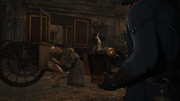 Arno packing the Apple for its journey to Egypt
 -
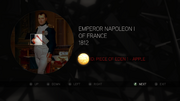 Napoleon hiding the Apple under his vest
 -
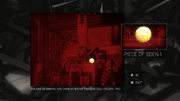 Houdini using the Apple during an act


Appearances[edit | edit source]
- Assassin's Creed II (Glyphs only)
- Assassin's Creed: Unity – Dead Kings (first appearance)
- Assassin's Creed: The Essential Guide (2nd edition)
- Le Secret de Napoléon Ier (mentioned only)
- Assassin's Creed: Valhalla – The Siege of Paris (indirect mention only)
References[edit | edit source]
- ↑ 1.0 1.1 Assassin's Creed: Initiates – Timeline
- ↑ 2.0 2.1 2.2 2.3 2.4 Assassin's Creed: Valhalla – The Siege of Paris – Notes from Eivor's travels: "Ancient Stone Tablet 2"
- ↑ 3.0 3.1 3.2 Assassin's Creed: Unity – Dead Kings
- ↑ Assassin's Creed II – Glyph #2: "Sixty-Four Squares"
- ↑ 5.0 5.1 5.2 Assassin's Creed II – Glyph #3: "Descendants"
- ↑ 6.0 6.1 Assassin's Creed II – Glyph #9: "Hat Trick"
- ↑ Assassin's Creed III – Modern day
- ↑ Assassin's Creed II – In Bocca al Lupo
- ↑ 9.0 9.1 9.2 Assassin's Creed: Unity – Dead Kings – A Crown of Thorns
- ↑ Assassin's Creed: Unity – Dead Kings – Suger's Legacy
- ↑ Assassin's Creed: Unity – Dead Kings – The Book Thief
- ↑
 The Assassin's Den - ft. Jeffrey Yohalem (Dead Kings discussion and more) on the Loomer YouTube channel. " [citation needed] "
- ↑ Le Secret de Napoléon Ier
- ↑ Assassin's Creed: Bloodstone – Book 1

| |||||||||||||||||||||||||||||||