

French Wars of Religion: Difference between revisions
Created page with "{{Era|Timeline}}{{WP-REAL}} The '''French Wars of Religion''' were a series of civil wars between French Catholics and Protestants (called Huguenots) from 1562, with the {{Wiki|Massacre of Vassy}},<ref name="Wiki">{{WP|French Wars of Religion}}</ref> until 1598, with the signing of the {{Wiki|Edict of Nantes}}.<ref name="Alienor">''Le Trésor Perdu d'Aliénor''</ref> ==History== As early as 1558, tensions between the two groups were not only high but alre..." |
No edit summary |
||
| (2 intermediate revisions by 2 users not shown) | |||
| Line 1: | Line 1: | ||
{{Era|Timeline}}{{WP-REAL}} | {{Era|Timeline}}{{WP-REAL}} | ||
The '''French Wars of Religion''' were a series of civil wars between | The '''French Wars of Religion''' were a series of civil wars between French {{Wiki|Catholic Church|Catholics}} and the {{Wiki|Protestantism|Protestant}} {{Wiki|Religious denomination|denomination}} called {{Wiki|Huguenots}} from 1562, with the {{Wiki|Massacre of Vassy}},<ref name="Wiki">{{WP|French Wars of Religion}}</ref> until 1598, with the signing of the {{Wiki|Edict of Nantes}}.<ref name="Alienor">''[[Le Trésor Perdu d'Aliénor]]''</ref> | ||
==History== | ==History== | ||
As early as 1558, tensions between the two groups were not only high but already reaching violent levels, with an example being the partial destruction of the Catholic ''{{Wiki|fr:Église Sainte-Croix de Loudun|Collégiale Sainte-Croix}}'' church in [[Loudun]].<ref name="Alienor"/> The massacre of the Huguenots at Vassy had also a quick response,<ref name="Wiki"/> with {{Wiki|Church of Notre-Dame la Grande, Poitiers|Notre-Dame-la-Grande}} at [[Poitiers]] being pillaged the same year of the official start of hostilities. A member of the [[Parisian Brotherhood of Assassins]] intervened, confronting the men burning the church's texts.<ref name="Alienor"/> | As early as 1558, tensions between the two groups were not only high but already reaching violent levels, with an example being the partial destruction of the Catholic ''{{Wiki|fr:Église Sainte-Croix de Loudun|Collégiale Sainte-Croix}}'' [[church]] in [[Loudun]].<ref name="Alienor"/> The massacre of the Huguenots at Vassy had also a quick response,<ref name="Wiki"/> with {{Wiki|Church of Notre-Dame la Grande, Poitiers|Notre-Dame-la-Grande}} at [[Poitiers]] being pillaged the same year of the official start of hostilities. A member of the [[Parisian Brotherhood of Assassins]] intervened, confronting the men burning the church's texts.<ref name="Alienor"/> | ||
The Huguenot army, led by [[Gaspard II de Coligny]] besieged various Catholic strongholds, attacking not only the cities but specifically targeting churches and cathedrals. In 1569, with the aid of the [[Templars|Templar Order]], Coligny led the Protestant troops during the {{Wiki|Siege of Poitiers (1569)|siege}} of Poitiers, and, later the same year, during the {{Wiki|Battle of Moncontour|siege}} of [[Chauvigny]]. As the city burned, an Assassin escaped the invading army destroying the {{Wiki|Archdiocese of Poitiers|Bishops}}' castle by taking a [[Leap of Faith]].<ref name="Alienor"/> | The Huguenot army, led by [[Gaspard II de Coligny]] besieged various Catholic strongholds, attacking not only the cities but specifically targeting churches and cathedrals. In 1569, with the aid of the [[Templars|Templar Order]], Coligny led the Protestant troops during the {{Wiki|Siege of Poitiers (1569)|siege}} of Poitiers, and, later the same year, during the {{Wiki|Battle of Moncontour|siege}} of [[Chauvigny]]. As the city burned, an Assassin escaped the invading army destroying the {{Wiki|Archdiocese of Poitiers|Bishops}}' castle by taking a [[Leap of Faith]].<ref name="Alienor"/> | ||
In 1572, two days after an attempted assassination of Admiral Coligny, King {{Wiki|Charles IX of France}} ordered the killing of a group of Huguenot leaders, including Coligny, and the slaughter spread throughout Paris, where many had gathered to attend the wedding between the king's sister [[Margaret of Valois]] and the Protestant King [[Henry IV of France|Henry III of Navarre]]. The {{Wiki|St. Bartholomew's Day massacre}} marked a turning point in the wars, removing many of the more prominent aristocratic Hugenots.<ref>{{WP|St. Bartholomew's Day massacre}}</ref> King Henry, however, managed to survive the slaughter.<ref name="Statue">''[[Assassin's Creed: Unity]]'' – [[Database: Statue of Henri IV]]</ref> | In 1572, two days after an attempted [[assassination]] of Admiral Coligny, King {{Wiki|Charles IX of France}} ordered the killing of a group of Huguenot leaders, including Coligny, and the slaughter spread throughout Paris, where many had gathered to attend the wedding between the king's sister [[Margaret of Valois]] and the Protestant King [[Henry IV of France|Henry III of Navarre]]. The {{Wiki|St. Bartholomew's Day massacre}} marked a turning point in the wars, removing many of the more prominent aristocratic Hugenots.<ref>{{WP|St. Bartholomew's Day massacre}}</ref> King Henry, however, managed to survive the slaughter.<ref name="Statue">''[[Assassin's Creed: Unity]]'' – [[Database: Statue of Henri IV]]</ref> | ||
Regardless, the wars continued throughout the territory. In 1574, the town of [[Lusignan]] was besieged and, on 27 September , the besieged managed to escape and killed at least five enemy captains.<ref name="Alienor"/> The battles were costly to maintain, and famously, | Regardless, the wars continued throughout the territory. In 1574, the town of [[Lusignan]] was besieged and, on 27 September, the besieged managed to escape and killed at least five enemy captains.<ref name="Alienor"/> The battles were costly to maintain, and famously, [[Louis IX of France|Louis IX]]'s tomb at the [[Royal Crypt of Saint-Denis]] was melted for its [[brass]] during the conflict.<ref>''[[Assassin's Creed: Unity]]'' – [[Database: Royal Crypt]]</ref> | ||
In 1593, following the death of [[Henry III of France|Henry III]] and his subsequent inheritance of the throne,<ref>{{WP|Henry IV of France}}</ref> King Henry of Navarre converted to Catholicism in order to stabilize his throne, becoming Henry IV of France and possibly uttering the apocryphal remark that "Paris is worth a mass."<ref name="Statue"/> In 1597 an assembly of Huguenots met at | In 1593, following the death of [[Henry III of France|Henry III]] and his subsequent inheritance of the throne,<ref>{{WP|Henry IV of France}}</ref> King Henry of Navarre converted to Catholicism in order to stabilize his throne, becoming Henry IV of France and possibly uttering the apocryphal remark that ''"Paris is worth a mass."''<ref name="Statue"/> In 1597, an assembly of Huguenots met at [[Maximilien de Béthune, Duke of Sully]]'s mansion in [[Châtellerault]] to prepare for negotiations with King Henry, leading to the 1598 Edict of Nantes, which ended the Wars of Religion.<ref name="Alienor"/> Three years later, Henry IV announced that a [[Place Dauphine|public square]] would be created and given to the first President of the Parliament, [[Achille de Harlay]], who had remained loyal to him during the conflict.<ref>''[[Assassin's Creed: Unity]]'' – [[Database: Place Dauphine]]</ref> | ||
==Gallery== | |||
<gallery widths="180" position="center" captionalign="center"> | |||
AC TPA Poitiers - Notre-Dame-la-Grande 1562.png|An Assassin at Notre-Dame-la-Grande, 1562 | |||
AC TPA Poitiers - Cathedral 1569.png|A Templar overseeing the siege of Poitiers, 1569 | |||
AC TPA Chauvigny - Château des Évêques 1569.png|The Bishops' Castle at Chauvigny being attacked, 1569 | |||
AC TPA Châtellerault - Hôtel Sully 1598.png|The Duke of Sully receiving a Huguenot at his mansion, 1598 | |||
</gallery> | |||
==Appearances== | ==Appearances== | ||
*''[[Assassin's Creed: Unity]]'' {{Mdat}} | *''[[Assassin's Creed: Unity]]'' {{1stm}} {{Mdat}} | ||
*''[[Le Trésor Perdu d'Aliénor]]'' {{1st}} | *''[[Le Trésor Perdu d'Aliénor]]'' {{1st}} | ||
| Line 22: | Line 30: | ||
{{Hootside}} | {{Hootside}} | ||
[[Category:Timeline]] | [[Category:Timeline]] | ||
[[Category:Wars]] | |||
Latest revision as of 14:01, 15 November 2026
The French Wars of Religion were a series of civil wars between French Catholics and the Protestant denomination called Huguenots from 1562, with the Massacre of Vassy,[1] until 1598, with the signing of the Edict of Nantes.[2]
History[edit | edit source]
As early as 1558, tensions between the two groups were not only high but already reaching violent levels, with an example being the partial destruction of the Catholic Collégiale Sainte-Croix church in Loudun.[2] The massacre of the Huguenots at Vassy had also a quick response,[1] with Notre-Dame-la-Grande at Poitiers being pillaged the same year of the official start of hostilities. A member of the Parisian Brotherhood of Assassins intervened, confronting the men burning the church's texts.[2]
The Huguenot army, led by Gaspard II de Coligny besieged various Catholic strongholds, attacking not only the cities but specifically targeting churches and cathedrals. In 1569, with the aid of the Templar Order, Coligny led the Protestant troops during the siege of Poitiers, and, later the same year, during the siege of Chauvigny. As the city burned, an Assassin escaped the invading army destroying the Bishops' castle by taking a Leap of Faith.[2]
In 1572, two days after an attempted assassination of Admiral Coligny, King Charles IX of France ordered the killing of a group of Huguenot leaders, including Coligny, and the slaughter spread throughout Paris, where many had gathered to attend the wedding between the king's sister Margaret of Valois and the Protestant King Henry III of Navarre. The St. Bartholomew's Day massacre marked a turning point in the wars, removing many of the more prominent aristocratic Hugenots.[3] King Henry, however, managed to survive the slaughter.[4]
Regardless, the wars continued throughout the territory. In 1574, the town of Lusignan was besieged and, on 27 September, the besieged managed to escape and killed at least five enemy captains.[2] The battles were costly to maintain, and famously, Louis IX's tomb at the Royal Crypt of Saint-Denis was melted for its brass during the conflict.[5]
In 1593, following the death of Henry III and his subsequent inheritance of the throne,[6] King Henry of Navarre converted to Catholicism in order to stabilize his throne, becoming Henry IV of France and possibly uttering the apocryphal remark that "Paris is worth a mass."[4] In 1597, an assembly of Huguenots met at Maximilien de Béthune, Duke of Sully's mansion in Châtellerault to prepare for negotiations with King Henry, leading to the 1598 Edict of Nantes, which ended the Wars of Religion.[2] Three years later, Henry IV announced that a public square would be created and given to the first President of the Parliament, Achille de Harlay, who had remained loyal to him during the conflict.[7]
Gallery[edit | edit source]
-
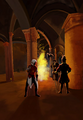 An Assassin at Notre-Dame-la-Grande, 1562
-
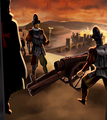 A Templar overseeing the siege of Poitiers, 1569
-
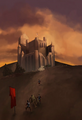 The Bishops' Castle at Chauvigny being attacked, 1569
-
 The Duke of Sully receiving a Huguenot at his mansion, 1598


Appearances[edit | edit source]
- Assassin's Creed: Unity (first mentioned) (mentioned in Database entry only)
- Le Trésor Perdu d'Aliénor (first appearance)
References[edit | edit source]
- ↑ 1.0 1.1
 French Wars of Religion on Wikipedia
- ↑ 2.0 2.1 2.2 2.3 2.4 2.5 Le Trésor Perdu d'Aliénor
- ↑ St. Bartholomew's Day massacre on Wikipedia
- ↑ 4.0 4.1 Assassin's Creed: Unity – Database: Statue of Henri IV
- ↑ Assassin's Creed: Unity – Database: Royal Crypt
- ↑ Henry IV of France on Wikipedia
- ↑ Assassin's Creed: Unity – Database: Place Dauphine
| |||||||||||||||||||||||||