

Mongol Empire: Difference between revisions
imported>Darman36 |
imported>Batfan13 No edit summary |
||
| Line 1: | Line 1: | ||
{{Era|Organizations}}{{WP-REAL}} | {{Era|Organizations}}{{WP-REAL}} | ||
{{Revamp}} | {{Revamp}} | ||
{{Regime Infobox | {{Regime Infobox | ||
| Line 34: | Line 33: | ||
During the latter part of the 13th century, the Mongols became the major enemy of the [[Assassins]]. In 1227, the [[Mentor]] of the [[Levantine Assassins]], [[Altaïr Ibn-La'Ahad]], his son [[Darim Ibn-La'Ahad|Darim]], and the [[Mongolian Brotherhood of Assassins|Mongolian Assassin]] [[Qulan Gal]] were responsible for the death of Genghis Khan, whom they suspected of wielding a [[Piece of Eden]] that had facilitated his rise to power.<ref name="The Secret Crusade">''[[Assassin's Creed: The Secret Crusade]]''</ref> | During the latter part of the 13th century, the Mongols became the major enemy of the [[Assassins]]. In 1227, the [[Mentor]] of the [[Levantine Assassins]], [[Altaïr Ibn-La'Ahad]], his son [[Darim Ibn-La'Ahad|Darim]], and the [[Mongolian Brotherhood of Assassins|Mongolian Assassin]] [[Qulan Gal]] were responsible for the death of Genghis Khan, whom they suspected of wielding a [[Piece of Eden]] that had facilitated his rise to power.<ref name="The Secret Crusade">''[[Assassin's Creed: The Secret Crusade]]''</ref> | ||
Thirty years later, in 1257, the Mongols reached and besieged the Assassins' fortress of [[Masyaf]], seizing it and forcing the Assassins to scatter throughout Europe, Africa and Asia.<ref name="The Secret Crusade" /> | Thirty years later, in 1257, the Mongols reached and besieged the Assassins' fortress of [[Masyaf]], seizing it and forcing the Assassins to scatter throughout Europe, Africa and Asia.<ref name="The Secret Crusade"/> After the siege, a Mongol patrol intercepted the fleeing Assassins and famed explorers [[Niccolò Polo|Niccolò]] and [[Maffeo Polo]] and seized the [[Altaïr Ibn-La'Ahad's Codex|Codex of Altaïr]] from them.<ref name="The Secret Crusade"/> Years later, Niccolò's son, [[Marco Polo|Marco]], traveled to the court of [[Kublai Khan]], grandson of Genghis Khan, and retrieved the Codex from him.<ref name="Assassin's Creed II">''[[Assassin's Creed II]]''</ref> | ||
In August 1259, the Mongols [[Siege of Diaoyu Castle|assaulted]] [[Diaoyu Castle]] and fought against the [[Song military|soldiers]] of the [[Song dynasty]]. General [[Wang Dechen]] plotted to do a night raid after their previous incursions failed and selected commander [[Bayan]] and his men to take the lead.<ref name="CH1">''[[Assassin's Creed: Last Descendants – Tomb of the Khan]]'' – Chapter One</ref> | |||
However, that night, Wang's ambush was discovered and a great number of his men, including himself, were severely injured or killed. This ambush led to a retreat but not before Bayan managed to kill a [[Zhang Zhi's father|Song commander]], who was an [[Assassins|Assassin]] of the [[Chinese Brotherhood of Assassins|Chinese Brotherhood]]. Wang Dechen was soon taken in by their leader [[Möngke Khan]] to recuperate.<ref name="CH5">''[[Assassin's Creed: Last Descendants – Tomb of the Khan]]'' – Chapter Five</ref> However, Wang succumbed to his wounds.<ref name="CH12">''[[Assassin's Creed: Last Descendants – Tomb of the Khan]]'' – Chapter Twelve</ref> On the 11th, the Khan was also assassinated in his sleep by [[Assassin apprentice]] [[Zhang Zhi]], in retaliation for her father's death.<ref name="CH9">''[[Assassin's Creed: Last Descendants – Tomb of the Khan]]'' – Chapter Nine</ref> From his death, their plans were temporarily halted<ref name="CH12"/> while his son [[Asutai]] took his body to rest at [[Burkhan Khaldun]].<ref name="CH21">''[[Assassin's Creed: Last Descendants – Tomb of the Khan]]'' – Chapter Twenty-One</ref> | |||
Although the Mongol Empire collapsed in the 14th century, the Mongols continued to pose a threat to various nations in Asia, most notably [[China]]. In the 1530s, the Templar [[Zhang Yong]], one of the [[Eight Tigers]], plotted to allow passage of the Mongols, led by [[Altan Khan]], into China by opening the gates of the [[Great Wall of China|Great Wall]]. To prevent this from happening, the Assassins [[Shao Jun]] and [[Kotetsu]] closed the gates and eliminated the Mongol scouts along the Wall.<ref>''[[Assassin's Creed Chronicles: China]]'' – [[The Betrayal (China)|The Betrayal]]</ref><ref>''[[Assassin's Creed: Blade of Shao Jun]]'' – [[The Great Wall]]</ref> A massive battle between the Mongol army and the [[Ming dynasty]] troops subsequently ensued outside the Wall, with the latter emerging victorious.<ref>''[[Assassin's Creed Chronicles: China]]'' – [[Vengeance]]</ref><ref>''[[Assassin's Creed: Blade of Shao Jun]]'' – [[Culmination]]</ref> | Although the Mongol Empire collapsed in the 14th century, the Mongols continued to pose a threat to various nations in Asia, most notably [[China]]. In the 1530s, the Templar [[Zhang Yong]], one of the [[Eight Tigers]], plotted to allow passage of the Mongols, led by [[Altan Khan]], into China by opening the gates of the [[Great Wall of China|Great Wall]]. To prevent this from happening, the Assassins [[Shao Jun]] and [[Kotetsu]] closed the gates and eliminated the Mongol scouts along the Wall.<ref>''[[Assassin's Creed Chronicles: China]]'' – [[The Betrayal (China)|The Betrayal]]</ref><ref>''[[Assassin's Creed: Blade of Shao Jun]]'' – [[The Great Wall]]</ref> A massive battle between the Mongol army and the [[Ming dynasty]] troops subsequently ensued outside the Wall, with the latter emerging victorious.<ref>''[[Assassin's Creed Chronicles: China]]'' – [[Vengeance]]</ref><ref>''[[Assassin's Creed: Blade of Shao Jun]]'' – [[Culmination]]</ref> | ||
| Line 73: | Line 74: | ||
{{ACBoSJ}} | {{ACBoSJ}} | ||
[[Category:Mongolia]] | [[Category:Mongolia]] | ||
[[Category:Empires]] | |||
Revision as of 18:38, 2 June 2025

|
Ezio, my friend! How may I be of service? This article is in desperate need of a revamp. Please improve it in any way necessary in order for it to achieve a higher standard of quality in accordance with our Manual of Style. |
The Mongol Empire was a pan-Asian and Eastern European empire originating from the Mongolian steppes of Northern Asia during the 13th and 14th centuries.
Expanding from a number disparate Mongolian tribes brought together by the future-Genghis Khan, the Mongol Empire went on to become the single largest contiguous empire in recorded history. Beginning in the steppes, it eventually stretched from the Sea of Japan to the gates of Vienna, Austria, and from the Republic of Novgorod in the north, to the Indian subcontinent in the South.
History
War with the Assassins
During the latter part of the 13th century, the Mongols became the major enemy of the Assassins. In 1227, the Mentor of the Levantine Assassins, Altaïr Ibn-La'Ahad, his son Darim, and the Mongolian Assassin Qulan Gal were responsible for the death of Genghis Khan, whom they suspected of wielding a Piece of Eden that had facilitated his rise to power.[1]
Thirty years later, in 1257, the Mongols reached and besieged the Assassins' fortress of Masyaf, seizing it and forcing the Assassins to scatter throughout Europe, Africa and Asia.[1] After the siege, a Mongol patrol intercepted the fleeing Assassins and famed explorers Niccolò and Maffeo Polo and seized the Codex of Altaïr from them.[1] Years later, Niccolò's son, Marco, traveled to the court of Kublai Khan, grandson of Genghis Khan, and retrieved the Codex from him.[2]
In August 1259, the Mongols assaulted Diaoyu Castle and fought against the soldiers of the Song dynasty. General Wang Dechen plotted to do a night raid after their previous incursions failed and selected commander Bayan and his men to take the lead.[3]
However, that night, Wang's ambush was discovered and a great number of his men, including himself, were severely injured or killed. This ambush led to a retreat but not before Bayan managed to kill a Song commander, who was an Assassin of the Chinese Brotherhood. Wang Dechen was soon taken in by their leader Möngke Khan to recuperate.[4] However, Wang succumbed to his wounds.[5] On the 11th, the Khan was also assassinated in his sleep by Assassin apprentice Zhang Zhi, in retaliation for her father's death.[6] From his death, their plans were temporarily halted[5] while his son Asutai took his body to rest at Burkhan Khaldun.[7]
Although the Mongol Empire collapsed in the 14th century, the Mongols continued to pose a threat to various nations in Asia, most notably China. In the 1530s, the Templar Zhang Yong, one of the Eight Tigers, plotted to allow passage of the Mongols, led by Altan Khan, into China by opening the gates of the Great Wall. To prevent this from happening, the Assassins Shao Jun and Kotetsu closed the gates and eliminated the Mongol scouts along the Wall.[8][9] A massive battle between the Mongol army and the Ming dynasty troops subsequently ensued outside the Wall, with the latter emerging victorious.[10][11]
Gallery
-
 Altaïr using the Apple of Eden to repel the Mongol vanguard
 -
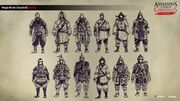 Concept art of Mongol soldiers
 -
 Mongolian scout development
 -
 Mongolian chief development
 -
 Mongolian scout
 -
 Mongolian chief


Appearances
- Assassin's Creed II (first mentioned)
- Assassin's Creed: The Secret Crusade (first appearance)
- Assassin's Creed: Revelations (flashback only)
- Assassin's Creed IV: Black Flag (mentioned only)
- Assassin's Creed: Memories
- Assassin's Creed: Unity (mentioned only)
- Assassin's Creed Chronicles: China
- Assassin's Creed: Last Descendants – Tomb of the Khan
- Assassin's Creed: Reflections
- Assassin's Creed: Blade of Shao Jun
- Assassin's Creed: The Desert Threat (non-canon)
- Echoes of History – Chinese Chronicles (mentioned only)
References
- ↑ 1.0 1.1 1.2 Assassin's Creed: The Secret Crusade
- ↑ Assassin's Creed II
- ↑ Assassin's Creed: Last Descendants – Tomb of the Khan – Chapter One
- ↑ Assassin's Creed: Last Descendants – Tomb of the Khan – Chapter Five
- ↑ 5.0 5.1 Assassin's Creed: Last Descendants – Tomb of the Khan – Chapter Twelve
- ↑ Assassin's Creed: Last Descendants – Tomb of the Khan – Chapter Nine
- ↑ Assassin's Creed: Last Descendants – Tomb of the Khan – Chapter Twenty-One
- ↑ Assassin's Creed Chronicles: China – The Betrayal
- ↑ Assassin's Creed: Blade of Shao Jun – The Great Wall
- ↑ Assassin's Creed Chronicles: China – Vengeance
- ↑ Assassin's Creed: Blade of Shao Jun – Culmination
| |||||||||||||||||||||||||||||||||||||
| |||||||||||||||||||||||||
| |||||||||||||||||||||||||||||||
| |||||||||||||||||||||||||
| |||||||||||||||||||||||||