


Alfred the Great: Difference between revisions
imported>Callum Konstantin No edit summary |
imported>Darman36 Initial proofreading, per Sol's advice. Saving for now, but ref tags for more details in Holy Day, Kingdom's End, Impaling the Seax are set up |
||
| Line 17: | Line 17: | ||
[[Templars|Templar Order]] | [[Templars|Templar Order]] | ||
}} | }} | ||
'''Alfred the Great''' (Old English: ''Aelfrēd''; c.849 – 899), also known as '''Alfred of Wessex''', and his pseudonym | '''Alfred the Great''' ({{Wiki|Old English}}: ''Aelfrēd''; c.849 – 899), also known as '''Alfred of Wessex''', and his pseudonym of '''A Poor-Fellow Soldier of Christ''', was King of [[Wessex]] from 871 to 886 and later King of the [[Anglo-Saxons]] from c. 886 to 899. During his reign, he repelled the [[Vikings]]' [[Viking expansion|invasions]] and laid the foundation for what became the [[Kingdom of England]]. | ||
Secretly, he was also the [[Grand Maegester of the Order of the Ancients|Grand Maegester]] of the [[Order of the Ancients]] in England, a position he inherited from his late elder brother [[Æthelred I, King of Wessex|Æthelred]], who in turn had adopted it after the death of their father [[Æthelwulf, King of Wessex|Æthelwulf]]. Seeing the role's required polytheistic worship of the [[Isu]] to be blasphemous and a defilement to his [[Christianity|Christian]] beliefs, Alfred worked to eliminate the Order from within, though the Viking invasion of [[England]] delayed his plans. | Secretly, he was also the [[Grand Maegester of the Order of the Ancients|Grand Maegester]] of the [[Order of the Ancients]] in England, a position he inherited from his late elder brother [[Æthelred I, King of Wessex|Æthelred]], who in turn had adopted it after the death of their father [[Æthelwulf, King of Wessex|Æthelwulf]]. Seeing the role's required polytheistic worship of the [[Isu]] to be blasphemous and a defilement to his [[Christianity|Christian]] beliefs, Alfred worked to eliminate the Order from within, though the Viking invasion of [[England]] delayed his plans. | ||
After the Viking and [[Hidden Ones]] ally [[Eivor Varinsdottir]] eradicated the Order's prominent agents in England, surreptitiously aided by the Grand Maegester himself, Alfred abandoned the remnants | After the Viking and [[Hidden Ones]] ally [[Eivor Varinsdottir]] eradicated the Order's prominent agents in England, surreptitiously aided by the Grand Maegester himself, Alfred abandoned the Order's remnants. Over the following years, he focused his attention on building a new "universal order" to replace it, one that was more compatible with his religious principles and which would rapidly develop into the [[Templars|Templar Order]]. | ||
==Biography== | ==Biography== | ||
===Early life=== | ===Early life=== | ||
Alfred was born | Alfred was born in 849 to King Æthelwulf of Wessex and {{Wiki|Osburh}}. In 853,<ref name="Wiki">{{WP|Alfred the Great}}</ref> he accompanied his father's {{Wiki|Via Francigena|pilgrimage}} to [[Rome]], where he met and was blessed by [[Papacy|Pope]] [[Leo IV]]. The pope recounted to Alfred his victory against [[Saracen]] [[Piracy|pirates]] at the {{Wiki|battle of Ostia}} in 849, which made a lasting impression on the boy. As the youngest of three living sons,<ref name="Database">''[[Assassin's Creed: Valhalla]]'' – [[Database: Aelfred]]</ref> his eldest brother {{Wiki|Æthelstan of Kent}} having died just before the trip to Rome,<ref>{{Wiki|Æthelstan of Kent}}</ref> the odds of Alfred being crowned king were thought to be slim, so he devoted himself to learning and scholarly pursuits.<ref name="Database"/> | ||
However, his father died in 858, leaving Wessex to Alfred's older brother {{Wiki|Æthelbald, King of Wessex|Æthelbald}}.<ref>{{WP|Æthelbald, King of Wessex}}</ref> He ruled only a few years before dying and passing the throne to {{Wiki|Æthelberht, King of Wessex|Æthelberht}}, who in turn had an equally brief reign.<ref>{{WP|Æthelberht, King of Wessex}}</ref> This near-total elimination of the patrilineal line in short order soon put Æthelred on the throne and advanced Alfred's own status as an ''{{Wiki|ætheling}}'', a prince in position of immediate succession.<ref name="Wiki"/> | |||
===Fighting the Vikings=== | ===Fighting the Vikings=== | ||
In the late 860s, Wessex | In the late 860s, Vikings from the [[Great Heathen Army]] stationed in northern England began subjecting Wessex to [[raid]]s as part of their wider incursions into the country. In response, Alfred joined forces with the newly-crowned Æthelred, and together they endeavored to push the Norse back through military might. Alfred quickly proved himself a capable commander on the battlefield, earning a victory at [[Battle of Reading|Reading]]<ref name="Database" /> despite heavy losses<ref name="TDS">''[[Assassin's Creed: Valhalla – Blood Brothers]]'' — [[The Dust Settles]]</ref> and again at [[Battle of Ashdown|Ashdown]],<ref name="Database"/> where many Viking ''[[jarl]]s'' and their warriors fell.<ref name="GSChapter 12">''[[Assassin's Creed: Valhalla – Geirmund's Saga]]'' — Chapter 12</ref><ref name="TDS" /> Although the subsequent {{Wiki|Wilton, Wiltshire|Battle of Wilton}} was a loss, the magnitude of Alfred's successes in resisting the Vikings eclipsed the result such that it became a much-storied event to the public.<ref name="Database"/> | ||
In late March 871, Alfred and Æthelred met a Viking force led by ''jarls'' [[Guthrum]] and [[Halfdan Ragnarsson]]<ref name="GSChapter 16">''Assassin's Creed: Valhalla – Geirmund's Saga'' — Chapter 16</ref> at the [[Battle of Meretun]].<ref name="Database"/> Unbeknownst to the other commanders, Guthrum was wearing the [[Rings of Eden|Ring of Eden]] [[Hnituðr]], which granted its bearer near-invincibility<ref name = "ACV GS Ch31">''Assassin's Creed: Valhalla – Geirmund's Saga'' – Chapter 31</ref> against weapons made with {{Wiki|Ferromagnetism|ferromagnetic}} metals like [[steel]] or [[iron]].<ref name = "ACV GS Ch16">''Assassin's Creed: Valhalla – Geirmund's Saga'' – Chapter 16</ref> During the battle, Guthrum charged the Anglo-Saxons' front line and shocked the army when he carved his way unharmed to reach the back lines from where Æthelred commanded the troops. Seeing a crucial opportunity to rid the army of both leadership and their king, Guthrum grabbed a [[spear]] and threw it into Æthelred's stomach, forcing his men to retreat from the field. From here, the battle devolved into another loss for Alfred which he was unable to recover from, and he was forced to sue Guthrum and Halfdan for peace.<ref name="GSChapter 17">''Assassin's Creed: Valhalla – Geirmund's Saga'' — Chapter 17</ref> | |||
===Kingship and Grand Maegester=== | ===Kingship and Grand Maegester=== | ||
{{Quote|Grand Maegester was not a title I desired. It passed to me on the death of my brother, from my father before him. Defilers of God's majesty and grandeur. I was their master, and I loathed them.|Alfred to Eivor, 878.|Assassin's Creed: Valhalla|The Poor Fellow-Soldier}} | {{Quote|Grand Maegester was not a title I desired. It passed to me on the death of my brother, from my father before him. Defilers of God's majesty and grandeur. I was their master, and I loathed them.|Alfred to Eivor, 878.|Assassin's Creed: Valhalla|The Poor Fellow-Soldier}} | ||
Once Æthelred died from his wound,<ref name="Database"/><ref name="GSChapter 17"/> Alfred became king and in turn, assumed his brother's leadership of the Order of the Ancients. Unlike his father and brother, however, Alfred disagreed with and deeply reviled the Order's ideals and beliefs, believing them to be sacrilegious to the one God preached by Christianity. Thus, he devised a plan to rid England of the Order and developed an alias for his vendetta. By posing as a spy by the pseudonym of "A Poor Fellow-Soldier of Christ", Alfred recruited the [[reeve]] of [[Winchester|Wincestre]] [[Goodwin]] as his personal informant to scout England for information while using a study in [[The Old Minster]] as a base of operations. To maintain his charade of service to the Order, Alfred continued in his role as Grand Maegester with [[Palatinus]] [[Fulke]] as his personal attendant,<ref name="Poor Fellow">''Assassin's Creed: Valhalla'' – [[The Poor Fellow-Soldier]]</ref> but also adopted another pseudonym of "[[Father of Understanding|The Father]]" when exchanging correspondence with Order members to keep his identity a secret.<ref name="Breaking the Order">''Assassin's Creed: Valhalla'' – [[Breaking the Order]]</ref> | |||
With his Order activities in affair, Alfred pivoted to settle his first trial as a king following his loss at Meretun and sent the [[priest]] Brother [[John (priest)|John]] as an envoy to the Norse offering peace terms. When John returned, Alfred met with the Viking leaders. After drafting and signing a peace accord, a clause of which set out that Danes were forbidden from crossing past the [[River Avon|Avon River]], the Viking army left Wessex.<ref name="GSChapter 17"/> | |||
Despite | Despite the peace terms, Alfred's plans to undermine the Order in the interlude were stymied by the Vikings' continued activities across England, particularly when they received help from the unexpected arrival of the third-party [[Raven Clan]] based in [[Leicestershire|Ledecestrescire]].<ref name="SonsOfRagnar">''Assassin's Creed: Valhalla'' – [[The Sons of Ragnar]]</ref> Perhaps most concerning to the new king, in 873, the clan's ''jarl'' [[Sigurd Styrbjornsson]] and his foster sister Eivor Varinsdottir had aided the [[Sons of Ragnar]]<ref name="SonsOfRagnar"/> in deposing his sister<ref name="Æthelswith">{{WP|Æthelswith}}</ref> [[Æthelswith]]<ref name="TheWallsOfTemplebrough">''Assassin's Creed: Valhalla'' – [[The Walls of Templebrough]]</ref> and his brother-in-law [[Burgred of Mercia|Burgred]] from [[Mercia]]'s thrones and installing [[Ceolwulf II of Mercia|Ceolwulf]] as ruler.<ref name="SonsOfRagnar"/><ref name="HeavyIsTheHead">''Assassin's Creed: Valhalla'' – [[Heavy is the Head]]</ref> Not only did this raise the very real threat of the Vikings succeesfully removing him from power, it also threatened to expose his secret identity as Grand Maegester, since Burgred had written one letter to Alfred requesting the Order's resources for aid<ref name="SonsOfRagnar"/> and another saying that he had called on the Order's fanatical [[Zealots]] to hunt the Danes responsible for [[Assault on Tamworth Fortress|sacking]] [[Tamworth Fortress]].<ref name="TiltingTheBalance">''Assassin's Creed: Valhalla'' – [[Tilting the Balance]]</ref> | ||
Fortunately, Alfred later that year learned the Hidden One [[Hytham]] ran his group's operations from [[Ravensthorpe bureau|within]] the Raven Clan's settlement of [[Ravensthorpe]], and on Goodwin's suggestion, Alfred made use of Hytham's affiliation with Eivor to unwittingly assist in his plans to destroy a mutual enemy.<ref name="Poor Fellow" /> Under his "Poor Fellow-Soldier" pseudonym, Alfred sent a letter to Hytham listing the Order's plans in the city of [[London|Lunden]] led by [[Vicelin|The Compass]], [[Avgos Spearhand|The Arrow]], and [[Frideswid|The Leech]].<ref name="Walls and Shadows">''Assassin's Creed: Valhalla'' – [[Walls and Shadows]]</ref> Over the next few years, Eivor aided Hytham and Alfred by proxy in eliminating the Order members throughout England.<ref name="Poor Fellow" /> | |||
===Encounter with Eivor=== | ===Encounter with Eivor=== | ||
{{Dialogue3|Sigurd|As I understand, King Aelfred, your name is not spoken with affection here in Mercia.|King Aelfred|Yet I am close enough to Wessex to hear myself praised from morn 'til twilight.|Return to your singing subjects then! And leave the affairs of Mercia to the Danes.|Not 'til your pagan war songs are safely out of hearing.|Alfred's meeting with Sigurd, c. 874|Assassin's Creed: Valhalla|The Saga Stone}} | {{Dialogue3|Sigurd|As I understand, King Aelfred, your name is not spoken with affection here in Mercia.|King Aelfred|Yet I am close enough to Wessex to hear myself praised from morn 'til twilight.|Return to your singing subjects then! And leave the affairs of Mercia to the Danes.|Not 'til your pagan war songs are safely out of hearing.|Alfred's meeting with Sigurd, c. 874|Assassin's Creed: Valhalla|The Saga Stone}} | ||
[[File:ACV The Saga Stone 11.png|thumb|250px|left|Alfred meeting with Eivor and Sigurd]] | [[File:ACV The Saga Stone 11.png|thumb|250px|left|Alfred meeting with Eivor and Sigurd]] | ||
Circa 874, Alfred received a request for an alliance by Lady [[Eadwyn]], the wife of the late [[ealdorman]] [[Theodric]] of [[Oxfordshire|Oxenefordscire]] who was killed by | Circa 874, Alfred received a request for an alliance by Lady [[Eadwyn]], the wife of the late [[ealdorman]] [[Theodric]] of [[Oxfordshire|Oxenefordscire]] who was killed by Guthrum's army. Alfred accepted the request and personally led a force to assist the noble lady and meet her at the stronghold of [[Cyne Belle Castle]]. By the time his army arrived, the castle had already [[Assault on Cyne Belle Castle|fallen]] to forces sworn to the rebel thegn [[Geadric]], Sigurd, Eivor, and an undercover Fulke operating for her own goals. As his army surround the castle keep, the rebels called for a parlay, with both Eivor and Sigurd meeting Alfred himself.<ref name="The Saga Stone">''Assassin's Creed: Valhalla'' – [[The Saga Stone]]</ref> | ||
Left with little options, Sigurd proposed | Left with little options, Sigurd proposed a prisoner exchange as a token of peace between Mercia and Wessex. Alfred accepted and offered his war thegn [[Wolfrich]] in exchange for Sigurd's associate, the Hidden One [[Basim Ibn Ishaq]]. However, this exchange was interrupted by Fulke's arrival, revealing her true allegiance. Fulke suggested that Alfred take Sigurd instead, given his status of a ''jarl'' and accusing him of being a [[Norse mythology|heretic]]. Alfred accepted the suggestion and thus took Sigurd prisoner, leaving him in Fulke's care.<ref name="The Saga Stone" /> Some time after these events, Alfred used his Poor Soldier moniker to deliver yet another list to Hytham and Eivor, sending the shieldmaiden to deal with the Order in [[York|Jorvik]] led by [[Audun|The Vault]], [[Grigorii|The Needle]], and [[Ingeborg|The Firebrand]].<ref name="TheWelcomingParty">''Assassin's Creed: Valhalla'' – [[The Welcoming Party]]</ref> | ||
===Hunted by the Order=== | ===Hunted by the Order=== | ||
{{Dialogue3|Eivor|You risk your life, Aelfred King.|King Aelfred|I have invited you here to speak on equal terms. Do the Danes laws of hospitality not apply in Wessex?|You gifted my | {{Dialogue3|Eivor|You risk your life, Aelfred King.|King Aelfred|I have invited you here to speak on equal terms. Do the Danes laws of hospitality not apply in Wessex?|You gifted my ''jarl'' to that whelp from The Order of Ancients, the warrior Fulke.|Fulke was an enemy of Wessex. But it seems someone has already removed her threat from my lands.|Alfred meeting with Eivor after the events in Oxenefordscire, c. 875|Assassin's Creed: Valhalla|The Reeve of Wincestre}} | ||
Circa 875, the Paladin Fulke was able to uncover Alfred's "exchange" with the Poor Soldier via a marked seal on the letters exchanged between them. Learning that the king was possibly responsible for the eradication of the Order in both Lunden and Jorvik, she sought to eliminate Alfred and uncover the Poor Soldier, unaware of his double identity. | Circa 875, the Paladin Fulke was able to uncover Alfred's "exchange" with the Poor Soldier via a marked seal on the letters exchanged between them. Learning that the king was possibly responsible for the eradication of the Order in both Lunden and Jorvik, she sought to eliminate Alfred and uncover the Poor Soldier, unaware of his double identity. Given her position in [[Sussex|Suthsexe]] as Sigurd's captor, she thus contacted the three Order members [[Selwyn|The Gallows]], [[Hilda|The Quill]], and [[Ealhferth|The Seax]] in [[Wincestre]] to deal with Alfred themselves. Unable to risk exposing his identity, Alfred contacted Hytham and Eivor once again, instructing her to meet with his associate [[Sigebeald]] in The Old Minster to initiate a secret meeting.<ref name="The Reeve of Wincestre">''Assassin's Creed: Valhalla'' – [[The Reeve of Wincestre]]</ref> | ||
=== | ===Fighting Guthrum=== | ||
Alfred sent | While Eivor eliminated Order members,<ref name="ImpalingTheSeax">''Assassin's Creed: Valhalla'' – [[Impaling the Seax]]</ref> Alfred sent an order for all soldiers across the realm to join him in fighting the Danes, an instruction that left many small towns such as [[Abingdon]] and his birthplace of [[Wanating]] practically defenseless as Alfred's forces grew.<ref name="GSChapter 26">''Assassin's Creed: Valhalla – Geirmund's Saga'' — Chapter 26</ref> However, Alfred was well aware of the tactical importance his old home would hold if captured by the enemy and so had purposefully left Wanating unguarded yet fully stocked with food as bait. He gambled correctly when the Norse warrior [[Geirmund Hel-hide|Geirmund Hjörrsson]] and his [[Hel-hides]] learned how close they were to the city while on a mission from Guthrum to raise havoc and draw Alfred's attention from the Viking army. When Alfred got word that the Hel-hides occupied the city, he personally marched 3,000 soldiers through the night to arrive on the doorstep and begin a surprise siege the day after the Vikings had entered and feasted.<ref name="GSChapter 27">''Assassin's Creed: Valhalla – Geirmund's Saga'' — Chapter 27</ref> | ||
Alfred and his troops left | Despite having far superior numbers, Alfred initially could not retake the town and the Hel-hides held strong, though they suffered a few causalities.<ref name="GSChapter 27"/> Just when it seemed the Hel-Hides would break after running out of supplies, Alfred and his troops abruptly left and quickly marched west<ref name="GSChapter 28">''Assassin's Creed: Valhalla – Geirmund's Saga'' — Chapter 28</ref> to intercept [[Ubba Ragnarsson]] and his men who were reported near [[Uffentune]] along the Avon River<ref name="Holy Day">''Assassin's Creed: Valhalla'' – [[Holy Day]]</ref> as they moved to meet Guthrum's force and coordinate a pronged strike.<ref name="Chippenham">{{WP|Battle of Chippenham}}</ref> Alfred did not fight the Ragnarson, though, instead giving {{Wiki|Devon}} county's ealdorman [[Odda, Ealdorman of Devon|Odda]] command of a sizeable detachment with instructions to show no quarter against the Dane;<ref name="Holy Day"/> Odda and his men proved soundly victorious in what was later called the [[Battle of Cynwit]],<ref name="Cynwit">{{WP|Battle of Cynwit}}</ref> where the Saxons slew Ubba,<ref name="KingdomsEnd">''Assassin's Creed: Valhalla'' – [[Kingdom's End]]</ref><ref name="Holy Day"/> claimed his {{Wiki|raven banner}}, and nearly annihilated the Vikings.<ref name="Cynwit"/> In the meantime, Alfred left for his Christmas feast in [[Chippenham]] and resumed correspondences with Guthrum asking for peace in return for delivering Hnituðr.<ref name="GSChapter 29">''Assassin's Creed: Valhalla – Geirmund's Saga'' — Chapter 29</ref> | ||
===Exile and revelation=== | ===Exile and revelation=== | ||
{{Quote|You have saved England, whether or not that was your intent. Now, let England save you.|Alfred to Eivor, 878.|Assassin's Creed: Valhalla|The Poor Fellow-Soldier}} | {{Quote|You have saved England, whether or not that was your intent. Now, let England save you.|Alfred to Eivor, 878.|Assassin's Creed: Valhalla|The Poor Fellow-Soldier}} | ||
Following the [[Battle of Chippenham|Battle of Cippanhamm]] in January 878, Alfred escaped after the | Following the [[Battle of Chippenham|Battle of Cippanhamm]] in January 878, Alfred escaped after Guthrum led the Vikings to defeat Goodwin and his troops who had stayed behind to buy Alfred time.<ref name="Holy Day"/> The king found himself being escorted to {{Wiki|Somerton|Sumorsæte}} with thirty soldiers, but was tracked by Geirmund and his warriors. He maintained his communications with Guthrum even as he mustered up his forces.<ref name="GSChapter 30">''Assassin's Creed: Valhalla – Geirmund's Saga'' — Chapter 30</ref> | ||
Eivor accepted the invitation and | While in exile, Alfred lived as a commoner at the village of [[Athelnay]] in the west of [[Hampshire|Hamtunscire]]. After Eivor had eliminated the entirety of the Order save for its Grand Maegester, Alfred sent a final letter to Hytham under his Poor Fellow-Solder alias and invited Eivor to the village to discuss the secret society.<ref name="Poor Fellow">''Assassin's Creed: Valhalla'' – [[The Poor Fellow-Soldier]]</ref> Eivor accepted the invitation and upon arriving at Athelnay, she met Alfred and was told of his identity as the Poor Fellow-Soldier. When she inquired what he knew of the Grand Maegester's identity, Alfred showed her his [[Order of the Ancients medallion|medallion]], revealing that the person she sought was himself and elaborated on his motives for bringing down the Order. After thanking Eivor for her efforts, he gave her a key to his Old Minster study and declared his intentions to make a new group inspired by God and dedicated for the betterment of man that would replace the Order he had broken. He then bade Eivor farewell and returned to his duties as a commoner in the village.<ref name="Poor Fellow" /> | ||
Meanwhile, Alfred | Meanwhile, Alfred continued sending John to Guthrum for weeks as they arranged for Guthrum's agreed-upon surrender, baptismal, and his relinquishing of Hnituðr to be destroyed. However, his plans were again disrupted by Geirmund when he confronted Guthrum about hiding his capitulation from the Norse, defeated him in single combat, and walked away with Hnituðr which he laid claim to as a family heirloom. Left without the ring, Guthrum could only follow through with his original plan of surrender.<ref name="GSChapter 31">''Assassin's Creed: Valhalla – Geirmund's Saga'' — Chapter 31</ref> | ||
===Later life and death=== | ===Later life and death=== | ||
Eventually, Alfred returned from | Eventually, Alfred returned from exile and rallied another army to defeat Guthrum's force at the [[Battle of Edington]]. This led to the {{Wiki|Treaty of Wedmore}}, which saw Guthrum's conversion to Christianity and departure from Wessex, and the official establishment of [[Danelaw]] in eastern and northern England.<ref name="Wiki"/> | ||
Alfred | In 889, Alfred called on Eivor to visit Winchester at the Old Minster, where he disclosed to her that Guthrum had indeed surrendered and sworn a treaty. He extended her an offer to serve himself and Christ as a lord of Mercia and join his burgeoning yet unnamed order, but Eivor politely rejected it and returned the cross he had given to her years ago. After allaying his initial fears of a Viking reprisal, she explained that she would be leaving the country on a journey of [[Reborn Isu|self-discovery]]. Having had a similar experience living as a commoner, Alfred wished her farewell and they parted ways for a last time.<ref name="Farewell">''Assassin's Creed: Valhalla – [[The Last Chapter]]'' – [[Fare Thee Well, Aelfred Rex]]</ref> | ||
Alfred died on 26 October, 899, and his reign lay the groundwork for his grandson {{Wiki|Æthelstan}} to found the Kingdom of England.<ref name="Wiki" /> | Alfred remained as King and continued to defend Wessex against Viking raids over the next few decades. A key focus of his during his reign was ensuring that the populace, particularly young nobility, were literate in {{Wiki|Latin}} and Old English.<ref name="OldEnglishLiterature">''[[Discovery Tour: Viking Age]]'' – [[Learnings: Old English Literature]]</ref> Alfred died on 26 October, 899, and his reign lay the groundwork for his grandson {{Wiki|Æthelstan}} to found the Kingdom of England.<ref name="Wiki">{{WP|Alfred the Great}}</ref> | ||
==Personality and | ==Personality and traits== | ||
As the king of the Anglo-Saxons, Alfred always stood tall, fearless and proud | As the king of the Anglo-Saxons, Alfred always stood tall, fearless, and proud even in the face of enemies who were more powerful than him. Inspired by his childhood visit with Pope Leo IV, Alfred was deeply devoted to his faith in God and rigorously pursued scholarly activities, turning himself into a highly educated man.<ref name="Database">''[[Assassin's Creed: Valhalla]]'' – [[Database: Aelfred]]</ref> When he summoned Eivor to his study in Winchestre, Alfred displayed immense charisma, hospitality, patience, thoughtfulness, and a strong vocabulary. These personality traits had helped him persuade Eivor, a woman who despised him at the time, to aid him in ridding Wincestre of the Order of the Ancients.<ref name="The Reeve of Wincestre"/> Even Guthrum admired him and secretly confided to Eivor how they both were envious of Alfred's inner strength which was fueled by faith.<ref name="Holy Day"/> | ||
Upon discovering the existence of the Order of Ancients, especially their theological beliefs, Alfred came to secretly despise the Order and even | Upon discovering the existence of the Order of Ancients, especially their theological beliefs, Alfred came to secretly despise the Order and even his own role as their Grand Maegester. Despite his repulsion of the Order, Alfred took a strong reverence for the Father of Understanding, whom he believed to be another name for God. In accordance with his staunch monotheism, Alfred displayed little to no tolerance for pagans, whether they were Viking invaders in northern England or [[druid]]s in the west.<ref name="Poor Fellow" /> However, he still saw the value in having a secluded organization with a vast network and sought to create his own secret order, but one guided by his strict Christian principles and held a strict reverence for the Father of Understanding.<ref name="Poor Fellow"/> This new secret order rapidly developed into the Templar Order.<ref name="Farewell"/> | ||
However, | |||
==Behind the scenes== | ==Behind the scenes== | ||
Alfred the Great is a historical figure and character first introduced in the 2020 ''[[Echoes of History]]'' podcast episodes on Vikings, though his voice actor is uncredited. He later featured in the 2020 video game ''[[Assassin's Creed: Valhalla]]'', where he is voiced by [[Tom Lewis]]. | Alfred the Great is a historical figure and character first introduced in the 2020 ''[[Echoes of History]]'' podcast episodes on Vikings, though his voice actor is uncredited. He later featured in the 2020 video game ''[[Assassin's Creed: Valhalla]]'', where he is voiced by [[Tom Lewis]]. According to ''Assassin's Creed: Valhalla''{{'}}s narrative director [[Darby McDevitt]], Alfred was meant to be an antagonist in the game, but not be the central antagonist.<ref>{{Cite web| url=https://www.gamespot.com/articles/assassins-creed-valhallas-narrative-director-on-cr/1100-6476661/| title=Assassin's Creed Valhalla's Narrative Director On Crafting A Unique New Story|author=Hussain, Tamoor|publisher=''{{Wiki|GameSpot}}''|date=1 May 2020|accessdate=6 June 2020| archiveurl=https://web.archive.org/web/20200607121203/https://www.gamespot.com/articles/assassins-creed-valhallas-narrative-director-on-cr/1100-6476661/|archivedate=7 June 2020}}</ref> | ||
According to ''Assassin's Creed: Valhalla''{{'}}s narrative director [[Darby McDevitt]], Alfred was meant to be an antagonist in the game, but not be the central antagonist.<ref>{{Cite web| url=https://www.gamespot.com/articles/assassins-creed-valhallas-narrative-director-on-cr/1100-6476661/| title=Assassin's Creed Valhalla's Narrative Director On Crafting A Unique New Story|author=Hussain, Tamoor|publisher=''{{Wiki|GameSpot}}''|date=1 May 2020|accessdate=6 June 2020| archiveurl=https://web.archive.org/web/20200607121203/https://www.gamespot.com/articles/assassins-creed-valhallas-narrative-director-on-cr/1100-6476661/|archivedate=7 June 2020}}</ref> | |||
When creating Alfred's digital model, the art department had to take care that his appearance reflected historical documents. While Alfred had to carry himself in a stately manner as was befitting for a king, he also suffered from {{Wiki|Chron's disease}}, which often left him in a weakened condition that he could ill-afford for enemies to see lest they think him unfit to rule and an easy target. To that end, artists made use of heavy contrasts to ensure that | When creating Alfred's digital model, the art department had to take care that his appearance reflected historical documents. While Alfred had to carry himself in a stately manner as was befitting for a king, he also suffered from {{Wiki|Chron's disease}}, which often left him in a weakened condition that he could ill-afford for enemies to see lest they think him unfit to rule and an easy target. To that end, artists made use of heavy contrasts to ensure that Alfred's clothes as a king were juxtaposed his facial features as a man.<ref>''Discovery Tour: Viking Age'' – Behind the scenes – Research: Long Live the King</ref> | ||
==Gallery== | ==Gallery== | ||
| Line 109: | Line 105: | ||
*''[[Assassin's Creed: Valhalla – Blood Brothers]]'' | *''[[Assassin's Creed: Valhalla – Blood Brothers]]'' | ||
*''[[Discovery Tour: Viking Age]]'' | *''[[Discovery Tour: Viking Age]]'' | ||
*''[[Assassin's Creed: Where's the Assassin?]]'' {{c|non- | *''[[Assassin's Creed: Where's the Assassin?]]'' {{c|non-canon}} | ||
==References== | ==References== | ||
Revision as of 03:15, 23 January 2023

|
Ezio, my friend! How may I be of service? This article has a lot of room for expansion. Please improve it with additional information in accordance with the Manual of Style |

|
Patience, brothers. Soon we will reveal the secrets of Assassin's Creed: Valhalla and Discovery Tour: Viking Age. This article has been identified as being out of date. Please update the article to reflect recent releases and then remove this template once done. |

|
Where are the paintings? This article is in need of more images and/or better quality pictures from official media in order to achieve a higher status. You can help the Assassin's Creed Wiki by uploading better images on this page. |
Alfred the Great (Old English: Aelfrēd; c.849 – 899), also known as Alfred of Wessex, and his pseudonym of A Poor-Fellow Soldier of Christ, was King of Wessex from 871 to 886 and later King of the Anglo-Saxons from c. 886 to 899. During his reign, he repelled the Vikings' invasions and laid the foundation for what became the Kingdom of England.
Secretly, he was also the Grand Maegester of the Order of the Ancients in England, a position he inherited from his late elder brother Æthelred, who in turn had adopted it after the death of their father Æthelwulf. Seeing the role's required polytheistic worship of the Isu to be blasphemous and a defilement to his Christian beliefs, Alfred worked to eliminate the Order from within, though the Viking invasion of England delayed his plans.
After the Viking and Hidden Ones ally Eivor Varinsdottir eradicated the Order's prominent agents in England, surreptitiously aided by the Grand Maegester himself, Alfred abandoned the Order's remnants. Over the following years, he focused his attention on building a new "universal order" to replace it, one that was more compatible with his religious principles and which would rapidly develop into the Templar Order.
Biography
Early life
Alfred was born in 849 to King Æthelwulf of Wessex and Osburh. In 853,[1] he accompanied his father's pilgrimage to Rome, where he met and was blessed by Pope Leo IV. The pope recounted to Alfred his victory against Saracen pirates at the battle of Ostia in 849, which made a lasting impression on the boy. As the youngest of three living sons,[2] his eldest brother Æthelstan of Kent having died just before the trip to Rome,[3] the odds of Alfred being crowned king were thought to be slim, so he devoted himself to learning and scholarly pursuits.[2]
However, his father died in 858, leaving Wessex to Alfred's older brother Æthelbald.[4] He ruled only a few years before dying and passing the throne to Æthelberht, who in turn had an equally brief reign.[5] This near-total elimination of the patrilineal line in short order soon put Æthelred on the throne and advanced Alfred's own status as an ætheling, a prince in position of immediate succession.[1]
Fighting the Vikings
In the late 860s, Vikings from the Great Heathen Army stationed in northern England began subjecting Wessex to raids as part of their wider incursions into the country. In response, Alfred joined forces with the newly-crowned Æthelred, and together they endeavored to push the Norse back through military might. Alfred quickly proved himself a capable commander on the battlefield, earning a victory at Reading[2] despite heavy losses[6] and again at Ashdown,[2] where many Viking jarls and their warriors fell.[7][6] Although the subsequent Battle of Wilton was a loss, the magnitude of Alfred's successes in resisting the Vikings eclipsed the result such that it became a much-storied event to the public.[2]
In late March 871, Alfred and Æthelred met a Viking force led by jarls Guthrum and Halfdan Ragnarsson[8] at the Battle of Meretun.[2] Unbeknownst to the other commanders, Guthrum was wearing the Ring of Eden Hnituðr, which granted its bearer near-invincibility[9] against weapons made with ferromagnetic metals like steel or iron.[10] During the battle, Guthrum charged the Anglo-Saxons' front line and shocked the army when he carved his way unharmed to reach the back lines from where Æthelred commanded the troops. Seeing a crucial opportunity to rid the army of both leadership and their king, Guthrum grabbed a spear and threw it into Æthelred's stomach, forcing his men to retreat from the field. From here, the battle devolved into another loss for Alfred which he was unable to recover from, and he was forced to sue Guthrum and Halfdan for peace.[11]
Kingship and Grand Maegester
Once Æthelred died from his wound,[2][11] Alfred became king and in turn, assumed his brother's leadership of the Order of the Ancients. Unlike his father and brother, however, Alfred disagreed with and deeply reviled the Order's ideals and beliefs, believing them to be sacrilegious to the one God preached by Christianity. Thus, he devised a plan to rid England of the Order and developed an alias for his vendetta. By posing as a spy by the pseudonym of "A Poor Fellow-Soldier of Christ", Alfred recruited the reeve of Wincestre Goodwin as his personal informant to scout England for information while using a study in The Old Minster as a base of operations. To maintain his charade of service to the Order, Alfred continued in his role as Grand Maegester with Palatinus Fulke as his personal attendant,[12] but also adopted another pseudonym of "The Father" when exchanging correspondence with Order members to keep his identity a secret.[13]
With his Order activities in affair, Alfred pivoted to settle his first trial as a king following his loss at Meretun and sent the priest Brother John as an envoy to the Norse offering peace terms. When John returned, Alfred met with the Viking leaders. After drafting and signing a peace accord, a clause of which set out that Danes were forbidden from crossing past the Avon River, the Viking army left Wessex.[11]
Despite the peace terms, Alfred's plans to undermine the Order in the interlude were stymied by the Vikings' continued activities across England, particularly when they received help from the unexpected arrival of the third-party Raven Clan based in Ledecestrescire.[14] Perhaps most concerning to the new king, in 873, the clan's jarl Sigurd Styrbjornsson and his foster sister Eivor Varinsdottir had aided the Sons of Ragnar[14] in deposing his sister[15] Æthelswith[16] and his brother-in-law Burgred from Mercia's thrones and installing Ceolwulf as ruler.[14][17] Not only did this raise the very real threat of the Vikings succeesfully removing him from power, it also threatened to expose his secret identity as Grand Maegester, since Burgred had written one letter to Alfred requesting the Order's resources for aid[14] and another saying that he had called on the Order's fanatical Zealots to hunt the Danes responsible for sacking Tamworth Fortress.[18]
Fortunately, Alfred later that year learned the Hidden One Hytham ran his group's operations from within the Raven Clan's settlement of Ravensthorpe, and on Goodwin's suggestion, Alfred made use of Hytham's affiliation with Eivor to unwittingly assist in his plans to destroy a mutual enemy.[12] Under his "Poor Fellow-Soldier" pseudonym, Alfred sent a letter to Hytham listing the Order's plans in the city of Lunden led by The Compass, The Arrow, and The Leech.[19] Over the next few years, Eivor aided Hytham and Alfred by proxy in eliminating the Order members throughout England.[12]
Encounter with Eivor
- Sigurd: "As I understand, King Aelfred, your name is not spoken with affection here in Mercia."
- King Aelfred: "Yet I am close enough to Wessex to hear myself praised from morn 'til twilight."
- Sigurd: "Return to your singing subjects then! And leave the affairs of Mercia to the Danes."
- King Aelfred: "Not 'til your pagan war songs are safely out of hearing."
- —Alfred's meeting with Sigurd, c. 874[src]-[m]

Circa 874, Alfred received a request for an alliance by Lady Eadwyn, the wife of the late ealdorman Theodric of Oxenefordscire who was killed by Guthrum's army. Alfred accepted the request and personally led a force to assist the noble lady and meet her at the stronghold of Cyne Belle Castle. By the time his army arrived, the castle had already fallen to forces sworn to the rebel thegn Geadric, Sigurd, Eivor, and an undercover Fulke operating for her own goals. As his army surround the castle keep, the rebels called for a parlay, with both Eivor and Sigurd meeting Alfred himself.[20]
Left with little options, Sigurd proposed a prisoner exchange as a token of peace between Mercia and Wessex. Alfred accepted and offered his war thegn Wolfrich in exchange for Sigurd's associate, the Hidden One Basim Ibn Ishaq. However, this exchange was interrupted by Fulke's arrival, revealing her true allegiance. Fulke suggested that Alfred take Sigurd instead, given his status of a jarl and accusing him of being a heretic. Alfred accepted the suggestion and thus took Sigurd prisoner, leaving him in Fulke's care.[20] Some time after these events, Alfred used his Poor Soldier moniker to deliver yet another list to Hytham and Eivor, sending the shieldmaiden to deal with the Order in Jorvik led by The Vault, The Needle, and The Firebrand.[21]
Hunted by the Order
- Eivor: "You risk your life, Aelfred King."
- King Aelfred: "I have invited you here to speak on equal terms. Do the Danes laws of hospitality not apply in Wessex?"
- Eivor: "You gifted my jarl to that whelp from The Order of Ancients, the warrior Fulke."
- King Aelfred: "Fulke was an enemy of Wessex. But it seems someone has already removed her threat from my lands."
- —Alfred meeting with Eivor after the events in Oxenefordscire, c. 875[src]-[m]
Circa 875, the Paladin Fulke was able to uncover Alfred's "exchange" with the Poor Soldier via a marked seal on the letters exchanged between them. Learning that the king was possibly responsible for the eradication of the Order in both Lunden and Jorvik, she sought to eliminate Alfred and uncover the Poor Soldier, unaware of his double identity. Given her position in Suthsexe as Sigurd's captor, she thus contacted the three Order members The Gallows, The Quill, and The Seax in Wincestre to deal with Alfred themselves. Unable to risk exposing his identity, Alfred contacted Hytham and Eivor once again, instructing her to meet with his associate Sigebeald in The Old Minster to initiate a secret meeting.[22]
Fighting Guthrum
While Eivor eliminated Order members,[23] Alfred sent an order for all soldiers across the realm to join him in fighting the Danes, an instruction that left many small towns such as Abingdon and his birthplace of Wanating practically defenseless as Alfred's forces grew.[24] However, Alfred was well aware of the tactical importance his old home would hold if captured by the enemy and so had purposefully left Wanating unguarded yet fully stocked with food as bait. He gambled correctly when the Norse warrior Geirmund Hjörrsson and his Hel-hides learned how close they were to the city while on a mission from Guthrum to raise havoc and draw Alfred's attention from the Viking army. When Alfred got word that the Hel-hides occupied the city, he personally marched 3,000 soldiers through the night to arrive on the doorstep and begin a surprise siege the day after the Vikings had entered and feasted.[25]
Despite having far superior numbers, Alfred initially could not retake the town and the Hel-hides held strong, though they suffered a few causalities.[25] Just when it seemed the Hel-Hides would break after running out of supplies, Alfred and his troops abruptly left and quickly marched west[26] to intercept Ubba Ragnarsson and his men who were reported near Uffentune along the Avon River[27] as they moved to meet Guthrum's force and coordinate a pronged strike.[28] Alfred did not fight the Ragnarson, though, instead giving Devon county's ealdorman Odda command of a sizeable detachment with instructions to show no quarter against the Dane;[27] Odda and his men proved soundly victorious in what was later called the Battle of Cynwit,[29] where the Saxons slew Ubba,[30][27] claimed his raven banner, and nearly annihilated the Vikings.[29] In the meantime, Alfred left for his Christmas feast in Chippenham and resumed correspondences with Guthrum asking for peace in return for delivering Hnituðr.[31]
Exile and revelation
Following the Battle of Cippanhamm in January 878, Alfred escaped after Guthrum led the Vikings to defeat Goodwin and his troops who had stayed behind to buy Alfred time.[27] The king found himself being escorted to Sumorsæte with thirty soldiers, but was tracked by Geirmund and his warriors. He maintained his communications with Guthrum even as he mustered up his forces.[32]
While in exile, Alfred lived as a commoner at the village of Athelnay in the west of Hamtunscire. After Eivor had eliminated the entirety of the Order save for its Grand Maegester, Alfred sent a final letter to Hytham under his Poor Fellow-Solder alias and invited Eivor to the village to discuss the secret society.[12] Eivor accepted the invitation and upon arriving at Athelnay, she met Alfred and was told of his identity as the Poor Fellow-Soldier. When she inquired what he knew of the Grand Maegester's identity, Alfred showed her his medallion, revealing that the person she sought was himself and elaborated on his motives for bringing down the Order. After thanking Eivor for her efforts, he gave her a key to his Old Minster study and declared his intentions to make a new group inspired by God and dedicated for the betterment of man that would replace the Order he had broken. He then bade Eivor farewell and returned to his duties as a commoner in the village.[12]
Meanwhile, Alfred continued sending John to Guthrum for weeks as they arranged for Guthrum's agreed-upon surrender, baptismal, and his relinquishing of Hnituðr to be destroyed. However, his plans were again disrupted by Geirmund when he confronted Guthrum about hiding his capitulation from the Norse, defeated him in single combat, and walked away with Hnituðr which he laid claim to as a family heirloom. Left without the ring, Guthrum could only follow through with his original plan of surrender.[33]
Later life and death
Eventually, Alfred returned from exile and rallied another army to defeat Guthrum's force at the Battle of Edington. This led to the Treaty of Wedmore, which saw Guthrum's conversion to Christianity and departure from Wessex, and the official establishment of Danelaw in eastern and northern England.[1]
In 889, Alfred called on Eivor to visit Winchester at the Old Minster, where he disclosed to her that Guthrum had indeed surrendered and sworn a treaty. He extended her an offer to serve himself and Christ as a lord of Mercia and join his burgeoning yet unnamed order, but Eivor politely rejected it and returned the cross he had given to her years ago. After allaying his initial fears of a Viking reprisal, she explained that she would be leaving the country on a journey of self-discovery. Having had a similar experience living as a commoner, Alfred wished her farewell and they parted ways for a last time.[34]
Alfred remained as King and continued to defend Wessex against Viking raids over the next few decades. A key focus of his during his reign was ensuring that the populace, particularly young nobility, were literate in Latin and Old English.[35] Alfred died on 26 October, 899, and his reign lay the groundwork for his grandson Æthelstan to found the Kingdom of England.[1]
Personality and traits
As the king of the Anglo-Saxons, Alfred always stood tall, fearless, and proud even in the face of enemies who were more powerful than him. Inspired by his childhood visit with Pope Leo IV, Alfred was deeply devoted to his faith in God and rigorously pursued scholarly activities, turning himself into a highly educated man.[2] When he summoned Eivor to his study in Winchestre, Alfred displayed immense charisma, hospitality, patience, thoughtfulness, and a strong vocabulary. These personality traits had helped him persuade Eivor, a woman who despised him at the time, to aid him in ridding Wincestre of the Order of the Ancients.[22] Even Guthrum admired him and secretly confided to Eivor how they both were envious of Alfred's inner strength which was fueled by faith.[27]
Upon discovering the existence of the Order of Ancients, especially their theological beliefs, Alfred came to secretly despise the Order and even his own role as their Grand Maegester. Despite his repulsion of the Order, Alfred took a strong reverence for the Father of Understanding, whom he believed to be another name for God. In accordance with his staunch monotheism, Alfred displayed little to no tolerance for pagans, whether they were Viking invaders in northern England or druids in the west.[12] However, he still saw the value in having a secluded organization with a vast network and sought to create his own secret order, but one guided by his strict Christian principles and held a strict reverence for the Father of Understanding.[12] This new secret order rapidly developed into the Templar Order.[34]
Behind the scenes
Alfred the Great is a historical figure and character first introduced in the 2020 Echoes of History podcast episodes on Vikings, though his voice actor is uncredited. He later featured in the 2020 video game Assassin's Creed: Valhalla, where he is voiced by Tom Lewis. According to Assassin's Creed: Valhalla's narrative director Darby McDevitt, Alfred was meant to be an antagonist in the game, but not be the central antagonist.[36]
When creating Alfred's digital model, the art department had to take care that his appearance reflected historical documents. While Alfred had to carry himself in a stately manner as was befitting for a king, he also suffered from Chron's disease, which often left him in a weakened condition that he could ill-afford for enemies to see lest they think him unfit to rule and an easy target. To that end, artists made use of heavy contrasts to ensure that Alfred's clothes as a king were juxtaposed his facial features as a man.[37]
Gallery
-
 Concept art of Alfred
 -
 Concept art of Alfred's robes
 -
 Promotional Art
 -
 Promotional Art
 -
 Alfred at his desk
 -
 Database image
 -
 Order of the Ancients menu render
 -
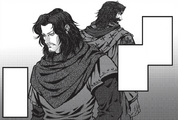 A young Alfred and his brother Æthelred
 -
 Alfred drawing a bow


Appearances
- Echoes of History (voice only)
- Assassin's Creed: Valhalla (first appearance)
- Assassin's Creed: Valhalla – Geirmund's Saga
- Assassin's Creed: Valhalla – Blood Brothers
- Discovery Tour: Viking Age
- Assassin's Creed: Where's the Assassin? (non-canon)
References
- ↑ 1.0 1.1 1.2 1.3
 Alfred the Great on Wikipedia
- ↑ 2.0 2.1 2.2 2.3 2.4 2.5 2.6 2.7 Assassin's Creed: Valhalla – Database: Aelfred
- ↑ Æthelstan of Kent
- ↑ Æthelbald, King of Wessex on Wikipedia
- ↑ Æthelberht, King of Wessex on Wikipedia
- ↑ 6.0 6.1 Assassin's Creed: Valhalla – Blood Brothers — The Dust Settles
- ↑ Assassin's Creed: Valhalla – Geirmund's Saga — Chapter 12
- ↑ Assassin's Creed: Valhalla – Geirmund's Saga — Chapter 16
- ↑ Assassin's Creed: Valhalla – Geirmund's Saga – Chapter 31
- ↑ Assassin's Creed: Valhalla – Geirmund's Saga – Chapter 16
- ↑ 11.0 11.1 11.2 Assassin's Creed: Valhalla – Geirmund's Saga — Chapter 17
- ↑ 12.0 12.1 12.2 12.3 12.4 12.5 12.6 Assassin's Creed: Valhalla – The Poor Fellow-Soldier
- ↑ Assassin's Creed: Valhalla – Breaking the Order
- ↑ 14.0 14.1 14.2 14.3 Assassin's Creed: Valhalla – The Sons of Ragnar
- ↑ Æthelswith on Wikipedia
- ↑ Assassin's Creed: Valhalla – The Walls of Templebrough
- ↑ Assassin's Creed: Valhalla – Heavy is the Head
- ↑ Assassin's Creed: Valhalla – Tilting the Balance
- ↑ Assassin's Creed: Valhalla – Walls and Shadows
- ↑ 20.0 20.1 Assassin's Creed: Valhalla – The Saga Stone
- ↑ Assassin's Creed: Valhalla – The Welcoming Party
- ↑ 22.0 22.1 Assassin's Creed: Valhalla – The Reeve of Wincestre
- ↑ Assassin's Creed: Valhalla – Impaling the Seax
- ↑ Assassin's Creed: Valhalla – Geirmund's Saga — Chapter 26
- ↑ 25.0 25.1 Assassin's Creed: Valhalla – Geirmund's Saga — Chapter 27
- ↑ Assassin's Creed: Valhalla – Geirmund's Saga — Chapter 28
- ↑ 27.0 27.1 27.2 27.3 27.4 Assassin's Creed: Valhalla – Holy Day
- ↑ Battle of Chippenham on Wikipedia
- ↑ 29.0 29.1 Battle of Cynwit on Wikipedia
- ↑ Assassin's Creed: Valhalla – Kingdom's End
- ↑ Assassin's Creed: Valhalla – Geirmund's Saga — Chapter 29
- ↑ Assassin's Creed: Valhalla – Geirmund's Saga — Chapter 30
- ↑ Assassin's Creed: Valhalla – Geirmund's Saga — Chapter 31
- ↑ 34.0 34.1 Assassin's Creed: Valhalla – The Last Chapter – Fare Thee Well, Aelfred Rex
- ↑ Discovery Tour: Viking Age – Learnings: Old English Literature
- ↑ Hussain, Tamoor (1 May 2020). Assassin's Creed Valhalla's Narrative Director On Crafting A Unique New Story. GameSpot. Archived from the original on 7 June 2020. Retrieved on 6 June 2020.
- ↑ Discovery Tour: Viking Age – Behind the scenes – Research: Long Live the King


| |||||||||||||||||||||||||||||||||||||||||||||||||||||||||
| |||||||||||||||||||||||||||||||
| |||||||||||||||||||||||||||||||
de:Ælfred von Westseaxe fr:Alfred le Grand it:Alfredo il Grande pl:Alfred Wielki pt-br:Alfredo, o Grande zh:阿尔弗雷德大帝
- Articles needing expansion
- Articles that need updating
- Articles needing images
- 849 births
- 899 deaths
- Individuals
- English people
- Authors
- Nobility
- Monarchs of Wessex
- Monarchs of England
- House of Wessex
- Order of the Ancients members
- Order of the Ancients leaders
- Grand Maegesters of the Order of the Ancients
- Templars
- Grand Masters
- British Templars