


Gaius Julius Caesar: Difference between revisions
imported>Gener4l Cl4ank4 mNo edit summary |
imported>Darman36 No edit summary |
||
| Line 2: | Line 2: | ||
{{Quote|In the end, it is impossible not to become what others believe you are.|Julius Caesar's final words, 44 BCE.|Assassin's Creed: Origins|Fall of an Empire, Rise of Another}} | {{Quote|In the end, it is impossible not to become what others believe you are.|Julius Caesar's final words, 44 BCE.|Assassin's Creed: Origins|Fall of an Empire, Rise of Another}} | ||
{{Character Infobox | {{Character Infobox | ||
|name = Julius Caesar | |name=Gaius Julius Caesar | ||
|native = | |native= | ||
|image = ACO DT Julius Caesar.PNG | |image=ACO DT Julius Caesar.PNG | ||
|birth = 13 July 100 BCE<br>[[Rome]], [[Roman Republic]] | |birth=13 July 100 BCE<br>[[Rome]], [[Roman Republic]] | ||
|death = 15 March 44 BCE {{c|aged 55}}<br>Rome, Roman Republic | |death=15 March 44 BCE {{c|aged 55}}<br>Rome, Roman Republic | ||
|species = [[Human]] | |species=[[Human]] | ||
|database = | |database= | ||
|affiliates = [[Roman Republic]] | |affiliates=[[Roman Republic]] | ||
*[[Roman army]]<br> | *[[Roman army]]<br> | ||
[[Order of the Ancients]] | [[Order of the Ancients]] | ||
}} | }} | ||
'''Gaius Julius Caesar''' (100 BCE – 44 BCE) was a prominent [[Rome|Roman]] statesman and general who expanded the territories of the [[Roman Republic]] across [[Europe]], before declaring himself {{Wiki|Roman dictator|dictator}} {{Wiki|Dictator perpetuo|for life}}. Today, Caesar is remembered as one of the greatest minds in history and is often credited with laying the foundation for the [[Roman Empire]]. | '''Gaius Julius Caesar''' (100 BCE – 44 BCE) was a prominent [[Rome|Roman]] statesman and general who expanded the territories of the [[Roman Republic]] across [[Europe]], before declaring himself {{Wiki|Roman dictator|dictator}} {{Wiki|Dictator perpetuo|for life}}. Today, Caesar is remembered as one of the greatest minds in history and is often credited with laying the foundation for the [[Roman Empire]]. In addition to his exploits as a Roman general and {{Wiki|Roman Senate|senator}}, Caesar secretly became affiliated with a cabal known as the [[Order of the Ancients]], an antecedent [[Templars|Order of the Knights Templar]], and near the end of his life, became the leader of the Order and began to spread its influence throughout the Republic. | ||
In addition to his exploits as a Roman general and senator, Caesar secretly became affiliated with a cabal known as the [[Order of the Ancients]], an antecedent [[Templars|Order of the Knights Templar]], and near the end of his life, became the leader of the Order and began to spread its influence throughout the Republic. | |||
==Biography== | ==Biography== | ||
| Line 26: | Line 24: | ||
{{Quote|Great lady. Your audacity is equaled only by your beauty. Flavius, please.|Caesar upon meeting Cleopatra, 48 BCE.|Assassin's Creed: Origins|Aya: Blade of the Goddess}} | {{Quote|Great lady. Your audacity is equaled only by your beauty. Flavius, please.|Caesar upon meeting Cleopatra, 48 BCE.|Assassin's Creed: Origins|Aya: Blade of the Goddess}} | ||
[[File:ACO Aya Blade of the Goddess 21.png|thumb|250px|left|Caesar being greeted by Cleopatra]] | [[File:ACO Aya Blade of the Goddess 21.png|thumb|250px|left|Caesar being greeted by Cleopatra]] | ||
Arriving in the city of [[Alexandria]], Caesar was greeted by [[Ptolemy XIII]], | Arriving in the city of [[Alexandria]], Caesar was greeted by [[Pharaoh]] [[Ptolemy XIII]], Cleopatra's younger brother and co-ruler of Egypt. Ptolemy presented Pompey's severed head to Caesar in hopes of gaining his favor to aid him against his older sister. Their meeting was interrupted by the arrival of Cleopatra and her followers. Cleopatra proved to be more successful than her brother in gaining favor, offering Caesar marriage, which he accepted.<ref name="Blade of the Goddess">''[[Assassin's Creed: Origins]]'' – [[Aya: Blade of the Goddess]]</ref> | ||
Caesar later became acquainted with [[Amunet|Aya]] and [[Bayek]], followers of Cleopatra who helped both him and the pharaoh to gain access to the [[Tomb of Alexander the Great]]. However, as retaliation for their alliance, Ptolemy [[Siege of Alexandria|besieged]] the city with his army. With Bayek's help, Caesar escaped the city and regrouped his army.<ref name="Blade of the Goddess" /> | |||
[[File:ACO The Battle of the Nile 21.png|thumb|250px|Caesar with Flavius during the Battle of the Nile]] | [[File:ACO The Battle of the Nile 21.png|thumb|250px|Caesar with Flavius during the Battle of the Nile]] | ||
Having | Having gathered his forces, Caesar, Aya, and Bayek confronted Ptolemy's army in the [[Nile Delta]], [[Battle of the Nile|defeating]] his forces. While Aya went to deal with Ptolemy, Bayek dealt with [[Pothinus]] and [[Lucius Septimius]], Ptolemy's regent and Pompey's killer, respectively. While Pothinus was killed, Septimius was spared by Caesar, much to Bayek's anger, as he also blamed Septimius for having killed his son [[Khemu]].<ref>''[[Assassin's Creed: Origins]]'' – [[The Battle of the Nile]]</ref> | ||
Having defeated Ptolemy | Having defeated Ptolemy, Caesar installed Cleopatra as Egypt's sole pharaoh with the Order of the Ancients's aid. These actions caused Aya and Bayek to relinquish their loyalty to them both and form the [[Assassins|Hidden Ones]] in hopes of protecting free will.<ref name="The Aftermath">''[[Assassin's Creed: Origins]]'' – [[The Aftermath]]</ref> Caesar moved his attention away from the {{Wiki|Roman Senate}} and scoffed at their concerns, instead placing his trust in foreign rulers and his own circle of Senators, while also adopting Cleopatra's lavish and self-centered lifestyle.<ref name="ACB">''[[Assassin's Creed: Brotherhood]]''</ref> Their relationship also led to the birth of [[Caesarion]], who was expected to become Caesar's heir.<ref name="ACO"/> | ||
===Death=== | ===Death=== | ||
| Line 44: | Line 41: | ||
==Legacy== | ==Legacy== | ||
{{Quote|Caesar built a strong order before he was stabbed in the back by your cowardly wife.|[[Gaius Julius Rufio]] berating Bayek's efforts, 38 BCE.|The Hidden Ones (DLC)}} | {{Quote|Caesar built a strong order before he was stabbed in the back by your cowardly wife.|[[Gaius Julius Rufio]] berating Bayek's efforts, 38 BCE.|The Hidden Ones (DLC)}} | ||
Despite | Despite Caesar's death, the Order of the Ancients rapidly grew in power, influence, conviction, and size due to Caesar's efforts. The civil war continued for another thirteen years, as the armies of Brutus and Longinus [[Liberators' civil war|clashed]] with those of [[Marcus Antonius]] and [[Augustus|Octavian]], Caesar's adopted son. Octavian eventually rose as the sole victor, naming himself Augustus and establishing the Roman Empire.{{Cite}} | ||
==Personality and traits== | ==Personality and traits== | ||
| Line 64: | Line 61: | ||
==Gallery== | ==Gallery== | ||
<gallery captionalign="center" position="center | <gallery captionalign="center" position="center" widths="180"> | ||
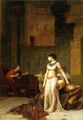
Cleopatra and Caesar by Jean-Leon-Gerome.jpg|''{{Wiki|Cleopatra and Caesar (painting)|Cleopatra and Caesar}}'', by {{Wiki|Jean-Léon Gérôme}} | Cleopatra and Caesar by Jean-Leon-Gerome.jpg|''{{Wiki|Cleopatra and Caesar (painting)|Cleopatra and Caesar}}'', by {{Wiki|Jean-Léon Gérôme}} | ||
DTAE Julius Caesar - Concept Art by Vincent Gaigneux.png|Concept art of Caesar | DTAE Julius Caesar - Concept Art by Vincent Gaigneux.png|Concept art of Caesar | ||
Revision as of 01:37, 22 June 2024
Gaius Julius Caesar (100 BCE – 44 BCE) was a prominent Roman statesman and general who expanded the territories of the Roman Republic across Europe, before declaring himself dictator for life. Today, Caesar is remembered as one of the greatest minds in history and is often credited with laying the foundation for the Roman Empire. In addition to his exploits as a Roman general and senator, Caesar secretly became affiliated with a cabal known as the Order of the Ancients, an antecedent Order of the Knights Templar, and near the end of his life, became the leader of the Order and began to spread its influence throughout the Republic.
Biography
Civil Wars
Around 59 BCE, Caesar founded the city of Florentia, later known as Florence.[1] He rose to prominence for his success in the Gallic Wars, in which he defeated the chieftain Vercingetorix and allowed the Roman Republic to annex Gaul.[2]
In 48 BCE, he and his forces entered Rome in the midst of civil war, and Caesar took power as the dictator of the Republic, while secretly being supported by the Order of the Ancients.[3] He then began a series of campaigns throughout Roman territories to secure his grasp. That same year, Caesar learned of Pompey's escape to Egypt to seek refuge with Cleopatra and pursued him across the Mediterranean Sea.[4]
Meeting Cleopatra

Arriving in the city of Alexandria, Caesar was greeted by Pharaoh Ptolemy XIII, Cleopatra's younger brother and co-ruler of Egypt. Ptolemy presented Pompey's severed head to Caesar in hopes of gaining his favor to aid him against his older sister. Their meeting was interrupted by the arrival of Cleopatra and her followers. Cleopatra proved to be more successful than her brother in gaining favor, offering Caesar marriage, which he accepted.[5]
Caesar later became acquainted with Aya and Bayek, followers of Cleopatra who helped both him and the pharaoh to gain access to the Tomb of Alexander the Great. However, as retaliation for their alliance, Ptolemy besieged the city with his army. With Bayek's help, Caesar escaped the city and regrouped his army.[5]

Having gathered his forces, Caesar, Aya, and Bayek confronted Ptolemy's army in the Nile Delta, defeating his forces. While Aya went to deal with Ptolemy, Bayek dealt with Pothinus and Lucius Septimius, Ptolemy's regent and Pompey's killer, respectively. While Pothinus was killed, Septimius was spared by Caesar, much to Bayek's anger, as he also blamed Septimius for having killed his son Khemu.[6]
Having defeated Ptolemy, Caesar installed Cleopatra as Egypt's sole pharaoh with the Order of the Ancients's aid. These actions caused Aya and Bayek to relinquish their loyalty to them both and form the Hidden Ones in hopes of protecting free will.[7] Caesar moved his attention away from the Roman Senate and scoffed at their concerns, instead placing his trust in foreign rulers and his own circle of Senators, while also adopting Cleopatra's lavish and self-centered lifestyle.[8] Their relationship also led to the birth of Caesarion, who was expected to become Caesar's heir.[4]
Death

Over the course the civil war, most of Caesar's opposition had been crushed and defeated, allowing him to be dictator and assume sole authority. His actions caught the attention of the Hidden Ones, who recruited Marcus Junius Brutus and Gaius Cassius Longinus into the organization. Brutus and Cassius in turn recruited the senators and began plotting to assassinate Caesar.[4][8]
On 15 March 44 BCE, Caesar appeared at a session of the Senate in the Theatre of Pompey, where he was accompanied by Septimius. While Aya dealt with Septimius, Brutus and Cassius went on to the meeting to set the plan in motion. Aya managed to defeat Septimius and made her way to the meeting, stabbing Caesar in his back. The rest of the senators followed by stabbing him twenty-three times, killing him.[9]
Legacy
- "Caesar built a strong order before he was stabbed in the back by your cowardly wife."
- ―Gaius Julius Rufio berating Bayek's efforts, 38 BCE.[src]
Despite Caesar's death, the Order of the Ancients rapidly grew in power, influence, conviction, and size due to Caesar's efforts. The civil war continued for another thirteen years, as the armies of Brutus and Longinus clashed with those of Marcus Antonius and Octavian, Caesar's adopted son. Octavian eventually rose as the sole victor, naming himself Augustus and establishing the Roman Empire. [citation needed]
Personality and traits
- "Caesar moves away from the Senate, placing his trust in foreign rulers, adopting the ego and pomp of his Egyptian whore. [...] [He] refuses to rise when he addresses us and scoffs at our concerns. He has created his own private senate, filled with deceivers, manipulators, people who have no business in Roman affairs."
- ―Marcus Junius Brutus.[src]
Caesar was a figure who often displayed an arrogant and headstrong exterior, clamoring for greatness and glory in battle. Caesar had a great degree of self-importance, as he greatly disliked the poet Catullus for irreverently disregarding him in his works as well as likening himself to a deity at the end of his life because of his popularity among the Roman people. Befitting his pride, Caesar had a level of insecurity with his tenure due to greatly admiring the legendary Alexander the Great and wanting to have a level of successful legacy equal to his idol but lamenting having not been as reputable in his five decades of life. His pride convinced him to wed Cleopatra simply because he wanted his legacy to be greater than his idol. [citation needed]
Caesar was also a man of great patriotism, as seen when he stopped Bayek of Siwa from killing Septimius because he was a Roman and wanted Septimius to be charged under Roman laws. He gladly accepted his status as "dictator for life" that he felt was entrusted to him by the people of Rome and tried to unite the republic of Rome into an empire with himself as the ruling head. He also greatly valued those he considered friends as he lamented Pompey's death and subsequent presentation of decapitation by Ptolemy XIII because they were once friends despite viewing Pompey's death as necessary for his goals. [citation needed]
However, beneath his prideful and patriotic exterior was a ruthless and determined politician and martial strategist willing to manipulate others to remove threats to his reputation. He was willing to ally with the Order of Ancients to secure his authority in Rome and allow his then ally Septimius to kill any opponents in the Senate that threatened his path to full control. Caesar also had a spiteful view of women, viewing them as inferior and initially disliked how Bayek of Siwa had entrusted his wife to fulfill a crucial part of his plan against Ptolemy. He developed a grudging respect for Aya's skill as a warrior but otherwise thought little of her. [citation needed]
Trivia
- There is an unlockable trophy for the PlayStation 3 version of the game named after Julius Caesar. It is earned by acquiring all other trophies, fifty in total.[8]
- The popular Caesar cipher code format is widely attributed to have been designed by Caesar, hence its name. The code has often been used in the Assassin's Creed series, most commonly in secret messages left behind by Clay Kaczmarek.
Behind the scenes
Gaius Julius Caesar is a historical character in Assassin's Creed: Origins, in which he is voiced by Scottish actor Michael Nardone,
Historically, the person who initiated Caesar's assassination was a senator named Servilius Casca, whom at first, Caesar managed to block his move and questioned his motive for trying to kill him. Casca called for help from his fellow senators, including Brutus and Cassius, upon which those who opposed Caesar joined him in killing the dictator. Additionally, a story persists that Caesar's third wife Calpurnia tried to prevent him from going to a meeting when an oracle reputedly told her that he would die that same day, which he rebuked.
Gallery
-
-
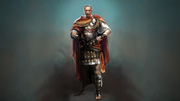 Concept art of Caesar
 -
 Concept art of Caesar in Alexandria
 -
 Concept art of Caesar meeting Cleopatra
 -
 Head model of Caesar
 -
 Promotional art of Caesar in Origins
 -
 Render of Caesar
 -
 Caesar and Lucius Septimius
 -
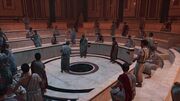 Caesar and the Senate
 -
 The assassination of Julius Caesar
 -
 Brutus betraying Caesar
 -
 Brutus and Caesar
 -
 Caesar's body laying on the ground
 -
 Aya and Caesar
 -
 Aya laying Caesar to rest


Appearances
- Assassin's Creed: Project Legacy (first mentioned)
- Assassin's Creed: Brotherhood (mentioned only)
- Assassin's Creed: Origins (first appearance)
- The Hidden Ones (mentioned only)
- Assassin's Creed: Origins comic
- Assassin's Creed: Where's the Assassin? (non-canonical appearance)
- Echoes of History (mentioned only)
References
- ↑ Assassin's Creed II – Database: Firenze
- ↑ Assassin's Creed: Project Legacy – Mnemonic sets
- ↑ Assassin's Creed Encyclopedia
- ↑ 4.0 4.1 4.2 Assassin's Creed: Origins
- ↑ 5.0 5.1 Assassin's Creed: Origins – Aya: Blade of the Goddess
- ↑ Assassin's Creed: Origins – The Battle of the Nile
- ↑ Assassin's Creed: Origins – The Aftermath
- ↑ 8.0 8.1 8.2 Assassin's Creed: Brotherhood
- ↑ Assassin's Creed: Origins – Fall of an Empire, Rise of Another


| ||||||||||||||||||||||||||||||||||
| ||||||||||||||||||||||||||||||||||||||||
| |||||||||||||||||||||||||
de:Gaius Julius Caesar
es:Julio César
fr:Jules César
it:Gaio Giulio Cesare
pt-br:Caio Júlio César
ru:Гай Юлий Цезарь
zh:盖乌斯·尤利乌斯·凯撒