


Odin

|
Patience, brothers. Soon we will reveal the secrets of Assassin's Creed: Valhalla. This article has been identified as being out of date. Please update the article to reflect recent releases and then remove this template once done. |

|
Where are the paintings? This article is in need of more images and/or better quality pictures from official media in order to achieve a higher status. You can help the Assassin's Creed Wiki by uploading better images on this page. |
Odin, also called the All-Father by worshippers and Havi by the Æsir, was an Isu who became a widely revered god in both Norse and Germanic mythology.
The leader of a group of Scandinavian Isu called the Æsir, he was known in Norse mythology as the king of all gods, associated with wisdom, healing, death, knowledge, and war. Along with being the original owner of the spear Gungnir, he was also the father of Heimdall, Baldr, and Thor, the warrior god of lightning and thunder.
Names
Odin, also referred to as Havi in Old Norse, meaning "High One", has numerous appellations.[1] Pagan Anglo-Saxons and Gaels referred to him as Woden or Wodin in Old English and Old Gaelic, respectively,[2] while the ancient Fomorian being called Balor knew him as Fjölnir.[3] Among his other epithets he is called The Hanged-God, Shield-Shaker, Graybeard, the Mad One, and Wanderer.[4] Andhrímnir referred to him as Lore-Keeper.[5]
Biography
Early Life
Odin was the son of Borr and the jötunn Bestla, and with the help of his brothers Vili and Vé, the killed the proto-being Ymir and gained control over Asgard.[6] At a later date, Odin became the single leader of the Æsir, a group of Asgardian Isu towards the end of the First Civilization. He was married to the Vanir Freyja but, while the pair developed a great respect for each other, their union was largely a political move.[7]
Protecting Asgard
At some time before the Great Catastrophe, Odin was warned by the Nornir that the calculations predicted that Fenrir, was to be the death of him at the onset of the cataclysm. Suddenly, the Greco-Roman Isu (with whom the Asgardian Isu were in war) breached through the walls of Asgard. Odin fought against them with his fellow Isu and closed the city's walls. There, he found Loki and the Builder, an Isu craftsman who said that he could help him protect Asgard, with the help of the mind methods of the Greco-Roman Isu. Distrustful with the Builder's presence and sense of oportunity but determined to protect his people from "Ragnarök" , Odin agreed to let him run a demonstration and sought to fetch the tools that he needed in the Well of Urdr. [1]
Odin reached the entrance of the Well and, while directing some beam lights to proceed, started to explore its depths, encountering many suspicious letters along the way. When he reached the bottom of the tunnel, he encountered Týr, sent by Loki. He told him that they shouldn't trust in the stranger's words. After unlocking the door to the main chamber of the Well, Odin dove in the pool and, for his surprise, Odin discovered a young Fenrir hidden in the chamber. He tried immediately to kill him, but was quickly stopped by his counselor. Týr insisted with him that they couldn't kill in the sacred well, after which Odin answered that he was determined to survive to his doom and nothing would stop him. [8]
Týr locked up the child, at his request, and Odin exited the Well, encountering a concerned Loki, strangely worried with the fate of the boy. He ended up indicating the location of the Builder and Odin, now with the necessary tools, head to meet with him.[8] He found him and, then, the stranger proceeded to a pillar and the technology formed a shield around the circling area. Although it temporarily failed, it proved efficient while keeping the Isu enemies out of reach. Odin found this very promising and asked him to make a shield to protect all of Asgard. But the Builder swiftly said that he would only do it if married Freyja, Odin's wife. He immediately disagreed but that shield was their strongest hope against the Catastrophe and their enemies so, he headed to Freyja with the Builder's conditions.[9]
Odin encountered the other Isu in a platform, surrounded by humans, next to the encaged Fenrir, now a teenager. Odin asked himself how he had grown so fast
Afterwards, Odin met with Aletheia and Juno, the Mother of Wisdom among the Capitoline Triad, who revealed to him that she, Jupiter, and Minerva were working on the supercomputer Yggdrasil as a seventh method of salvation to avoid the cataclysm, similar to an earlier attempt where their species' DNA would be uploaded into humanity's genome. However, Minerva was concerned that it would human's genome, so she and Jupiter and Minerva abandoned the method. Odin then began searching for a way to resurrect his son.[10]
Odin had him imprisoned for life.[11]
Outraged at the treatment of his child, Loki secretly murdered Odin's son Baldr by poisoning his food with mistletoe berries. Odin stood over his son and grieved while Loki watched from afar. After learning who was responsible, Odin ordered Loki be apprehended to answer for his crimes.[10]

At some point in his life, Odin met and fought Balor, though the old god was not killed in the ensuing battle.[3]
When the Great Catastrophe came, Odin summoned his trusted eight to his secret chamber and uploaded themselves. He stated that none could follow them, especially Loki. He broke his mask and led the eight to face their end. Millennia later, Odin was reincarnated as the Viking shieldmaiden Eivor Varinsdottir of the Raven Clan.[10]
Odin had him imprisoned for life.[11]
Mythology
According to the mythology, Odin was accompanied by the ravens Huginn and Muninn, who kept him informed of the goings-on in the worlds.[12]
Odin was also in charge of the sword-maidens, who were thought to visit battlefields.[13]
At some point, Odin disguised himself as a beggar and plunged a sword into a tree called Barnstokkr, stating that whoever was able to pull it free would receive it as a gift. Only the warrior Sigmund proved able to do so, and subsequently claimed the Sword as his own.[14]
It is said that Odin was killed or will be killed by Loki's son, Fenrir, the giant wolf during the final battle of Ragnarök.[15]
Legacy and influence
During the 9th century, the Vikings made offerings and sacrifices to Odin and prayed for strength in battle.[12] A statue of him was a key feature of Viking settlements.[16]
Odin had a totem named after him in the popular dice game Orlog, played in the 9th century. The piece "Odin's Sacrifice" would allow players to sacrifice a number of health tokens in order to gain more God Favor. An Anglo-Saxon man in Crawleah, Suthsexe possessed the piece, which he gave to Eivor after being defeated.[17]
Gallery
-
 Concept art of Odin
 -
 Alternative image of Odin in the database
 -
 Odin and other Isu leaving the Yggdrasil chamber to meet their fate
 -
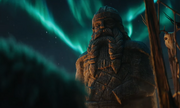 Statue of Odin
 -
 An engraving of Odin revealing the sword to Sigmund
 -
 Odin's Sacrifice piece for Orlog
 -
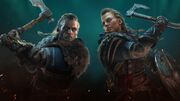 Eivor Varinsdottir, the reincarnation of Odin and the Animus render of Odin's DNA conflicting with Eivor's (From right to left)


Appearances
- Assassin's Creed II (appears in Glyphs only)
- Assassin's Creed: Last Descendants – Fate of the Gods (mentioned only)
- Assassin's Creed: Valhalla (first appearance)
- Wrath of the Druids (mentioned only)
- Assassin's Creed: Rebellion – The Ravens' Wound (appears as statue only)
- Discovery Tour: Viking Age
References
- ↑ 1.0 1.1 Assassin's Creed: Valhalla – View Above All
- ↑ Assassin's Creed: Valhalla – Breaking the Order
- ↑ 3.0 3.1 Assassin's Creed: Valhalla – Wrath of the Druids – Amber Sun
- ↑ Assassin's Creed: Valhalla – Database: Odin
- ↑ Assassin's Creed: Valhalla – Food of the Gods
- ↑ Assassin's Creed: Valhalla – Floating conversations: Cairns
- ↑ Assassin's Creed: Valhalla – Database: Freyja
- ↑ 8.0 8.1 Assassin's Creed: Valhalla - Well-Traveled
- ↑ Assassin's Creed: Valhalla - Defensive Measures
- ↑ 10.0 10.1 10.2 Assassin's Creed: Valhalla - Animus Anomalies
- ↑ 11.0 11.1 Assassin's Creed: Valhalla – Binding Fate
- ↑ 12.0 12.1
 Assassin's Creed Valhalla: Developer Commentary Trailer | Ubisoft [NA] on the Ubisoft North America YouTube channel
- ↑ Assassin's Creed: Valhalla – A Fury from the Sea
- ↑ Assassin's Creed II – Glyph #5: "Instruments of Power"
- ↑ Assassin's Creed: Last Descendants – Fate of the Gods – Chapter 12
- ↑ Assassin’s Creed Valhalla: Cinematic World Premiere Trailer on the Ubisoft YouTube channel
- ↑ Assassin's Creed: Valhalla

| |||||||||||||||||||||||||||||||||||||||||||||||||||||||||