

Storming of the Bastille: Difference between revisions
imported>Lacrossedeamon No edit summary |
imported>Gener4l Cl4ank4 No edit summary |
||
| Line 10: | Line 10: | ||
|date = 14 July 1789 | |date = 14 July 1789 | ||
|end = 14 July 1789 | |end = 14 July 1789 | ||
|place = [[Paris]], [[France]] | |place = [[Paris]], [[France]] | ||
|result = *Bastille captured | |result = *Bastille captured | ||
*Beginning of the revolution | |||
|side1 = *[[National Guard (France)|Parisian militia]] | |side1 = *[[National Guard (France)|Parisian militia]] | ||
*Gardes Françaises | *Gardes Françaises | ||
|side2 = *[[File:Kingdom of France Flag.svg|20px|border]] French government | |side2 = *[[File:Kingdom of France Flag.svg|20px|border]] French government | ||
|commanders1 = *{{Wiki|Pierre-Augustin Hulin}} | |commanders1 = *{{Wiki|Pierre-Augustin Hulin}} | ||
|commanders2 = *[[Bernard-René de Launay]] †}} | |commanders2 = *[[Bernard-René de Launay]] † | ||
}} | |||
The '''Storming of the Bastille''' was an event that occurred on 14 July 1789, during which angry [[Paris]]ian [[Civilian|citizens]] stormed and captured the infamous [[Bastille]] prison, a symbol of monarchist oppression in [[France]]. | The '''Storming of the Bastille''' was an event that occurred on 14 July 1789, during which angry [[Paris]]ian [[Civilian|citizens]] stormed and captured the infamous [[Bastille]] prison, a symbol of monarchist oppression in [[France]]. | ||
Although the prison was thought to be filled with political prisoners, only seven inmates were held at the time of the storming. Two of them were [[Pierre Bellec]], a member of the [[French Assassins|French Brotherhood]] of [[Assassins]], and [[Arno Dorian]], the son of the late Assassin, [[Charles Dorian]]. After the two met in the Bastille, Bellec began training Arno in combat.<ref name=" | Although the prison was thought to be filled with political prisoners, only seven inmates were held at the time of the storming. Two of them were [[Pierre Bellec]], a member of the [[French Assassins|French Brotherhood]] of [[Assassins]], and [[Arno Dorian]], the son of the late Assassin, [[Charles Dorian]]. After the two met in the Bastille, Bellec began training Arno in combat.<ref name="Imprisoned">''[[Assassin's Creed: Unity]]'' – [[Imprisoned]]</ref> | ||
Two months later, a delegation of the [[National Assembly]] was invited to the Bastille to discuss terms with the governor. However, the protesters outside had become restless and managed to cut the chains holding the raised drawbridge. The fortress was attacked by outraged Frenchmen joined by the [[Templars|Templar]] [[Élise de la Serre]] who was | Two months later, a delegation of the [[National Assembly]] was invited to the Bastille to discuss terms with the governor. However, the protesters outside had become restless and managed to cut the chains holding the raised drawbridge.<ref>''[[Assassin's Creed: Unity]]'' – [[Database: Storming of the Bastille]]</ref> The fortress was attacked by outraged Frenchmen joined by the [[Templars|Templar]] [[Élise de la Serre]], who was searching for Arno. The general of the Bastille, [[Bernard-René de Launay|de Launay]], was killed by the mob; his head was hanged on a pike, which served as the start of the [[French Revolution]].<ref>[[Assassin's Creed: Unity (novel)|''Assassin's Creed: Unity'' novel]]</ref> During the havoc, Arno and Bellec used the opportunity to make their escape. The novelist [[Donatien Alphonse François, Marquis de Sade]] was also a prisoner, but had been transferred shortly before the building fell to the mob.<ref name="Imprisoned"/> | ||
After the attack, the Bastille was used as a powerful propaganda tool during the French Revolution, symbolizing the might and willpower of the people. In the following months, and after much debate on what to do with the former prison, the [[Honoré Gabriel Riqueti, comte de Mirabeau|comte de Mirabeau]] settled the matter by destroying the first brick. By November, almost the entire structure had been demolished. The date of the storming, 14 July, was commemorated the following year as ''Le quatorze juillet'', or French National Day, known around the [[Earth|world]] as Bastille Day.<ref | After the attack, the Bastille was used as a powerful propaganda tool during the French Revolution, symbolizing the might and willpower of the people. In the following months, and after much debate on what to do with the former prison, the [[Honoré Gabriel Riqueti, comte de Mirabeau|comte de Mirabeau]] settled the matter by destroying the first brick. By November, almost the entire structure had been demolished. The date of the storming, 14 July, was commemorated the following year as ''Le quatorze juillet'', or French National Day, known around the [[Earth|world]] as Bastille Day.<ref>{{WP|Storming of the Bastille}}</ref> | ||
==Gallery== | ==Gallery== | ||
<gallery captionalign="center" position="center | <gallery captionalign="center" position="center" widths="180"> | ||
ACU Storming of the Bastille - Concept Art.jpg|Concept art of revolutionaries on the streets | ACU Storming of the Bastille - Concept Art.jpg|Concept art of revolutionaries on the streets | ||
ACU - Storming of the Bastille concept 2.jpg|Concept art of a crowd gathering to storm the fort | ACU - Storming of the Bastille concept 2.jpg|Concept art of a crowd gathering to storm the fort | ||
ACU Civilian Casualties - Concept Art.jpg|Concept art of civilians storming the fortress walls | ACU Civilian Casualties - Concept Art.jpg|Concept art of civilians storming the fortress walls | ||
AC Unity - Concept Art.jpg|The storming, as seen from Notre-Dame's rooftops | AC Unity - Concept Art.jpg|The storming, as seen from Notre-Dame's rooftops | ||
Imprisoned 10.png|Citizens rioting outside the Bastille | |||
</gallery> | </gallery> | ||
| Line 38: | Line 41: | ||
==Appearances== | ==Appearances== | ||
*''[[Assassin's Creed: Unity]]'' {{1st}} | *''[[Assassin's Creed: Unity]]'' {{1st}} | ||
*[[Assassin's Creed: Unity (novel)|''Assassin's Creed: Unity'' | *[[Assassin's Creed: Unity (novel)|''Assassin's Creed: Unity'' novel]] | ||
*''[[Assassin's Creed Unity: Abstergo Entertainment – Employee Handbook]]'' | *''[[Assassin's Creed Unity: Abstergo Entertainment – Employee Handbook]]'' | ||
*''[[Echoes of History]]'' {{Mo}} | *''[[Echoes of History]]'' {{Mo}} | ||
| Line 46: | Line 49: | ||
{{ACU}} | {{ACU}} | ||
{{Timeline}} | {{Timeline}} | ||
[[es:Asalto a la Bastilla]] | [[es:Asalto a la Bastilla]] | ||
[[ru:Взятие Бастилии]] | [[ru:Взятие Бастилии]] | ||
Revision as of 23:13, 31 July 2025

|
Patience, brothers. Soon we will reveal the secrets of Project Widow and Echoes of History. This article has been identified as being out of date. Please update the article to reflect recent releases and then remove this template once done. |
The Storming of the Bastille was an event that occurred on 14 July 1789, during which angry Parisian citizens stormed and captured the infamous Bastille prison, a symbol of monarchist oppression in France.
Although the prison was thought to be filled with political prisoners, only seven inmates were held at the time of the storming. Two of them were Pierre Bellec, a member of the French Brotherhood of Assassins, and Arno Dorian, the son of the late Assassin, Charles Dorian. After the two met in the Bastille, Bellec began training Arno in combat.[1]
Two months later, a delegation of the National Assembly was invited to the Bastille to discuss terms with the governor. However, the protesters outside had become restless and managed to cut the chains holding the raised drawbridge.[2] The fortress was attacked by outraged Frenchmen joined by the Templar Élise de la Serre, who was searching for Arno. The general of the Bastille, de Launay, was killed by the mob; his head was hanged on a pike, which served as the start of the French Revolution.[3] During the havoc, Arno and Bellec used the opportunity to make their escape. The novelist Donatien Alphonse François, Marquis de Sade was also a prisoner, but had been transferred shortly before the building fell to the mob.[1]
After the attack, the Bastille was used as a powerful propaganda tool during the French Revolution, symbolizing the might and willpower of the people. In the following months, and after much debate on what to do with the former prison, the comte de Mirabeau settled the matter by destroying the first brick. By November, almost the entire structure had been demolished. The date of the storming, 14 July, was commemorated the following year as Le quatorze juillet, or French National Day, known around the world as Bastille Day.[4]
Gallery
-
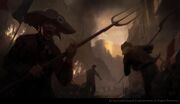 Concept art of revolutionaries on the streets
 -
 Concept art of a crowd gathering to storm the fort
 -
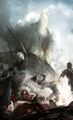 Concept art of civilians storming the fortress walls
 -
 The storming, as seen from Notre-Dame's rooftops
 -
 Citizens rioting outside the Bastille


Behind the scenes
Despite the fact that the prison was demolished by 1790, it remains intact throughout the storyline of Assassin's Creed: Unity, albeit heavily damaged.
Appearances
- Assassin's Creed: Unity (first appearance)
- Assassin's Creed: Unity novel
- Assassin's Creed Unity: Abstergo Entertainment – Employee Handbook
- Echoes of History (mentioned only)
References

| ||||||||||||||||||||||||||||||||||||||||||||||||||||||||||||||||||||||||||||||||||||||||||||||||
es:Asalto a la Bastilla ru:Взятие Бастилии fr:Prise de la Bastille