

Greece: Difference between revisions
imported>Jasca Ducato m Intro tweaks |
imported>Lady Kyashira No edit summary |
||
| Line 14: | Line 14: | ||
|date = 13th century BCE {{C|Ancient}}<br>338 BCE {{c|Hellenic League}}<br>25 March 1821 {{C|Ottoman Independence}}<br>11 June 1975 {{C|Current constitution}} | |date = 13th century BCE {{C|Ancient}}<br>338 BCE {{c|Hellenic League}}<br>25 March 1821 {{C|Ottoman Independence}}<br>11 June 1975 {{C|Current constitution}} | ||
|landmark = [[Akropolis Sanctuary|Acropolis of Athens]]<br>[[Parthenon]]<br>[[Temple of Zeus (Olympia)|Temple of Zeus]]}} | |landmark = [[Akropolis Sanctuary|Acropolis of Athens]]<br>[[Parthenon]]<br>[[Temple of Zeus (Olympia)|Temple of Zeus]]}} | ||
'''Greece''', historically known as '''Hellas''' or the '''Greek World''',<ref name="ACOD">'' | '''Greece''', officially the '''Hellenic Republic''' and historically known as '''Hellas''',<ref name="Packing for Greece">''[[Assassin's Creed: Odyssey]]'' – [[Packing for Greece]]</ref> or the '''Greek World''',<ref name="ACOD">''Assassin's Creed: Odyssey''</ref> is a civilization and country located in Southeastern [[Europe]] and is popularly regarded as the cradle of {{wiki|Western culture|Western civilization}}. | ||
Jutting out into the [[Mediterranean Sea]], Greece is a largely mountainous region consisting of several peninsula and numerous small island archipelagos in the adjacent [[Aegean Sea]]. | Jutting out into the [[Mediterranean Sea]], Greece is a largely mountainous region consisting of several peninsula and numerous small island archipelagos in the adjacent [[Aegean Sea]]. | ||
| Line 54: | Line 54: | ||
During the 1510s, the Assassins stored an Apple of Eden in one of their hideout in the country, which according to [[Giovanni Borgia]] was their most remote European spot. However, in 1516, one of their own, [[Hiram Stoddard]], assaulted the location in order to recover the artifact, but was prevented to do so by Borgia.<ref name="ACA">''[[Assassin's Creed (Titan Comics)|Assassin's Creed]]'' #12</ref> | During the 1510s, the Assassins stored an Apple of Eden in one of their hideout in the country, which according to [[Giovanni Borgia]] was their most remote European spot. However, in 1516, one of their own, [[Hiram Stoddard]], assaulted the location in order to recover the artifact, but was prevented to do so by Borgia.<ref name="ACA">''[[Assassin's Creed (Titan Comics)|Assassin's Creed]]'' #12</ref> | ||
==Modern times== | |||
In 1821, Greece revolted against the Ottomans, fighting an eight-year {{Wiki|Greek War of Independence|war}} which resulted in the Greeks declaring their independence.<ref name="Packing for Greece" /> | |||
In 1981, Greece joined the {{Wiki|European Communities}} which was later incorporated into the {{Wiki|European Union}}.<ref name="Packing for Greece" /> | |||
==Trivia== | ==Trivia== | ||
Revision as of 15:30, 27 March 2019
Greece, officially the Hellenic Republic and historically known as Hellas,[1] or the Greek World,[2] is a civilization and country located in Southeastern Europe and is popularly regarded as the cradle of Western civilization.
Jutting out into the Mediterranean Sea, Greece is a largely mountainous region consisting of several peninsula and numerous small island archipelagos in the adjacent Aegean Sea.
Throughout the second and first millennia BCE, Greece was divided into a myriad of city-states, or poleis, which vied for regional hegemony beginning with the Mycenaean civilization. Shortly after the sacking of Troy during the Trojan War–immortalized in the Iliad–the Mycenaean civilization collapsed.
These poleis would not rise to prominence again until the 5th century BCE when two in particular, Athens and Sparta, became leading powers of Greece in the aftermath of the Greco-Persian Wars. Left without a common enemy, their rivalry culminated in the Peloponnesian War in 431 BCE, lasting until Athens' defeat in 404 BCE.
During this time, Athens, often cited as the birth place of democracy, witnessed an explosion of intellectual and cultural arts that developed the foundations for modern Western medicine, philosophy, historiography, political science, sports, and literature. The poleis were finally united for the first time in 336 BCE following their conquest by Alexander III of Makedonia, who carved out a short-lived empire across the Western Asia, spreading Hellenic culture from the Roman Republic, to Egypt, all the way to the borders of India.
Owing to its historical significance, Athens is the capital and largest city of the Hellenic Republic, the current regime of Greece as a sovereign state.
History
Greek mythology included the tales of Perseus, Jason, and Herakles, whose stories were reflections of human contact with the Pieces of Eden.[3]
Archaic period
During the sixth century BCE, the famous scholar Pythagoras and his disciple Kyros of Zarax lived in Samos, a small island in Greece, where Pythagoras became a well respected man by discovering the Tetractys.[4]
A few years later, they moved to Croton, Italy, where Pythagoras founded his own academy to teach young scholars everything he knew. However, tension in Croton began to rise and Pythagoras and Kyros were forced to flee back to Greece after a few years.[4]
Many years later, they travelled through a Greek desert to find Hermes Trismegistus. They eventually located him and he awarded Pythagoras with his staff, beginning the Hermeticist traditions.[4]
Kyros then decided to travel to Arkadia, hoping to challenge its princess, Atalanta, to a race and be allowed to marry her. Before traveling to Arcadia, however, Kyros first ventured to the abandoned temple of Aphrodite, where he found an Apple of Eden. With the help of the ancient artifact, he was able to defeat Atalanta, earning her hand in marriage.[4]
Classical period
In the early 5th century BCE, the Achaemenid Empire under King Darius I, having conquered Anatolia, made various attempts to invade and conquer the Greek world. In response, numerous poleis including Athens and Sparta rallied the Greek states in a coalition against the Persian invasion.[2]
In early 431 BCE, war broke out between Sparta's Peloponnesian League, and Athens' Delian League. This conflict was known as the Peloponnesian War.[2]
Kassandra, a misthios and the granddaughter of the late Spartan King Leonidas, took part in the war as a mercenary. She later discovered a plot by the Cult of Kosmos to take control of Greece. She made it her mission to remove the Cult.[2]
Hellenistic period
Alexander the Great, who ruled an Empire spanning from Greece to Egypt and India, used a Staff of Eden given to him by the Templars.[5]
Renaissance
While Greece was under Ottoman rule during the Renaissance, the Byzantine Templars controlled Athens. They were rooted out by the Ottoman Assassins, sent by the Mentor Ezio Auditore da Firenze, who established Assassin Dens in the city and recovered Isu technology that was discovered beneath the Acropolis.[6]
Around this time, the Knights Hospitalier controlled the island of Rhodes. After they executed the Master Assassin Castor, Ezio sent the Assassins to burn a Hospitalier compound in revenge.[6]
During the 1510s, the Assassins stored an Apple of Eden in one of their hideout in the country, which according to Giovanni Borgia was their most remote European spot. However, in 1516, one of their own, Hiram Stoddard, assaulted the location in order to recover the artifact, but was prevented to do so by Borgia.[7]
Modern times
In 1821, Greece revolted against the Ottomans, fighting an eight-year war which resulted in the Greeks declaring their independence.[1]
In 1981, Greece joined the European Communities which was later incorporated into the European Union.[1]
Trivia
- Greek buildings and clothing in Project Legacy are inaccurately depicted as white, when in reality, the Greeks favored a myriad of bright colors.
Gallery
-
 Greek scholars gathered at Pythagoras's villa in Samos
 -
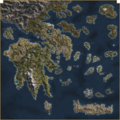 Map of Greece during the Peloponnesian War


Appearances
- Assassin's Creed: Project Legacy (first appearance)
- Assassin's Creed: Revelations (mentioned only)
- Assassin's Creed (mentioned only)
- Assassin's Creed: Origins (mentioned only)
- Assassin's Creed: Odyssey
References
- ↑ 1.0 1.1 1.2 Assassin's Creed: Odyssey – Packing for Greece
- ↑ 2.0 2.1 2.2 2.3 Assassin's Creed: Odyssey
- ↑ Assassin's Creed II – Glyphs
- ↑ 4.0 4.1 4.2 4.3 Assassin's Creed: Project Legacy – Divine Science: Chapter 2 – Kyros of Zarax
- ↑ Assassin's Creed Encyclopedia
- ↑ 6.0 6.1 Assassin's Creed: Revelations – Mediterranean Defense
- ↑ Assassin's Creed #12
| ||||||||||||||||||||||||||||||||||||||||||||||