

Excalibur: Difference between revisions
imported>Darman36 |
imported>Soranin m Heresy's epilogue only says, and I quote "Arthur would die disillusioned, betrayed by his wife, his best friend, and his son" no mention of a battle. Please add your sources or desist. |
||
| Line 28: | Line 28: | ||
Excalibur was created by Hephaestus, "the maker", during the [[Isu Era]] to bring about the end of the War of Unification.<ref name="ACS" /> At some point after; it was later taken to Britain in what would become [[England]].<ref name="ACV" /> | Excalibur was created by Hephaestus, "the maker", during the [[Isu Era]] to bring about the end of the War of Unification.<ref name="ACS" /> At some point after; it was later taken to Britain in what would become [[England]].<ref name="ACV" /> | ||
By the 5th or 6th century, the Sword had become lodged in a stone. During that time, it was later pulled out of the stone by the young [[Britons|Briton]] leader named [[Arthur Pendragon]] who, with backing from the [[British Rite of the Templar Order|local chapter]] of the [[Order of the Ancients]],<ref name="ACV"/> used the blade to rally his people as the newly crowned high king of Britain to fight in defense of their lands against the invading [[Anglo-Saxons]].<ref name="AC2" /> However, he was later betrayed years after, ultimately leading to his death | By the 5th or 6th century, the Sword had become lodged in a stone. During that time, it was later pulled out of the stone by the young [[Britons|Briton]] leader named [[Arthur Pendragon]] who, with backing from the [[British Rite of the Templar Order|local chapter]] of the [[Order of the Ancients]],<ref name="ACV"/> used the blade to rally his people as the newly crowned high king of Britain to fight in defense of their lands against the invading [[Anglo-Saxons]].<ref name="AC2" /> However, he was later betrayed years after, ultimately leading to his death.<ref name="ACH">''[[Assassin's Creed: Heresy]]'' – Epilogue</ref> The sword, which was then considered one of the thirteen [[Treasures of Britain|Treasures]] of [[United Kingdom|Britain]], was then hidden in an [[Isu Barracks|Isu vault]] beneath the [[Myrddin's Cave]] in [[Hampshire|Hamtunscire]] and locked in place, only to be released by returning 12 tablets scattered throughout England representing the other Treasures to the mechanism.<ref name="ACV" /> | ||
Nearly three hundred years later in the late-9th century, Excalibur was recovered and claimed by the [[Vikings|Viking]] [[shieldmaiden]] [[Eivor Varinsdottir]] of the [[Raven Clan]],<ref name="ACV" /> a Norse clan that relocated to [[England]] to escape the rule of a [[Unification of Norway|unified]] [[Norway]] under its first king, [[Harald Fairhair]].<ref>''Assassin's Creed: Valhalla'' – [[The Seas of Fate]]</ref> | Nearly three hundred years later in the late-9th century, Excalibur was recovered and claimed by the [[Vikings|Viking]] [[shieldmaiden]] [[Eivor Varinsdottir]] of the [[Raven Clan]],<ref name="ACV" /> a Norse clan that relocated to [[England]] to escape the rule of a [[Unification of Norway|unified]] [[Norway]] under its first king, [[Harald Fairhair]].<ref>''Assassin's Creed: Valhalla'' – [[The Seas of Fate]]</ref> | ||
Revision as of 03:53, 8 April 2021

|
Where are the paintings? This article is in need of more images and/or better quality pictures from official media in order to achieve a higher status. You can help the Assassin's Creed Wiki by uploading better images on this page. |
Excalibur, also known in Welsh as Caladfwlch, was one of the Swords of Eden, sword-like artifacts created by the Isu scientist Hephaestus to fight during the War of Unification. These Pieces of Eden granted their bearers great power and leadership, and were later used by influential humans in battle.
Owners
- Isu (? – ?)[1][2]
- Arthur Pendragon (fl. 5th – 6th centuries)[1]
- Eivor Varinsdottir (870s)[3]
History
Excalibur was created by Hephaestus, "the maker", during the Isu Era to bring about the end of the War of Unification.[2] At some point after; it was later taken to Britain in what would become England.[3]
By the 5th or 6th century, the Sword had become lodged in a stone. During that time, it was later pulled out of the stone by the young Briton leader named Arthur Pendragon who, with backing from the local chapter of the Order of the Ancients,[3] used the blade to rally his people as the newly crowned high king of Britain to fight in defense of their lands against the invading Anglo-Saxons.[1] However, he was later betrayed years after, ultimately leading to his death.[4] The sword, which was then considered one of the thirteen Treasures of Britain, was then hidden in an Isu vault beneath the Myrddin's Cave in Hamtunscire and locked in place, only to be released by returning 12 tablets scattered throughout England representing the other Treasures to the mechanism.[3]
Nearly three hundred years later in the late-9th century, Excalibur was recovered and claimed by the Viking shieldmaiden Eivor Varinsdottir of the Raven Clan,[3] a Norse clan that relocated to England to escape the rule of a unified Norway under its first king, Harald Fairhair.[5]
Weapon statistics
| Class | Rarity | Attack | Stun | Weight | Speed | Critical Precision | Availability |
|---|---|---|---|---|---|---|---|
| Bear | Mythical | 122 | 86 | 18 | 40 | 67 | Collect all Treasure of Britain tablets |
| Description | |||||||
| A legendary sword that can only be wielded by someone who has the makings of a king. Legends say it can break anything. | |||||||
Gallery
-
 Concept art
 -
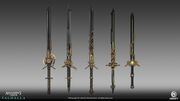 Concept art
 -
 Arthur draws the Sword from the Stone by Walter Crane
 -
 Excalibur in Valhalla's inventory menu
 -
 Eivor Varinsdottir before Excalibur


Appearances
- Assassin's Creed II (appears in Glyphs only)
- Assassin's Creed: Heresy (mentioned only)
- Assassin's Creed: Valhalla (first appearance)
References
- ↑ 1.0 1.1 1.2 Assassin's Creed II – Glyph 5: Instruments of Power
- ↑ 2.0 2.1 Assassin's Creed: Syndicate – Database: Reconstructed Data 003
- ↑ 3.0 3.1 3.2 3.3 3.4 Assassin's Creed: Valhalla
- ↑ Assassin's Creed: Heresy – Epilogue
- ↑ Assassin's Creed: Valhalla – The Seas of Fate

| |||||||||||||||||||||||||||||||||||||||||||||||||||||||||