


Shrouds of Eden

|
You cannot know anything. Only suspect. This article contains content from pre-release sources that may or may not be reflective of canon upon release. This article therefore likely contains spoilers. |

|
Patience, brothers. Soon we will reveal the secrets of The Fate of Atlantis: Judgment of Atlantis and Assassin's Creed: Fragments – The Witches of the Moors. This article has been identified as being out of date. Please update the article to reflect recent releases and then remove this template once done. |
The Shrouds of Eden are Pieces of Eden shaped like cloths capable of restoration and healing. The Shrouds are nanotech matter regenerators designed by the Isu Consus, who created the original in the year 1923 of the Isu Era to treat casualties of the War of Unification. His own consciousness was stored inside the original Shroud, resulting in his ability to possess the bodies of the artifact's users temporarily upon activation.[1]
The original Shroud was described as a white cloth stained with blood, which was usually kept in a simple wooden box. The shape of a seemingly tortured man was also burned onto its surface, positioned with arms to his sides and palms forward. However, Church records noted that the man's visage changed multiple times throughout history.
Powers and side effects[edit | edit source]
- "The voice does not seem hostile, despite its urgency. Perhaps it does only wish to heal, but I will not take a chance!"
- ―Mario Auditore, regarding the use of the Shroud.[src]
The original Shroud has been used to heal wounds of varying severity, mending injuries ranging from stab wounds to birth defects. It spoke in an almost kind voice that constantly offered healing, and urged its users to disregard their own physical frailty.[4][5]

When worn by the British Templars' Grand Master Crawford Starrick, a Shroud bestowed enhanced healing abilities; he was able to regenerate from wounds that would be considered instantaneously fatal. The Shroud also granted Starrick enhanced strength, as he was easily able to overpower the Frye twins and Jayadeep Mir and drain their energy. However, he lost these abilities as soon as he was physically separated from the artifact.[1]
Despite the rumors of their ability to do so, the Shrouds could not bring a deceased being back to life. However, they could reanimate bodies to a small degree for a short amount of time.[6]
The Shrouds were also known to cause severe hallucinations in those who had used them, and in extreme cases like that of Niccolò di Pitigliano, they could seemingly tear a person from the inside out.[5]
Giovanni Borgia in particular suffered lasting effects from the original Shroud. Though the artifact healed his defective body as a baby, throughout his childhood, he would have vivid dreams of the memories of others who had come into contact with the Shroud, such as his father and Marcus Junius Brutus.[7]

Additionally, Giovanni frequently spoke with a being no one else could see, an entity he called Consus. In his later life, Giovanni became known among the other Assassins as one who "spoke" with Pieces of Eden, and was particularly receptive to their presence. This led to him being sent on a mission to retrieve one such artifact in the New World.[8]
According to an analysis by Abstergo Industries, when a Shroud of Eden is wrapped around a body, it scans it for damage, then reconstructs it on a cellular level, enabling potential reconstruction of decomposed organisms.[1]
The Shrouds were identified as "nanotech matter regenerators" by Azaes in a simulation of Atlantis experienced by Kassandra on behalf of Aletheia.[9]
Known Shrouds of Eden[edit | edit source]
Original Shroud of Eden[edit | edit source]
- Main article: Shroud of Eden 1

Created by Consus, this Shroud also contained his consciousness, which communicated with those who were healed by the artifact. The first to recover the Shroud was the Isu Juno, who studied it for her own plans.[1]
In ancient Greece, the hero Jason was tasked to recover the Golden Fleece, which was, in fact, the original Shroud.[10] In 42 BCE, the Hidden Ones used the Shroud to try and save their brother Marcus Junius Brutus, who had committed suicide. Brutus opened his eyes and moved, but did not appear to breathe and eventually fell still in a seeming second death.[6]
By 1356, the Shroud was possessed by the Templar Geoffroy de Charny. The Italian Assassins stole the artifact and hid it for a century in Monteriggioni before it was relocated to Agnadello.[4] In 1498, the Assassin Perotto Calderon betrayed the Brotherhood and stole the Shroud, using it to save his malformed son.[11]
During the Battle of Agnadello in 1509, the condottiero Niccolò di Pitigliano stole the Shroud. A year later, the Assassin Francesco Vecellio mortally wounded Niccolò, who used the Shroud to heal himself. As he tried to use it against the Assassin, Niccolò was torn apart by the artifact, allowing Vecellio to recover the Shroud.[5]

During the 19th century, the Hermeticist William Robert Woodman came into contact with the Shroud and began to communicate with Consus.[1] By 1944, the Baguttiani family owned the Shroud. The Templar Keith Scipione purchased the artifact and brought it to Abstergo Industries, the Templars' front company.[6]
In 2011, Abstergo's Director of Research of the Future Technology division, Álvaro Gramática, began studying the Shroud. In 2013, Gramática became the Director of the Phoenix Project, an initiative to fully sequence an Isu genome. He used the Shroud in the project and communicated with Consus. In 2014, the Assassins attacked Gramática's lab in Paris, and Galina Voronina threw a grenade at the Templar. The explosion severly damaged the Shroud, and the artifact was destroyed after healing Gramática's injuries.[1]
Shroud of Eden #2[edit | edit source]
- Main article: Shroud of Eden 2
Circa 1723, the former pirate and British Assassin Edward Kenway recovered a Shroud of Eden in a cache and hid it in the Tower of London. In 1847, Queen Victoria's husband, the Prince Consort Albert, found the cache and had it relocated to a newly-built vault underneath Buckingham Palace.[1]

In 1868, Grand Master Crawford Starrick accessed the Shroud's vault and wore the artifact during his fight against the twin Assassins Jacob and Evie Frye, though the Assassins separated Starrick from the Shroud and killed him. The twins then locked the artifact in its cache, which remained in the vault.[1]
In 2015, the Templars Isabelle Ardant, Juhani Otso Berg, and Violet da Costa found the vault and took the cache but were confronted by the Assassins Shaun Hastings, Rebecca Crane, and Galina Voronina. Although Shaun assassinated Ardant, Violet retrieved the cache and brought it to Álvaro Gramática, who intended to use the artifact in the Phoenix Project as a replacement for the destroyed original Shroud.[1]
In 2018, the Instruments of the First Will forced Gramática to use the Shroud to create a new Isu body for Juno's consciousness to inhabit. The procedure was successful, but Juno was killed not long after by the Assassin Charlotte de la Cruz, while the Shroud was presumably destroyed when Berg blew up Gramática's laboratory in an attempt to wipe out the Instruments.[2]
Shroud of Eden copy[edit | edit source]
- Main article: Shroud of Eden copy

This imperfect Shroud was an attempt by Juno to replicate the original Shroud of Eden's properties. Unlike said artifact, it possessed only limited healing capabilities and retained fragments of both Consus' and Juno's consciousnesses. Wearing it for extended periods of time was considered dangerous due to the consciousnesses' ability to speak with and even possess the wearer.[3]
In 872, the Order of the Ancients found the Shroud in the Warwick Burh fortress on the River Avon, in the possession of a merchant family. The Order captain Aleksi retrieved the artifact and wore it for days, writing tirelessly and doing "calculations" while talking to the consciousnesses.[3]
Eventually, Aleksi was confronted by the Viking Eivor Varinsdottir and her allies, at which point Consus briefly possessed the Order captain to speak with Eivor before Juno took over his body and forced Aleksi to attack the group. Eivor and her allies defeated Aleksi and succeeded in recovering the Shroud.[3]
Other Shrouds[edit | edit source]
- Many biblical figures possessed a Shroud of Eden. Joseph, son of Jacob, received a Shroud from his father. David wore a Shroud during his fight against Goliath. Jesus of Nazareth had a Shroud of Eden, and the Order of the Ancients condemned him to recover it. It is unknown if it is the same Shroud or three different artifacts.[10]
- Circa 422 BCE, in a simulation of Atlantis, the misthios Kassandra saw an experimental replica of a Shroud.[9]
- In 870, the Hidden One Ammon was tasked with retrieving a Shroud of Eden from a merchant's palace in Bulgar. Due to the interference of the Viking Sigurd Styrbjornsson, Ammon failed his mission and was killed, with the Shroud remaining in the palace as soldiers from the Order of the Ancients approached.[12]
Trivia[edit | edit source]
- The Shroud was based on a real object known as the Shroud of Turin. It is kept in the royal chapel of the Cathedral of Saint John the Baptist in Turin, Italy.
- In the French version of Assassin's Creed II, the Shroud was referred to as Piece of Eden #36, not #66.
- In Assassin's Creed: Project Legacy, Erudito gave the user three memories of the Shroud as a "Christmas present".
- In Project Legacy, one of the Mnemonic sets from the Holiday pack is "Shroud of Turin," with the description "Greatest mystery, or clever hoax?" Its components are: Jesus of Nazareth, Jacques de Molay, Geoffroi de Charney, and Cesare Borgia.
- Interestingly, both Assassin's Creed: Syndicate (2015) and The Fate of Atlantis (2019), the three-part downloadable expansion for Assassin's Creed: Odyssey (2018), share the same texture files for the Shrouds.
Gallery[edit | edit source]
-
 A fully unfolded Shroud of Eden
 -
 An experimental Shroud replica seen in Atlantis' simulation
 -
 The unfolded Shroud replica
 -
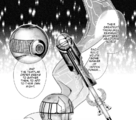 A Shroud alongside other Pieces of Eden
 -
 Ammon holding the Shroud he found in Bulgar
 -
 Stained glass depicting a Shroud
 -
 The Shroud of Eden in Assassin's Creed Roleplaying Game


Appearances[edit | edit source]
- Assassin's Creed II (Glyphs only)
- Assassin's Creed: Project Legacy (first appearance)
- Assassin's Creed: Syndicate
- Assassin's Creed: Uprising
- Assassin's Creed: Odyssey – The Fate of Atlantis: Judgment of Atlantis (simulation only)
- Assassin's Creed: Blade of Shao Jun (cameo)
- Assassin's Creed: Valhalla – Song of Glory
- Assassin's Creed: Fragments – The Witches of the Moors
- Assassin's Creed: Forgotten Temple (cameo)
- Assassin's Creed Roleplaying Game
References[edit | edit source]
- ↑ 1.00 1.01 1.02 1.03 1.04 1.05 1.06 1.07 1.08 1.09 Assassin's Creed: Syndicate
- ↑ 2.0 2.1 Assassin's Creed: Uprising
- ↑ 3.0 3.1 3.2 3.3 Assassin's Creed Roleplaying Game – Legacy of the Brotherhood – The Cursed Treasure
- ↑ 4.0 4.1 Assassin's Creed: Project Legacy – Italian Wars: Chapter 3 – Mario Auditore
- ↑ 5.0 5.1 5.2 Assassin's Creed: Project Legacy – Italian Wars: Chapter 2 – Francesco Vecellio
- ↑ 6.0 6.1 6.2 Assassin's Creed: Project Legacy – Holidays: Chapter 1 – Ghosts of Christmas Past
- ↑ Assassin's Creed: Project Legacy – Rome: Chapter 2 – Giovanni Borgia
- ↑ Assassin's Creed: Project Legacy – Rome: Chapter 4 – Giovanni Borgia
- ↑ 9.0 9.1 Assassin's Creed: Odyssey – The Fate of Atlantis: Judgment of Atlantis – The Atlantean Patient
- ↑ 10.0 10.1 Assassin's Creed II – Glyphs
- ↑ Assassin's Creed: Project Legacy – Italian Wars: Chapter 4 – Perotto Calderon
- ↑ Assassin's Creed: Valhalla – Song of Glory – Issue #3
