

Odin

|
He who increaseth knowledge, increaseth sorrow. This article contains spoilers, meaning it has information and facts concerning recent or upcoming releases from the Assassin's Creed series. If you do not want to know about these events, it is recommended to read on with caution, or not at all. |

|
Where are the paintings? This article is in need of more images and/or better quality pictures from official media in order to achieve a higher status. You can help the Assassin's Creed Wiki by uploading better images on this page. |

|
Ezio, my friend! How may I be of service? This article has a lot of room for expansion. Please improve it with additional information in accordance with the Manual of Style |
Odin, also called the All-Father, was a widely revered god in Germanic mythology. In Norse mythology, he was known as the king of all gods, associated with wisdom, healing, death, knowledge, and war.
Names
Odin is also referred to as Havi in Old Norse, meaning "High One".[1] The Anglo-Saxon pagans referred to him as Woden in Old English.
Mythology
According to the mythology, Odin was accompanied by the ravens Huginn and Muninn, who kept him informed of the goings-on in the worlds.[2]
Odin was also in charge of the sword-maidens, who were thought to visit battlefields.[3]
At some point, Odin disguised himself as a beggar and plunged a sword into a tree called Barnstokkr, stating that whoever was able to pull it free would receive it as a gift. Only the warrior Sigmund proved able to do so, and subsequently claimed the Sword as his own.[4]
It is said that Odin was killed by Loki's son, Fenrir, the giant wolf during the final battle of Ragnarök.[5]
Legacy
During the 9th century, the Vikings made offerings and sacrifices to Odin and prayed for strength in battle.[2] A statue of him was a key feature of Viking settlements.[6]
Gallery
-
 Concept art of Odin
 -
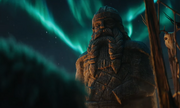 Statue of Odin
 -
 An engraving of Odin revealing the sword to Sigmund


Appearances
- Assassin's Creed II (appears in Glyphs only)
- Assassin's Creed: Last Descendants – Fate of the Gods (mentioned only)
- Assassin's Creed: Valhalla (first appearance)
References
- ↑ Assassin's Creed: Valhalla – View Above All
- ↑ 2.0 2.1
 Assassin's Creed Valhalla: Developer Commentary Trailer | Ubisoft [NA] on the Ubisoft North America YouTube channel
- ↑ Assassin's Creed: Valhalla – A Fury from the Sea
- ↑ Assassin's Creed II – Glyph #5: "Instruments of Power"
- ↑ Assassin's Creed: Last Descendants – Fate of the Gods – Chapter 12
- ↑ Assassin’s Creed Valhalla: Cinematic World Premiere Trailer on the Ubisoft YouTube channel

| |||||||||||||||||||||||||||||||||||||||||||||||||||||||||