


Agamemnon
In Greek mythology, Agamemnon was a legendary king of Mycenae and the brother of King Menelaus of Sparta. Together with his wife, queen Klytaimnestra, Agamemnon fathered Iphigenia and Orestes. Agamemnon was prominently featured in Homer's works; the Iliad and the Odyssey. The authors Euripides and Sophokles also wrote of him.
Biography
Mythology
In most Greek mythology traditions, Agamemnon was best known for being the commander of the united Greek forces during the Trojan War, a war fought against Troy after Menelaus' consort Helen was kidnapped by the Trojan prince Paris.[1]
Upon returning from the war, Agamemnon was killed by his wife's lover Aigisthos at his homecoming banquet.[1]
Simulation
In a simulation created by the Isu Aletheia, Agamemnon's soul resided in a vault connected to the Pit of Deprivation in the Chasm of Torment in Tartaros. He met the Spartan misthios Kassandra, who was sent by Hades to recruit him as a guardian of Tartaros. After being defeated by Kassandra, Agamemnon agreed and travelled to the Gate of the Unbowed to defend it.[2]
Legacy and influence
After his death, a tomb dedicated to him was built in Argolis, within the region regarded as his 'palace'.[1]
During the Classical period, Agamemnon was referred by the Cult of Kosmos as the first servant of Kosmos, the Cult's ideal of peace through order. Because of this the Worshippers of the Bloodline sought to resurrect him. However, when that failed the Sage of the Eyes of Kosmos branch, Nyx the Shadow, sought to remove all traces of Agamemnon and his lineage from the history books. This task was given especially to Midas, a Cultist active in Argolis.[3]
In addition, Agamemnon's own personal armor, which he allegedly wore during the Trojan War, was recovered by the Cult of Kosmos and split amongst the members of the Silver Vein branch. During the Peloponnesian War, the misthios Kassandra eliminated the Cultists and recovered the armor for herself.[4]
Trivia
- His name in Greek, Ἀγαμέμνων (Agamémnōn), means 'very steadfast', derived from ἀγα- (aga-, 'very') + μέμνων (mémnōn, 'steadfast').
- Throughout his appearance in The Fate of Atlantis: Torment of Hades, Agamemnon is always shown wearing his personal armor. His face is never shown.
Gallery
-
 A 5th century BCE mural featuring Agamemnon
 -
 Kassandra wearing Agamemnon's armor
 -
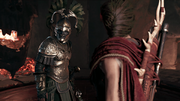 Agamemnon recruited by Kassandra
 -
 Agamemnon at the Gate of the Unbowed


Appearances
- Assassin's Creed: Odyssey (mentioned only)
- The Fate of Atlantis: Torment of Hades (simulation only)
References
- ↑ 1.0 1.1 1.2 Assassin's Creed: Odyssey
- ↑ Assassin's Creed: Odyssey – The Fate of Atlantis: Torment of Hades – The Underworld's Fallen Guardians
- ↑ Assassin's Creed: Odyssey – The Eyes of Kosmos
- ↑ Assassin's Creed: Odyssey – The Silver Vein


| ||||||||||||||||||||||||||||||||||||||||||||||