


Medjay

Medjay (mḏꜣ.j) was originally the name for a nomadic Nubian people and later the term for an elite Egyptian paramilitary police force that operated throughout the Old, Middle, and New Kingdom periods.
As desert scouts who protected the kingdom's subjects and areas that interested the pharaohs , at their peak, the Medjay were highly esteemed[1] and perceived as the very symbol of true honor, courage, and duty. For this reason, their badge was emblazoned with the Eye of Horus,[2] an emblem representing the protection of the Egyptian people.
History
The Medjay were originally established during the Old Kingdom of Egypt and were tasked with the protection of the pharaoh's people. As the pharaoh's trusted guard, they were considered the ultimate protector of the god-king incarnate and their subjects.[2] A Medjay's duties extended into their wards' afterlives, as they were also entrusted with protecting mummification temples such as the Wabet of Memphis.[3] Their ranks were hereditary at least in part, for Medjay would pass on their duties from one son to the next. This created lineages whose family tradition revolved around serving as Medjay.[4][5][6]
By the time of the Ptolemaic dynasty, however, the Medjay had faded away, with only three Medjay left by 70 BCE: Emsaf of Hebenou, Hemon of Djerty, and Sabu of Siwa. That year, the Order of the Ancients member Raia hired the mercenary Bion to exterminate the Medjay bloodlines. Because of the Medjay's long-established role as protectors of the people, the Ancients deemed them a threat to their goal of unifying and controlling Egypt through Hellenization and sought their deaths.[6]
After Bion had killed Emsaf and his family, Sabu met Hemon to warn him about the threat. Once Sabu left the city, Bion attacked and executed both Hemon and his son Sabestet. Unaware of this but determined to maintain the tradition even with so few members left, Sabu decided to train his son Bayek as a Medjay. Bayek would later pass his teachings onto his lover, Aya of Alexandria.[6]
In 56 BCE, Aya unintentionally led Bion to their training camp. Sabu pushed his son in a river before being killed by Bion, and Aya fled to Siwa. In the village, she was captured by Bion, who deduced that she bore Bayek's child. Bayek arrived in Siwa and killed Bion, who revealed in his last breath the name of his benefactor. In Alexandria, Bayek assassinated Raia, ending the threat on the Medjay. Bayek married Aya, who later gave birth to their son, Khemu.[6]
As the last Medjay, Bayek's duties largely revolved around him acting as a sheriff of sorts for Siwa. Aya also served as a Medjay. Despite their duties being largely taken over by the Phylakitai, Egyptians throughout the land still recognized the symbol of the Medjay, hailing Bayek as a "protector".[2]
In 48 BCE, Cleopatra appealed to Bayek's sense of duty by making him "Egypt's Medjay", granting him a golden badge to replace his original leather one.[7] Bayek eventually discarded upon the foundation of the Hidden Ones.[8]
Prayer of The Medjay
- "I am a Medjay. I am a feather in the eagle's wing... a living dagger, plunged from the sky into the heart of chaos. I am a truth unknown... a scabbard unfilled... a son of the Nile... and a defender of the people. You cannot kill me, for I walk among the dead. Come forth by day, and I will guide you home."
- ―Bayek reciting the Medjay's Prayer, 48 BCE.[src]-[m]
Like the Assassins, who evolved as a direct result of the Medjay teachings, the Medjay had their own guiding principles that dictated their way of life. Like the Creed of the Assassins, the Prayer of the Medjay was passed down orally; Bayek reminisced about it and his own childhood, while watching over a protective ritual performed by Taimhotep and her maidservant Mara for Taimhotep's unborn child, and how he should have taught it to his son before Khemu's untimely death.[9]
Members
Ptolemaic Egypt
- Bayek (until 47 BCE)
- Bayek's grandfather
- Emsaf
- Hemon
- Sabu
Gallery
-
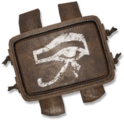 The simple Medjay Badge owned by Bayek and Hepzefa
 -
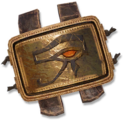 The ornate Medjay Badge given to Bayek by Cleopatra
 -
 The different badges on top of a map
 -
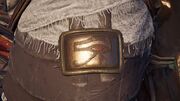 The badge worn by the Animus mod crew skin aboard the Adrestia


Behind the scenes
Assassin's Creed: Origins is centered on the journey of Bayek as Egypt's last Medjay before the Ptolemaic dynasty's collapse, which ultimately culminates in his founding of the Assassin Brotherhood. Historically, there is no attestation for the Medjay's continued existence past the Twentieth Dynasty (1189 – 1077 BCE),[10] making this anachronistic.
The in-game badge incorrectly portrays the Eye of Ra, a minor goddess that serves as an extension of Ra to defeat his enemies and the iconography of which was invoked to protect sacred areas, the pharaoh, and common folks at home,[11] despite the inventory flavor text calling it the Eye of Horus, a non-divine separate symbol associated with healing and protection through apotropaic magic. Both eyes' overlapping yet distinct dominions are often erroneously conflated.[12]
A crew skin named Medjays is available via the Helix Store for the ship Adrestia in Assassin's Creed: Odyssey.
Appearances
- Assassin's Creed: Origins – Desert Oath (first appearance)
- Assassin's Creed: Origins
- Assassin's Creed Roleplaying Game (mentioned only)
References
- ↑
 Medjay on Wikipedia
- ↑ 2.0 2.1 2.2 Assassin's Creed: Origins
- ↑ Assassin's Creed: Origins – Odor Most Foul
- ↑ Assassin's Creed: Origins – The False Oracle
- ↑ Assassin's Creed: Origins – Taimhotep's Song
- ↑ 6.0 6.1 6.2 6.3 Assassin's Creed: Origins – Desert Oath
- ↑ Assassin's Creed: Origins – Egypt's Medjay
- ↑ Assassin's Creed: Origins – Last of the Medjay
- ↑ Cite error: Invalid
<ref>tag; no text was provided for refs namedTaimhotem's Song - ↑ Wilkinson, Toby (2005). Dictionary of Ancient Egypt. Thames & Hudson.
- ↑ Eye of Ra on Wikipedia
- ↑ Eye of Horus on Wikipedia


| |||||||||||
| ||||||||||||||||||||||||||||||||||||||||