

Gold

Gold is a chemical element which takes the form of a soft, bright yellow metal. Throughout the history of human society, it has been highly valued for its beauty to the extent that it is an almost universal symbol of wealth, nobility, and luxury.
History[edit | edit source]
General[edit | edit source]
Gold has been used throughout human history not only to craft jewellery and mint coinage, but also in other arts.[1]
Ancient Greece[edit | edit source]
In 5th-century BCE Greece, the Athenian sculptor Phidias became famous for using chryselephantine, a combination of gold and ivory, to create exquisite statues, such as the Athena Parthenos, a statue of the goddess Athena within the Parthenon,[2] and the Statue of the god Zeus within the Temple of Zeus in the Sanctuary of Olympia, Elis.[1]
Crusades[edit | edit source]
In 1190, the Templar leader Basilisk and the Assassin Altaïr Ibn-La'Ahad both ventured into the Temple of Sand in a race for its fabled Chalice but found within it an empty shrine made of gold instead.[3]
The Knights Templar minted currency using various metals, including gold, for their own usage during the Crusades. Later, these coins were obtained by the Assassin Altaïr Ibn-La'Ahad from Templar guards, pirate, and duelists in Cyprus and Acre's harbor.[4]
Renaissance[edit | edit source]
During the Renaissance, the Basilica di San Marco of Venice was such a symbol of opulence and power that it was often referred to as the Chiesa d'Oro, the "Church of Gold".[5]

In 1486, the acting Doge of Venice, Marco Barbarigo, held an exclusive party during Carnevale, with a Golden Mask proving an honorary guest's right to enter it. Among the competitors for the mask was the Assassin Ezio Auditore da Firenze, as well as Dante Moro.[6][7][8] Due to foul play by Silvio Barbarigo, Dante won the mask,[9] but Ezio pickpocketed it soon after.[10]
In the 15th and 16th centuries, the Spanish Brotherhood of Assassins forged a number of weapons and armor with gold for use against the Spanish Templars.[11]
19th century[edit | edit source]
In 19th-century United States, gold was found in a mill owned by John Sutter, a discovery which resulted in the California Gold Rush.[12]
In 1868, Duleep Singh, the last Maharaja of the Sikh Empire, became aware of an East India Company operation to smuggle stolen Punjabi gold into London.[13] With the help of the British Assassins Jacob and Evie Frye, Singh recovered the gold and had it shipped back to India, in spite of the British Templars' efforts to stop them.[14][15]
Symbolism[edit | edit source]
Gold's relative rarity alongside its natural beauty cemented it as a prized metal for civilizations across the world and a symbol of elite status. As a result, the word gold has been used to connote prosperity; "Golden Age" is a metaphor used to refer to a peak era, such as the Golden Age of Piracy, a period of high pirate activity in the West Indies which became romanticized in later generations.[16][17]
Behind the scenes[edit | edit source]
Gold is used for crafting in several Assassin's Creed games.
Gallery[edit | edit source]
-
 Gold ingot
 -
 Bars of gold
 -
 A knife with a golden handle
 -
 A nautilus sculpture plated with gold
 -
 A piece of Aztec gold
 -
 An Aztec gold bar
 -
 A golden Aztec ring
 -
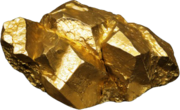 A gold ore from 16th century Japan


Appearances[edit | edit source]
 This list is incomplete. You can help the Assassin's Creed Wiki by expanding it. This list is incomplete. You can help the Assassin's Creed Wiki by expanding it.
|
|---|
- Assassin's Creed: Altaïr's Chronicles (first appearance)
- Assassin's Creed II
- Assassin's Creed: Project Legacy
- Assassin's Creed: Brahman (mentioned only)
- Assassin's Creed: Pirates
- Assassin's Creed: Syndicate
- Assassin's Creed Chronicles: India (mentioned in Database entry only)
- Assassin's Creed (Titan Comics)
- Assassin's Creed: Origins
- Assassin's Creed: Odyssey
- Assassin's Creed: Rebellion
- Assassin's Creed: Valhalla
- Discovery Tour: Viking Age
- Assassin's Creed: Brotherhood of Venice – Creed vs Crows (non-canon)
- Assassin's Creed: Mirage
- Assassin's Creed: Shadows
References[edit | edit source]
- ↑ 1.0 1.1 Assassin's Creed: Odyssey
- ↑ Assassin's Creed: Odyssey – Attika: "Parthenon"
- ↑ Assassin's Creed: Altaïr's Chronicles
- ↑ Assassin's Creed: Bloodlines
- ↑ Assassin's Creed: A Walk Through History (1189-1868) – Chapter 2: The Italian Renaissance – Venice
- ↑ Assassin's Creed II – And They're Off
- ↑ Assassin's Creed II – CTF
- ↑ Assassin's Creed II – Ribbon Round-Up
- ↑ Assassin's Creed II – Cheaters Never Prosper
- ↑ Assassin's Creed II – Having a Blast
- ↑ Assassin's Creed: Rebellion
- ↑ Assassin's Creed – Issue #01
- ↑ Assassin's Creed: Syndicate – The Last Maharaja – Stealing from the Poor
- ↑ Assassin's Creed: Syndicate – The Last Maharaja – A Golden Path
- ↑ Assassin's Creed: Syndicate – The Last Maharaja – A Good Send-Off
- ↑ Assassin's Creed IV: Black Flag
- ↑ Assassin's Creed: Rogue