

Wanted poster: Difference between revisions
imported>Lacrossedeamon No edit summary |
imported>Gener4l Cl4ank4 No edit summary |
||
| Line 1: | Line 1: | ||
{{Era|Culture}} {{WP-REAL}} | {{Era|Culture}} {{WP-REAL}} | ||
{{Update| | {{Update|''[[Assassin's Creed: Valhalla]]''}} | ||
{{Quote|I've seen posters all across the district. Tearing them down will help the city forget your face.|Paola to Ezio Auditore, | {{Quote|I've seen posters all across the district. Tearing them down will help the city forget your face.|Paola to Ezio Auditore, 1476.|Assassin's Creed II|Laying Low}} | ||
[[File:Wantedposterpazzi.jpg|thumb|A wanted poster of Ezio initiated by the Pazzi]] | [[File:Wantedposterpazzi.jpg|thumb|A wanted poster of Ezio Auditore initiated by the Pazzi]] | ||
'''Wanted posters''' | '''Wanted posters''' are printed signs containing information about a person whom the authorities wish to apprehend. They typically feature an image of the criminal in question, along with a set [[Economy|monetary]] reward that will be offered to any [[Civilian|citizen]] who assists in the criminal's capture. | ||
Over the centuries, numerous [[Assassins]] whose actions attracted the attention of the authorities have had wanted posters of them hanged around the cities in which they operated. These Assassins often had to tear down the posters in order to reduce their [[notoriety]] and facilitate their activities. | |||
==History== | ==History== | ||
In [[Baghdad]] during the | In [[Baghdad]] during the 860s, the [[Hidden Ones|Hidden One]] [[Basim Ibn Ishaq]] removed wanted posters of himself to reduce his notoriety to the [[Soldier|guards]] and public.<ref name="ACM">''[[Assassin's Creed: Mirage]]''</ref> | ||
In late 9th-century [[England]], the [[Cambridgeshire|Grantebridgescire]] [[reeve]] [[Othswith]] hanged a number of posters demanding the head of the criminal [[Egil the Fornicating Crow]], who was wanted under [[Danelaw]] and in the jurisdictions of both King [[Alfred the Great|Alfred]] of [[Wessex]] and [[Burgred of Mercia|Burgred]] of [[Mercia]] for a number of thefts and the murders of innocent [[Norse people|Norsefolk]].<ref name="Note">''[[Assassin's Creed: Valhalla]]'' – [[Viking Expansion notes#Grantebridge|Viking Expansion notes]]: "Dane Wanted for Murder"</ref> | |||
In 1476, [[Ezio Auditore da Firenze|Ezio Auditore]] first encountered wanted posters in [[Florence]] after his murder of [[Uberto Alberti]],<ref>''[[Assassin's Creed II]]'' – [[Judge, Jury, Executioner]]</ref> and tore them down on the instructions of the Assassin [[Paola]] in order to lose his notoriety. The posters prominently displayed the [[House of Pazzi|Pazzi]] family crest and promised a reward of 50,000 [[florin]]s to anyone who killed or captured the Assassin.<ref>''[[Assassin's Creed II]]'' – [[Laying Low]]</ref> As he traveled to other cities in [[Italy]] and [[Spain]] during the late 15th and early 16th centuries, Ezio encountered more posters that were hanged by the authorities once the Assassin had committed socially unacceptable actions, requiring him to tear them down as well.<ref name="AC2">''[[Assassin's Creed II]]''</ref><ref name="AC2:D">''[[Assassin's Creed II: Discovery]]''</ref><ref name="ACB">''[[Assassin's Creed: Brotherhood]]''</ref> | |||
In | In 1725, the [[Macau]] authorities hanged several wanted posters of the Assassin [[Edward Kenway]] around the city, after Edward was blamed for the murder of the [[Netherlands|Dutch]] navigator [[Hendrik]], as well as other incidents in the city.<ref name="ACFT">''[[Assassin's Creed: Forgotten Temple]]''</ref> | ||
In | In the mid-18th century, the Assassin [[Aveline de Grandpré]] found need to remove wanted posters bearing the image of her [[Slavery|slave]] persona, to decrease any negative focus of her in the public eye.<ref name="AC3:L">''[[Assassin's Creed III: Liberation]]''</ref> Around the same time, the Assassin [[Ratonhnhaké:ton]] also removed wanted posters to reduce his notoriety, or could bribe [[printers]] to stop producing them altogether.<ref name="AC3">''[[Assassin's Creed III]]''</ref> | ||
In | In 1918, the [[Bolsheviks]] hanged several wanted posters of the Assassin [[Nikolai Orelov]] in [[Kazan]], due to his involvement with Princess [[Anastasia Nikolaevna of Russia|Anastasia Romanova]], whom the Assassin had gone on the run with. While on his way to meet with his friend [[Leon Trotsky]] to secure passage to [[Moscow]], Nikolai tore down any posters he came across.<ref name="Chronicles">''[[Assassin's Creed Chronicles: Russia]]'' – [[A Friendly Hand]]</ref> | ||
==Trivia== | ==Trivia== | ||
*Many of the posters displayed in | *Many of the posters displayed in Florence, [[Venice]], [[Forlì]], and [[San Gimignano]] were placed in unusual places where [[Civilian|citizens]] could hardly see them, negating their intended purpose. However, the posters in [[Rome]] were often placed at ground level and in more crowded areas. | ||
*In [[New Orleans]] and the [[Louisiana Bayou]], just about all posters were posted on street level. | *In [[New Orleans]] and the [[Louisiana Bayou]], just about all posters were posted on street level. | ||
*''[[Assassin's Creed II: Discovery]]'' | *''[[Assassin's Creed II: Discovery]]'' included a feature to insert one's photos in place of Ezio's printed face. | ||
* | *In ''[[Assassin's Creed II]]'', the wanted posters continued to state that members of the Pazzi family would offer a reward even after all the [[Pazzi conspiracy|Pazzi conspirators]] had been killed by Ezio. | ||
*The posters in ''[[Assassin's Creed: Brotherhood]]'' remained the same as the ones in '' | *The posters in ''[[Assassin's Creed: Brotherhood]]'' remained the same as the ones in ''Assassin's Creed II'', though the symbol of the Pazzi family was replaced with that of the [[Borgia]]. | ||
*If a poster was located on the wall of a [[Borgia tower]], igniting the tower would not remove the poster or lower notoriety. | *If a poster was located on the wall of a [[Borgia tower]], igniting the tower would not remove the poster or lower notoriety. | ||
*Contrary to the notices issued for Ezio, the depicted image in Colonial American posters would update as Ratonhnhaké:ton grew older and became a full Assassin. | *Contrary to the notices issued for Ezio, the depicted image in Colonial American posters would update as Ratonhnhaké:ton grew older and became a full Assassin. | ||
*The message on the | *The message on the Italian wanted posters was erroneously translated, as ''"morti di vivo"'' translates to 'dead of alive', whereas the correct phrasing would be ''"vivo o morto"''. | ||
*Though the posters for Aveline de Grandpré could be seen as early as 1765, when Louisiana was still under French rule, they would be written in Spanish. | *Though the posters for Aveline de Grandpré could be seen as early as 1765, when Louisiana was still under French rule, they would be written in Spanish. | ||
| Line 41: | Line 45: | ||
==Appearances== | ==Appearances== | ||
*''[[Assassin's Creed II]]'' {{1st}} | *''[[Assassin's Creed II]]'' {{1st}} | ||
*''[[Assassin's Creed II: Discovery]]'' | |||
*''[[Assassin's Creed: Brotherhood]]'' | *''[[Assassin's Creed: Brotherhood]]'' | ||
*''[[Assassin's Creed III]]'' | *''[[Assassin's Creed III]]'' | ||
*''[[Assassin's Creed III: Liberation]]'' | *''[[Assassin's Creed III: Liberation]]'' | ||
*''[[Assassin's Creed IV Black Flag: Blackbeard – The Lost Journal]]'' | *''[[Assassin's Creed IV Black Flag: Blackbeard – The Lost Journal]]'' | ||
*''[[Assassin's Creed Chronicles: Russia]]'' | |||
*''[[Assassin's Creed: Forgotten Temple]]'' | *''[[Assassin's Creed: Forgotten Temple]]'' | ||
*''[[Assassin's Creed: Mirage]]'' | *''[[Assassin's Creed: Mirage]]'' | ||
Revision as of 01:21, 25 April 2024

|
Patience, brothers. Soon we will reveal the secrets of Assassin's Creed: Valhalla. This article has been identified as being out of date. Please update the article to reflect recent releases and then remove this template once done. |

Wanted posters are printed signs containing information about a person whom the authorities wish to apprehend. They typically feature an image of the criminal in question, along with a set monetary reward that will be offered to any citizen who assists in the criminal's capture.
Over the centuries, numerous Assassins whose actions attracted the attention of the authorities have had wanted posters of them hanged around the cities in which they operated. These Assassins often had to tear down the posters in order to reduce their notoriety and facilitate their activities.
History
In Baghdad during the 860s, the Hidden One Basim Ibn Ishaq removed wanted posters of himself to reduce his notoriety to the guards and public.[1]
In late 9th-century England, the Grantebridgescire reeve Othswith hanged a number of posters demanding the head of the criminal Egil the Fornicating Crow, who was wanted under Danelaw and in the jurisdictions of both King Alfred of Wessex and Burgred of Mercia for a number of thefts and the murders of innocent Norsefolk.[2]
In 1476, Ezio Auditore first encountered wanted posters in Florence after his murder of Uberto Alberti,[3] and tore them down on the instructions of the Assassin Paola in order to lose his notoriety. The posters prominently displayed the Pazzi family crest and promised a reward of 50,000 florins to anyone who killed or captured the Assassin.[4] As he traveled to other cities in Italy and Spain during the late 15th and early 16th centuries, Ezio encountered more posters that were hanged by the authorities once the Assassin had committed socially unacceptable actions, requiring him to tear them down as well.[5][6][7]
In 1725, the Macau authorities hanged several wanted posters of the Assassin Edward Kenway around the city, after Edward was blamed for the murder of the Dutch navigator Hendrik, as well as other incidents in the city.[8]
In the mid-18th century, the Assassin Aveline de Grandpré found need to remove wanted posters bearing the image of her slave persona, to decrease any negative focus of her in the public eye.[9] Around the same time, the Assassin Ratonhnhaké:ton also removed wanted posters to reduce his notoriety, or could bribe printers to stop producing them altogether.[10]
In 1918, the Bolsheviks hanged several wanted posters of the Assassin Nikolai Orelov in Kazan, due to his involvement with Princess Anastasia Romanova, whom the Assassin had gone on the run with. While on his way to meet with his friend Leon Trotsky to secure passage to Moscow, Nikolai tore down any posters he came across.[11]
Trivia
- Many of the posters displayed in Florence, Venice, Forlì, and San Gimignano were placed in unusual places where citizens could hardly see them, negating their intended purpose. However, the posters in Rome were often placed at ground level and in more crowded areas.
- In New Orleans and the Louisiana Bayou, just about all posters were posted on street level.
- Assassin's Creed II: Discovery included a feature to insert one's photos in place of Ezio's printed face.
- In Assassin's Creed II, the wanted posters continued to state that members of the Pazzi family would offer a reward even after all the Pazzi conspirators had been killed by Ezio.
- The posters in Assassin's Creed: Brotherhood remained the same as the ones in Assassin's Creed II, though the symbol of the Pazzi family was replaced with that of the Borgia.
- If a poster was located on the wall of a Borgia tower, igniting the tower would not remove the poster or lower notoriety.
- Contrary to the notices issued for Ezio, the depicted image in Colonial American posters would update as Ratonhnhaké:ton grew older and became a full Assassin.
- The message on the Italian wanted posters was erroneously translated, as "morti di vivo" translates to 'dead of alive', whereas the correct phrasing would be "vivo o morto".
- Though the posters for Aveline de Grandpré could be seen as early as 1765, when Louisiana was still under French rule, they would be written in Spanish.
Gallery
-
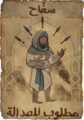 Basim's wanted poster in 9th century Baghdad
 -
 Basim near a wanted poster depicting his likeness
 -
 3D model of a Florentine official holding a wanted posted
 -
 Ezio's wanted poster in Spain
 -
 Ezio ripping away a wanted poster
 -
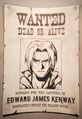 Edward's wanted poster in 18th century Macau
 -
 Aveline tearing away a wanted poster
 -
 Samuel Adams removing Connor's wanted poster


Appearances
- Assassin's Creed II (first appearance)
- Assassin's Creed II: Discovery
- Assassin's Creed: Brotherhood
- Assassin's Creed III
- Assassin's Creed III: Liberation
- Assassin's Creed IV Black Flag: Blackbeard – The Lost Journal
- Assassin's Creed Chronicles: Russia
- Assassin's Creed: Forgotten Temple
- Assassin's Creed: Mirage
References
- ↑ Assassin's Creed: Mirage
- ↑ Assassin's Creed: Valhalla – Viking Expansion notes: "Dane Wanted for Murder"
- ↑ Assassin's Creed II – Judge, Jury, Executioner
- ↑ Assassin's Creed II – Laying Low
- ↑ Assassin's Creed II
- ↑ Assassin's Creed II: Discovery
- ↑ Assassin's Creed: Brotherhood
- ↑ Assassin's Creed: Forgotten Temple
- ↑ Assassin's Creed III: Liberation
- ↑ Assassin's Creed III
- ↑ Assassin's Creed Chronicles: Russia – A Friendly Hand
| ||||||||||||||||||||||||||||
| ||||||||||||||||||||||||||||||||||||||||
| ||||||||||||||||||||||||||||||||||
| |||||||||||||||||||||||||||||||||||||
fr:Avis de recherche ru:Плакаты розыска uk:Плакати розшуку zh:通缉布告